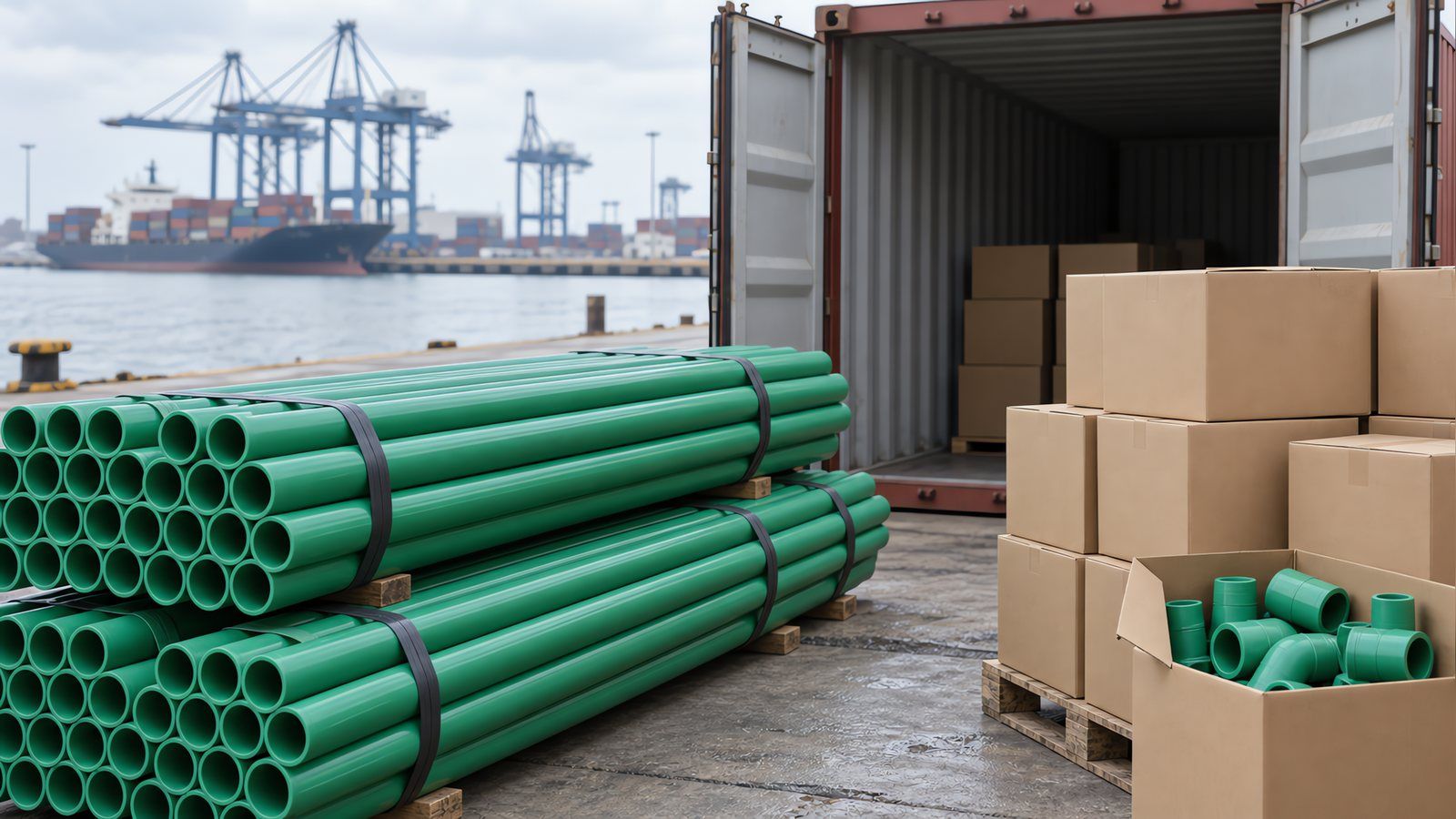

uPVC Pressure Pipe Class B, C, D and E: What the BS 3505 Classes Mean in East and West African Tenders, and How They Map to PN
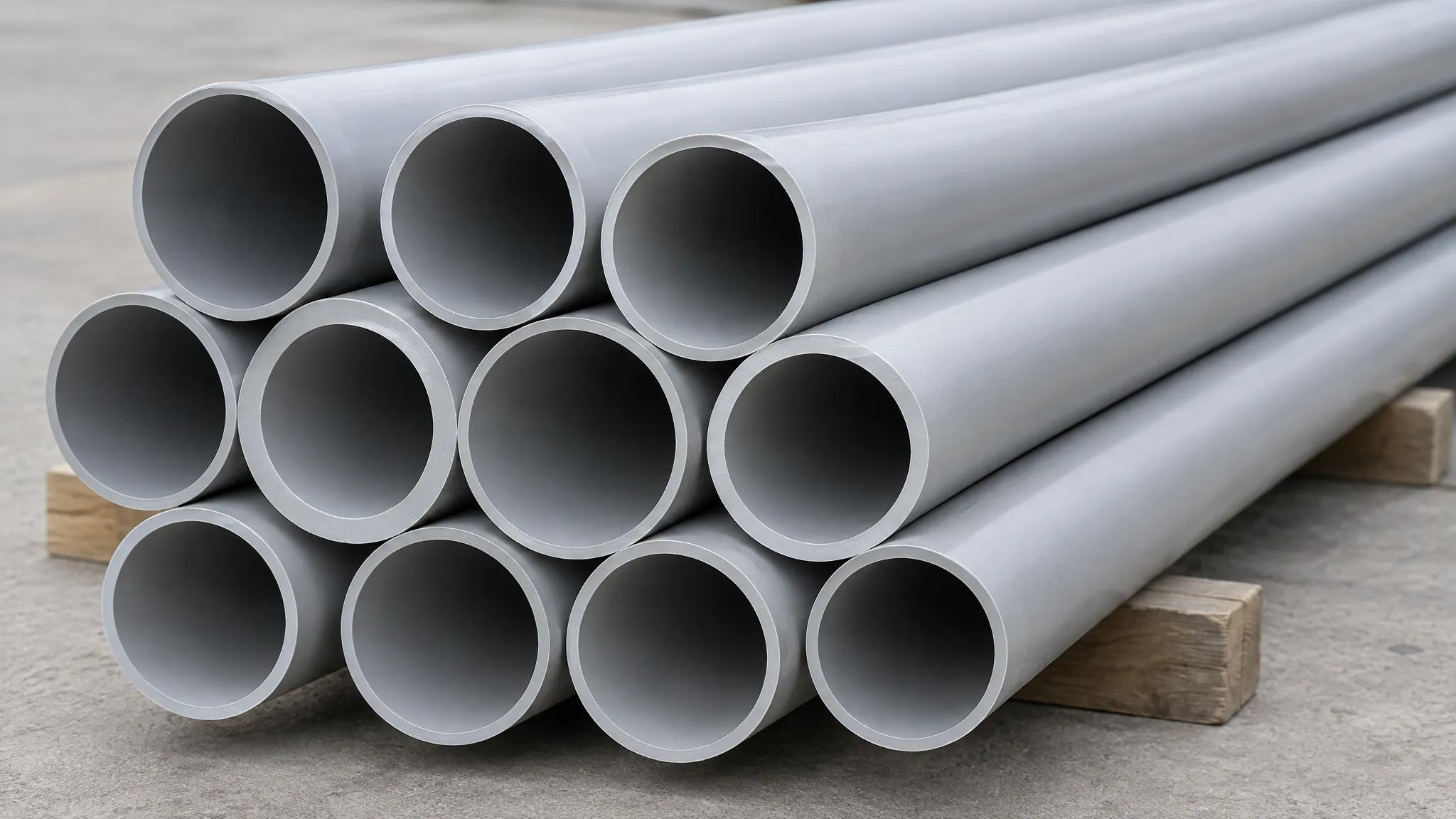
Your tender says BS 3505 Class D and the mill quotes PN 12. They are not the same pipe, and BS 3505 was withdrawn in 2022. What to put on the PO instead.
The bill of quantities says “uPVC pressure pipe to BS 3505, Class D”, the mill quotes in PN, and nobody will say what the two have to do with each other. BS 3505 answers plainly. Clause 3 classifies pipe by maximum sustained working pressure into three classes and only three: 9 bar is class C, 12 bar is class D, 15 bar is class E, for cold water at 20°C. Class B is absent because the 1986 revision deleted it. And the standard doing the classifying was withdrawn by BSI on 23 August 2022.
That does not make the class word meaningless on a Kenyan or Nigerian tender sheet. It makes it a translation with three traps. Below: what each class commits you to, the design stress behind it, why Class D is not PN 12, how to read the class off a delivered pipe, and which standard your inspectorate will test against.
Key Takeaways
- BS 3505:1986 has three classes: 9 bar (class C), 12 bar (class D), 15 bar (class E), for cold water at 20°C.
- Class B was removed when the 1986 edition superseded the 1968 one. A tender naming it is quoting a 1968 document.
- BS 3505:1986 was withdrawn on 23 August 2022; the live standard is the BS EN ISO 1452 series.
- The class wall thicknesses were calculated from three design stresses by size: 9.8, 11.0 and 12.3 MPa.
- A PN is built differently — MRS 25 MPa over a design coefficient the buyer picks — so no class equals a PN.
- Kenya lists KS ISO 1452-2:2009; Nigeria’s catalogue lists NIS 76:1980, a cold-water-services standard.
What Class C, D and E Mean, and Where Class B Went
Clause 3 is four lines long and it is the whole class system. Pipes are classified by maximum sustained working pressure: 9 bar is class C, 12 bar class D, 15 bar class E. The note beneath fixes the service condition — cold water at 20°C — and for hotter water or pulsating pressure it sends you to CP 312-2 instead of publishing a derating table. On a booster main cycling against a closed valve, the class number has stopped describing your duty.
Class B is the one buyers cannot find, and the foreword says why. The 1986 edition supersedes the 1968 edition, which is withdrawn, and one of the listed differences reads: the class B classification has also been removed.
The Class B that catalogues still print is a 1968 leftover. Catalogues file it with the industrial sibling, BS 3506:1969, but that standard’s own added wall series are tabulated as Class 6 and Class 7. A 2026 clause naming Class B cites a class deleted 40 years ago.
| Class (as marked) | Working pressure at 20°C (bar) | Minimum 1 h proof pressure (bar) | Tabulated sizes (in) | Verdict for a tender sheet |
|---|---|---|---|---|
| Class C | 9 | 32.4 | 2 to 24 | The only class tabulated above 18 in |
| Class D | 12 | 43.2 | 1¼ to 18 | The class most East and West African tenders name |
| Class E | 15 | 54.0 | ⅜ to 16 | Stops at 16 in; a 20 in Class E line is not BS 3505 |
| Class B | not classified | not classified | none | Removed in 1986; the tender is quoting the 1968 edition |
Source: BS 3505:1986 clause 3, Table 1 and Table 4 (BSI; standard withdrawn 23 August 2022). Read 16 September 2026.
The Number Is a Working Pressure, Not a Material Grade
Ask a trader what stress a Class D pipe is designed to and the conversation stops. The foreword answers it: there is no single number. The recommended maximum working stress is based on three values according to nominal size: 9.8 MPa up to ¾ in, 11.0 MPa for sizes 1 to 6 inclusive, and 12.3 MPa for size 8 and above. That is why a 4 in and a 10 in class D pipe carry 12 bar on very different wall-to-diameter ratios.
The margin is tabulated too. Table 2 requires each category to demonstrate a 50-year extrapolated circumferential stress of 20.6, 23.0 and 26.0 MPa — roughly twice the working stress. The short-term check is blunter: Table 4 sets a minimum one-hour failure pressure of 32.4 bar for class C, 43.2 for class D and 54.0 for class E — 3.6 times the class pressure every time.
Clause 5.2.3 adds a 60°C requirement written as a hoop stress of 10.0 MPa held for 1 000 hours rather than a derated bar figure, which is the standard declining to say what the pipe may carry hot.
Why Class D Is Not PN 12
Substituting PN 12 for Class D fails for three reasons. First, the basis. ISO 1452-2:2009 requires a minimum required strength, MRS, of at least 25 MPa and builds the PN from that divided by a design coefficient. BS 3505 fixed its stress by size band and gave the buyer no coefficient.
Second, in ISO 1452 the margin is a choice that changes what you order. Table 2 is printed twice, for a design coefficient of 2,5 and of 2,0, and its footnote is explicit: to apply 2,5 instead of 2,0 above 90 mm, the next higher pressure rating shall be chosen. A buyer specifying the safer coefficient on a dn 160 main orders PN 16 to get PN 12.5 duty.
Third, geometry ends the argument. BS 3505 is an inch series where 4 in is a mean outside diameter of 114.1 to 114.5 mm, while the ISO 1452-2 metric table steps 110 mm then 125 mm with nothing between, handling imperial sizes separately in Annex B. There is no metric pipe that is the same pipe. PN, SDR and Schedule are compared in our breakdown of the three pressure-class systems.
| Question | BS 3505 class | EN ISO 1452 PN | Consequence on the order |
|---|---|---|---|
| What the number is | Max sustained working pressure, bar | Nominal pressure, bar | Same unit, different derivation |
| Strength basis | Design stress 9.8, 11.0 or 12.3 MPa | MRS at least 25 MPa, divided by C | One is fixed by size; one is chosen |
| Who sets the margin | The standard, per size band | The purchaser: C = 2,0 or C = 2,5 | Above dn 90 at C = 2,5, order the next PN up |
| Diameter series | Inch; 4 in is 114.1 to 114.5 mm | Metric; 110 mm, then 125 mm | No like-for-like metric substitute exists |
| Current status | Withdrawn 23 August 2022 | Published, 2009 edition | Only one of them can be tested against today |
Source: BS 3505:1986 clause 3, Table 1 and foreword; ISO 1452-2:2009 clause 4.3, Table 2 and its footnote, Annex B. Read 16 September 2026.
Reading the Class Off the Pipe in the Yard
A container lands and somebody has an hour to decide whether it matches the clause. Clause 7.1 lists what must be printed at intervals not exceeding 1 m: maker’s identification, standard number and date, PVC-U, nominal size, batch identification, and the pressure classification in bars.
Note the wording. The pipe must say “12 bar”, and footnote 3 makes the class letter optional. An inspector rejecting a delivery because the print omits “Class D” is rejecting compliant pipe.
Clause 7.2 gives a second check that costs nothing: the marking colour is fixed by class. Black or dark blue at 9 bar, green at 12 bar, brown at 15 bar. Green print on a pipe stamped 9 bar is a contradiction worth photographing before the container is opened.
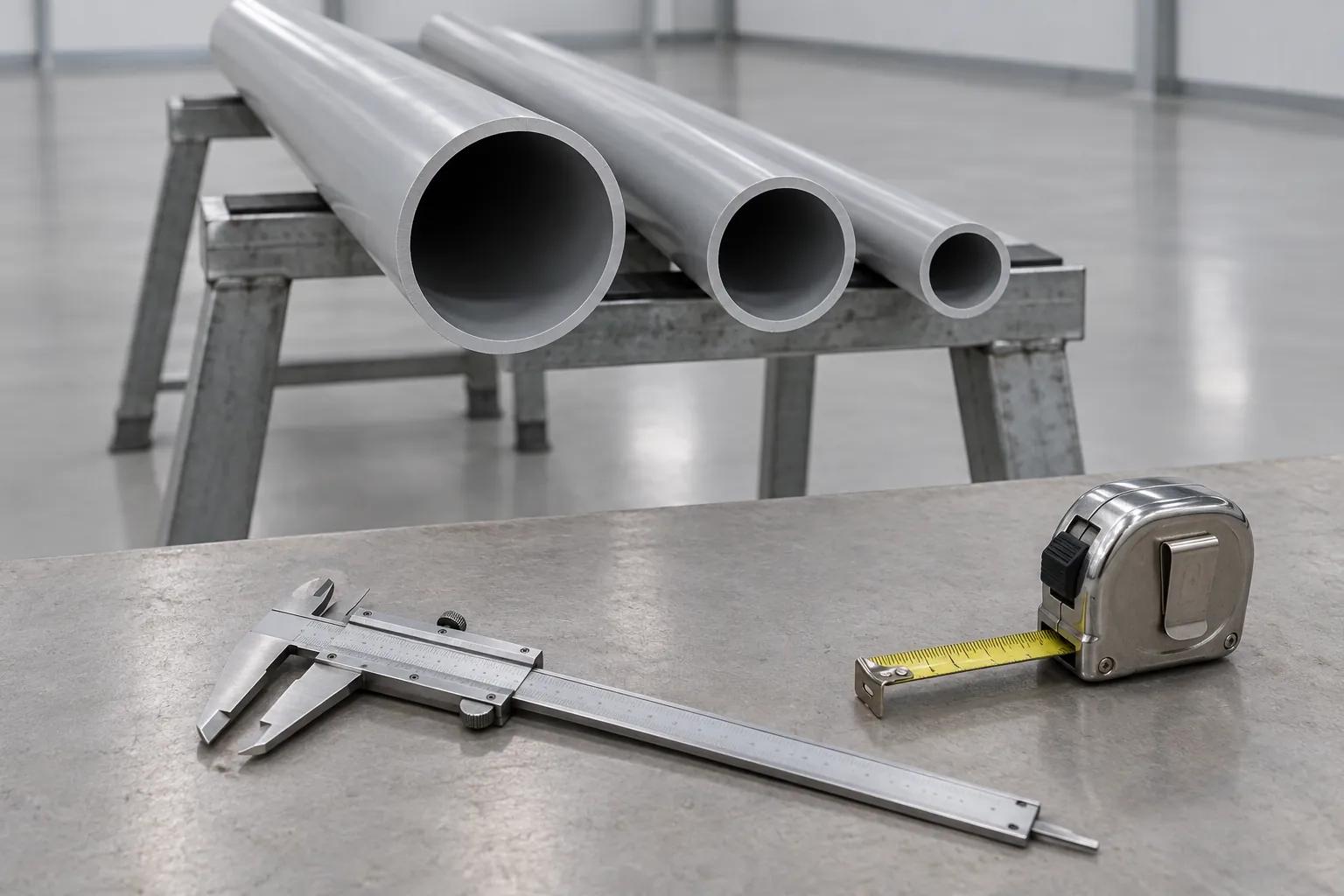
Then measure: at 4 in the average wall must not exceed 5.2 mm for class C, 6.8 mm for class D or 8.3 mm for class E. Check the size exists in the class first: class D is not tabulated below 1¼ in, and class E stops at 16 in.
Which Standard Your Tender Actually Points To
The class vocabulary survives because the national standards behind these tenders were written from British parents and never rewritten. Kenya is the clean case: KEBS lists KS ISO 1452-2:2009, a direct adoption of the metric ISO standard whose diameter series runs 12 mm to 1 000 mm, so a Kenyan specification that also says Class D carries two incompatible systems in one clause.
Nigeria shows the other pattern. The SON catalogue lists NIS 76:1980, unplasticised polyvinyl chloride pipes for cold-water services — the title BS 3505 carried in 1968, reissued 12 years later.
For Ghana and Tanzania we will not invent a number. No Ghana Standards Authority or Tanzania Bureau of Standards entry for a PVC-U pressure pipe standard was retrievable on 16 September 2026. Read the number off the tender and ask the inspection body which clause it will test against — worth asking everywhere, since BS 3505 and BS 3506 were withdrawn within 4 months of each other in 2022. Our notes on KEBS PVoC and SONCAP set out who issues what.
What to Write on the Purchase Order, and Where We Stop
Write the duty, not the label. An order stating the working pressure in bar at 20°C, the outside-diameter series in millimetres, the wall thickness per size and the standard edition is enforceable on either system. If the tender will not move off the class word, carry both — the class clause for the client, the dimensional standard and its coefficient for the factory — and one line saying which governs. That stops a mill shipping dn 110 against a 4 in clause.
Then match the supplier to the clause, which means being straight about our catalogue. IFAN’s uPVC line is scoped to wastewater and drainage, not pressure water: built against ISO 4435, EN 1401 and EN 1329, batch certificate per shipment from a CNAS-accredited laboratory, 45-day lead time, mixed containers by SKU spec and stiffness class.
None of that is a BS 3505 class pipe and we will not quote one. The pressure families we extrude are PP-R in DN20 to DN160 at PN12.5 to PN25 and HDPE to ISO 4427 and EN 12201, on a one-container minimum with sizes mixed — both in the product catalogue.
Conclusion
Before signing anything carrying a class letter, run four checks. Does the class exist at the diameter you need, in Table 1 rather than in a catalogue? Does the clause name a standard still published, given BS 3505 went on 23 August 2022? Has anyone written a PN against a class without stating the coefficient and the diameter series? Does the delivered pipe say the pressure in bars, in the right colour? Get those right and the class word is harmless legacy.
Frequently Asked Questions
What pressure is Class D uPVC pipe?
BS 3505:1986 classifies class D pipe at 12 bar maximum sustained working pressure for cold water at 20°C. Its short-term proof test is a minimum one-hour failure pressure of 43.2 bar. Class C is 9 bar and class E is 15 bar.
What is Class B uPVC pipe under BS 3505?
There is none. The foreword to BS 3505:1986 records that the class B classification was removed when that edition superseded the 1968 one. A Class B in a supplier catalogue is carried over from the withdrawn 1968 edition, not from BS 3505:1986.
Is BS 3505 still current?
No. BSI records BS 3505:1986 as withdrawn on 23 August 2022. It was superseded by the BS EN 1452 series in 2000, and the current replacements are BS EN ISO 1452-1:2009 through -5:2009, with Part 3 dated 2010.
Is Class D the same as PN 12?
No. The class comes from a design stress fixed by size at 9.8, 11.0 or 12.3 MPa; a PN comes from MRS 25 MPa divided by a design coefficient the purchaser selects. BS 3505 is also an inch series, and ISO 1452-2 has no 114.3 mm size.
Which standard applies to uPVC pressure pipe in Kenya and Nigeria?
KEBS lists KS ISO 1452-2:2009, the direct adoption of the metric ISO standard. The Standards Organisation of Nigeria catalogue lists NIS 76:1980 for unplasticised PVC pipes for cold-water services, which is why British class wording persists there.
How do I check the class on a delivered pipe?
Clause 7.1 requires the pressure classification printed in bars at intervals of no more than 1 m, and the class letter is optional. Clause 7.2 fixes the print colour: black or dark blue at 9 bar, green at 12 bar, brown at 15 bar.
Related Briefings
Importing PP-R Pipe to Tanzania: TBS PVoC, TZS 2344 and the TRA Levy Stack
Sea Freight for Pipe from China to West and East Africa: What Drives the Number