
Longitud de tubería PPR: longitudes estándar y cómo se cargan
El tubo PPR se suministra en longitudes estándar de 4 m y 6 m, 5,8 m para gran diámetro. Ninguna norma internacional fija una; las normas nacionales y el contenedor lo hacen.
La mayoría de los tubos PP-R se suministran en tramos rectos de 4 m, y 6 m es la otra longitud estándar — la que no cabe en un contenedor de 20 pies. Los diámetros grandes pasan a 5,8 m; los diámetros pequeños también se suministran en rollos. Ningún estándar internacional lo fija: ISO 15874-2:2013 nunca usa la palabra “longitud”. Dos nacionales sí lo hacen: GB/T 18742.2-2017 con 4 m o 6 m, IS 15801:2008 con 3 a 6 m. La longitud es un término comercial, definido por su pedido de compra y la caja en la que debe caber.
Puntos clave
- Ningún estándar internacional fija una longitud; los nacionales sí. ISO 15874-2:2013 y DIN 8077:2008-09 solo definen la sección transversal. GB/T 18742.2-2017 §7.3.3 indica 4 m o 6 m sin desviación negativa; IS 15801:2008 §7.4 indica 3 a 6 m con una tolerancia de +10 mm.
- 4 m y 6 m son longitudes de 40 pies; 5,8 m es la de 20 pies. 3 × 4 m y 2 × 6 m llegan ambas a 12.000 de los 12.032 mm de un HC de 40 pies; 6.000 mm no entran a lo largo en una caja de 20 pies.
- En una caja de 20 pies, 5,8 m aporta un 45 % más de metros — ambas cargan un tubo de profundidad, así que 5,8 / 4,0 = 1,45. En un HC de 40 pies se invierte.
- El PP-R nunca alcanza el límite por peso. 9.000 m de DN20 PN20 a 0,172 kg/m son unos 1.550 kg frente a una carga útil de 28.130 kg.
En esta página
¿Alguna norma establece una longitud para el tubo PP-R?
Las dos que cita su proveedor no lo hacen. La ISO 15874-2:2013 fija únicamente el diámetro exterior medio y el espesor de pared — cláusula 6.2, donde DN20 clase A serie S2.5 es de 20 a 20,3 mm de diámetro exterior con un espesor de pared de 3,4 mm — y su lista de marcado de la Tabla 12 tiene ocho elementos, ninguno de ellos la longitud. La palabra no aparece en ninguna parte. La DIN 8077:2008-09 abarca dimensiones, tolerancias y pesos.
Las normas nacionales sí la fijan, y son la excepción que confirma la regla. La GB/T 18742.2-2017 §7.3.3, conforme a la cual se fabrica la mayor parte del stock de origen asiático, establece que la longitud es generalmente de 4 m o 6 m o según lo acordado, sin desviación negativa. La IS 15801:2008 de la India, en su §7.4, establece que el tubo recto «tendrá de 3 a 6 m o lo acordado entre el fabricante y el comprador», con una tolerancia de +10 mm sobre la longitud total. Ambas son convenciones comerciales puestas por escrito, no requisitos hidráulicos — y de ahí provienen las cifras de su cotización.
Qué longitud entregan realmente los fabricantes
Los catálogos confluyen en una lista corta.
| Forma de suministro | Diámetro (mm) | Dónde se encuentra | Atención a |
|---|---|---|---|
| 4 m recto | 20–125; todos los tamaños en algunos fabricantes | Estándar global de facto; primera longitud en GB/T §7.3.3 | Desperdicia 1.900 mm de una caja de 20 ft |
| 6 m recto | Cualquiera | Segunda longitud GB/T; habitual en cotizaciones asiáticas | No carga en una caja de 20 ft a lo largo: 6.000 vs 5.900 mm |
| 5,8 m recto | 160–630 en algunos fabricantes; Norteamérica | Stock norteamericano, aunque rollos SDR 11 de ½"–1" | Rara vez catalogado por debajo de ø160 en otros mercados |
| 3 m recto (2 m solo cortado a medida) | 20–125 | Longitud estándar según IS 15801 §7.4; ATP almacena PN20 ø20×3,4 | Peor longitud para 20 ft: dos necesitan 6.000 mm, desperdiciando 2.900 mm |
| Rollos, 50–100 m | 20–32 | Pequeño diámetro de pared fina; una forma real de PP-R, no solo PE-X | Solo algunas series de pared se enrollan; pregunte por código |
| Fuente: GB/T 18742.2-2017 §7.3.3; IS 15801:2008 §7.4; aquatherm 09/2024 y NA Parts Guide 03/2025; ATP. Las cantidades por paquete no están normalizadas. | |||
La longitud responde a la manipulación, no a la hidráulica. Para la sección transversal, nuestra tabla de tamaños de tubería PP-R en mm y pulgadas incluye las tablas de DN y de pared.
Por qué 4 m es una medida para contenedor de 40 pies y 5,8 m para uno de 20 pies
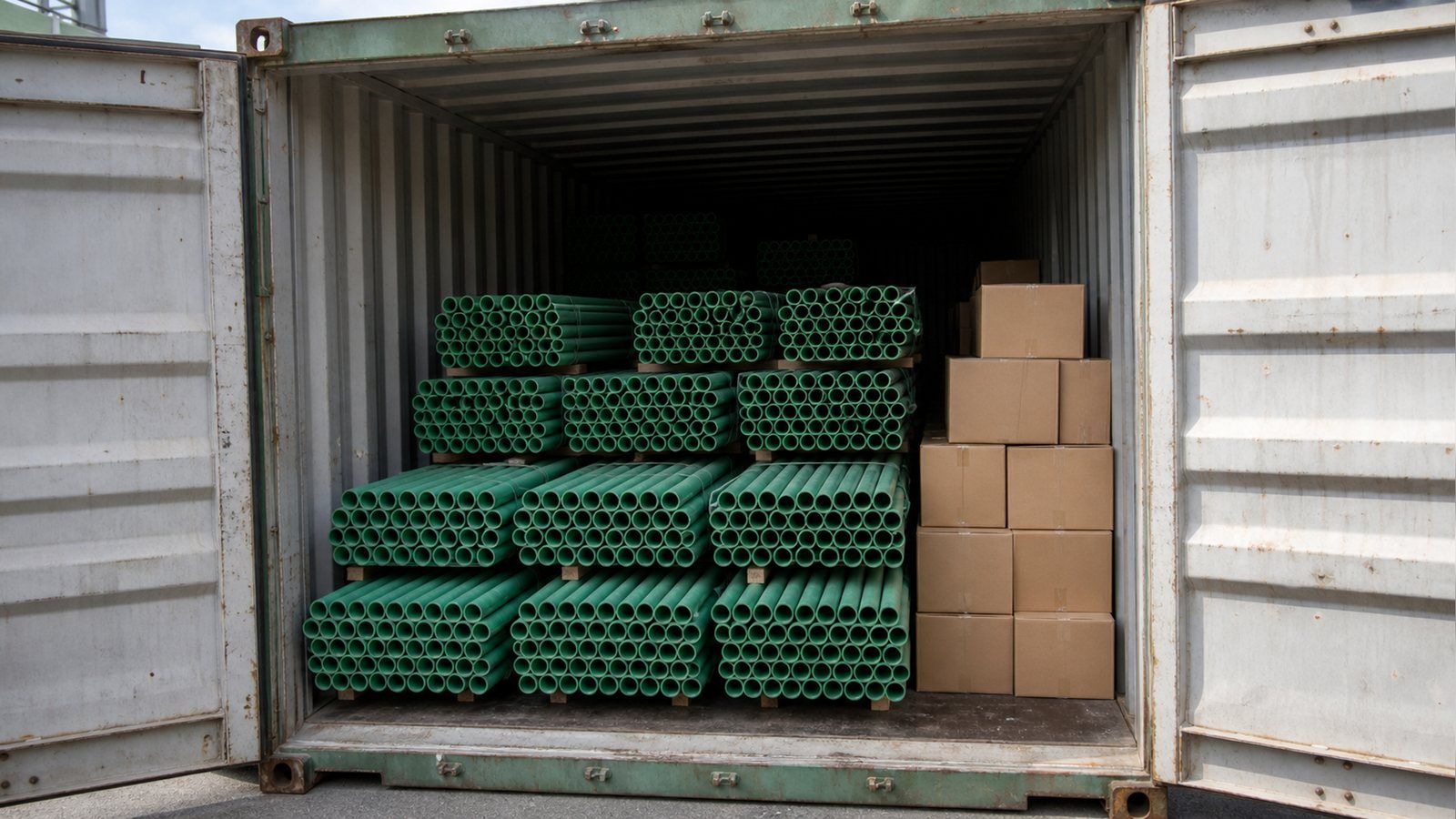
La tubería se carga a lo largo, por lo que la geometría que importa es la longitud útil del piso frente a la longitud de corte. Hapag-Lloyd publica 5.900 mm para un contenedor Standard de 20 ft y 12.032 mm para un High Cube de 40 ft:
- 20 ft, 4 m: 2 × 4.000 = 8.000 > 5.900, por lo que un tubo; 5.900 − 4.000 = 1.900 mm perdidos, 67,8 %. Con 5,8 m la holgura es de 100 mm, 98,3 %.
- 20 ft, 6 m: 6.000 > 5.900 — no carga a lo largo.
- 40 ft HC: 3 × 4.000 y 2 × 6.000 suman ambos 12.000, 32 mm de sobra, 99,7 %; 2 × 5.800 = 11.600, 96,4 %.
| Longitud de corte (m) | 20 ft GP, tuberías de extremo a extremo (5.900 mm) | Suelo utilizado (%) | 40 ft HC, tuberías de extremo a extremo (12.032 mm) | Suelo utilizado (%) |
|---|---|---|---|---|
| 3,0 | 1 (dos necesitan 6.000) | 50,8 | 4 | 99,7 |
| 4,0 | 1 | 67,8 | 3 | 99,7 |
| 5,8 | 1 | 98,3 | 2 | 96,4 |
| 6,0 | 0, no en sentido longitudinal | — | 2 | 99,7 |
| Fuente: dimensiones internas de Hapag-Lloyd; porcentajes de nuestra aritmética. Los contenedores varían y los haces necesitan separadores; considérense valores máximos. | ||||
Lea de nuevo la columna de 20 ft. La sección transversal no cambia, por lo que el contenedor admite aproximadamente el mismo número de tuberías en ambos casos, pero 5,8 / 4,0 = 1,45, así que 5,8 m transporta alrededor de un 45 % más de metros por el mismo flete. En un 40 ft HC esto se invierte. No obstante, la palanca a menudo no está en su mano: aquatherm publica 4 m para ø20–125 y 5,8 m solo a partir de ø160, por lo que por debajo de ø160 es una producción especial. Ambas normas nacionales permiten cualquier longitud acordada; el coste de cambio de la extrusora decide.
La carga medida por IFAN es de 8.000–9.000 m de DN20 PN20 en un contenedor de 20 ft — nuestro dato, medido no calculado, y varía con el diámetro y el espesor. Con un valor publicado de 0,172 kg/m (RAKtherm SDR 6 PN 20; nominal geométrico unos 0,16 kg/m) eso supone aproximadamente 1.550 kg frente a los 28.130 kg de carga útil. El PP-R nunca alcanza el límite por peso; los huecos y el suelo muerto llenan el contenedor — véase carga de contenedores de PP-R.
El recorte que pagas dos veces
El desperdicio en obra va por otro camino, y es una propiedad de tu módulo de forjado, no del tubo. Frente a una bajante de 2,9 m, 4 m da una bajante y un recorte de 1,1 m (27,5 % de desperdicio), mientras que 5,8 m da exactamente dos bajantes. Con un forjado de 3,0 m se invierte: 4 m deja 1,0 m (25 %), 5,8 m deja 2,8 m (48 %). Divide la altura de tu forjado entre cada longitud candidata antes de hacer el pedido.
El acceso decide el resto. Un haz de 5,8 m o 6 m tiene que salvar los giros de escalera y llegar a la planta donde se suelda; ningún ascensor de pasajeros lo admite. Si la obra no puede moverlo entero, se corta en la puerta — se envía una longitud larga para hacer una corta. Ver dimensionado de bajantes PP-R.
Qué debe figurar en la orden de compra
Cuatro datos deben ir en el contrato, no en un correo: la longitud de corte en milímetros; la tolerancia de longitud, para la cual existen fórmulas ya establecidas — los +10 mm sobre la longitud total de IS 15801 §7.4, o la prohibición de cualquier desviación negativa de GB/T §7.3.3; las piezas y los metros por paquete con las dimensiones exteriores del paquete; y si se pueden fraccionar los paquetes para completar un contenedor. ISO 15874-2 exige el marcado al menos una vez por metro, por lo que una barra corta se detecta al contar las marcas — véase embalaje de exportación de PP-R.
Fabricando desde 1993 en una fábrica inteligente de 120.000 m² en Zhejiang, exportando a más de 120 países: más de 3.000 referencias PP-R, DN20–DN160, PN12.5–PN25, 100 % PP-R virgen, certificado de lote en cada partida, conforme a DIN 8077/8078 e ISO 15874.
Preguntas frecuentes
¿Cuál es la longitud estándar de un tubo?
Las normas que la especifican son nacionales, no internacionales. GB/T 18742.2-2017 §7.3.3 indica 4 m o 6 m o según lo acordado, sin desviación negativa; IS 15801:2008 §7.4 indica de 3 a 6 m con una tolerancia de +10 mm. ISO 15874-2 y DIN 8077 no especifican ninguna — 4 m es la longitud global de facto, 5,8 m para gran diámetro.
¿Cuánto mide un tubo de PP-R?
Un tubo de PP-R individual normalmente mide 4 m de largo, con 6 m como segunda opción habitual. El gran diámetro a partir de ø160 mm suele ser de 5,8 m, el stock norteamericano de 19 ft, y existen barras de 3 m y rollos de DN20–DN32 para tamaños pequeños.
¿Cuál es la longitud de un tubo de PP-R de 1/2"?
La misma que cualquier otro tubo de PP-R de pequeño diámetro: 4 m como estándar, 3 m o un rollo donde el fabricante los tenga en stock. La longitud no varía con el diámetro por debajo de ø125 mm. En PP-R, 1/2" es DN20, cuyo diámetro exterior es de 20 mm según ISO 15874-2:2013.
¿Cuáles son los tamaños estándar de tubo de PP-R?
La clase A de ISO 15874-2:2013 abarca desde DN12 hasta DN160 de diámetro exterior, con el espesor de pared determinado por la serie del tubo, no por el diámetro. La correspondencia completa de DN, pulgadas y espesor de pared está en nuestra tabla de tamaños de tubo de PP-R.
Fuentes
- GB/T 18742.2-2017 §7.3.3 — 4 m o 6 m, sin desviación negativa
- IS 15801:2008 §7.4 — 3 a 6 m, +10 mm sobre la longitud total
- ISO 15874-2:2013 (ed. 2; confirmada 2023, revisión señalada 2025), con Amd 1:2018 y Amd 2:2022. Texto completo consultado; cero coincidencias para “length”
- DIN 8077:2008-09 — Dimensiones
- Hapag-Lloyd — 20' Standard y 40' High Cube
- aquatherm catálogo 09/2024 y NA Parts Guide 03/2025
- Catálogo Peštan PP-R
- ATP PP-R PN20, barras de 3 m
- RAKtherm SDR 6 PN 20 (0.172 kg/mt)