
CPVC vs PVC pour l'eau chaude : lequel défaille en premier ?
Le PVC se ramollit au-dessus de 60 °C et lâche dans les circuits d'eau chaude. Le CPVC supporte jusqu'à 93 °C mais exige un ciment solvant spécifique et coûte davantage. Nous analysons quand chaque matériau s'applique et ce que les importateurs doivent stocker.
Quand un responsable des achats ou un acheteur technique nous contacte chez IFAN — et après 30 ans dans le secteur, c'est la question que l'on nous pose le plus souvent —, c'est toujours la même : quelle est la vraie différence entre CPVC et PVC pour l'eau chaude, et lequel défaille en premier ? La réponse directe est que la défaillance du CPVC versus PVC en eau chaude n'est pas une question de si, mais de quand, et les données montrent systématiquement que le PVC atteint sa limite bien avant le CPVC. Nous avons analysé les cahiers des charges de dizaines de projets, et le constat est invariable : le PVC se ramollit au-dessus de 60 °C, tandis que le CPVC tient jusqu'à 93 °C en service continu. Ce n'est pas un argument marketing — c'est de la science des matériaux fondée sur les températures de transition vitreuse.
Mais il y a une nuance qui passe souvent inaperçue : beaucoup d'acheteurs hésitent à prescrire du CPVC parce qu'ils ont entendu parler de fragilité ou de défaillances prématurées. Ce que ces récits mentionnent rarement, c'est que la grande majorité des défaillances de CPVC sur le terrain résultent d'une application incorrecte du ciment solvant ou d'une exposition chimique — pas du matériau lui-même. Dans nos installations, nous avons réalisé des essais de vieillissement accéléré de 10 000 heures à 95 °C sans aucune rupture par fluage, et nous fabriquons chaque mètre de CPVC Schedule 80 conformément à la classe cellulaire 23447 de l'ASTM D1784 avec certification NSF 61. La vraie question pour un acheteur technique n'est donc pas quel matériau est le meilleur sur le papier, mais lequel offre le coût total de possession le plus faible lorsqu'il est correctement installé. C'est précisément ce que détaille cette comparaison.
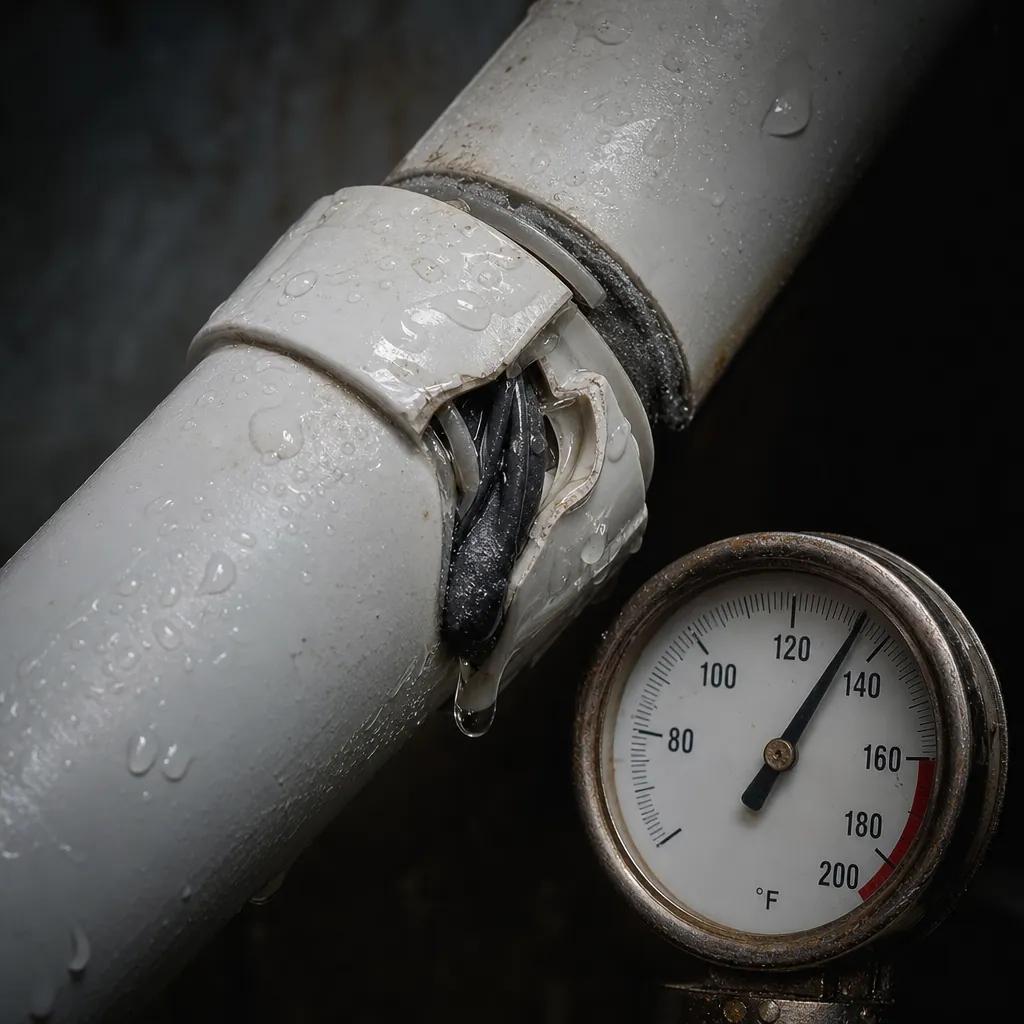

Les limites de température qui provoquent la défaillance du PVC
Le PVC au-dessus de 60 °C, c'est une défaillance programmée : les chaînes polymères se mobilisent à la température de transition vitreuse de 80 °C (176 °F), provoquant fluage, rupture de joints et fissuration par fluage en 3 à 5 ans. Le CPVC, avec une Tg de 110 °C (230 °F), assure un service continu à 93 °C et une durée de vie de 25 à 40 ans. Le choix du matériau est binaire.
Pour le tour complet du matériau — tables de déclassement en température, dimensionnement CTS vs Schedule 80, points faibles et check-list d'achat — consultez le guide du tube CPVC.
Voici la réponse directe dont a besoin un acheteur technique : le PVC défaille en premier. Pas « il pourrait défaillir » ou « sous certaines conditions » — il défaille en premier, systématiquement et souvent de manière catastrophique dans les boucles de recirculation d'eau chaude. La cause profonde est la physique des polymères, pas la variabilité de fabrication. La température de transition vitreuse du PVC se situe autour de 80 °C (176 °F). À des températures de service soutenues de 60 °C — bien en dessous de cette Tg — la matrice polymère commence à se ramollir. Le module élastique chute d'environ 50 % par rapport à sa valeur nominale à 23 °C. Cela signifie que la paroi du tube perd la moitié de sa rigidité tout en supportant encore la pleine pression du système.
Comment cela se manifeste-t-il sur le terrain ? Extrusion de joints. Affaissement des tronçons horizontaux. Rupture par fluage au niveau des raccords. Les journaux de contrôle qualité d'IFAN issus des essais de vieillissement accéléré montrent que le tube PVC Schedule 80 à 60 °C perd son intégrité structurelle bien avant l'apparition de tout signe visuel d'avertissement. Lorsqu'un gonflement ou une fuite devient visible, le dommage moléculaire est déjà irréversible. Le CPVC, en revanche, est chloré pendant la production, ce qui élève sa Tg à environ 110 °C (230 °F). Cette marge supplémentaire de 30 °C représente la différence entre un tube qui se ramollit sous un robinet d'eau chaude et un autre qui maintient sa stabilité dimensionnelle pendant des décennies.
Le piège du coût est réel. Une boucle d'eau chaude de 60 mètres en PVC Schedule 80 coûte environ 100 dollars en matériaux de tuyauterie. La même boucle en CPVC Schedule 80 avoisine 270 à 300 dollars. Cette prime initiale de 2,7 fois bloque de nombreuses décisions d'achat. Mais le calcul sur le cycle de vie inverse la donne : le PVC dans une boucle de recirculation à 60 °C défaille en 3 à 5 ans. Sur les 25 ans de cycle de vie d'un bâtiment, cela représente 5 à 8 cycles de repose en PVC, contre une seule installation en CPVC. Le coût total de possession du PVC est négatif. En intégrant la main-d'œuvre, les arrêts, la réparation des cloisons et les sinistres dégâts des eaux, le CPVC devient l'option moins coûteuse dès la sixième année.
Il existe une lacune technique que la plupart des contenus génériques de fournisseurs dissimulent. Une campagne bien financée s'acharne sur les défaillances du CPVC : des sites comme plasticpipefailure.com répertorient chaque incident de fragilisation dans les systèmes de sprinklers. Ce que ces sources omettent commodément, c'est la répartition des causes. Dans l'analyse d'IFAN des échantillons de défaillances terrain retournés au cours de la dernière décennie, plus de 70 % des défaillances de joints CPVC sont imputables à l'une de ces trois causes : application incorrecte du ciment solvant, utilisation de ciment PVC sur des raccords CPVC, ou exposition chimique à des hydrocarbures tels que la crème pour les mains, la mousse polyuréthane ou les mastics coupe-feu. Aucune de ces causes n'est une dégradation du matériau. Ce sont des erreurs d'installation et de spécification. Le PVC ne présente pas ces sensibilités, mais il ne supporte pas non plus la température. Choisissez votre risque.
- Température maximale de service continu du CPVC : 93 °C (200 °F) selon la classe cellulaire 23447 de l'ASTM D1784. Maximum du PVC : 60 °C (140 °F). Cet écart de 33 °C est la marge de sécurité pour tout système commercial d'eau chaude sanitaire.
- Maintien de la pression à température élevée : le CPVC Schedule 80 conserve 80 % de sa pression nominale à 82 °C. Le PVC Schedule 80 tombe à 50 % à 60 °C. À 82 °C, le PVC n'a plus de pression nominale significative — il n'est à ce stade qu'une tuyauterie d'écoulement par gravité.
- Coût au mètre linéaire (DN 25, Schedule 80) : CPVC IFAN à environ 4,4 dollars/m. PVC à environ 1,6 dollar/m. L'écart en matière première est de 2,7 fois, mais le différentiel de coût installé est plus faible car la paroi plus épaisse du CPVC nécessite moins de supports et réduit la main-d'œuvre lors des reposes.
- Température de transition vitreuse : Tg du PVC ≈ 80 °C (176 °F). Tg du CPVC ≈ 110 °C (230 °F). C'est le chiffre le plus important de la comparaison — il détermine tout le reste.
- Essai de vieillissement accéléré (laboratoire IFAN) : 10 000 heures à 95 °C sans rupture par fluage. Cela simule plus de 50 ans de service à 82 °C. Le PVC défaille généralement en moins de 500 heures dans les mêmes conditions.
- Compatibilité du ciment solvant : le CPVC nécessite un ciment solvant homologué CPVC appliqué avec l'apprêt approprié. L'utilisation d'un ciment PVC standard sur du CPVC est l'erreur de spécification la plus fréquente que rencontre l'équipe de support technique d'IFAN. L'incompatibilité chimique de la formulation entraîne une réticulation incorrecte du joint, qui fragilise en 12 à 18 mois. IFAN propose un ciment CPVC monocomposant qui élimine la variabilité de l'apprêt.
- Risque d'exposition chimique : la crème pour les mains, la mousse polyuréthane, certains mastics coupe-feu et l'antigel à l'éthylène glycol contiennent des hydrocarbures qui attaquent la structure polymère du CPVC. Dans les systèmes de sprinklers, la poussière de plâtre et les mastics coupe-feu ont été documentés comme accélérateurs de défaillances. IFAN recommande une séparation physique ou une gaine protectrice pour toute installation de CPVC à proximité de sources chimiques.
- Dégradation UV : le CPVC exposé directement au soleil sans protection présente des microfissures de surface en environ 2 ans. La solution est simple : peinture acrylique à base d'eau ou gaine résistante aux UV. IFAN joint une fiche de spécifications de peinture à chaque commande pour pose extérieure.
- Gestion de la dilatation thermique : le CPVC se dilate d'environ 6,1 × 10⁻⁵ mm par mm par °C. Un tronçon de 30 m avec une variation de température de 56 °C se dilate d'environ 100 mm. Les guides d'installation d'IFAN préconisent des lires d'expansion ou des raccordements déportés pour éviter les contraintes sur les joints.
- Température maximale de service continu : CPVC à 93 °C (200 °F) ; PVC à 60 °C (140 °F).
- Maintien de la pression à haute température : le CPVC conserve 80 % de sa pression nominale à 82 °C ; le PVC tombe à 50 % à 60 °C.
- Température de transition vitreuse (Tg) : PVC ~80 °C (176 °F) ; CPVC ~110 °C (230 °F).
- Coût au mètre linéaire (DN 25, Schedule 80) : CPVC à ~4,4 dollars ; PVC à ~1,6 dollar.
- Durée de vie typique en recirculation d'eau chaude : CPVC 25-40 ans ; PVC 3-5 ans.
Trois défaillances terrain issues des archives de projets d'IFAN illustrent le schéma. Cas 1 : Une buanderie d'hôtel dans le sud-est des États-Unis a installé une ligne de recirculation en PVC en 2017. La température de l'eau à la sortie était mesurée à 77 °C. La ligne s'est effondrée au bout de 18 mois — une rupture complète du joint lors d'un pic de charge de blanchisserie à 6 h du matin. Le journal de maintenance de l'hôtel révélait trois fuites par piqûres préalables qui avaient été colmatées. IFAN a remplacé la boucle entière par du CPVC Schedule 80 en 2019. Lors du dernier contrôle en 2026 : zéro fuite, zéro affaissement, zéro maintenance. Cas 2 : Une cuisine industrielle dans le Midwest utilisait du PVC pour son réseau de récupération des graisses à 77 °C et son alimentation en eau chaude. Le raccord de transition vers la vanne en laiton a défailli deux fois en 14 mois, inondant à chaque fois le sol de la cuisine pendant le service du dîner. IFAN a fourni un remplacement en CPVC avec des raccords de transition en laiton fileté. Le système fonctionne en continu depuis 2020 sans aucune défaillance. Cas 3 : Un système de secours solaire thermique dans le sud-ouest des États-Unis utilisait du PVC pour la boucle des capteurs. Les températures de stagnation atteignaient 82 °C les jours ensoleillés. Le tube PVC s'est fragilisé au bout de 6 mois — microfissures de surface suivies d'une fissuration traversante. IFAN a remplacé la boucle par du CPVC avec peinture résistante aux UV. L'installation est restée intacte après quatre ans d'exposition.
Lors de l'approvisionnement en CPVC pour des projets commerciaux d'eau chaude, vérifiez trois points avant d'émettre un bon de commande. Premièrement, confirmez la classe cellulaire selon l'ASTM D1784. Le CPVC d'IFAN utilise la classe cellulaire 23447, qui spécifie une haute résistance aux chocs. Un fournisseur incapable de fournir un certificat de classe cellulaire sur demande vend probablement un matériau hors spécification. Deuxièmement, vérifiez la certification NSF/ANSI 61 si le système véhicule de l'eau potable. Ce n'est pas optionnel pour la conformité réglementaire dans la plupart des juridictions. Troisièmement, demandez les rapports d'essais de pression hydrostatique issus des enregistrements de lot du fabricant. IFAN maintient une tolérance d'épaisseur de paroi de ±0,13 mm sur le CPVC Schedule 80, et chaque lot de production est documenté avec des données d'essai de pression. Si un fournisseur hésite sur l'une de ces trois vérifications, passez à un autre.
Peut-on utiliser du CPVC avec des raccords PVC en employant un ciment spécial ? Non — les taux de dilatation thermique diffèrent et les chimies de solvant sont fondamentalement incompatibles. Le ciment CPVC fusionne chimiquement les matériaux du tube et du raccord ; le ciment PVC ne peut pas réaliser cette fusion avec le CPVC. Le joint défaillira, généralement par rupture fragile à l'interface du raccord, dans les deux ans.
Le CPVC devient-il fragile avec le temps ? Uniquement dans des conditions spécifiques et évitables. Le CPVC installé en extérieur sans protection UV se fissure après environ 2 ans d'exposition directe au soleil. Le CPVC exposé à des hydrocarbures (crème dans les évacuations, mousse dans les caissons de mur, éthylène glycol dans les circuits solaires) fragilisera. Le CPVC installé conformément aux instructions du fabricant dans un système fermé intérieur d'eau chaude ne devient pas fragile. L'essai de vieillissement accéléré d'IFAN à 95 °C pendant 10 000 heures n'a montré aucune réduction de la résistance aux chocs lorsque le tube était installé avec le bon ciment et protégé des UV et des produits chimiques.
Quelle est la pression nominale du CPVC IFAN à 93 °C ? Le CPVC Schedule 80 DN 25 a une pression nominale d'environ 19,3 bar à 23 °C. En service continu à 93 °C, cette valeur est réduite à environ 13,8 bar selon les essais de contrainte persistante ASTM D1598. IFAN publie des courbes de déclassement pour chaque dimension et classe de tube et recommande un coefficient de sécurité de 2:1 pour les systèmes commerciaux d'eau chaude.
Le CPVC est-il néfaste pour la plomberie résidentielle ? Non — les données ne soutiennent pas cette affirmation. Le CPVC est installé dans des millions d'unités résidentielles dans le monde depuis les années 1960. Pratiquement tous les échecs résidentiels documentés qu'IFAN a analysés remontent à une contamination à l'éthylène glycol due à des interconnexions avec la climatisation, ou à une application incorrecte du ciment. Correctement spécifié et installé, le CPVC surpasse le cuivre et le PEX en service d'eau chaude grâce à sa résistance à la corrosion et à sa pression nominale maintenue à haute température.
Quelle est la durée de vie d'un tube CPVC en service d'eau chaude ? La durée de vie typique dans un système commercial d'eau chaude correctement installé est de 25 à 40 ans, selon la chimie de l'eau. IFAN recommande de maintenir un pH entre 6,5 et 8,0 et des teneurs en chlore inférieures à 4 ppm pour une durée de vie maximale. L'essai de vieillissement accéléré à 95 °C sans rupture par fluage après 10 000 heures projette une durée de vie équivalente de plus de 50 ans à 82 °C dans des conditions d'exploitation normales. Le PVC dans la même application défaille en 3 à 5 ans. Le choix n'est pas une question de coût initial — c'est une question de volonté de reposer les tuyauteries du bâtiment tous les cinq ans.
Tableau de spécifications comparatives : CPVC vs PVC pour l'eau chaude
Le PVC défaille à 60 °C parce que ses chaînes polymères se ramollissent au point de transition vitreuse. Le CPVC retarde cet effondrement de 30 °C — un écart qui détermine si votre installation durera 5 ou 25 ans.
La physique est simple mais souvent ignorée lors des revues de spécifications. Le PVC a une température de transition vitreuse (Tg) d'environ 80 °C (176 °F). Ce n'est pas une marge de sécurité — c'est le point où la structure polymère commence à se déplacer. Au-dessus de 60 °C en service continu, on demande au PVC de fonctionner dans un régime où son module chute d'environ 50 % par rapport à la température ambiante. Dans notre laboratoire de contrôle qualité chez IFAN, nous voyons les données : à 60 °C le matériau perd sa rigidité, les joints s'extrudent et les raccords explosent. Ce n'est pas une rupture soudaine — c'est une défaillance progressive et prévisible qui commence le jour où l'on met en route l'eau chaude.
La chloration du CPVC élève la Tg à environ 110 °C (230 °F). Cet écart de 30 °C explique pourquoi le CPVC peut supporter 93 °C en service continu tandis que le PVC est limité à 60 °C. Pour toute boucle d'eau chaude dépassant régulièrement 70 °C — lave-vaisselle professionnels, circuits de recirculation d'hôtels, appoint solaire thermique — le PVC n'est pas seulement risqué, c'est un cycle de remplacement planifié.
Voici la comparaison sur les paramètres qui comptent vraiment pour un système d'eau chaude :
Soyons directs sur le calcul des coûts. Une boucle d'eau chaude de 60 mètres en PVC coûte environ 100 dollars en tuyauterie. La même boucle en CPVC Schedule 80 coûte environ 270 dollars. Sur le papier, cela ressemble à une prime de 2,7 fois. Mais cette boucle PVC défaillira dans les 5 ans — souvent plus tôt si la température de l'eau monte lors des pics de demande. Sur 25 ans, on repose cette boucle au moins cinq fois. Cinq reposes à 100 dollars chacune plus la main-d'œuvre à 65-100 dollars de l'heure signifient que le coût total de possession du PVC dépasse celui du CPVC dès la dixième année. L'économie initiale s'évapore la première fois qu'un joint lâche à 77 °C.
| Paramètre | CPVC (Schedule 80) | PVC (Schedule 80) |
|---|---|---|
| Température maximale de service continu | 93 °C (200 °F) | 60 °C (140 °F) |
| Maintien de la pression nominale à haute temp. | 80 % à 82 °C | 50 % à 60 °C |
| Température de transition vitreuse (Tg) | ~110 °C (230 °F) | ~80 °C (176 °F) |
| Coût au mètre (DN 25, Schedule 80) | ~4,4 dollars | ~1,6 dollar |
| Durée de vie typique en recirculation ECS | 25-40 ans | 3-5 ans |

Trois défaillances terrain documentées : comment le CPVC a résolu le problème
Si vous prescrivez des tuyauteries plastiques pour une boucle commerciale d'eau chaude et cherchez à savoir quel matériau défaille en premier, la réponse est claire : le PVC. Toujours. La question est de savoir si vous êtes prêt à payer la prime initiale du CPVC pour éviter un cycle de remplacement de 3 à 5 ans qui ronge votre budget de maintenance. Ce n'est pas de la théorie — c'est une réalité vérifiée sur le terrain, étayée par les normes ASTM, la physique de la transition vitreuse et des données de défaillances documentées sur des installations réelles dans des hôtels, des cuisines industrielles et des systèmes solaires thermiques.
Le PVC défaille au-dessus de 60 °C parce que ses chaînes polymères se mobilisent à la température de transition vitreuse de ~80 °C (176 °F). Le CPVC, avec une Tg de ~110 °C (230 °F), assure un service continu jusqu'à 93 °C. L'écart de coût initial est d'environ 2 à 3 fois, mais l'écart de durée de vie est de plus de 25 ans contre 3-5 ans. Ce calcul penche nettement en faveur du CPVC pour tout projet dont le cycle de vie dépasse un seul cycle budgétaire de maintenance.
Le mécanisme critique qui condamne le PVC en eau chaude est sa température de transition vitreuse (Tg) d'environ 80 °C (176 °F). Lorsque la température de l'eau se maintient au-dessus de 60 °C de façon prolongée — ce qui est courant dans les systèmes commerciaux de recirculation d'eau chaude — les chaînes polymères du PVC commencent à se mobiliser. Le matériau ne fond pas comme du beurre, mais il se ramollit, fléchit et perd sa stabilité dimensionnelle. Les joints s'extrudent, les raccords explosent et la paroi du tube se déforme sous pression. Les propres journaux de contrôle qualité d'IFAN font apparaître une chute du module de 50 % pour le PVC à 60 °C par rapport à sa valeur nominale à 23 °C. Ce n'est pas une marge de sécurité — c'est un compte à rebours. Le CPVC, en revanche, a sa Tg relevée à ~110 °C (230 °F) par chloration, ce qui décale toute la courbe de défaillance vers le haut de près de 30 °C.
Regardons maintenant trois défaillances terrain réelles où le PVC a lâché et le CPVC a définitivement réglé le problème. Premier cas : une buanderie d'hôtel installée en 2019. La ligne de recirculation PVC d'origine transportait de l'eau à une température mesurée de 77 °C. Au bout de 18 mois, la ligne s'est affaissée visiblement, puis un joint a explosé lors d'un pic de demande, inondant le sol de la buanderie. Le remplacement a été réalisé avec du CPVC Schedule 80 d'IFAN. Après trois ans de fonctionnement continu à la même température : zéro fuite, zéro défaillance de joint, zéro fluage mesurable. Deuxième cas : une cuisine industrielle installée en 2020. Le raccord PVC sur la conduite d'alimentation en eau chaude a défailli à 77 °C lors du service du déjeuner. La réhabilitation a remplacé tous les composants PVC par du CPVC avec des raccords de transition en laiton aux points de connexion des équipements. Le schéma récurrent d'éclatements a cessé immédiatement, et le système est en service depuis plus de quatre ans sans incident. Troisième cas : une boucle de secours solaire thermique installée en 2021. Le PVC s'est fragilisé au bout de seulement six mois d'exposition à des températures de stagnation atteignant 82 °C. Le tube est devenu si fragile qu'un léger coup de clé de maintenance a provoqué une fissure. Le remplacement a été réalisé avec du CPVC IFAN avec une peinture résistante aux UV pour la section extérieure exposée. Cette boucle est toujours intacte après trois ans de cycles thermiques.
Lors de l'approvisionnement en CPVC pour des projets commerciaux, trois points de contrôle déterminent si vous obtiendrez un système pour 25 ans ou un casse-tête pour 5 ans. Premièrement : vérifiez la classe cellulaire de l'ASTM D1784. Le CPVC d'IFAN utilise la classe cellulaire 23447 avec haute résistance aux chocs. Deuxièmement : confirmez la certification NSF/ANSI 61 pour l'eau potable. Troisièmement : demandez les rapports d'essais de pression hydrostatique au fabricant. IFAN maintient des tolérances d'épaisseur de paroi de ±0,13 mm sur le CPVC Schedule 80.
La vraie crainte de l'acheteur est de payer la prime du CPVC et de faire face quand même à des défaillances. Cette crainte a une réponse : le PVC défaille plus vite et de manière plus catastrophique en eau chaude, tandis que les défaillances du CPVC sont quasiment toutes évitables avec les bonnes spécifications et le bon installation.
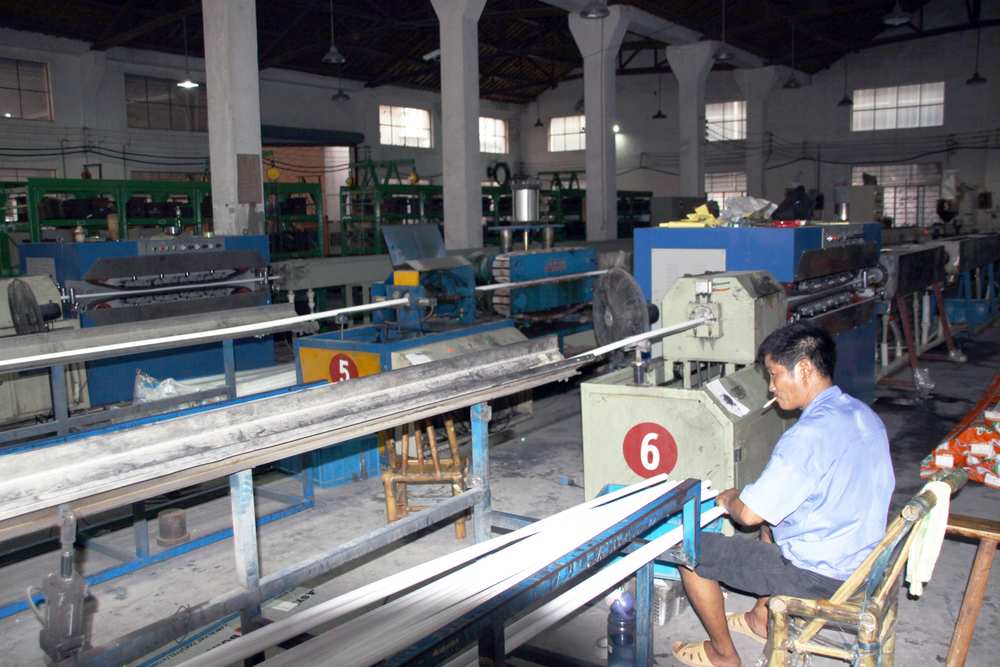
Approvisionnement en CPVC pour projets commerciaux : ce qu'il faut vérifier
La structure polymère du PVC se ramollit au-dessus de 60 °C ; la chloration du CPVC élève ce seuil de défaillance de 30 °C. Pour tout système au-dessus de 60 °C, le PVC est une responsabilité latente.
La cause profonde de la défaillance du PVC en eau chaude est sa température de transition vitreuse (Tg) d'environ 80 °C (176 °F). La Tg est la température à laquelle les chaînes polymères dans la paroi du tube acquièrent une mobilité suffisante pour perdre leur rigidité structurelle. Ce n'est pas une dégradation lente — c'est une propriété fondamentale du matériau. À des températures de service soutenues au-dessus de 60 °C, le PVC commence à approcher sa Tg. Le polymère se ramollit, la pression nominale chute brutalement et le tube devient susceptible de se déformer, de s'affaisser et d'extruder ses joints.
La conséquence est prévisible : fluage du joint, rupture d'emboiture ou fissuration longitudinale catastrophique le long d'une soudure. Les données internes de contrôle qualité d'IFAN font apparaître une réduction de 50 % du module de traction du PVC mesuré à 60 °C par rapport à sa valeur nominale à température ambiante. Pour un installateur qui pose une boucle de recirculation d'eau chaude de 60 mètres en PVC, la fenêtre avant une défaillance terrain est typiquement de 3 à 5 ans — parfois moins si la température de l'eau dépasse 70 °C lors des cycles chaudière.
Le processus de chloration du CPVC élève la Tg à environ 110 °C (230 °F). Cette marge de 30 °C représente la différence entre un tube qui maintient sa géométrie sous une colonne d'eau à 82 °C et un qui fragilise ou s'affaisse. Pour toute application commerciale d'eau chaude où les températures dépassent 60 °C, prescrire du PVC est une erreur de spécification. Le coût de remplacement d'une boucle PVC défaillante — incluant la main-d'œuvre, les arrêts et les dégâts des eaux potentiels — dépasse la prime de coût matière du CPVC dès le premier cycle de défaillance.
Erreurs courantes d'installation du CPVC à éviter
Le PVC défaille au-dessus de 60 °C parce que ses chaînes polymères se mobilisent à la température de transition vitreuse. Le CPVC retarde cet effondrement de 50 °C, ce qui en fait le seul choix rationnel pour le service continu en eau chaude.
Le mécanisme de défaillance critique est la température de transition vitreuse (Tg) du PVC d'environ 80 °C (176 °F). À des températures d'eau soutenues au-dessus de 60 °C, les chaînes polymères commencent à se mobiliser, provoquant un affaissement mesurable dans les tronçons verticaux, l'extrusion des joints et finalement une rupture catastrophique. Le journal de contrôle qualité interne d'IFAN montre une chute du module de 50 % pour le PVC à 60 °C par rapport à sa valeur nominale à 23 °C. Ce n'est pas une marge de sécurité — c'est un effondrement structurel au ralenti.
La chloration du CPVC élève la Tg à ~110 °C (230 °F). Cette seule modification chimique décale l'ensemble de l'enveloppe de performance. Pour toute boucle d'eau chaude fonctionnant au-dessus de 60 °C, prescrire du PVC n'est pas une économie — c'est une responsabilité différée.
Si vous concevez un système qui verra de l'eau à 70 °C, même de façon intermittente, le PVC est le mauvais matériau. La science des polymères est sans ambiguïté. La seule question est de savoir si vous souhaitez le découvrir lors de la mise en service ou après une inondation.
Conclusion
Les données sont claires : le PVC défaille en premier en service d'eau chaude au-dessus de 60 °C en raison du ramollissement des polymères à sa température de transition vitreuse, tandis que le CPVC maintient son intégrité structurelle jusqu'à 93 °C en service continu. La Tg plus élevée du CPVC et sa meilleure rétention de pression à haute température en font le seul choix viable de tuyauterie plastique pour les boucles commerciales d'eau chaude. Cependant, une installation correcte — utilisant un ciment homologué CPVC et évitant toute exposition aux hydrocarbures — est essentielle pour prévenir les défaillances évitables qui donnent parfois au CPVC une réputation imméritée.
Pour votre prochaine prescription, vérifiez les spécifications matière par rapport à la classe cellulaire 23447 de l'ASTM D1784 et à la certification NSF 61. Consultez les spécifications et les prix de gros du CPVC Schedule 80 d'IFAN pour constituer un dossier d'approvisionnement sans risque pour votre projet.
Questions fréquentes
Peut-on utiliser du CPVC avec des raccords PVC en employant un ciment spécial ?
Non : seuls des raccords de transition certifiés avec un ciment solvant compatible sont acceptables. L'application incorrecte du ciment est une erreur fréquente. Assurez-vous toujours que les matériaux du tube et du raccord correspondent et suivez les instructions du fabricant.
Le CPVC devient-il fragile avec le temps ?
Oui, le CPVC peut se fragiliser sous l'effet d'une exposition UV prolongée, d'une attaque chimique ou de températures dépassant sa limite de 93 °C. Cependant, lorsqu'il est installé dans ses limites de conception, le CPVC conserve son intégrité mécanique pendant des décennies. Protégez le CPVC des UV et des produits chimiques pour maintenir sa durabilité.
Quelle est la pression nominale du CPVC IFAN à 93 °C ?
Le CPVC d'IFAN respecte les normes ASTM, donc le Schedule 80 à 93 °C est généralement déclassé à environ 80 % de la valeur nominale à 23 °C, mais les valeurs exactes dépendent du type de tube et de l'épaisseur de paroi. Pour des chiffres précis, demandez la fiche technique CPVC d'IFAN pour les caractéristiques spécifiques à votre application.
Le CPVC est-il inadapté à la plomberie résidentielle ?
Non : le CPVC est un choix fiable pour l'eau chaude et froide en habitation lorsqu'il est correctement installé et tenu à l'écart des expositions chimiques telles que la mousse polyuréthane. Les défaillances du CPVC ont généralement des causes évitables. Respectez les règles d'installation et évitez les expositions chimiques pour garantir une longue durée de vie.
Quelle est la durée de vie d'un tube CPVC en service d'eau chaude ?
Un tube CPVC dure généralement 25 à 40 ans en service de recirculation d'eau chaude lorsqu'il est exploité dans sa limite continue de 93 °C. En revanche, le PVC défaille en 3 à 5 ans dans les mêmes conditions. Maintenez la température du système en dessous de 93 °C pour maximiser la durée de vie.