
Vanne à opercule PPR : ce que le corps en plastique renferme vraiment
Spécifications des vannes à opercule PPR que la plupart des fournisseurs omettent : le tableau de déclassement ISO 16139, pourquoi un corps en plastique PN16 tient 4,32 bar à 70C, et les codes de commande 25mm vs 32mm.
Commandez une vanne à opercule PPR auprès de trois fournisseurs chinois différents et vous obtiendrez trois produits différents. L'un expédie un corps en plastique avec une poignée à levier. Un autre expédie un corps en plastique avec un volant et une tige en laiton insérée. Un troisième expédie ce que son propre catalogue appelle une vanne d'arrêt, dans le même carton, au même prix. Les trois répondent à la même ligne de bon de commande, et aucun ne contient le opercule montant que les mots "vanne à opercule" décrivent dans toutes les normes de vannes métalliques jamais écrites.
Ce laxisme de dénomination a plus d'importance qu'il n'y paraît, car ce qui détermine réellement si la vanne survit n'est pas la forme de la poignée. C'est le matériau du corps. Un corps en plastique est déclassé par la température bien plus durement qu'un tuyau du même matériau : selon l'ISO 16139, la norme internationale spécifiquement écrite pour les vannes à opercule en thermoplastiques, un corps en polypropylène porte un facteur de déclassement de 0,40 à 60 °C. Une vanne marquée PN10 est autorisée à 4 bar dans une conduite à 60 °C, pas 10. La plupart des pages produits vendant ces vannes ne mentionnent jamais ce chiffre, ni la norme dont il provient.

Points clés à retenir
- "Vanne à opercule PPR" est un nom commercial, pas un type de vanne. Ce qui est expédié est presque toujours une vanne d'isolement à corps en plastique avec une bille quart de tour ou une tige de compression — pas un opercule montant.
- La norme qui la couvre réellement est l'ISO 16139:2006 (amendée en 2019) — vannes à opercule en matériaux thermoplastiques, classées de −40 °C à +120 °C pour une durée de vie de 25 ans.
- Un corps en polypropylène perd rapidement sa capacité de pression : facteur de déclassement 1,0 à 20 °C, 0,70 à 40 °C, 0,40 à 60 °C, 0,15 à 80 °C. Pression admissible = facteur × PN.
- L'EN 13828, la norme que la plupart des acheteurs demandent par son nom, exige un corps en alliage de cuivre ou en acier inoxydable — elle ne peut donc pas certifier une vanne à corps en plastique du tout.
- 25mm et 32mm sont des tailles d'emboîture, pas le même code de commande : la vanne à opercule IFAN se décline en 104-77 (20×1/2F), 104-78 (25×3/4F), 104-79 (32×3/4F) — notez que 25 et 32 partagent le même filetage 3/4".
- L'ISO 16139 exige que l'étanchéité du siège et du presse-étoupe soit vérifiée sur toutes les vannes complètes, pas sur un échantillon — le test du siège est à 1,1 × PN, le test du presse-étoupe à 1,5 × PN.
- Le DN, le PN, le matériau du corps, le fabricant et le code de production doivent être marqués sur la vanne elle-même. La pression/température nominale peut légalement ne figurer que sur la fiche technique — demandez donc la fiche technique.
Ce qu'est réellement une vanne à opercule PPR
Une vanne à opercule, au sens strict, se ferme en entraînant un disque plat ou en forme de coin vers le bas à travers l'alésage jusqu'à ce qu'il s'appuie sur les deux faces. Tournez le volant, l'opercule monte ; tournez-le en sens inverse, l'opercule descend. C'est le mécanisme que décrivent les mots, et c'est pourquoi les vannes à opercule nécessitent plusieurs tours pour fonctionner au lieu d'un quart de tour.
Regardez maintenant ce qui arrive réellement dans un carton PPR. Deux extrémités à emboîture pour soudage par fusion, un corps en polypropylène moulé, et soit un levier qui pivote à 90 degrés, soit un petit volant entraînant une tige de compression courte sur une rondelle d'étanchéité. La version à levier est une vanne à bille. La version à volant est plus proche d'une vanne à soupape ou d'arrêt — le disque se déplace parallèlement à l'axe d'écoulement, pas en travers. Ni l'une ni l'autre n'est un opercule en coin. L'industrie a conservé le mot parce que les acheteurs le recherchent, et parce que sur un bon de commande, « vanne à opercule » en est venu à signifier une seule chose : la vanne d'isolement que vous soudez dans une colonne montante PPR pour fermer une dérivation.
Ce n'est pas du pédantisme, car le mécanisme change ce que la vanne tolère. Un opercule en coin maintenu à moitié ouvert développe une vitesse de bord élevée à travers le siège, ce qui érode la face d'étanchéité — la raison pour laquelle les vannes à opercule en métal portent un avertissement explicite contre l'étranglement. Les portées ISO font la même distinction pour les plastiques : l'ISO 16139 couvre les vannes à opercule en thermoplastique « destinées au service d'isolement », tandis que sa norme sœur ISO 16135 pour les vannes à bille en thermoplastique couvre le service d'isolement et le service de régulation. Si un fournisseur vous dit que sa vanne à opercule PPR convient à la régulation de débit, il décrit une vanne à bille et l'appelle autrement. Ouvert à fond ou fermé à fond est l'intention de conception, quelle que soit la poignée qu'elle porte.
Une autre distinction mérite d'être clarifiée tôt, car elle explique la plupart des écarts de prix que vous verrez dans les devis. Certaines de ces vannes sont entièrement en plastique — corps, tige et disque moulés en PP-R, scellés par un joint torique. D'autres ont un corps en plastique avec un noyau en laiton ou en acier inoxydable portant le siège et la tige. IFAN fabrique les deux : la gamme tout-plastique est proposée sous les références BK-257, BK-258 et BK-259 en 20, 25 et 32 mm, tandis que les versions à noyau métallique sont proposées à côté sous la même série PPR. La version tout-plastique n'a rien à l'intérieur qui puisse se corroder et rien qui puisse s'infiltrer. La version à noyau métallique conserve mieux le couple après des années sans être touchée. Celle que vous choisissez dépend de si la vanne est actionnée ou oubliée, et nous y reviendrons ci-dessous.
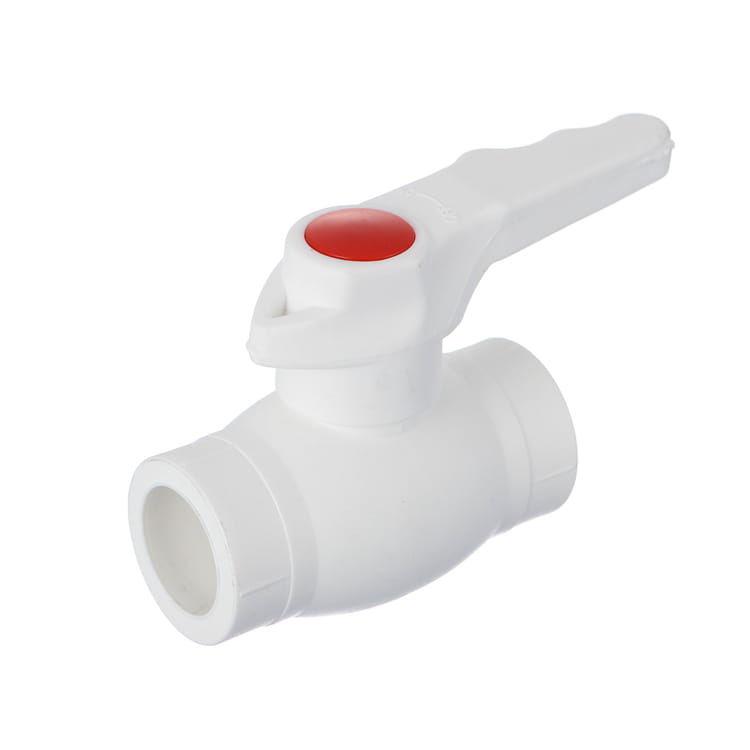
Le produit auquel le mot-clé renvoie : un corps en plastique monobloc avec deux emboîtures de fusion et pas d'opercule montant.
La norme que personne ne cite : ISO 16139
Recherchez cette catégorie de produits et on vous montrera ISO 15874 et DIN 8077/8078 à maintes reprises. Ce sont les normes appropriées — pour le tube et les raccords, où ISO 15874-3 couvre les raccords à emboîture pour soudage par fusion, les raccords électrosoudables et les raccords mécaniques et les raccords avec inserts incorporés. Ce ne sont pas des normes de vannes. La norme pour les vannes est ISO 16139:2006, Robinetterie industrielle — Vannes à opercule en matériaux thermoplastiques, publiée en mars 2006 et modifiée par l'amendement 1 en 2019. Elle spécifie la conception, les caractéristiques fonctionnelles, la fabrication, le raccordement au système de tuyauterie, les matériaux du corps et le régime pression/température entre −40 °C et +120 °C, pour une durée de vie de 25 ans. Elle spécifie également les essais.
L'amendement de 2019 est important pour quiconque achète les deux tailles populaires. La liste DN d'origine omettait le DN 32 ; l'amendement 1 l'a réécrite pour lire DN 10, 15, 20, 25, 32, 40, 50, 65, 80, 100, 125, 150, 200, 250, 300 et 350. Les classes de pression sont PN 6, PN 10, PN 16 et Class 150, avec une note explicite indiquant qu'un fabricant peut déclarer un DN ou PN différent. Cette note explique pourquoi vous voyez des vannes PPR PN20 et PN25 sur le marché — ce sont des déclarations du fabricant en dehors des classes listées dans la norme, ce qui est autorisé, mais cela signifie que le numéro PN sur le corps est une affirmation du fabricant et que la fiche technique est l'endroit où vous vérifiez ce qui la soutient.
Voici le piège qui attrape les équipes d'approvisionnement dans le Golfe et en Afrique. Les acheteurs qui ont été formés à demander un certificat européen de vanne de bâtiment demandent l'EN 13828, car c'est la norme pour les vannes à boisseau sphérique à commande manuelle pour l'alimentation en eau potable dans les bâtiments.EN 13828:2025 couvre les DN 6 à DN 100 en PN10 ou PN16, avec une température de distribution normale de 65 °C maximum et des excursions occasionnelles à 90 °C pendant une heure. Elle stipule également, à l'article 5.1.2.1, que toutes les parties du corps doivent être en alliage de cuivre ou en acier inoxydable. Une vanne à corps en plastique ne peut pas se conformer à une clause qui exige un corps métallique. Ainsi, lorsqu'un fournisseur vous remet un certificat EN 13828 pour une vanne PPR, soit le certificat couvre un produit différent de sa gamme, soit quelque chose ne va pas. Demandez plutôt l'ISO 16139, et les enregistrements d'essais ISO 9393-2 qui la sous-tendent.
L'endroit où la vanne est destinée ajoute une deuxième couche. Aux Émirats arabes unis, la voie vers le marché passe par le Emirates Conformity Assessment Scheme, où un organisme notifié désigné gère les essais et l'examen de certification et télécharge le certificat de conformité dans la base de données nationale d'enregistrement des produits ; l'organisme des Émirats siège également au sein de l'Organisation de normalisation du CCG, de sorte que les normes GSO à l'échelle du Golfe s'appliquent en parallèle. Ce dont une vanne de plomberie a spécifiquement besoin varie selon le produit, le projet et le rôle de l'importateur — confirmez la liste actuelle avec votre organisme notifié ou un courtier en douane avant l'expédition du conteneur plutôt qu'après. La gamme PPR d'IFAN est certifiée DIN 8077/8078, ISO 15874, CE et SGS en standard, avec des approbations régionales telles que SASO, SONCAP ou NOM arrangées sur demande, et les mêmes documents de certification accompagnant une expédition PPR couvrent les vannes du lot.
Comment le corps en plastique modifie la pression nominale
C'est la section qui devrait décider de votre commande, et elle repose sur un tableau dans l'ISO 16139. L'article 4.3 fixe la pression de service maximale admissible comme PMA = fr × PN, où frest un facteur de réduction lu dans le tableau 1 à la température du fluide. Pour un corps en polypropylène, le facteur reste à 1,0 jusqu'à 25 °C, puis diminue : 0,85 à 30 °C, 0,70 à 40 °C, 0,55 à 50 °C, 0,40 à 60 °C, 0,27 à 70 °C, 0,15 à 80 °C et 0,08 à 90 °C.
| Température du fluide | Facteur de réduction PP fr | Autorisé sur un corps PN10 | Autorisé sur un corps PN16 |
|---|---|---|---|
| 20 °C | 1,0 | 10 bar | 16 bar |
| 30 °C | 0,85 | 8,5 bar | 13,6 bar |
| 40 °C | 0,70 | 7 bar | 11,2 bar |
| 50 °C | 0,55 | 5,5 bar | 8,8 bar |
| 60 °C | 0,40 | 4 bar | 6,4 bar |
| 70 °C | 0,27 | 2,7 bar | 4,32 bar |
| 80 °C | 0,15 | 1,5 bar | 2,4 bar |
| 90 °C | 0,08 | 0,8 bar | 1,28 bar |
Relisez la ligne à 70 °C. Une vanne à corps plastique PN16 est autorisée à 4,32 bar dans une conduite à 70 °C. Les colonnes montantes d'eau chaude sanitaire dans les immeubles résidentiels du Golfe et d'Afrique de l'Ouest fonctionnent généralement dans la plage de 55 à 60 °C une fois le ballon réglé et équilibré, ce qui vous place sur le facteur 0,40 — soit 6,4 bar pour cette même vanne PN16. La pression du réseau dans un immeuble de hauteur moyenne est confortablement supérieure à cela dans de nombreuses villes. La vanne n'est pas sous-dimensionnée ; on lui demande de faire quelque chose que sa propre norme n'autorise pas.
L'ISO 16139 attache à ce tableau un avertissement en langage clair : ces valeurs ne coïncident pas avec les facteurs pertinents pour les tubes et raccords. La vanne se détarre plus fortement que le tube dans lequel elle est soudée.
Cette seule note explique toute une classe de défaillances sur le terrain. Un prescripteur dimensionne le système à partir des tableaux des tubes — où un tube PPR PN20 porte réellement 20 bar à 20 °C et reste en service à chaud pendant des décennies — puis installe des vannes portant le même marquage PN et suppose que la chaîne est uniforme. Elle ne l'est pas. La vanne est le maillon faible par conception, car un corps moulé avec une pénétration de tige et un joint ne peut pas être traité comme une paroi extrudée simple. C'est aussi pourquoi les pages de concurrents qui annoncent « jusqu'à 95 °C de température de service » pour une vanne PPR sans nommer une norme de vanne doivent être lues avec prudence : 95 °C est une valeur de classe de dysfonctionnement pour les systèmes de tubes, et à 90 °C, le facteur ISO pour un corps de vanne en PP est déjà tombé à 0,08.
La règle pratique qui en découle : choisissez le PN de la vanne en fonction de la température qu'elle verra réellement, et non du PN du tube. Sur une branche d'eau chaude à 60 °C qui doit tenir 8 bar, un corps PN10 donne 4 bar et échoue, un corps PN16 donne 6,4 bar et échoue encore, et la réponse honnête est une vanne à corps métallique ou une pression de conception inférieure. Sur une branche d'eau froide à 25 °C, le même corps plastique PN16 porte ses 16 bar complets et il n'y a aucune raison de dépenser plus. Le système PPR d'IFAN couvre DN20–DN160 en PN12.5 à PN25, donc le côté tube de cette décision est rarement la contrainte — le côté vanne l'est généralement.
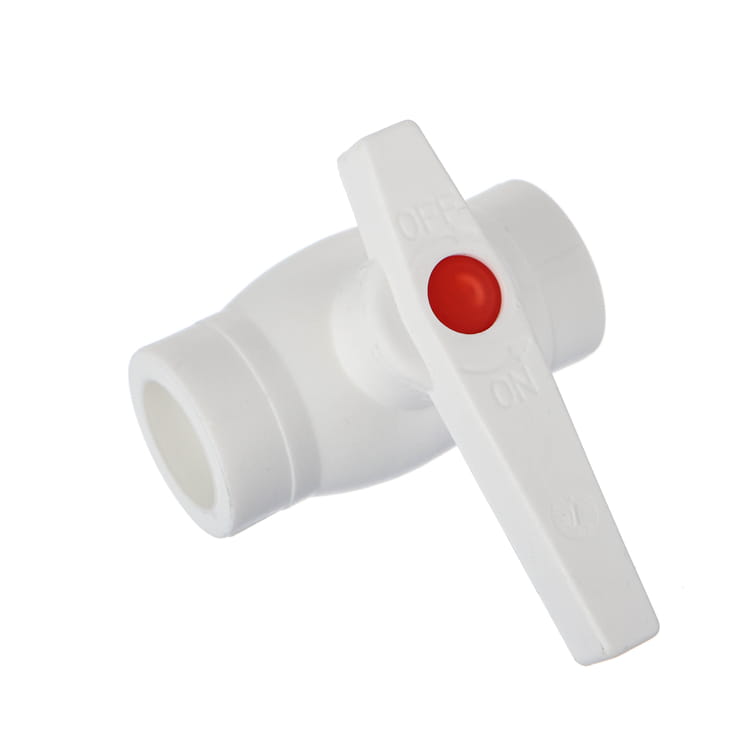
Corps moulé en une seule pièce : la pénétration de la tige et le joint sont la raison pour laquelle toute la vanne porte le facteur de réduction PP.
Dimensionnement d'une vanne à opercule PPR : 25mm et 32mm
Les deux dimensions réellement commandées sont 25 mm et 32 mm, et elles ne sont en aucun cas interchangeables. Le 25 mm alimente un groupe sanitaire ou une branche de colonne montante. Le 32 mm alimente un étage, une petite colonne d'immeuble ou un collecteur d'irrigation. Le chiffre correspond au diamètre extérieur du tube que la douille accepte, et c'est également ainsi que le tube est vendu — donc une vanne 25 mm se soude sur un tube 25 mm et rien d'autre.
Ce qui surprend, c'est le côté fileté. Dans la gamme de vannes à opercule d'IFAN, les codes vont de 104-77 en 20×1/2F, 104-78 en 25×3/4F et 104-79 en 32×3/4F. Regardez les deux derniers : la douille passe de 25 à 32 mm, mais le filetage femelle reste en 3/4 de pouce sur les deux. Un entrepreneur qui commande des vannes 32 mm en s'attendant à un filetage 1 pouce pour se raccorder à un collecteur 1 pouce se retrouvera sur le chantier avec un sac d'adaptateurs. La gamme correspondante de vannes d'arrêt, codes 1031-147 à 1031-152, suit le même schéma et ne passe à 1F qu'en 40 mm, puis 1-1/4F en 50 mm et 1-1/2F en 63 mm. Vérifiez la colonne filetage, pas seulement le chiffre en millimètres.
| Code article | Dimension | Épaisseur de paroi du tube en PN20 / PN25 | Pièces / carton |
|---|---|---|---|
| 104-77 | 20 × 1/2F | 3,4 mm / 4,1 mm | 50 |
| 104-78 | 25 × 3/4F | 4,2 mm / 5,1 mm | 50 |
| 104-79 | 32 × 3/4F | 5,4 mm / 6,5 mm | 50 |
| 1031-150 | 40 × 1F | 6,7 mm / 8,1 mm | 45 |
| 1031-152 | 63 × 1-1/2F | 10,5 mm / 12,7 mm | 35 |
La colonne épaisseur concerne le tube sur lequel la vanne se soude, et elle détermine la quantité de matière dont dispose le joint par fusion. En 25 mm, le tube PN20 a une paroi de 4,2 mm et le PN25 de 5,1 mm ; en 32 mm, ces valeurs passent à 5,4 mm et 6,5 mm. Le PN20 est en SDR6 et le PN25 en SDR5 — le rapport diamètre/épaisseur qui reste constant pour toutes les dimensions. La paroi plus épaisse pardonne plus facilement un cycle de chauffe légèrement trop long, ce qui explique pourquoi le stock PN25 résiste mieux aux équipes de chantier peu expérimentées. L'échelle complète du DN20 au DN160 se trouve dans notre référence des dimensions des tubes PPR si vous établissez une nomenclature plutôt qu'une commande unique.
Un point purement commercial qui coûte réellement de l'argent sur un conteneur. Ces vannes sont expédiées à 0,036 CBM par carton pour la gamme 20–32 mm, avec 50 pièces par carton. Une palette de vannes 32 mm et une palette de vannes 25 mm occupent le même volume — le volume est déterminé par le carton, pas par la vanne. Ainsi, la tentation de standardiser sur une seule dimension pour simplifier la liste de colisage n'économise rien sur le fret et vous coûte des adaptateurs sur le chantier. Commandez les dimensions indiquées sur les plans. Si vous mélangez les dimensions dans une expédition, la gamme PPR d'IFAN compte plus de 3 000 références avec un minimum d'un conteneur, donc un mélange équilibré ne nécessite pas un chargement complet d'un seul article.
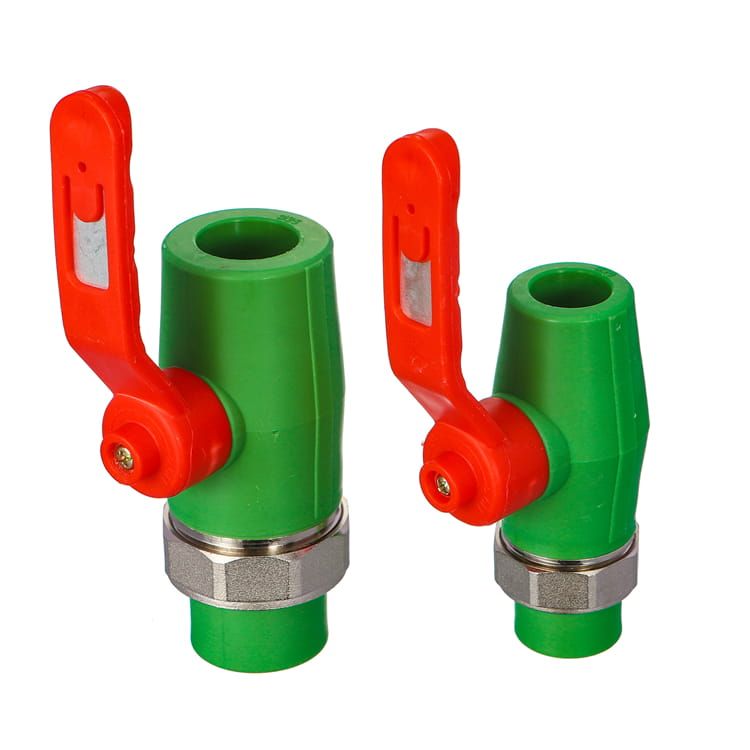
Deux tailles de douille, une taille de filetage : le décalage qui transforme une livraison en course aux adaptateurs.
Quelle vanne PPR convient à votre canalisation
Quatre produits se disputent le même emplacement dans un système PPR, et la réponse honnête est que l'un d'entre eux gagne la plupart du temps. Si la vanne doit être actionnée plus de deux fois par an, achetez la vanne à boisseau sphérique. Quart de tour, fermeture étanche, un siège qui soit assure l'étanchéité, soit ne la assure pas de manière visible, et une tige qui survit à cinq ans d'ignorance avant d'être manœuvrée. Le modèle à volant tout plastique est moins cher et plus léger et a une place réelle — mais cette place n'est pas un point d'isolement de maintenance que quelqu'un doit fermer en urgence à minuit.
| Vanne | Idéale pour | Pas idéale pour |
|---|---|---|
| Vanne PPR tout plastique (BK-257/258/259) | Eau froide, canalisations enterrées ou noyées, chimie de l'eau agressive, stock de détail axé sur le prix | Colonnes montantes d'eau chaude, vannes actionnées fréquemment, tout ce qui dépasse la pression déclassée |
| Vanne à boisseau sphérique PPR, noyau en laiton | Isolement des colonnes montantes et des branchements, eau chaude, tout ce que touche une équipe de maintenance | Étranglement ou équilibrage de débit ; appels d'offres uniquement axés sur le budget |
| Vanne d'arrêt PPR, volant (1031-147+) | Fermeture lente et contrôlée lorsque le coup de bélier est un problème ; service sur tige masquée | Arrêt d'urgence, espaces restreints sans dégagement pour la manœuvre |
| Vanne à opercule PPH, filetée (701-54/55) | Canalisations industrielles et d'irrigation filetées en 1/2" et 3/4" ; rénovations sans accès pour soudure par fusion | Systèmes PPR soudés par fusion ; diamètres supérieurs à 3/4" |
L'argument de la fermeture lente pour le modèle à volant mérite d'être pris au sérieux plutôt que rejeté. Une vanne à boisseau sphérique quart de tour fermée brusquement sur une longue canalisation de 32 mm génère un pic de pression, et des pics répétés sont la raison pour laquelle les joints par fusion en aval commencent à suinter des années plus tard. Un volant nécessite plusieurs tours, ce qui étale la fermeture sur plusieurs secondes au lieu d'une fraction de seconde. Sur un collecteur d'irrigation pompé ou une conduite principale horizontale longue, c'est une raison d'ingénierie réelle de choisir la vanne plus lente — pas un compromis. Sur un point d'isolement de salle de bain, c'est juste plus lent.
Notez également que la vanne à opercule PPH est un animal différent des autres. Elle est dimensionnée en pouces — 701-54 en 1/2" et 701-55 en 3/4" — et elle se visse plutôt que de se souder par fusion, donc elle appartient aux travaux industriels et d'irrigation filetés plutôt qu'à une colonne montante PPR soudée. Elle est aussi plus dense à l'expédition : 100 pièces par carton en 1/2" contre 50 pour les vannes à fusion, à 0,0272 CBM. Si votre projet est réellement en PPR sur toute la ligne, achetez la version à fusion et gardez le système homogène. Mélanger des joints filetés dans un système soudé réintroduit exactement les joints mécaniques que la fusion a été choisie pour éliminer.
Ce qu'il faut vérifier avant d'accepter un conteneur de vannes PPR
L'ISO 16139 vous offre une liste de contrôle d'inspection gratuite, car le tableau 2 de la norme modifiée divise les informations requises entre ce qui doit être marqué sur la vanne et ce qui peut figurer uniquement sur la fiche technique. Marqués sur la vanne : DN, PN ou classe, le matériau du corps, l'identification du fabricant et un code de production ou la date de fabrication. Fiche technique uniquement : le couple pression/température et le numéro de la norme elle-même. Le matériau du siège et du joint doit également être marqué sur la vanne, et toute limitation de la température de service doit apparaître dans la fiche technique.
Relisez cette répartition, car c'est la partie que vous pouvez réellement utiliser. Le couple p/t — celui qui vous indique que la vanne n'est bonne que pour 4 bar à 60 °C — est légalement autorisé à être absent du produit. Ainsi, une vanne peut être entièrement conforme, entièrement marquée, et ne vous dire rien sur sa limite de température à moins d'avoir la fiche technique en main. Les acheteurs qui n'inspectent que le moulage n'inspectent que la moitié de l'exigence qui ne contient pas le risque.
Les cinq contrôles qui détectent les vrais problèmes
- Lisibilité du marquage du corps :Le DN, le PN, le matériau et le code de production doivent être lisibles sur le moulage, et non sur une étiquette. Une étiquette n'est pas un marquage, et elle se décolle dans un conteneur humide.
- La fiche technique, demandée par numéro de norme :demandez la fiche technique ISO 16139 avec le couple p/t et la limitation de température de service. Si le fournisseur envoie à la place un certificat de tube, il n'a pas compris la question.
- Composé du joint nommé par écrit :la norme exige que le matériau du siège et du joint soit marqué, mais ne prescrit pas le composé. Il vous incombe donc d'obtenir le composé du joint torique nommé sur la fiche technique plutôt que de le supposer — le joint, et non le corps, est généralement ce qui cède en premier sur une ligne chaude.
- Déclaration du passage :le passage intégral selon l'ISO 16139 signifie au moins 90 % du DN en millimètres. Moins que cela est un passage réduit, et pour un passage réduit, le fabricant doit indiquer le facteur de perte de charge ou le diamètre minimal de passage. Le silence sur les deux signifie que personne n'a mesuré.
- Effort sur le volant :la clause 4.6.5 plafonne l'effort sur le levier et la jante du volant nécessaire pour ouvrir et fermer complètement la vanne à la force de manœuvre EN 12570, et exige que toutes les pièces fonctionnelles restent en état de service après application de cette force. Fermez et ouvrez un échantillon à la main. S'il faut deux mains à froid, il faudra une clé à chaud.
Côté usine, l'ISO 16139 fixe une exigence plus stricte que ce que la plupart des acheteurs ne le pensent : la clause 4.6.3 exige que l'étanchéité du siège et de la garniture soit vérifiée sur toutes les vannes complètes, par des essais selon ISO 9393-2. Pas un échantillon AQL — tous. Le test de siège dure 60 secondes à 0,5 bar avec air à l'intérieur et eau à l'extérieur, plus 15 secondes à 1,1 × PN avec eau à l'intérieur pour tout ce qui va jusqu'au DN 200, le tout à 20 ± 2 °C. Le test de garniture dure 15 secondes à 1,5 × PN pour DN 50 et moins. La pression d'essai est plafonnée à PN + 5 bar. Derrière cela, le test de l'enveloppe du corps pour une vanne PP-R dure une heure à 3,2 × PN par rapport à une contrainte de calcul de 5 MPa, et le test de comportement à long terme sur la vanne complète dure 1 000 heures à 1,52 × PN.
Voilà les chiffres à mettre dans un e-mail à un fournisseur. « Faites-vous des tests de pression ? » obtient un oui de tout le monde. « Effectuez-vous des tests de siège et de garniture à 100 % selon ISO 9393-2, et pouvez-vous envoyer l'enregistrement de 1 000 heures à 1,52 × PN pour ce code article ? » sépare une usine avec un laboratoire d'une société de négoce avec un entrepôt. IFAN fabrique depuis 1993 sur un site de 120 000 m² dans le Zhejiang avec injection plastique en interne, son propre atelier de moules et un laboratoire d'essais ISO, et chaque expédition PPR est accompagnée d'un certificat de lot contre 100 % de matière vierge PP-R 100 — c'est le document qui rend la deuxième question recevable. Si vous êtes encore en train de présélectionner, notre page fournisseur PPR détaille ce que couvre l'audit d'usine et le processus d'échantillonnage avant qu'une commande ne soit passée.
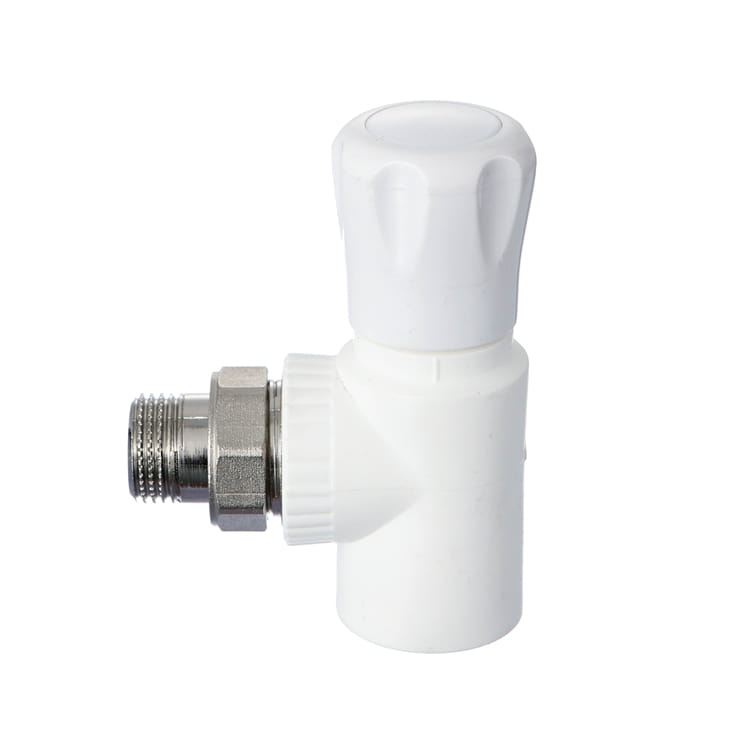
Un corps hybride : vérifiez le marquage moulé sur le plastique et la forme du filetage sur l'insert, séparément.
Installation sans cuire le joint
Une vanne PPR se soude de la même manière qu'un raccord, avec une règle supplémentaire que les installateurs enfreignent régulièrement : la vanne doit être complètement ouverte pendant le soudage. L'emboîture est à quelques millimètres d'un siège de joint et d'une tige, et la chaleur se propage. Soudez une vanne fermée et vous pouvez déformer le siège contre la bille ou le disque, puis le découvrir à la mise en service lorsque la vanne ne se rouvre pas ou ne s'étanchéifie pas.
Les paramètres de fusion sont ceux que le reste du système utilise. Fer à environ 260 °C, temps de chauffe proportionnel au diamètre — environ 5 secondes pour DN20, environ 7 pour DN25, plus long à mesure que la paroi s'épaissit. Marquez d'abord la profondeur de l'emboîture sur le tuyau pour savoir que le tuyau est bien enfoncé, et ne tournez pas pendant l'insertion. Le mode de défaillance à craindre est la surchauffe plutôt que la sous-chauffe : maintenez le joint sur le fer trop longtemps et la matière se carbonise, produisant une soudure qui semble parfaite et qui casse des mois plus tard sous pression. C'est aussi pourquoi la paroi plus épaisse PN25 est plus facile pour une nouvelle équipe. La séquence complète, y compris les erreurs qui produisent un joint qui passe un contrôle visuel puis fuit, se trouve dans notre guide de soudage et d'installation PPR.
Un exemple concret : l'isolation d'un étage d'un immeuble de six étages
Prenons un cas concret que vous pouvez réutiliser. Un immeuble résidentiel de six étages, colonne montante d'eau froide PPR de 32 mm, dérivations de 25 mm vers chaque appartement, pression du réseau à 6 bar, eau froide à 25 °C, et l'exigence que chaque étage puisse être isolé sans vidanger le bâtiment.
À 25 °C, le facteur de correction PP est de 1,0, donc un corps en plastique PN16 supporte pleinement ses 16 bar pour une exigence de 6 bar — confortable, et il n'y a aucune raison de payer plus cher pour du métal ici. Six vannes de sol en 32 mm signifient six pièces de code 104-79, et notez le filetage 3/4F afin que les sorties du collecteur soient commandées en conséquence plutôt qu'adaptées. Chaque branche d'appartement prend une vanne de 25 mm, code 104-78, et à raison de quatre appartements par étage, cela fait 24 pièces. Total 30 vannes, ce qui à 50 pièces par carton représente un carton de 32 mm et un de 25 mm, soit 0,072 CBM de volume sur la liste de colisage. Les deux types de vannes sont soudés en position entièrement ouverte. Les vannes de sol se montent côté colonne montante du té de branchement, pas côté branche, sinon vous ne pourrez pas isoler l'étage sans couper aussi la colonne au-dessus.
Changez maintenant une donnée et regardez la réponse basculer. Faites-en une colonne montante d'eau chaude à 60 °C au lieu d'eau froide. Le facteur chute à 0,40, le corps PN16 est autorisé à 6,4 bar, l'exigence est de 6 bar, et vous vous retrouvez avec une marge de 0,4 bar sur un système qui subira des transitoires de pression à chaque fermeture de vanne. Ce n'est pas une spécification, c'est un pile ou face. Sur la colonne d'eau chaude, vous achetez une vanne à boisseau sphérique à noyau en laiton ou vous réduisez la pression de conception avec un réducteur de pression en amont. Même bâtiment, même plan, vanne différente — parce que la température a changé.
Conclusion
L'expression « vanne à opercule PPR » masque deux décisions qui comptent réellement : si le corps est en plastique ou à noyau métallique, et à quelle température la conduite fonctionne. Si vous vous trompez sur la seconde, le PN moulé dans le corps est une fiction — une vanne en plastique PN16 est un composant de 4,32 bar à 70 °C, et ISO 16139 le dit dans un tableau que la plupart des fournisseurs ne montrent jamais. Si vous vous trompez sur la première, vous avez placé une vanne qui n'aime pas être manœuvrée au seul endroit du système où quelqu'un doit la manœuvrer.
Si vous spécifiez plutôt que d'acheter, l'étape la plus rapide et utile est d'indiquer la température du fluide à côté de chaque vanne sur le plan et de déclasser à partir de là. Si vous approvisionnez un conteneur mixte et souhaitez aligner les codes article, les dimensions de raccordement et les données de conditionnement sur votre nomenclature, c'est une conversation qui vaut la peine d'avoir avant la commande plutôt qu'après l'arrivée des vannes.
Questions fréquemment posées
Une vanne à opercule PPR peut-elle être utilisée pour le gaz ?
Non. Ces vannes sont spécifiées pour le service de l'eau selon les normes des systèmes d'eau chaude et froide PPR. Les installations de gaz suivent des règles nationales distinctes et des approbations de produits distinctes — vérifiez auprès de votre autorité locale du gaz, ne remplacez jamais une vanne d'eau.
Pourquoi ma vanne PPR fuit-elle au niveau de la tige et non du raccord ?
Le presse-étoupe s'est détendu ou le joint torique a subi la chaleur. C'est le joint de presse-étoupe, testé séparément à 1,5 × PN selon ISO 9393-2. Les fuites au niveau du raccord indiquent un problème de soudure ; les fuites au niveau de la tige indiquent un problème du joint.
Une vanne à opercule PPR de 32 mm est-elle la même qu'une vanne de 1 pouce ?
Non. 32 mm est le diamètre extérieur du tube pour la fusion. Sur la ligne IFAN, la vanne de 32 mm (104-79) porte un filetage femelle de 3/4 de pouce, pas 1 pouce — le 1F commence à 40 mm. Commandez avec les deux numéros.
Puis-je réparer une vanne PPR en place, ou dois-je la découper ?
Les types à volant acceptent souvent une tige de remplacement ou une cartouche d'étanchéité, de sorte que le corps reste soudé. Les robinets à boisseau sphérique entièrement moulés ne le permettent généralement pas, et les emboîtures fusionnées signifient que le remplacement est un travail de coupe et de soudure des deux côtés.
Une vanne à opercule PPR réduit-elle le débit lorsqu'elle est complètement ouverte ?
Uniquement si elle est à passage réduit. En pleine section selon ISO 16139, le passage doit être d'au moins 90 % du DN en millimètres. Pour le passage réduit, le fabricant doit publier le facteur de perte de charge ou le diamètre minimal du passage.
Quelle est la durée de vie d'une vanne PPR à corps plastique ?
ISO 16139 évalue les vannes à opercule thermoplastiques pour une durée de vie de 25 ans, et ses facteurs de classification sont calculés sur cette base. C'est le fonctionnement de la vanne au-dessus de sa pression déclassée pour sa température réelle qui la raccourcit.
Rédigé par l'équipe technique du groupe IFAN. IFAN fabrique des systèmes de plomberie et de chauffage à Zhejiang, en Chine, depuis 1993, dans une installation de 120 000 m² avec moulage par injection en interne, son propre atelier de moules et un laboratoire d'essais ISO, exportant vers plus de 120 pays. Les chiffres des normes cités dans cet article proviennent de ISO 16139:2006/Amd 1:2019, ISO 9393-2:2005 et EN 13828:2025 ; les codes produits et les données d'emballage proviennent du catalogue de produits en direct d'IFAN.