
Brass Ball Valve: The Complete Buyer's Guide
A brass ball valve is the workhorse shut-off valve of plumbing, heating, gas, and industrial water systems — a quarter turn takes it from fully open to fully sealed, and a good one does that for decades without seizing or weeping. But "brass ball valve" is not one product. The brass alloy, the body process, the port size, the connection type, the handle, the seat material, and the pressure rating all change where a valve belongs and how long it lasts. Specify the wrong combination and you get a valve that leaks at the stem, dezincifies in aggressive water, throttles your flow, or fails a pressure test on site. This complete guide covers everything a specifier, contractor, or wholesale buyer needs — how the valve works, the materials and construction that decide its life, sizes and standards, how it compares to other valve types, how to choose and install it, what goes wrong, and how to vet the manufacturer behind it.
Key Takeaways
- A brass ball valve seals with a quarter-turn ball — simple, fast, and drip-tight when built right.
- The alloy decides corrosion life: CW617N is the common EU standard; specify DZR for aggressive water and low-lead for potable.
- Forged bodies are denser and stronger than cast; full-port preserves flow.
- Match the connection (FF/FM/MM/union) to your pipework before sizing.
- Ball valves beat gate/globe valves for fast isolation; they're not throttling valves.
- A PTFE seat + blow-out-proof stem + air-tightness testing mark a valve that lasts.
- IFAN's range: CW617N brass, DN8–DN100, PN16–40, CE/ACS/WRAS/SASO certified — no MOQ, ~10-day lead, stocked year-round.

How a Brass Ball Valve Works
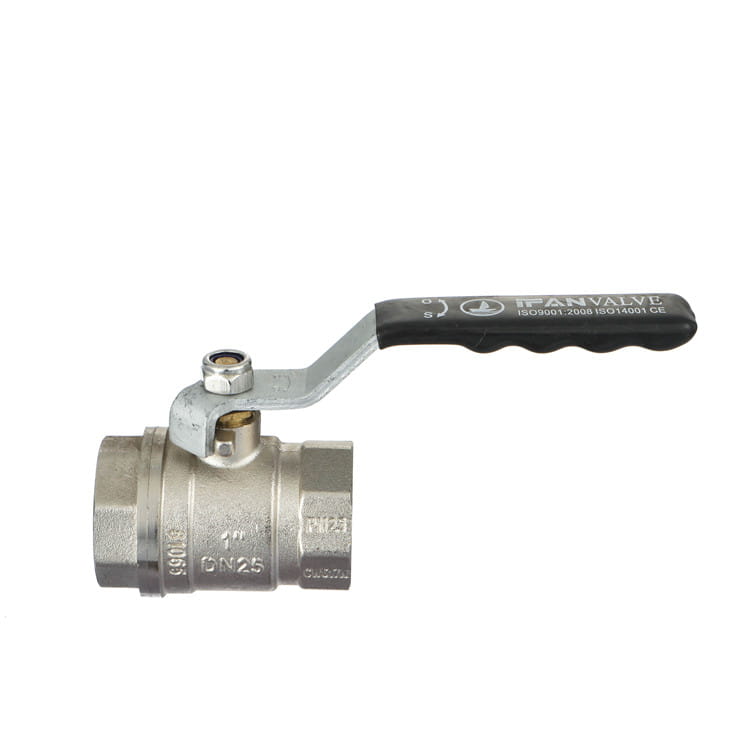
Inside the valve is a solid brass ball with a hole (the bore) through its centre. Line the bore up with the pipe and flow passes straight through; rotate the ball 90° with the handle and the solid side of the ball blocks the flow completely. That quarter-turn action is why ball valves are fast to operate and easy to read at a glance — a handle in line with the pipe is open, a handle across it is shut. The ball seals against two PTFE seats soft enough to form a drip-tight seal yet hard enough to resist wear, and the stem that turns the ball is sealed with O-rings and, on a well-made valve, designed to be blow-out-proof so line pressure can't push it out. There is nothing to wear out quickly and no rubber diaphragm to perish, which is why a quality brass ball valve routinely lasts the life of the pipework.
Anatomy: The Parts That Decide Quality
Understanding the components tells you where a cheap valve cuts corners:
- Body: the brass shell that carries pressure — its alloy and wall thickness set the valve's strength and corrosion life.
- Ball: a proper hard, smooth sealing surface — a well-finished solid brass ball (as in IFAN's range) or a chrome-plated brass ball — not plated pot-metal that corrodes and sticks.
- Seats: two PTFE (or reinforced PTFE) rings the ball seals against — the single most important sealing part.
- Stem: transfers the handle's turn to the ball; a blow-out-proof design seats from inside so pressure can't eject it.
- Stem seals: O-rings and/or a gland packing that stop leaks around the turning stem — the usual point a worn valve weeps.
- Handle: lever or butterfly, usually steel (zinc- or chrome-plated) or reinforced plastic, sized for the torque the valve needs.
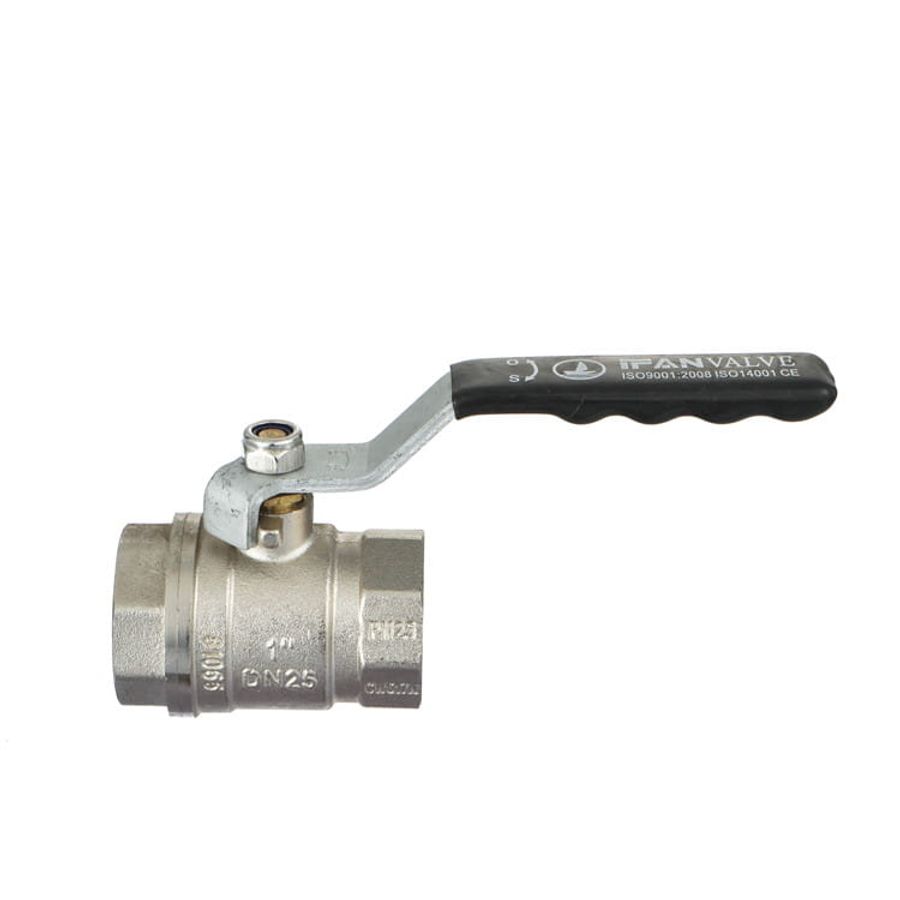
The Brass Alloy — Why It Decides Corrosion Life
Not all brass is equal, and the alloy is the biggest single driver of how long the valve survives. The most widely specified body alloy in Europe is CW617N — a hot-forging brass of roughly 58% copper with lead added for machinability — valued for its balance of strength, machinability, and corrosion resistance. Where water is soft, acidic, or high in chloride, the failure mode to guard against is dezincification: zinc leaches out of ordinary brass and leaves a weak, porous body that eventually cracks or leaks. The upgrade for those conditions is a DZR (dezincification-resistant) brass such as CW602N, which resists that attack. For drinking-water systems, many markets now mandate low-lead or lead-free brass to limit lead migration into the supply, so confirm the alloy meets the potable standard of your destination country. The practical rule: "brass" alone is never a specification — always pin down the exact alloy grade for the water and market the valve will serve.
| Alloy | Character | Specify for |
|---|---|---|
| CW617N | Standard hot-forging brass, strong & machinable | General water, heating, industrial |
| DZR (e.g. CW602N) | Dezincification-resistant | Soft, acidic, or high-chloride water |
| Low-lead / lead-free | Limited lead migration to the water | Potable water (per market rules) |
Are brass or bronze ball valves better?
For plumbing, heating, gas and compressed air a forged brass ball valve is the better buy: it is denser, lighter, cheaper and seals gas-tight; choose cast bronze only for seawater, brackish or zinc-attacking chemical service. Brass is copper-zinc (CW617N, or DZR CW602N where dezincification is a risk); bronze is copper-tin, cast rather than forged, so it needs thicker walls, weighs and costs more, and its porosity makes it a poorer choice for gas. Where bronze earns its premium is marine and aggressive chemical water, where zinc-bearing alloys can dezincify — but for that duty a DZR brass valve to EN 13828:2025 covers most building-services cases at brass prices. See the alloy detail in CW617N and lead-free brass explained.
| Factor | Brass (CW617N / DZR CW602N) | Bronze (Cu-Sn, cast) |
|---|---|---|
| Alloy base | Copper + zinc (≈58–60% Cu) | Copper + tin (+ Pb, P, Al in some grades) |
| Body process | Hot forged — dense, void-free, tight tolerances | Sand/investment cast — heavier, some porosity |
| Corrosion | Fine for potable, heating, gas, air; use DZR in soft or chloride-rich water | Better in seawater and zinc-attacking chemicals |
| Weight and cost | Lighter, lower cost, easier overhead install | Thicker walls, heavier, higher cost |
| Best for | Buildings: water, heating, gas, compressed air | Marine, brackish, severe chemical service |
| Sources: RuB Inc., "Bronze ball valves vs brass ball valves"; EN 13828:2025 scope (copper-alloy and stainless-steel ball valves for potable water in buildings). | ||
Forged vs Cast Bodies
A brass body is made one of two ways, and it changes the valve's strength. Forged bodies are pressed from a solid billet under high force, giving a dense, void-free grain structure that handles pressure and mechanical stress better and machines to tighter tolerances. Cast bodies are poured molten into a mould and can carry internal porosity that becomes a leak path under pressure or over thermal cycling. Forged is the stronger, more reliable choice for pressure duty, which is why it's worth asking a manufacturer directly which process they use — a factory that forges in-house will say so plainly and usually show it. IFAN offers both forged and cast brass valves, and its forged range runs cold forging through precision machining as one in-house process (see the video above) — the level of process control a bulk buyer should look for when forged strength matters. Note also that KE search data shows "forged brass ball valve" is a real, low-competition buyer query — a sign that forging is a differentiator buyers actively look for.
Full-Port vs Reduced-Port
The bore through the ball comes in two sizes relative to the pipe. A full-port (full-bore) valve has a bore equal to the pipe's inner diameter, so it barely restricts flow and causes almost no pressure drop — the choice wherever flow rate matters, on pump lines, and where the valve stays open most of the time. A standard-port (reduced-bore) valve has a smaller bore, is more compact and cheaper, and throttles the flow slightly; it's fine for isolation duty on lines where a small pressure drop is acceptable. For most B2B water and heating work, full-port is the safer default unless space or budget forces the reduced-port. Whichever you choose, remember a ball valve is a two-position isolation valve — open or shut — not a throttling valve (more on that below).
Connection Types — Match the Pipework First
Before you size a valve, fix the connection, because it determines how the valve joins your line. The common configurations are named by their ends:
| Type | Ends | Typical use |
|---|---|---|
| FF (female × female) | Both ends internal thread | Inline between two male-threaded pipes/fittings |
| FM (female × male) | One internal, one external thread | Connecting a pipe to a female fitting/appliance |
| MM (male × male) | Both ends external thread | Joining two female-threaded components |
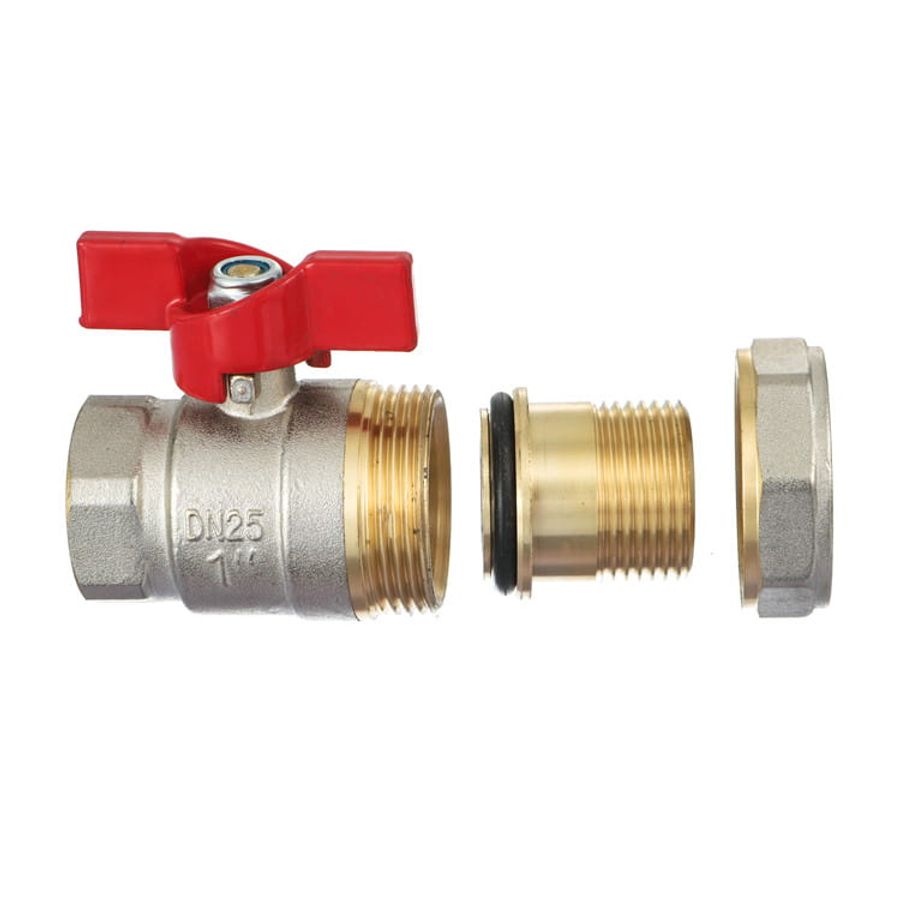
| Double-union | Union nuts both ends | Removable without cutting the line — service-friendly |
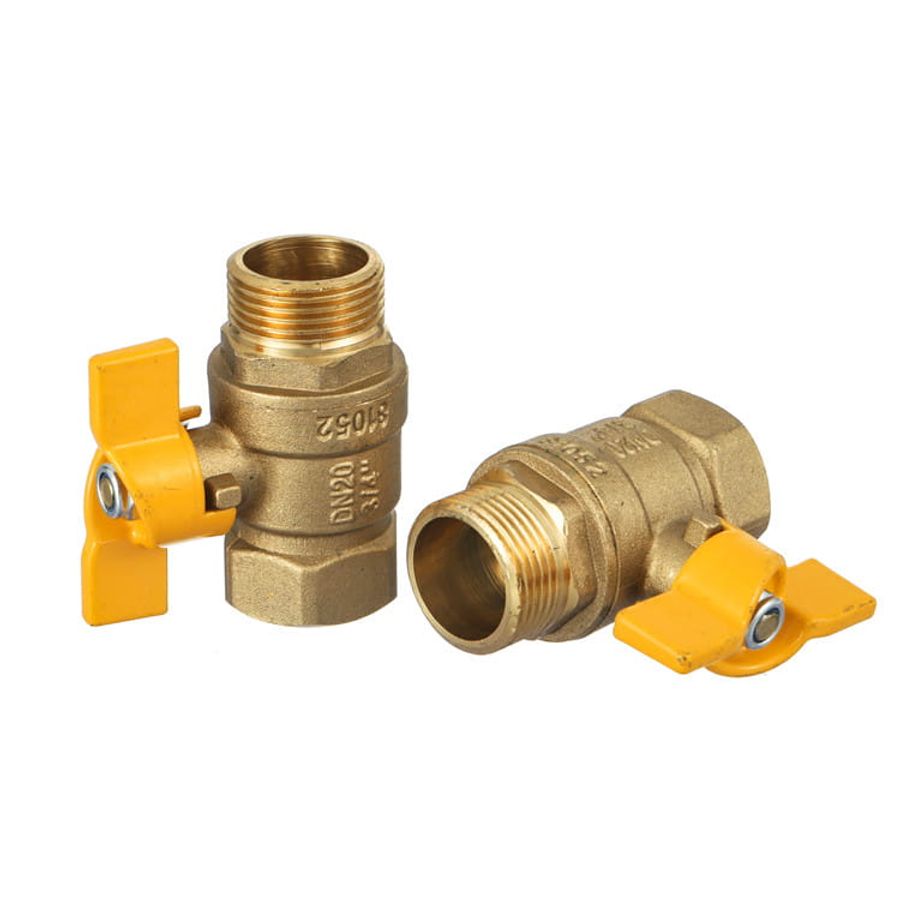
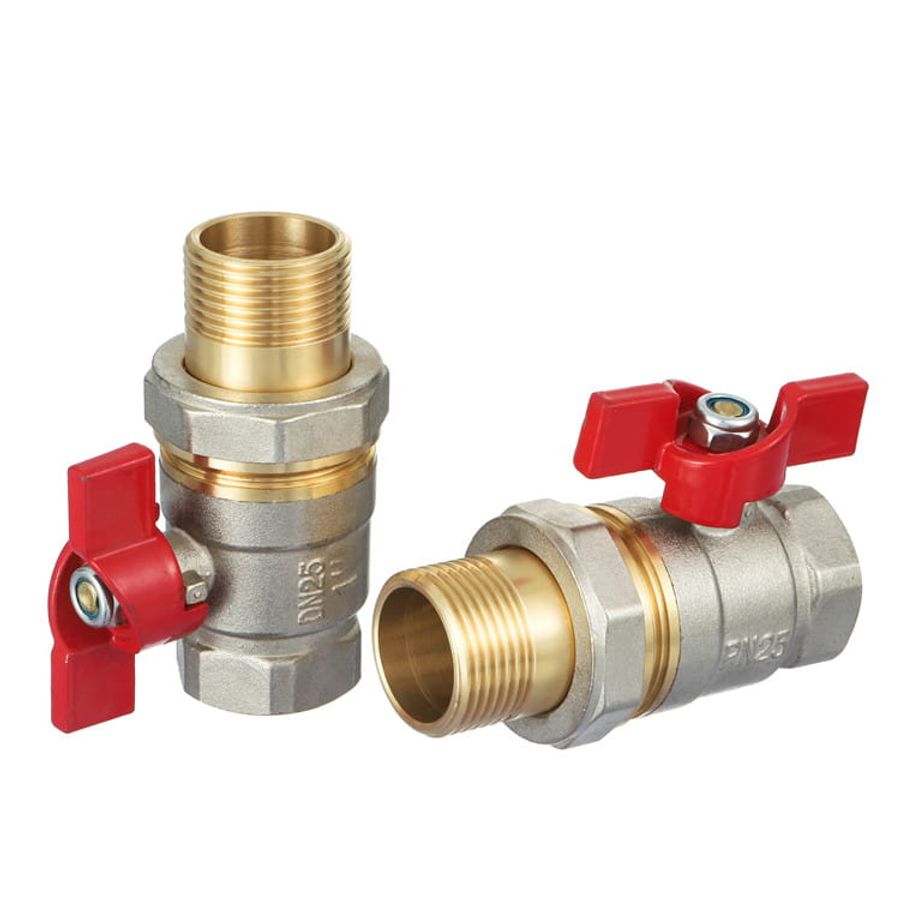
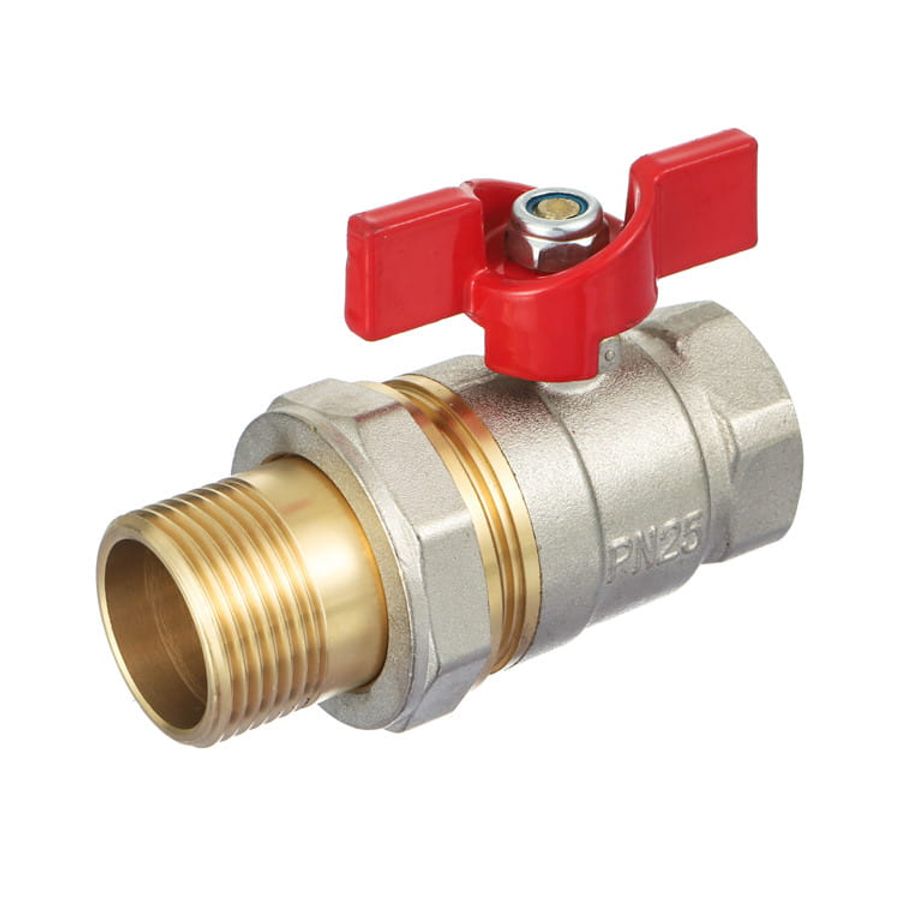
Handles matter too: a lever handle gives fast, obvious on/off and is standard for isolation duty; a butterfly (T-bar) handle is more compact and comfortable for frequent hand operation in tight spaces. IFAN's brass ball valve range covers all of these — FF, FM, and MM in both lever and butterfly handles, plus double-union bodies with a brass core — so one supplier can match every point in a system.
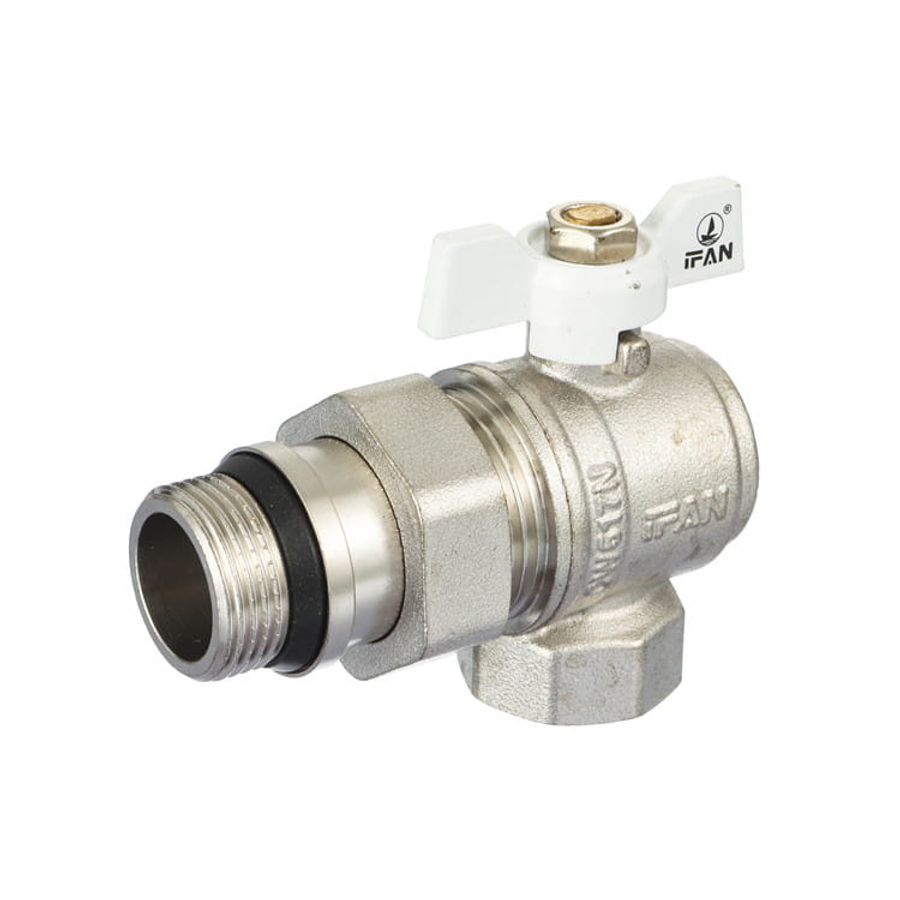
Thread Standards: BSP vs NPT
One detail catches out international buyers more than any other: the thread standard. BSP (British Standard Pipe, used across Europe, the Middle East, Africa, Asia, and Australia) and NPT (National Pipe Thread, used in North America) are not interchangeable — they have different thread angles and pitches, so a BSP valve will not seal correctly on an NPT pipe even where the sizes appear to match. BSP further splits into parallel (BSPP/G) and tapered (BSPT/R) forms. Getting this wrong means a container of valves that won't seal on the destination's pipework. Always state the thread standard on the order — for example "½" BSP parallel" — and confirm it matches the market you're shipping to. A supplier serving multiple regions should offer both BSP and NPT; ask which they're quoting.
Sizes and Pressure Ratings
Brass ball valves span a wide size range — commonly from around DN8 (¼") up to DN100 (4") — covering everything from a small appliance isolation valve to a main-line shut-off. Pressure rating (PN) is the maximum working pressure, and it generally steps down as the valve gets larger. The table shows the typical pattern, but the exact rating depends on the specific valve, so confirm the figure for the model you're quoting rather than assuming.
| Nominal size | Thread (BSP) | Typical PN band |
|---|---|---|
| DN15–DN25 | ½"–1" | Up to ~PN40 |
| DN32–DN50 | 1¼"–2" | ~PN25–PN30 |
| DN65–DN100 | 2½"–4" | ~PN16–PN25 |
Rate the valve to your line's working pressure plus a margin for surge, and remember temperature de-rates pressure — a valve on a hot-water or heating line carries less than its cold rating. Confirm both the pressure and the temperature limit for the exact model.
IFAN Brass Ball Valve — Specifications at a Glance
To make the guidance above concrete, here is the specification of IFAN's brass ball valve range, so you can see exactly what a compliant spec looks like:
| Body alloy | CW617N brass (CuZn40Pb2, 1.6–2.5% Pb) |
| Ball / core | Solid brass core |
| Size range | DN8–DN100 (¼"–4") |
| Pressure rating | PN16 / PN25 / PN40 (by size) |
| Connections | FF, FM, MM, double-union |
| Handles | Lever, butterfly |
| Body process | Forged and cast options |
| Certifications | CE, ACS, WRAS, SASO, potable-water, ISO 9001 |
| MOQ / lead time | No minimum order · ~10-day lead time · stock held year-round |
The differentiator behind those figures is scope: IFAN supplies the complete piping system — PPR, HDPE, and PVC pipe plus the brass fittings and valves that connect them — so a contractor or distributor can source every component of a job from one factory, matched and certified, instead of chasing a valve supplier separately. The no-minimum-order and year-round stock make that practical for small and repeat orders, not just containers.
Standards and Certifications
For a compliant, sellable valve, the paperwork matters as much as the metal. Manufacturing and performance are commonly governed by standards such as EN 13828:2025 (building valves — manually operated copper-alloy and stainless-steel ball valves for potable water in buildings; replaces EN 13828:2003) and the relevant ISO valve standards. On top of that sit market-access and potable-water approvals that vary by destination: ACS (France), WRAS (UK), NSF/ANSI/CAN 61-2024 (North America; December 2025 addendum), SASO/SABER (Saudi Arabia), and CE marking where applicable. For a drinking-water application, structural compliance is not enough — the valve also needs the potable approval for that market. When you buy, specify the standards and approvals you need and ask for the test reports and certificates behind them, not just a claim. A genuine manufacturer provides verifiable documentation; treat an unverifiable "certified" label as unproven. IFAN's brass ball valves carry CE, ACS, WRAS, SASO, potable-water, and ISO 9001:2015 (current edition incl. Amd 1:2024) certification, so a buyer can match the approval to the destination market rather than hunting for a valve that qualifies.
Ball Valve vs Gate, Globe, and Butterfly Valves
A common buyer question is when to use a ball valve versus the alternatives. The short answer: ball valves win for fast, reliable on/off isolation; other valve types win for throttling or very large diameters.
| Valve | Best for | Weakness |
|---|---|---|
| Ball | Fast quarter-turn isolation, drip-tight, durable | Not for throttling/regulating flow |
| Gate | Full-bore isolation on larger lines | Slow multi-turn; seat wears; can seize |
| Globe | Throttling / flow regulation | High pressure drop when open |
| Butterfly | Large diameters, low cost/weight | Less tight shut-off; disc obstructs bore |
For most plumbing, heating, and small-to-medium industrial water lines, the brass ball valve is the default isolation valve because it's fast, sealing, compact, and long-lived. Reach for a globe valve when you genuinely need to regulate flow, and a butterfly when the line is large and cost/weight drive the choice.
Which type of ball valve is better, brass or PVC?
Brass wins on temperature, pressure and mechanical strength — up to about PN40 and 90°C-plus in small sizes, plus gas-rated versions — while PVC wins on price and corrosion immunity for cold water, irrigation, pool and chemical lines below 60°C (140°F). The deciding questions are media temperature and what the valve screws into: PVC valves are solvent-welded or threaded into PVC systems and lose their pressure rating as water warms, exactly like PVC pipe to ASTM D1785-21a; brass valves take repeated make-and-break on threads, survive hot water and heating, and are the only option for gas. Buy PVC for cold, chemical or outdoor irrigation duty; buy brass for anything hot, pressurised above PN10–PN16, or connected to metal, PPR-with-brass-insert or gas pipework.
| Factor | Brass ball valve | PVC ball valve |
|---|---|---|
| Max media temperature (°C) | Typically 90–120 (PTFE seats) | ≈60, with pressure de-rated above 23 |
| Pressure class at 20°C (bar) | PN16–PN40 by size | Typically PN10–PN16 (150 psi class) |
| Media | Water, heating, gas, air, oil | Cold water, irrigation, pool, many acids/bases |
| Connection | BSP/NPT thread, union, press, PPR insert | Solvent socket or plastic thread |
| Cost and weight | Higher; tracks copper price | Lower; light |
| Sources: brass limits per EN 13828:2025 (PN and temperature classes for copper-alloy ball valves) and manufacturer data; PVC limits per ASTM D1785-21a material de-rating (see our PVC vs UPVC vs CPVC de-rating table). Values are typical ranges — confirm on the model data sheet. | ||
Applications by Industry
Brass ball valves appear across a wide range of systems, each with a spec nuance:
- Potable water: isolation at meters, risers, and appliances — specify low-lead/lead-free brass and the market's potable approval.
- Heating / HVAC: isolation on boilers, radiators, and manifolds — mind the temperature de-rating and choose full-port for circulation.
- Gas: gas-rated brass ball valves to the relevant gas standard and approval — never substitute a water valve for gas.
- Irrigation / agriculture: hard-wearing, low-cost isolation, often with lever handles for frequent operation.
- Industrial & compressed air: full-port valves for minimal pressure drop; confirm the pressure and media compatibility.
Need brass ball valves for a project or resale?
Tell us the sizes, connections, and destination market — we'll spec the right alloy, port, and certification.
Request a QuoteHow to Choose the Right Brass Ball Valve
Work through these decisions in order and the specification falls out:
1. Media & market → sets the alloy (potable low-lead, DZR for aggressive water, gas-rated for gas) and the certification.
2. Connection → FF/FM/MM/union to match your pipework and whether the valve must be removable.
3. Size & port → DN to match the line; full-port where flow matters, reduced-port to save cost/space.
4. Pressure & temperature → PN rating above working pressure plus surge, de-rated for hot media.
5. Handle & operation → lever for isolation, butterfly for tight or frequently-operated positions.
Nail those five and you have a complete, unambiguous spec to quote — the same spec that lets a supplier price accurately and stops a cheaper, wrong substitute arriving.
Installation Best Practices
A good valve still fails if it's installed badly. Seal threaded connections with PTFE tape or a suitable thread sealant, and tighten to seat firmly without over-torquing the brass, which can distort the body. Support the pipework so the valve doesn't carry pipe weight or bending load. Leave room to swing the handle fully to both stops. On a new line, flush debris before commissioning — grit dragged across the ball scores the seats and starts a weep. For a double-union valve, the union nuts let you remove the valve for service without cutting the pipe; snug them properly against their gaskets. Finally, cycle the valve fully open and shut after installation to confirm free, complete operation before pressurising.
Common Failures and Troubleshooting
Weeping at the stem: worn or dried stem O-rings/packing — the most common age-related leak. On a quality valve the gland can sometimes be re-tightened; otherwise replace.
Not sealing fully shut: seat wear or debris on the ball — grit scoring is usually the cause; flush and inspect, replace if the PTFE seats are damaged.
Stiff or seized handle: a valve left in one position for years, or a poorly-finished or soft ball that has corroded/stuck — a reason to choose a hard, well-finished sealing ball and to cycle isolation valves occasionally.
Body porosity or cracking: dezincification in aggressive water, or casting voids under pressure — the case for DZR brass and forged bodies. A body leak is a replace, not a repair.
What are the common problems with brass valves?
The five recurring problems are stem weeping from worn packing, seat leakage from grit-scored balls, seized handles after years unused, dezincification cracking in soft or chloride-rich water, and lead leaching from non-low-lead alloy on drinking-water lines. Each has a specification fix rather than a maintenance fix:
- Stem weeping → specify a blow-out-proof stem with double O-rings and an adjustable gland.
- Seat leakage → chrome-plated or solid brass ball with virgin PTFE seats, and a strainer upstream on dirty lines.
- Seized handle → hard-finished ball, and cycle isolation valves once or twice a year.
- Dezincification → DZR brass (CW602N) tested to EN 13828:2025 for soft, acidic or high-chloride water; see CW617N vs DZR vs lead-free.
- Lead leaching → low-lead or lead-free alloy certified to NSF/ANSI/CAN 61-2024 (or WRAS/ACS) for potable duty.
- Body cracking → forged rather than cast body, and no over-tightening on tapered threads; see forged vs cast brass valves.
Maintenance, Lifespan, and Options
A quality brass ball valve is close to maintenance-free — there's no diaphragm to perish and nothing to lubricate in normal service. The one useful habit is to cycle isolation valves fully open and shut once or twice a year: a valve left untouched for a decade can stiffen, and exercising it keeps the ball and seats free. Correctly specified and installed, a brass ball valve routinely lasts the service life of the pipework — decades — which is why the upfront choice of alloy, body process, and seat quality matters more than any ongoing maintenance.
Two options are worth knowing for B2B specs. A lockable handle (padlock hole in the lever) lets you lock a valve open or shut — useful for safety isolation and tamper prevention. An actuated ball valve replaces the manual handle with an electric or pneumatic actuator for remote or automated on/off, common in plant and building-management systems; the valve body is the same, so the sizing and alloy logic above still applies. If your project needs either, confirm the manufacturer offers the matching handle or actuator mounting.
What Separates a Good Valve From a Cheap One
Two brass ball valves can look identical and perform very differently. The quality markers: a hard, well-finished sealing ball — solid brass or chrome-plated, not plated pot-metal; a genuine PTFE seat; a blow-out-proof stem with proper O-ring sealing; and honest wall thickness and weight — a suspiciously light valve is usually thin-walled or made of downgraded alloy. On a bulk order the single most important process marker is whether every valve is 100% air-tightness tested before it ships, not just spot-checked. Ask the supplier to state their test pressure and whether testing is per-piece or sampled — a factory confident in its product tests every unit.
Price: What Actually Drives Cost
Brass ball valve pricing tracks a few real variables, and an unusually cheap quote almost always means one of them was cut. The biggest driver is the brass itself — copper is a traded commodity, so valve prices move with the copper market, and a price well below the pack usually means downgraded or recycled alloy, or a thinner, lighter body using less metal. Beyond the metal: forged vs cast (forging costs more but is stronger), full vs reduced port (more brass in a full-port), certification (real ACS/WRAS/NSF testing has a cost), and order volume (bulk lowers unit price). Compare quotes on the same alloy, port, pressure rating, and certification — a lower per-unit price for a downgraded spec isn't a saving, it's a different product. Factor freight and duties into a landed cost, since copper-alloy valves are dense and ship heavy.
How much does a 2 inch brass ball valve cost?
At US retail a 2-inch (DN50) threaded full-port brass ball valve runs about US$55–100 each in September 2026: roughly $55 for a PN16 non-lead-free import, $70 for a lead-free full-port valve, and about $98 for a forged 600 WOG valve built to MSS SP-110. Wholesale and factory-direct prices are set per container on the copper price of the day, the alloy (CW617N vs DZR vs lead-free), port size and the certification bundle, so a quote is always lower than the figures below — but the spread between a thin-walled PN16 valve and a forged, certified one is the same in every market.
| Valve | Price (USD) | Rating | Lead-free | Seller |
|---|---|---|---|---|
| Nickel-plated brass, full port, 2" FNPT | 55.05 | PN16 (232 psi) | No | Irrigation King |
| Brass FIP × FIP, full port, 2" | 69.67 | Not stated on listing | Yes (LF model) | The Home Depot |
| Forged brass 2-piece, full port, chrome ball, PTFE seats, 2" NPT | 98.32 | 600 WOG / 150 WSP, MSS SP-110 | Not stated | PPR Supply |
| Sources: irrigationking.com, homedepot.com, pprsupply.com; all retrieved 2026-09-03, single-unit retail, pre-tax. Brass prices track the copper market, so re-check before budgeting. | ||||
For project or distributor quantities, send the DN50 spec — alloy, port, PN, thread standard and destination certification — and get factory-direct pricing on the IFAN HVAC valve range.
How to Vet a Brass Ball Valve Manufacturer
For a wholesale or OEM order, the supplier matters as much as the valve. Confirm they actually manufacture rather than resell: ask whether they forge and machine in-house, and request a look at the production line and the air-tightness test station. Pin down the specification in writing — alloy, port, pressure rating, connection, handle, and the certification your market requires — and ask for the test reports behind those claims, not just a logo. Clarify MOQ, lead time, OEM/branding capability, and whether they hold stock for repeat orders. Test their responsiveness with a detailed technical question before you commit; the quality of the answer previews the support you'll get as a customer. A real manufacturer answers all of this readily — vagueness or "trust us" is the warning sign. IFAN, for instance, forges and machines brass valves in-house, holds CE/ACS/WRAS/SASO certification, imposes no minimum order, ships in around 10 days from year-round stock, and supplies the matching PPR, HDPE, and PVC pipe so the whole system comes certified from one source.
Frequently Asked Questions
What brass is used for ball valves?
The common European standard body alloy is CW617N, a hot-forging brass. For soft or aggressive water, ask for a dezincification-resistant (DZR) brass such as CW602N; for drinking water, specify a low-lead or lead-free brass that meets your market's potable standard. "Brass" alone isn't a spec — always confirm the alloy grade.
Is a forged brass ball valve better than cast?
For pressure duty, yes. Forging presses solid brass into a dense, void-free body that resists pressure and stress; casting can leave porosity that becomes a leak path. Ask the manufacturer which process they use — a factory that forges in-house will tell you directly.
What do FF, FM, and MM mean on a ball valve?
They describe the thread ends. FF is female × female (both internal threads), FM is female × male (one of each), and MM is male × male (both external). Double-union valves add union nuts so the valve can be removed without cutting the line. Match the connection to your pipework before sizing.
Can a brass ball valve be used to throttle flow?
No — it's an isolation valve, meant to be fully open or fully shut. Holding it part-open wears the seats unevenly and erodes the ball over time. For flow regulation use a globe valve; use the ball valve for fast, drip-tight on/off.
How can I tell a quality brass ball valve on a bulk order?
Look for a hard, well-finished sealing ball (solid brass or chrome-plated), a genuine PTFE seat, a blow-out-proof stem, honest wall thickness/weight, and — most important at volume — 100% per-piece air-tightness testing rather than spot checks. Ask the supplier for their test pressure and the certification test reports.
Explore the Brass Ball Valve Cluster
This guide is the hub. For the detail behind each decision, see the focused articles in the cluster: brass ball valve sizes & pressure chart, forged vs cast brass valves, brass ball valve vs gate valve, CW617N and lead-free brass explained, brass ball valve connection types, and how to source a brass valve manufacturer. (Spoke articles link back here as they publish.)