
The Complete Guide to HDPE Pipe (PE100): Grades, SDR, Jointing & Sourcing
HDPE pipe decisions come down to three things: which resin grade you're buying, which SDR (wall-to-diameter ratio) matches your pressure, and how the joints are fused. Get those right and you have a corrosion-free, leak-free pressure line rated for 50+ years, buried or exposed, for water, gas, mining or irrigation. Get any of them wrong and you've either overpaid for wall you didn't need or under-specified a main that fails under surge. This guide covers all three — plus fittings, applications, standards and sourcing — and links down to the detailed guide for each.
The single idea that anchors it: HDPE is a fully fused system with no threads and no gaskets on the main line. A correct butt-fusion or electrofusion joint is as strong as the pipe itself, which is exactly why HDPE dominates buried water and gas networks where you can't afford a joint to fail underground.

Key Takeaways
- PE100 is the current standard — MRS 10 MPa vs 8 MPa for older PE80, so it holds 25% more pressure at the same wall or a bigger bore at the same rating.
- SDR = OD ÷ wall. Lower SDR means a thicker wall and higher pressure — PE100 SDR11 ≈ PN16, SDR17 ≈ PN10.
- Sizes run DN20 to DN1600; up to DN90 ships in coils, DN110+ in straight lengths.
- Two joint methods: butt fusion (DN90+, heater plate ~210–240°C) and electrofusion (smaller sizes, tight spaces, coil fittings).
- HDPE is flexible, corrosion-free and fully fused — its edge over PVC and metal on buried mains, gas and long runs.
- Governing standards: ISO 4427 (water), EN 12201, DIN 8074, plus gas and regional certs.
- Buy on genuine PE100 resin with a batch certificate — grade and SDR are where quotes get gamed.
What HDPE Pipe Is
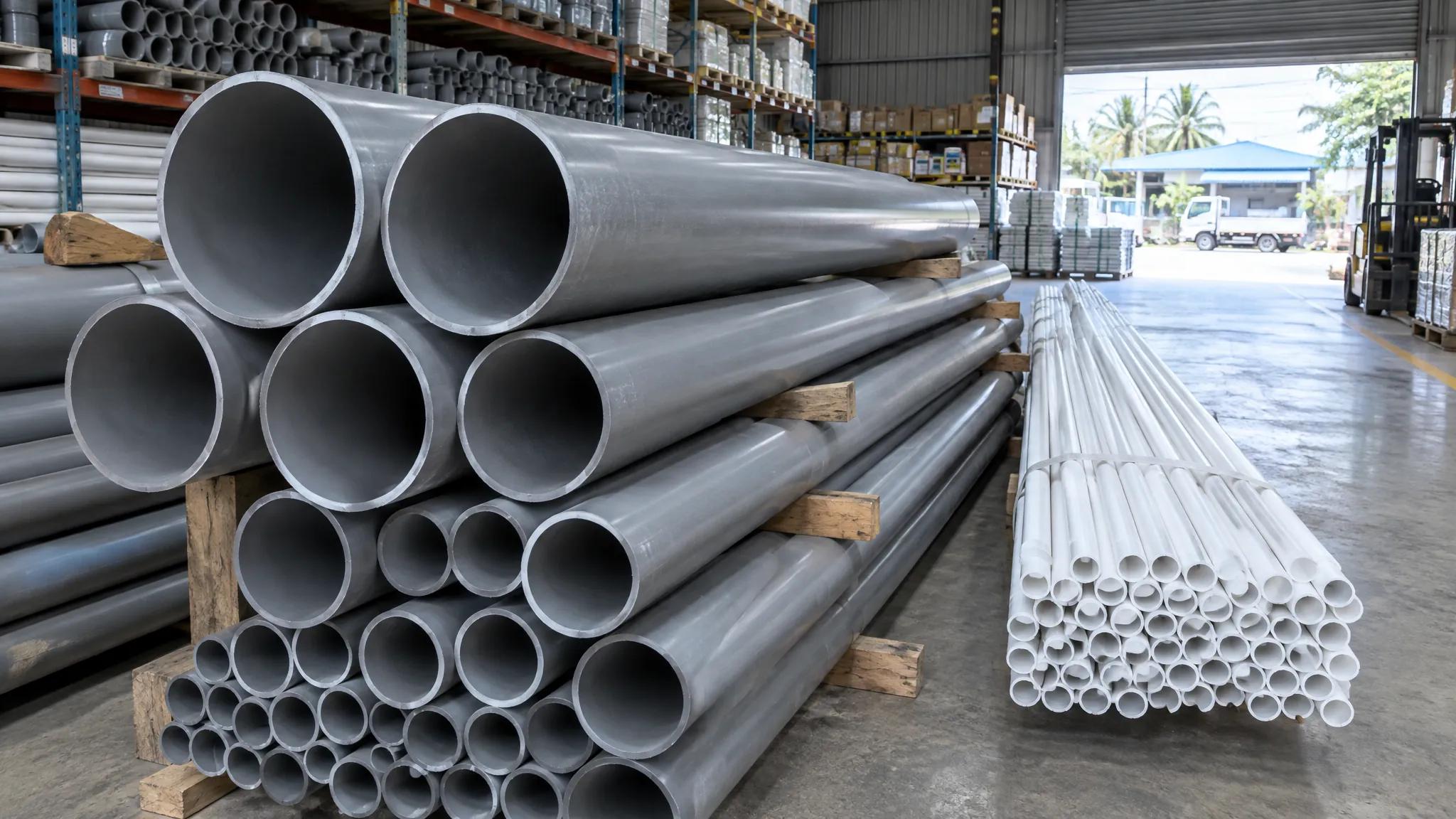
HDPE stands for high-density polyethylene — a tough, flexible thermoplastic drawn from PE100 (or older PE80) resin. It's the black pipe, usually with coloured stripes that code the service: blue stripe for potable water, yellow for gas, sometimes plain black for general or drainage use. Road and driveway cross-drains are their own discipline — materials, cover depths, and sizing live in the culvert pipe guide. Unlike rigid PVC or metal, HDPE flexes: it bends around obstacles, absorbs ground movement and water-hammer surge, and tolerates a freeze far better than brittle materials. It doesn't corrode, rust, scale or support biofilm the way metal does, and it carries a 50-year-plus design life at rated conditions.
Two practical traits shape how you buy it. First, smaller sizes coil, so a single DN20–DN90 coil can run 50–200 m with zero joints — a huge advantage for trenched water and irrigation lines. Second, HDPE has no threaded joints on the main; it's fused, so the network is effectively one continuous pipe. Those two facts are why it became the default for buried municipal water and gas. Beyond flexibility, HDPE brings a few properties that matter on demanding jobs: high impact resistance even in cold weather (it won't shatter like PVC when dropped in a winter trench), strong abrasion resistance that suits mining slurry and sand-laden water, broad chemical resistance to most soils and effluents, and a smooth bore that keeps friction low and resists scaling over decades. As with any polymer pipe, the properties only hold if the resin is genuine — recycled or off-grade PE fails the long-term pressure test, which is why the grade and its certificate matter more than anything else on the quote.
PE100 vs PE80: The Resin Grade
The resin grade is the first thing to pin down, because it sets everything downstream. The grade number is the material's Minimum Required Strength (MRS) in MPa: PE100 has an MRS of 10.0, PE80 of 8.0. That 25% difference means PE100 either holds 25% more pressure at the same wall thickness, or delivers the same pressure with a thinner wall — a larger bore, more flow, and often less resin per meter.
| Grade | MRS | Relative strength | Where it fits |
|---|---|---|---|
| PE100 | 10.0 MPa | Highest (current standard) | All new water & gas mains |
| PE80 | 8.0 MPa | Lower, older grade | Legacy, small-diameter, some gas |
| PE-RT | Raised-temperature PE | Better hot performance | Hot water, underfloor heating |
For any new municipal or industrial project, specify PE100 — PE80 mostly survives in legacy replacements and some small-diameter runs. The full grade breakdown, including where PE-RT fits, is in the PE100 vs PE80 comparison.
Sizes, SDR and Pressure Rating
HDPE isn't classed by a simple PN wall like PPR — it's classed by SDR, the Standard Dimension Ratio, which is the outer diameter divided by the wall thickness. A lower SDR means a proportionally thicker wall and a higher pressure rating; a higher SDR means a thinner wall and lower rating. The pressure follows the ISO 4427/12162 formula, P = (20 × MRS) ÷ [C × (SDR − 1)] in bar, where MRS is the resin strength and C is the design coefficient (typically ≥1.25 for water). You don't need to run the math on site — you need to know that SDR and grade together set the pressure.
| SDR (PE100) | Pressure (water) | Wall | Typical use |
|---|---|---|---|
| SDR26 | PN6 (6 bar) | Thin | Low-pressure, gravity, irrigation |
| SDR17 | PN10 (10 bar) | Medium | Transmission mains ≤10 bar |
| SDR11 | PN16 (16 bar) | Thick | Distribution networks, gas |
| SDR9 | PN20 (20 bar) | Thickest common | High-pressure, pumped mains |
One thing not to do is chase the thinnest SDR that "meets" the working pressure. Real networks see surge — the pressure spike when a pump starts or a valve slams shut — and repeated surge fatigues a wall that's sized only for steady pressure. HDPE tolerates surge better than most materials, but on pumped mains it's normal to step to a lower SDR (thicker wall) than the static pressure alone would suggest, giving margin for transients and a longer fatigue life. That headroom is cheap compared to digging up a fatigued main. Diameters run from DN20 to DN1600. A key logistics point: up to DN90 the pipe is flexible enough to ship in coils of 50–200 m, which cut joint counts dramatically on trenched lines; DN110 and above come in straight 6 m or 12 m lengths. The full DN/SDR/wall chart is in the HDPE pipe size and SDR guide.
Coils vs Straight Lengths: Form, Handling and Container Loading
How HDPE is supplied changes your install economics and your shipping, so it's worth planning before you order. Up to about DN90, the pipe is flexible enough to wind onto coils — commonly 50, 100 or 200 m per coil. A coiled run means one continuous pipe with almost no joints across a trench, which is the single biggest labor saving HDPE offers on water and irrigation lines. From DN110 upward the pipe is too stiff to coil economically and ships in straight lengths, usually 6 m or 12 m.
That split drives container planning. Coils nest and load densely, so small-diameter orders ship efficiently; straight lengths of large-diameter pipe are volume-heavy and load light for their weight, so a 40ft container fills on cubic space long before it hits weight. If you're importing, confirm coil length and how many coils or lengths load per container up front — it's the difference between a full container and paying to ship air. Longer coils cut joints but are heavier and harder to handle by hand, so match coil length to how the crew will move it on site.
Colors, Stripes and Markings
HDPE is base black — the carbon black in the compound is what gives it UV resistance for above-ground and exposed runs — with coloured stripes that code the service. Blue stripes mean potable water, yellow means gas, and plain black or other colours cover general, drainage or cable-duct use. The stripe is a field convention that lets crews and inspectors identify a buried line's duty at a glance, so order the correct stripe for the application, not just "black pipe."
More important than colour is the printing along the pipe. A compliant HDPE pipe prints its own spec: manufacturer, material grade (PE100), diameter, SDR or pressure class, the standard it meets (ISO 4427, EN 12201), a batch or date code, and usually meter markings. That printed line is your first quality check — match the grade and SDR against your order, and treat faint or missing markings as a red flag, because reputable factories print clearly for traceability.
Jointing: Butt Fusion vs Electrofusion
HDPE is joined by fusing the polyethylene itself — no glue, no threads on the main. Two methods dominate, and choosing between them is mostly about diameter and site conditions.
| Method | How | Best for |
|---|---|---|
| Butt fusion | Heater plate ~210–240°C melts both ends, then presses them together | DN90 and up, long straight runs, lowest fitting cost |
| Electrofusion | Current heats a coil embedded in the fitting (~190–240°C) | Smaller sizes, repairs, tight or hard-to-align spaces |
Butt fusion is the workhorse for mains: no fitting cost beyond the machine time, and a joint as strong as the pipe. The sequence is disciplined — clamp and align both ends in the machine, face them square with the trimmer, heat both against the plate at ~210–240°C for the time set by wall thickness, withdraw the plate and press the ends together at the specified force, then hold under pressure until the joint cools fully before unclamping. Skip the cooling hold or misalign the ends and you get a weak or beaded joint; that's why fusion is done by trained operators to a logged procedure. Electrofusion costs more per joint (you buy a coil fitting each time) but needs far less alignment room and skill, which makes it the default for repairs, connections in trenches, and anything under DN90. The full step-by-step with fusion pressures and the mistakes that ruin a weld is in the HDPE butt fusion guide, and the method-by-method decision is in butt fusion vs electrofusion.
HDPE Fittings
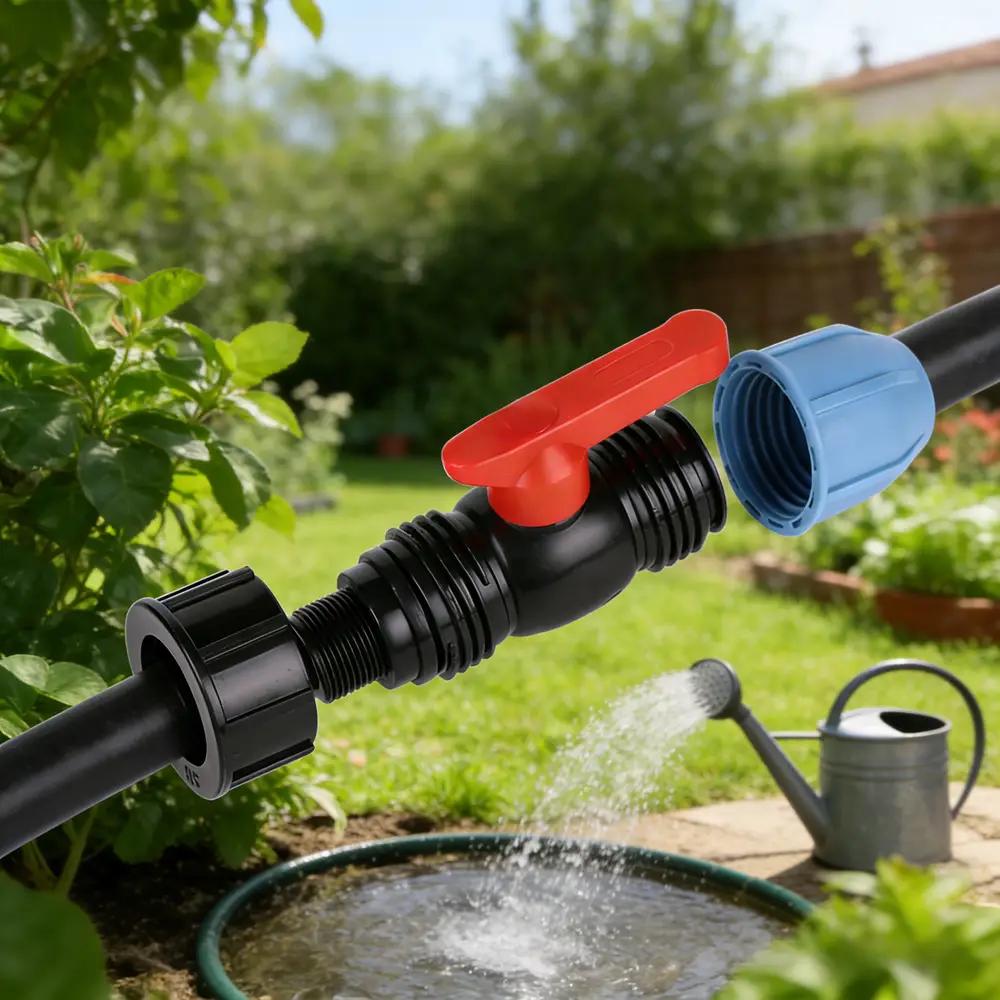
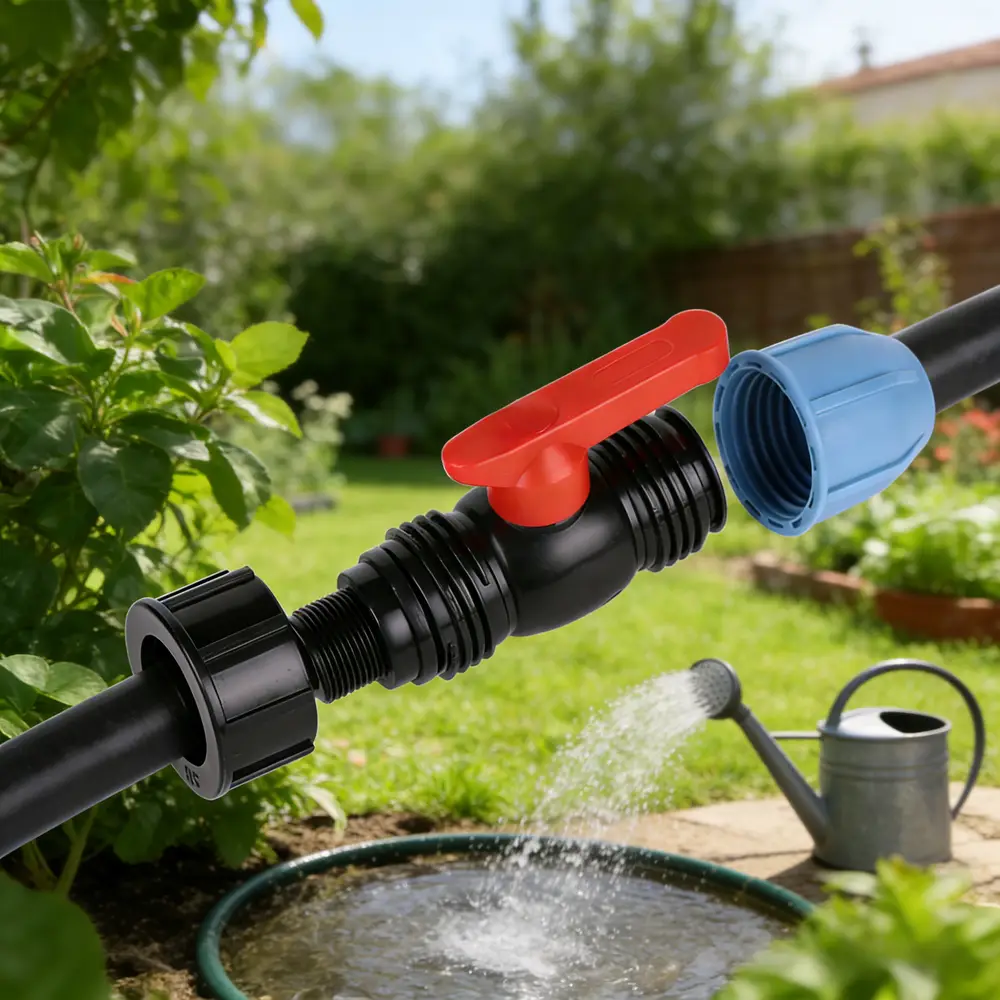
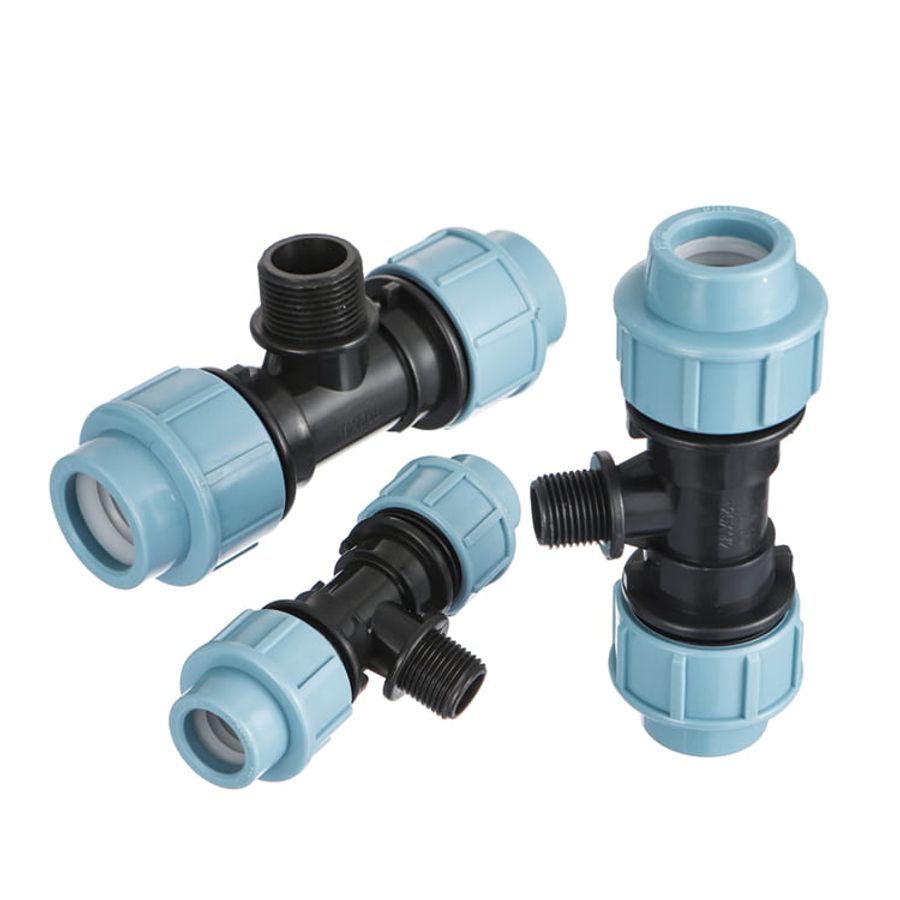
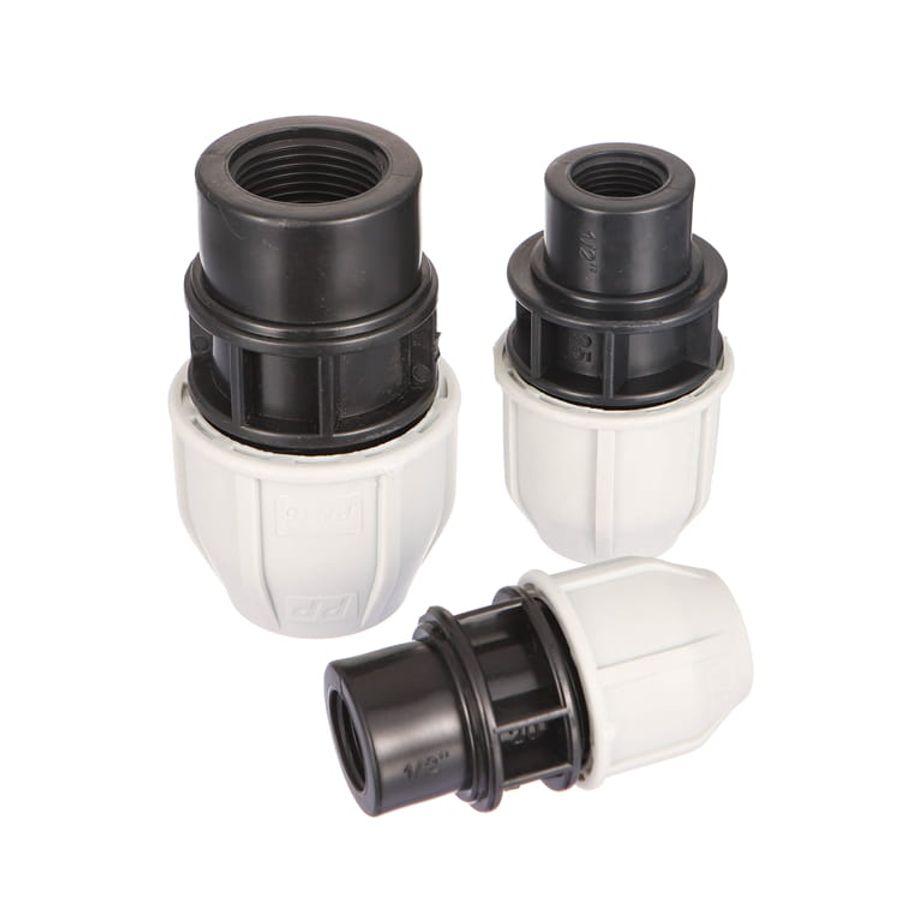
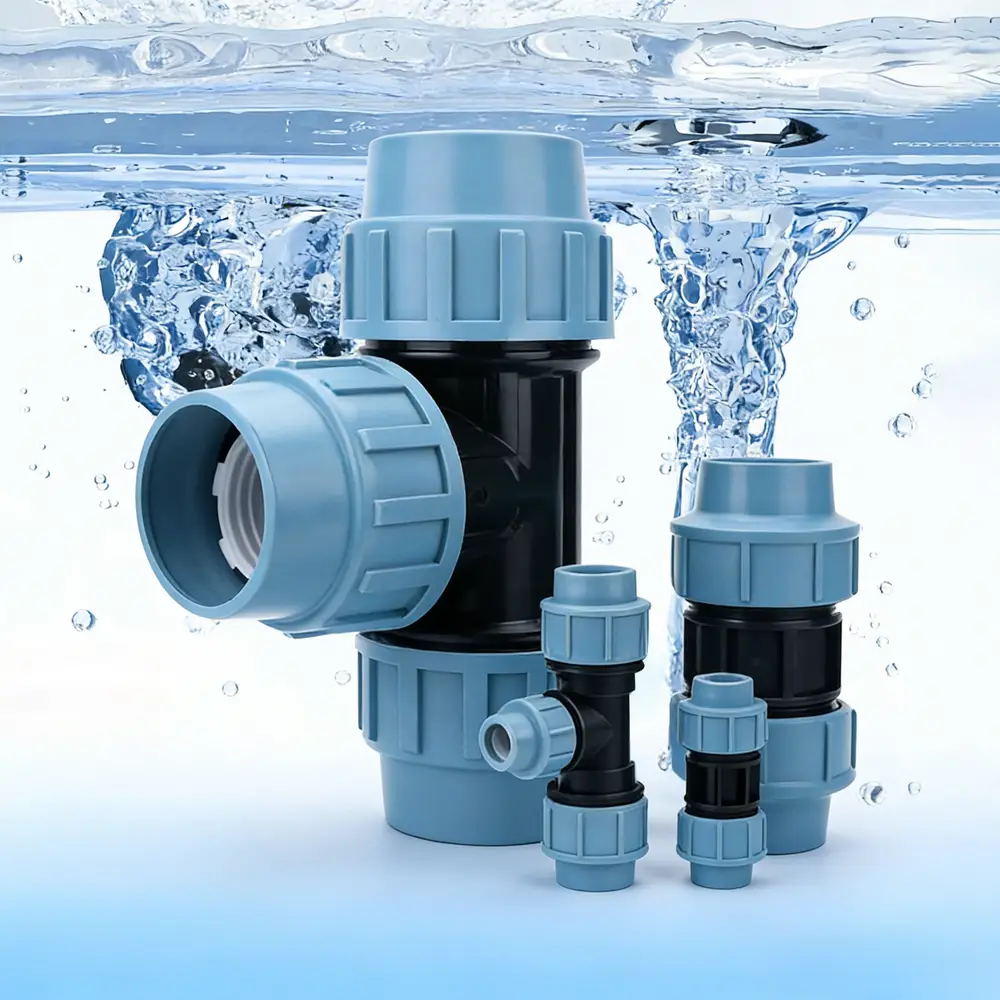
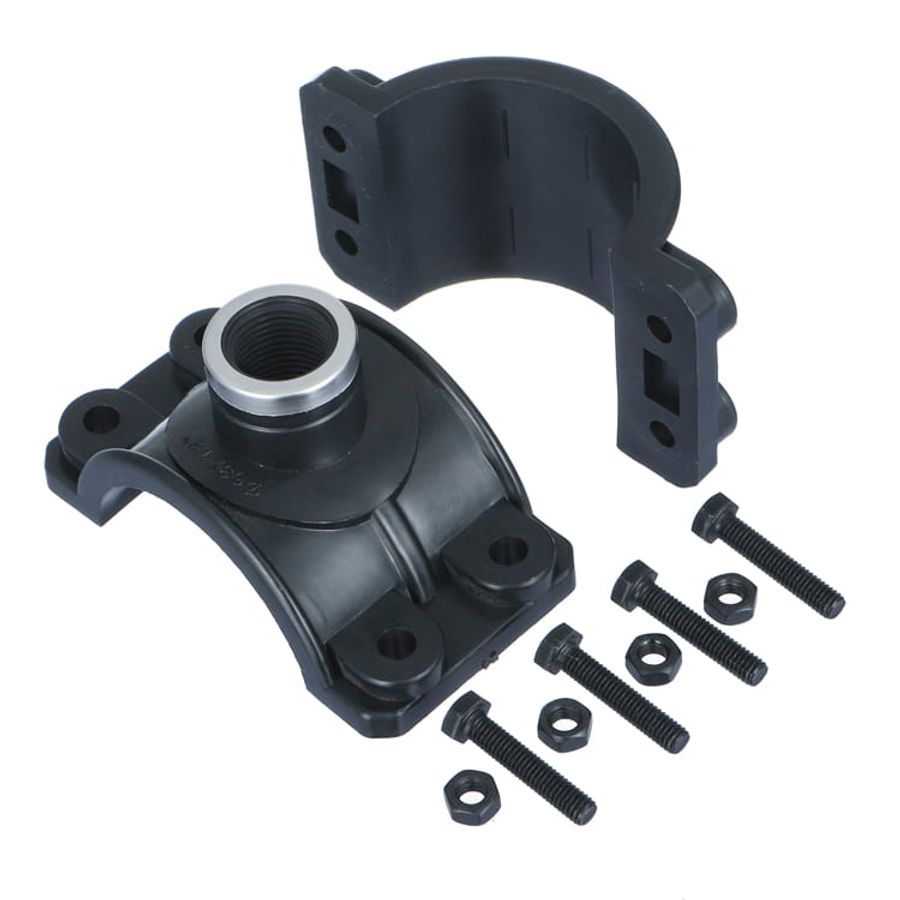
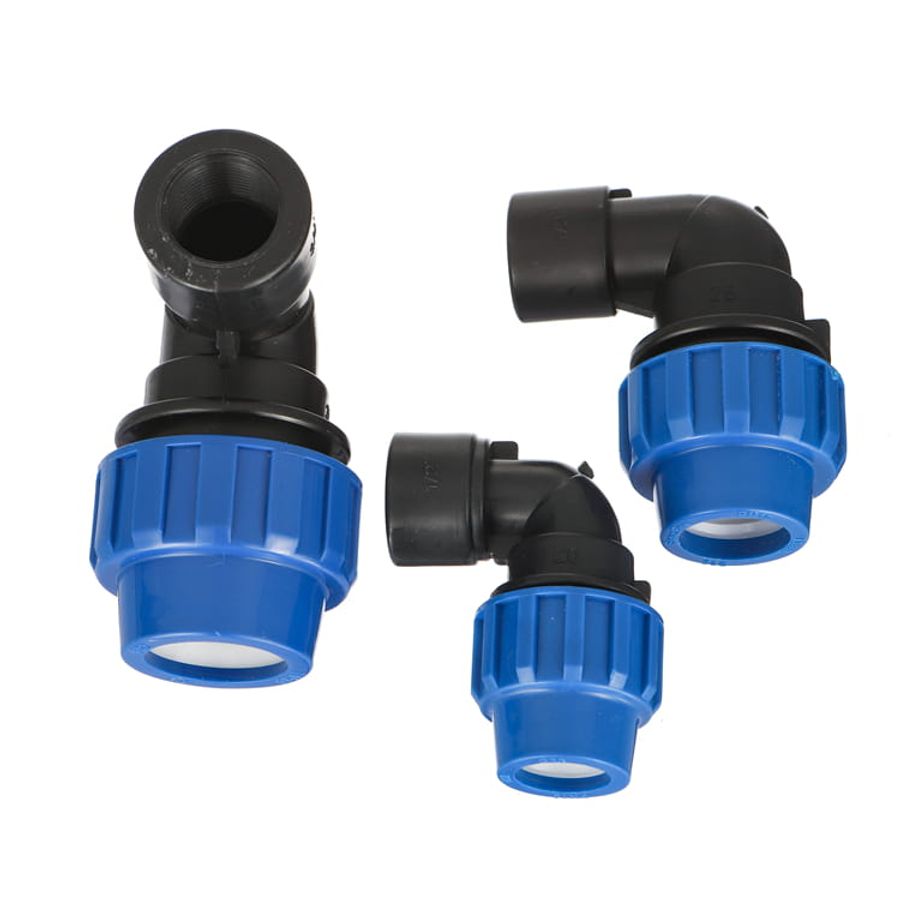
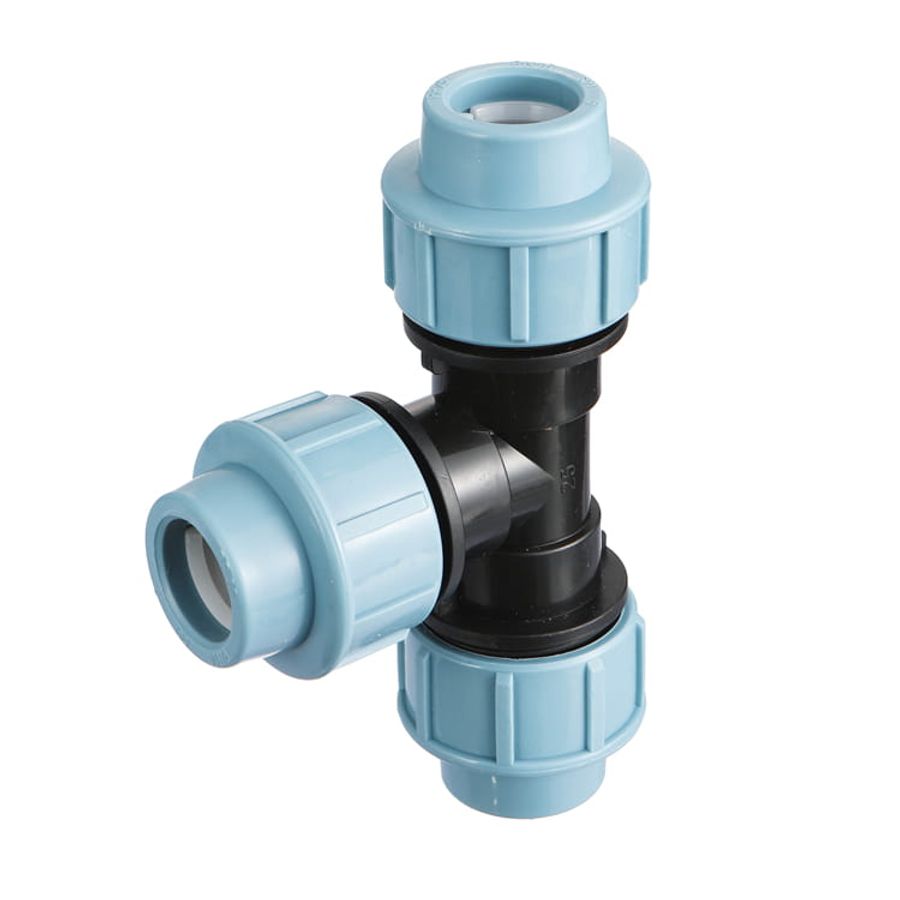
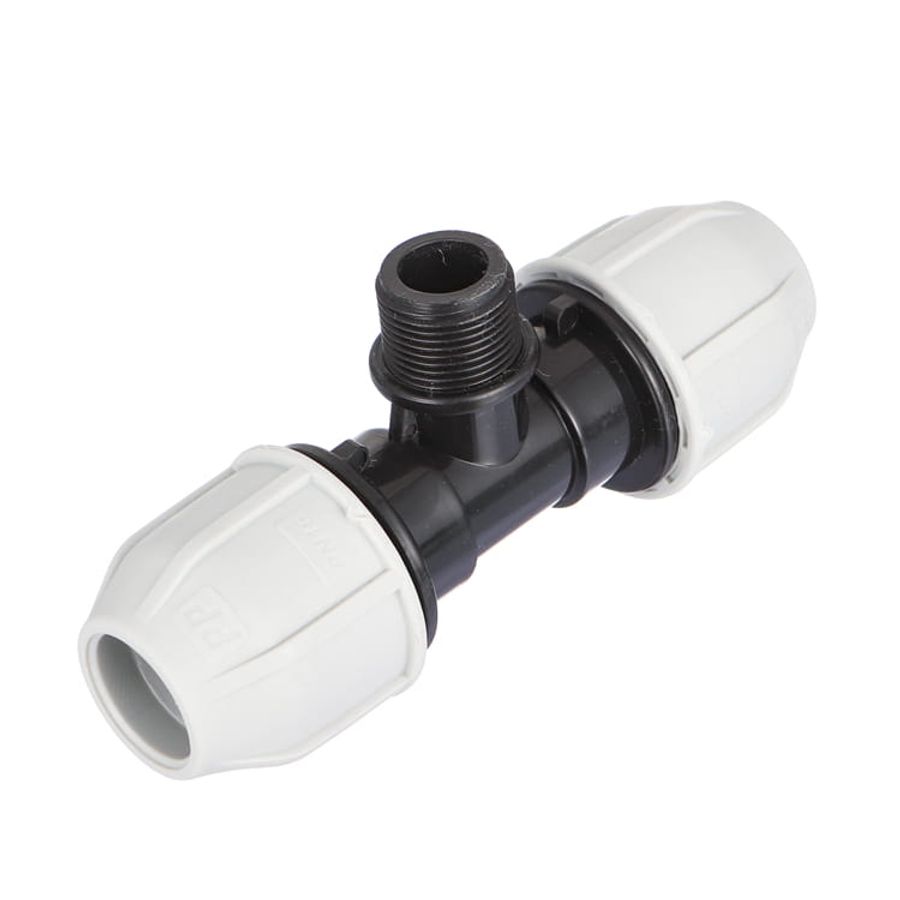
Fittings follow the joint method. Butt-weld fittings (elbows, tees, reducers, end caps) are fused directly with the same machine as the pipe. Electrofusion fittings (couplers, elbows, tees, tapping saddles) carry the embedded heating coil. Where HDPE meets a valve, pump, or a metal or PVC line, you transition with a flange adapter (stub end plus backing ring) or a threaded/compression fitting. Compression fittings need no fusion tool at all, which makes them popular for small-diameter irrigation and quick field connections.
| Fitting type | How it joins | Best for |
|---|---|---|
| Butt-weld (elbow, tee, reducer, cap) | Fused with the butt machine | DN90+ mains, lowest fitting cost |
| Electrofusion (coupler, saddle, elbow) | Embedded coil, current-heated | Small sizes, repairs, tight spaces |
| Compression | Mechanical, no tool needed | Small-diameter irrigation, field ties |
| Flange adapter (stub + backing ring) | Bolted flange face | Transitions to valves, pumps, metal/PVC |
The rule that catches importers: fittings must match the pipe's grade and SDR, and electrofusion couplers must match the pipe OD precisely. The full roster and how to spec them is in the HDPE fittings guide, with the cost trade-offs in compression vs electrofusion vs butt-weld.
HDPE vs PVC and PPR: When HDPE Wins
HDPE, PVC and PPR overlap but each owns different ground. PVC is rigid, cheap, and joins with solvent cement or rubber-ring sockets — fine for buried cold water and drainage, but brittle and prone to joint pull-out under ground movement. PPR is the specialist for in-building hot and cold water, heat-fused at every joint. HDPE's territory is the buried, the long, and the moving: water and gas mains, where its flexibility absorbs ground shift and its fused joints never pull apart.
| Trait | HDPE | PVC | PPR |
|---|---|---|---|
| Flexibility | High (coils, bends) | Rigid | Rigid |
| Joint | Fused (butt/electro) | Solvent / ring socket | Heat fusion |
| Hot water | No (cold/ambient) | No | Yes (to 95°C) |
| Best role | Buried water/gas mains | Cold supply, drainage | In-building hot & cold |
In short: HDPE for what's buried and pressurized, PPR for hot water inside the building, PVC for cold and drainage on a budget. For the in-building side, see the complete PPR pipe guide and PPR vs PVC vs PEX.
HDPE vs Ductile Iron and Steel for Buried Mains
On large buried mains the real contest is often HDPE against ductile iron or steel, and it's worth knowing why utilities keep switching to HDPE. Metal mains corrode from the inside and outside, need cathodic protection and lining, and join at gasketed or welded joints that can leak, pull apart under ground movement, or corrode at the joint. Each metal joint is also a potential leak path — and on a long main that's a lot of joints.
HDPE removes most of that. It doesn't corrode, so no lining or cathodic protection; it flexes with ground movement and seismic action instead of cracking; and its fused joints are as strong as the pipe, effectively eliminating joint leakage across the network. The trade-offs are honest: metal handles higher pressures and temperatures at large diameters, and it resists point loads better, so pressurized transmission at very high heads or certain industrial duties still favour steel. But for the bulk of municipal water distribution, HDPE's leak-free fused network and zero-corrosion life win on total cost — which is exactly why it has become the default for new and replacement mains across Africa, the Middle East and Asia.
Where HDPE Is Used
HDPE's combination of fused joints, flexibility and corrosion resistance puts it across most buried and industrial pipework. The common thread is that these are jobs where a leak is expensive to reach — underground, across a field, down a mine, or under a road — so a fully fused, joint-leak-free network pays for itself. The main applications:
- Potable water mains and distribution — the core use; blue-stripe PE100, coiled up to DN90.
- Gas distribution — yellow-stripe pipe to gas-grade PE, where a leak-free fused network is safety-critical.
- Mining and slurry — abrasion resistance and flexibility suit tailings, dewatering and process lines.
- Irrigation and agriculture — long coiled runs with minimal joints across fields.
- Cable and telecom duct — smooth bore and flexibility for pulling cable.
- Sewer, drainage and outfalls — corrosion-free under aggressive effluent.
Where HDPE Fits Best — and Where It Doesn't
Best for
- Buried pressure mains — water and gas, where fused joints and flexibility beat every rigid alternative.
- Long trenched runs — coiled small diameters slash joint counts and install time.
- Ground movement, seismic and marine — it flexes instead of cracking, and can even be floated and sunk for outfalls and submerged crossings.
Not the best choice for
- Hot water inside buildings — that's PPR or PE-RT territory; standard HDPE is for cold/ambient.
- Exposed to long-term UV without carbon-black protection — spec UV-stabilized pipe for above-ground runs.
- Jobs with no fusion equipment — butt/electrofusion needs machines and trained operators; on small jobs, budget for compression fittings or hired fusion gear instead.
Standards and Certifications
HDPE water pipe is governed internationally by ISO 4427 (polyethylene for water supply), with EN 12201 as the European equivalent and DIN 8074/8075 for dimensions and testing. Gas pipe follows its own standards (such as ISO 4437 / EN 1555). On top of these sit third-party test reports (SGS, BV) and any regional or utility approval your market needs — WRAS in the UK, plus SASO, SONCAP, NOM and others by destination.
Requirements vary by product, application and market, so confirm the exact standard and approval your project needs with the utility or a customs broker before ordering — a compliant pipe can still be rejected for a missing local approval. Ask the supplier which certificates they hold in the manufacturing entity's own name.
Sourcing HDPE Without Getting Burned
The sourcing traps mirror any polymer pipe, with an HDPE twist. Grade fraud is the big one: pipe sold as "PE100" that's actually PE80 or a recycled blend looks identical but fails the long-term pressure rating. The second is SDR shaving — a thinner wall than the stated SDR, which quotes cheaper and bursts under surge. Defend with a short routine before any deposit:
- Demand a PE100 material certificate and third-party test report per batch — not a generic brochure.
- Confirm OD and wall against the SDR in writing, and check weight per meter — a light pipe means a shaved wall.
- Verify the maker is a real factory, not a reseller — the same checks as any pipe, covered in how to verify a real manufacturer.
HDPE price, like all polyolefin pipe, is driven mostly by resin, so compare per kilogram of genuine PE100 rather than per meter — the same logic laid out in the pipe price breakdown.
A Buyer's Scenario, Start to Finish
Say you're supplying a municipal water distribution project in West Africa. You'd specify PE100 throughout, blue-stripe for potable use. The distribution network at 16 bar takes SDR11 (PN16); the longer transmission mains at 10 bar take SDR17 (PN10) to save resin where the pressure allows. You'd order DN63 and smaller in coils to cut trench joints, DN110+ in 12 m lengths for the mains, butt-fusion the large diameters on site and electrofusion the tie-ins and repairs. Before paying, you'd get a PE100 batch certificate and third-party report, confirm wall-per-SDR and weight-per-meter, check the supplier's business license and the destination's water approval, and order samples. That single disciplined pass — grade, SDR, jointing, sourcing checks — is what keeps a buried network leak-free for its full 50-year life.
Conclusion
HDPE earns its place on buried and pressurized lines by being flexible, corrosion-free, and fully fused — but it only delivers when the resin is genuine PE100, the SDR matches the pressure, and the joints are fused correctly. Everything else, from fittings to certifications to price, follows from those three.
Use this guide as the overview and the linked deep-dives for the detail. When your spec is ready, list diameters, SDR, coil-versus-length, stripe colour, and joint method, and confirm every item ships as certified PE100 with a batch report — that's how an HDPE network reaches its full service life underground. Do the checks once, at the order stage, and you avoid the one failure that HDPE was chosen to prevent: a leak you have to dig up.
Explore the HDPE series
- HDPE pipe sizes, SDR and dimensions
- PE100 vs PE80 material grades
- HDPE pipe standards and certification
- HDPE fittings: types and selection
- Butt fusion vs electrofusion jointing
- HDPE pipe installation guide
- HDPE pipe applications
- HDPE vs PVC vs PPR compared
- HDPE pipe price guide
- Sourcing HDPE for African projects
Frequently Asked Questions
What is HDPE pipe used for?
Mainly buried water and gas mains, plus mining, irrigation, cable duct and drainage. Its fused joints, flexibility and corrosion resistance make it the default for pressurized buried pipework.
What is the difference between PE100 and PE80?
PE100 has a minimum required strength of 10 MPa versus 8 MPa for PE80, so it holds about 25% more pressure at the same wall — or a bigger bore at the same rating. PE100 is the standard for new projects.
What does SDR mean on HDPE pipe?
SDR is the outer diameter divided by the wall thickness. A lower SDR means a thicker wall and higher pressure — PE100 SDR11 is about PN16, SDR17 about PN10.
Butt fusion or electrofusion — which should I use?
Butt fusion suits DN90 and larger, long straight runs, with the lowest fitting cost. Electrofusion suits smaller sizes, repairs and tight or hard-to-align spaces, at a higher cost per joint.
Can HDPE pipe carry hot water?
Standard HDPE is for cold and ambient service. For hot water inside buildings use PPR or PE-RT; HDPE's strength is buried cold water, gas and industrial lines.
How do I know I'm getting genuine PE100?
Require a per-batch PE100 material certificate and third-party report, confirm wall thickness against the stated SDR, and check weight per meter. A suspiciously cheap, light pipe usually means PE80, recycled resin, or a shaved wall.