
Guide de bride de toilette en PVC : tailles, règle de hauteur, installation et réparation
Guide de bride de toilette en PVC : tailles, règle de hauteur, installation et réparation
Une bride de toilette en PVC — la bride de cuvette — est le seul raccord dans une salle de bain qui remplit trois fonctions à la fois : elle relie la toilette à la conduite d'évacuation, elle ancre la toilette à la structure, et elle assure l'étanchéité qui empêche les gaz d'égout de pénétrer dans la pièce. C'est également un raccord qui coûte quelques euros et qui, lorsqu'il tombe en panne ou se trouve à la mauvaise hauteur, endommage le sol. La plupart des toilettes qui basculent, des fuites à la base et des odeurs d'égout sont attribuables à cette seule pièce fissurée, non ancrée ou installée trop bas. Ce guide couvre les dimensions et la question du 4x3, les types de bagues et de corps, la règle de hauteur qui détermine si le joint de cire survit, les exigences du code, l'installation par soudage chimique, et les options de réparation qui sauvent une bride sans retirer le coude de cuvette.
La bride est le dernier raccord du circuit d'évacuation — pour le système en amont, du dimensionnement de la colonne à la ventilation, voir le guide complet de l'évacuation en PVC.
Points clés à retenir
- La dimension standard est la bride de cuvette 4x3 : elle s'adapte à l'intérieur d'un tuyau Schedule 40 de 4" et par-dessus un tuyau de 3", de sorte qu'une seule référence couvre la plupart des installations.
- La règle de hauteur : bride sur le dessus du sol fini, le dessus se trouvant à environ 1/4"–1/2" au-dessus. Les brides en dessous du sol nécessitent un kit d'espacement — ne jamais empiler deux joints de cire.
- Le code (IPC 405.4.1) exige que la bride soit fixée à l'évacuation ET ancrée à la structure avec des vis résistantes à la corrosion — une bride maintenue uniquement par le tuyau est une infraction et une future fuite.
- Choisissez une bague en acier inoxydable plutôt qu'une bague plaquée ou entièrement en plastique lorsque le budget le permet ; les fentes de boulons de la bague sont l'endroit où les brides se cassent.
- Une bride cassée nécessite rarement un remplacement complet : les bagues de réparation, les brides à joint torique vissé et les kits de rehausse traitent les trois pannes courantes sur place.
- L'entraxe standard est de 12" du mur fini au centre de la bride ; mesurez avant la fermeture de la dalle ou du sous-plancher, pas après.

Ce que fait réellement la bride
Décomposez l'installation d'une toilette en ses chemins de charge et la bride les supporte tous. Les boulons de cuvette passent à travers les fentes de l'anneau de la bride et tirent la base de la toilette vers le bas — la toilette est boulonnée à la bride, pas au sol. Le corps de la bride est soudé au solvant sur le tuyau d'évacuation, donc chaque chasse d'eau le traverse. Et le joint en cire ou en élastomère est comprimé entre la sortie de la toilette et la face de la bride, de sorte que la barrière étanche aux gaz entre la pièce et l'égout dépend du maintien en position de la bride sous charge. Ce triple rôle explique pourquoi les codes modèles traitent ce petit raccord spécifiquement : le Code international de plomberie 2024 (section 405.4.1) exige que les brides de cuvette en plastique aient au moins 1/4" d'épaisseur, soient fixées à l'évacuation et ancrées à la structure avec des vis ou boulons résistants à la corrosion. Une bride qui flotte uniquement sur le tuyau — courante dans les travaux rapides sur dalle — laisse passer l'eau correctement, puis laisse la toilette osciller, et chaque oscillation sollicite le joint jusqu'à ce qu'il suinte. Les symptômes en aval sont familiers à tout plombier de service : une toilette qui bouge, de l'eau à la base après la chasse, un boulon de cuvette qui tourne inutilement dans une fente cassée, ou une odeur d'égout sans fuite visible. Diagnostiquez d'abord ces quatre signes en remontant à la bride.
Tailles : 3 pouces, 4 pouces, et pourquoi le 4x3 gagne
Les brides de WC se connectent aux deux diamètres DWV utilisés pour les toilettes : 3" et 4". La question de la taille est tranchée par le tuyau déjà présent dans le sol, et la réponse du marché à « lequel dois-je stocker » est la bride combinée 4x3 — un corps qui s'adapte à l'intérieur d'un tuyau Schedule 40 de 4" et par-dessus un tuyau de 3", avec une bague standard d'environ 7" de diamètre extérieur. Un seul raccord, deux systèmes. Les boulons de WC sont en 5/16", longueur standard 2-1/4" (des versions extra-longues de 3-1/2" existent pour les rallonges et le carrelage épais), montés dans des fentes espacées de 6" d'axe en axe.
| Bride | S'adapte à | Où elle est utilisée |
|---|---|---|
| Combinée 4x3 | À l'intérieur d'un tuyau Sch 40 de 4" / par-dessus un tuyau de 3" | Article de stock par défaut ; couvre la plupart des installations résidentielles |
| Emboîture 3" | Par-dessus un tuyau de 3" uniquement | Branchements en 3" où un corps 4x3 ne dégage pas le coude de WC |
| Emboîture 4" | Par-dessus un tuyau de 4" | Colonnes en 4" et batteries commerciales |
| Déportée | 3"/4", axe de la cuvette décalé d'environ 1-1/2" (jusqu'à 2" selon le modèle) | Sauver une évacuation qui a manqué la distance au mur |
| À 45° / à emboîture mâle | Colonnes inclinées ; extrémités mâles | Coudes de WC obstrués, travaux de rénovation |
La position compte autant que la taille. L'évacuation standard des toilettes est à 12" du mur fini jusqu'au centre de la bride, avec des toilettes en 10" et 14" conçues pour les exceptions — et « mur fini » est le mot clé : mesurer à partir de la face du montant et la cloison sèche vole un demi-pouce, ce qui transforme exactement une évacuation de 12" en un problème de 11-1/2". L'IPC fixe également des dégagements autour de l'appareil : au moins 15" de l'axe de la cuvette à tout mur latéral ou meuble vasque, 21" de dégagement devant, et 30" d'axe en axe entre les appareils (IPC 405.3.1 — le Uniform Plumbing Code comporte des valeurs similaires ; vérifier localement). Une bride déportée peut récupérer environ un pouce et demi d'évacuation manquée sans casser la dalle, ce qui explique pourquoi elle a sa place dans chaque camion de service même si elle se vend rarement.
Types de bagues : là où les brides cèdent
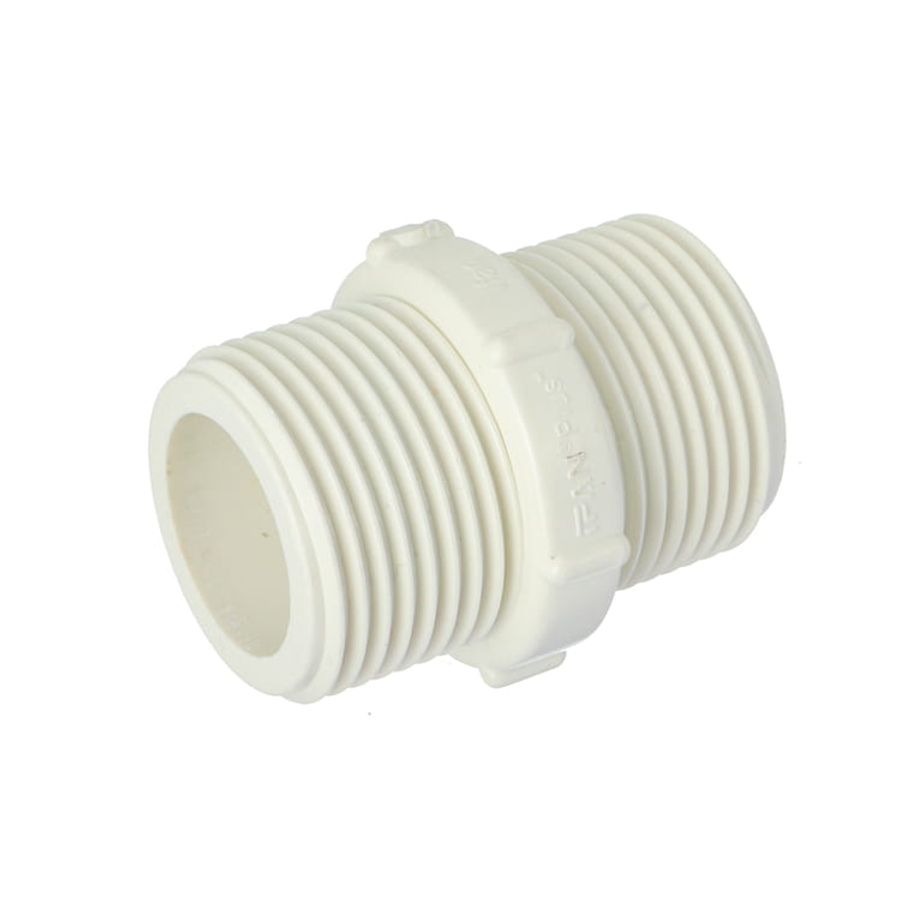
Une bride en PVC est en réalité composée de deux parties : le corps en PVC qui se soude au tuyau, et la bague qui supporte la charge des boulons. La bague est le point de défaillance, et le marché en propose trois qualités. Les bagues entièrement en plastique sont l'option économique — convenables sous une cuvette de WC installée une fois pour toutes et qui ne bouge jamais, mais les fentes de boulon sont les premières à se fissurer lorsqu'un boulon de cuvette est trop serré ou que la cuvette bouge. Les bagues en acier plaqué ajoutent de la résistance mais se corrodent dans l'espace humide sous une cuvette, et une bague rouillée perd les bords de ses fentes. Les bagues en acier inoxydable coûtent légèrement plus cher et éliminent ces deux modes de défaillance, c'est pourquoi les fabricants orientent les prescripteurs vers elles pour tout ce qui doit durer plus longtemps qu'un carrelage. Au-delà du métal de la bague, deux caractéristiques justifient leur prix : un obturateur ou bouchon d'essai moulé dans le corps empêche les débris de chantier de pénétrer dans la canalisation et permet au système DWV de retenir l'eau pour son test de mise en place — percé uniquement lors de la pose de la cuvette — et les bagues métalliques qui tournent sur le corps permettent d'aligner les fentes de boulon après la prise de la soudure chimique, ce qui est important car une soudure ne vous laisse que quelques secondes, et non des minutes, pour positionner le raccord.
Concernant les normes : le joint entre une cuvette de WC et le système d'évacuation est couvert par la norme ASME A112.4.3 (raccords en plastique pour la connexion des cuvettes de WC au système d'évacuation sanitaire, réaffirmée en 2024), et les raccords spéciaux en PVC relèvent plus largement de la norme ASTM F1970. Une bride répertoriée selon une norme reconnue est l'un des rares signes visibles de qualité sur un raccord aussi simple — les signes invisibles sont le métal de la bague, l'épaisseur de paroi au niveau des fentes et la précision du moulage de l'emboîture.
La règle de hauteur décide tout
Plus d’interventions sur les brides sont dues à la hauteur qu’à la casse. La règle : la bride repose sur le dessus du sol fini, avec le haut de l’anneau dépassant d’environ 1/4" à 1/2" — cette géométrie permet à un joint de cire standard de se comprimer correctement entre la sortie de la cuvette et la face de la bride. Un affleurement parfait avec le sol fonctionne encore avec un joint de cire extra-épais. Les problèmes commencent lorsque la bride se retrouve en dessous du niveau du sol, ce qui arrive à chaque fois qu’une salle de bain est recarrelée sur l’ancien sol sans repositionner la bride : l’écart devient trop grand pour que la cire puisse le combler, le joint perd le contact, et le premier symptôme est une odeur, pas une flaque. La solution correcte est un kit de rehausse ou d’extension de bride — des anneaux empilables par incréments de 1/8", 1/4", 1/2" et 3/4" qui se vissent sur la bride existante et reconstituent la hauteur, avec des kits atteignant environ 1-5/8" de surélévation. La mauvaise solution est d’empiler deux joints de cire : les corps en cire ne fusionnent jamais en un seul joint, la jonction entre eux se déforme sous la charge, et les fabricants précisent que les joints empilés sont un chemin de fuite, pas une solution. Pour les entrepreneurs qui soumissionnent des travaux de recarrelage, la ligne honnête est « repositionner ou rehausser la bride de WC » sur chaque salle de bain — l’alternative, ce sont des réparations sous garantie.
Installation d'une bride PVC : souder, puis ancrer
Le joint est une soudure standard au solvant PVC — le ciment (spécifié selon la norme ASTM D2564 pour les systèmes PVC) ramollit chimiquement les deux surfaces afin qu'elles fusionnent en une seule pièce. Effectuez d'abord un assemblage à sec et marquez l'alignement, car la position assemblée doit placer les fentes de boulons à 3 et 9 heures par rapport au mur, de sorte que les boulons de cuvette tombent là où la base des toilettes les attend. Appliquez un primaire sur l'emboîture (ou le tuyau, pour les corps à ajustement intérieur) et la surface de contact, appliquez du ciment sur les deux, insérez avec un quart de tour et maintenez pendant la prise. Ensuite, l'étape que le code exige et que les équipes de dalle sautent : vissez des vis résistantes à la corrosion à travers la bague dans la structure — vis de sous-plancher dans le bois, chevilles dans le béton, et jamais de vis à cloison sèche, qui sont cassantes et rouillent. Sur les travaux neufs, laissez l'obturateur en place jusqu'à la pose de l'appareil afin que la conduite puisse retenir son eau d'essai et rester exempte de débris. La même discipline qui régit tout joint soudé au solvant PVC s'applique ici, avec un ajout : il s'agit du seul raccord DWV qui est également fixé mécaniquement, et la fixation n'est pas une finition optionnelle — c'est ce qui empêche les toilettes d'utiliser le joint de cire comme une charnière.
Joint en cire ou joint sans cire
Le joint en cire assure cette liaison depuis un siècle parce qu'il fonctionne : peu coûteux, tolérant aux petites imperfections de la bride, étanche aux gaz lorsqu'il est comprimé une fois. Ses limites sont tout aussi claires : la cire est à usage unique (soulevez la cuvette et le joint est à jeter), elle ne peut pas se reconstituer si la cuvette bouge, et elle se déforme en cas de températures extrêmes. Les joints sans cire — joints en élastomère et conceptions en caoutchouc empilé — répondent aux faiblesses du joint en cire : ils peuvent être repositionnés lors d'une installation délicate de la cuvette, plusieurs modèles tolèrent d'être soulevés et remis en place, et ils conservent leur forme là où la chaleur ferait s'affaisser la cire. Ils coûtent plus cher et sont moins tolérants envers une bride dont la hauteur est hors spécifications. La distinction pratique : la cire pour les brides de hauteur standard lors d'installations uniques ; le sans cire lorsque la cuvette peut être déposée à nouveau, lorsque la hauteur de la bride est limite, ou lorsque la température plaide contre la cire. Dans les deux cas, les boulons de cuvette sont remplacés avec le joint — réutiliser des boulons étirés sur un joint neuf est une fausse économie qui se manifeste par une fuite lente.
Réparer une bride sans la remplacer
Une bride soudée par solvant ne peut pas être dévissée, donc un remplacement complet implique de couper le coude de toilette — c'est pourquoi le marché de la réparation existe, et pourquoi le connaître permet de sauver des chantiers.
| Défaut | Réparation sur place | Couper le tuyau ? |
|---|---|---|
| Fentes de boulons fissurées, corps sain | Bague de réparation à visser ou bague fendue en deux parties | Non |
| Bride en dessous du niveau du sol fini | Kit d'extension/entretoise (bagues de 1/8" à 3/4", jusqu'à ~1-5/8") | Non |
| Corps ou embout compromis | Bride à visser avec joint expansible, se loge à l'intérieur du tuyau | Non |
| Toilette instable, bride intacte | Ancrage à la structure + nouveau joint et boulons | Non |
| Embout brisé / bride trop décalée | Aucune — remplacer au niveau du coude de toilette | Oui |
Faites correspondre le défaut à la réparation. Fentes de boulons fissurées ou cassées sur une bride par ailleurs saine : une bague de réparation — un anneau métallique qui se visse par-dessus la bride endommagée et restaure les fentes — ou une bague fendue en deux parties qui se glisse en dessous sans soulever le corps de la bride. Bride en dessous du niveau du sol : les kits d'extension/entretoise ci-dessus. Corps de bride cassé ou embout compromis : une bride de remplacement à visser avec un joint en élastomère expansible se loge à l'intérieur du tuyau existant sans soudure par solvant ni excavation — la conception fonctionne sur les embouts en PVC, ABS et fonte, ce qui en fait également la solution standard pour la conversion fonte vers PVC. Bride non ancrée (la toilette est instable, la bride est intacte) : vissez-la dans la structure, puis un nouveau joint — l'ancien est déjà desserré. Les seuls défauts qui nécessitent réellement de couper le tuyau sont un embout brisé ou une bride soudée tellement décalée qu'aucune bague de déport ne peut l'atteindre.
Vous stockez des raccords DWV à l'échelle d'un conteneur ?
IFAN fabrique des raccords d'évacuation en uPVC, du ciment solvant, des systèmes PPR, PEX et en laiton — une seule usine, conteneurs mixtes, certificats de lot par expédition. Vente en gros B2B uniquement.
Demander un devisPVC vs Fonte et la Règle de Correspondance des Matériaux
La bride suit le tuyau : bride PVC sur tuyau PVC, ABS sur ABS, fonte ou type à joint torique sur embouts en fonte. Le ciment solvant ne fusionne que des plastiques similaires — une bride PVC ne peut pas être soudée à de l'ABS avec du ciment PVC, et les ciments de transition verts « universels » relèvent d'une question de code auprès de l'inspecteur local, et non d'une solution par défaut. Sur le fond, le PVC a conquis ce marché pour des raisons qui tiennent : il ne peut pas rouiller au niveau des fentes de boulons comme le font les vieux anneaux en fonte, il se soude au tuyau en quelques secondes, et avec un anneau en inox, il égale la durée de vie structurelle de la fonte pour une fraction du poids et du coût. Les brides en fonte persistent dans la rénovation — pour correspondre à ce qui est dans la dalle — et dans les juridictions qui spécifient encore la fonte pour les réseaux DWV en immeubles de grande hauteur pour l'acoustique. Pour les questions de dimensions en amont de la bride — diamètres des colonnes et des branchements, charges en unités de puisage — voir le guide des tailles de tuyaux d'évacuation PVC ; pour la géométrie du siphon à côté, le guide du siphon P-trap couvre le reste du groupe salle de bain.
Pour les distributeurs : quoi stocker et pourquoi
Les brides sont un article d’appoint — personne n’importe un conteneur de brides de WC seules, mais chaque commande DWV devrait en inclure, car l’entrepreneur qui achète les tuyaux et raccords achète la bride auprès de celui qui pense à la proposer. Une liste de stock de base : brides à bague inox 4x3 comme SKU principal, manchons droits 3" et 4" derrière, un petit nombre de brides déportées et de réparation à visser (forte marge, zéro substitut en cas de besoin), kits de rallonge, et bagues de cire en version standard et extra-épaisse. Associez-les au solvant et au primaire nécessaires à la soudure — le ciment est consommable, se renouvelle indéfiniment et verrouille la commande de raccords au fournisseur qui le regroupe. IFAN produit les raccords d’évacuation en uPVC et le ciment solvant PVC de cet ensemble — moulé en interne dans l’usine de 120 000 m² du Zhejiang, exporté dans plus de 120 pays, avec certificats de lot par expédition et MOQ en conteneur mélangé à partir d’un conteneur — voir le catalogue produits pour la série uPVC. La bride elle-même est une extension naturelle de gamme qu’un acheteur en gros devrait inclure dans le même conteneur que les raccords DWV qu’elle dessert.
Erreurs courantes
Carreler par-dessus le sol et laisser la bride enterrée. Chaque surépaisseur de carrelage élève le sol au-dessus de la bride. Rehaussez ou prolongez la bride lors de la rénovation, pas après l'apparition des odeurs.
Omettre les vis de structure. Une bride maintenue uniquement par le tuyau permet à la cuvette de basculer sur la soudure. L'IPC exige un ancrage avec des fixations résistantes à la corrosion ; traitez-la comme un élément structurel, pas optionnel.
Souder avec les fentes de boulons mal alignées. Le ciment solvant ne laisse que quelques secondes pour positionner. Faites un assemblage à sec, marquez, et utilisez une bride à bague rotative si l'alignement est incertain.
Empiler des bagues en cire pour compenser une bride basse. Deux bagues ne fusionnent jamais ; le joint fluctue et fuit. Utilisez un kit de rehausse ou une bague unique extra-épaisse.
Serrage excessif des boulons de cuvette sur une bague en plastique. La porcelaine l'emporte, la fente se fissure, et la "fuite" six mois plus tard est une bride cassée. Serrez à bloc, de niveau, et arrêtez.
Questions fréquemment posées
Les brides de toilettes sont-elles universelles ?
L’entraxe des boulons l’est effectivement — des boulons de cuvette de 5/16" dans des fentes espacées d’environ 6" s’adaptent aux toilettes standard. La connexion au tuyau ne l’est pas : adaptez la bride au matériau du tuyau et à un diamètre de 3" ou 4", ou utilisez un réducteur 4x3 pour couvrir les deux.
Collez-vous une bride de toilette en PVC au tuyau ?
Oui — avec du ciment solvant (ASTM D2564), qui soude plutôt qu’il ne colle : apprêt, ciment sur les deux surfaces, insertion d’un quart de tour, maintien. Les exceptions sont les brides de réparation à visser et à joint, qui s’étanchéifient mécaniquement à l’intérieur du tuyau sans ciment.
Que faire si la bride se trouve en dessous du sol fini ?
Installez un kit de rehausse ou d’entretoise de bride — des bagues empilables par incréments de 1/8" à 3/4", offrant jusqu’à environ 1-5/8" de hauteur. Un anneau de cire extra-épais couvre un cas marginal. Les anneaux de cire empilés ne sont pas une option ; ils se déplacent et fuient.
Une bride cassée peut-elle être réparée sans couper le tuyau ?
Généralement. Les fentes de boulons fissurées nécessitent un anneau de réparation à visser ou fendu ; un corps endommagé nécessite une bride de remplacement à visser avec un joint expansif qui se loge à l’intérieur du tuyau existant. Seul un moyeu brisé oblige à couper le coude de la cuvette.
Dans quoi les vis de la bride s’ancrent-elles sur le béton ?
Des ancrages à béton — des chevilles plastiques ou des vis de type Tapcon classées résistantes à la corrosion — enfoncés à travers les trous de l’anneau dans la dalle. Sur le bois, des vis en inox ou revêtues dans le sous-plancher. Les vis à placoplâtre échouent tant à la résistance à la corrosion qu’à l’exigence de solidité.