
Compression Fittings for Poly Pipe: How They Work & the Nut Test
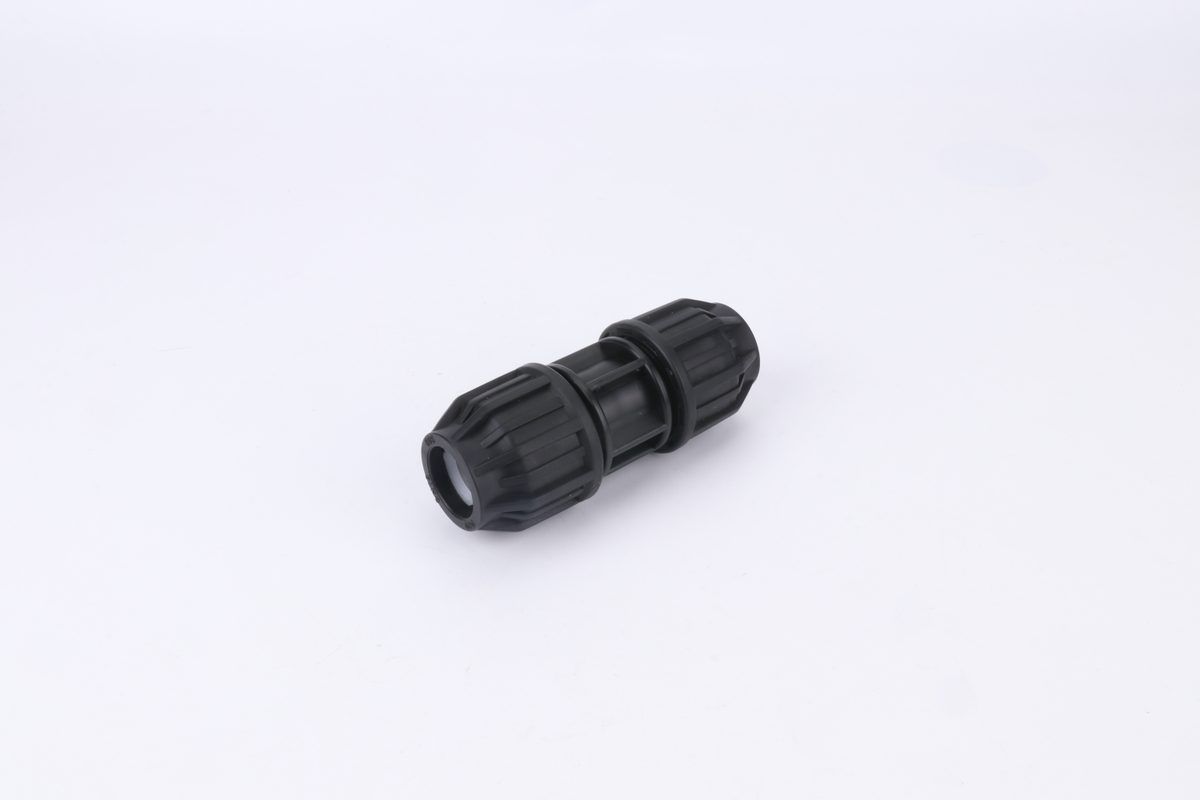
Spin the nut on IFAN's new 605 PP compression fitting and it runs the full thread smoothly, in either direction, with no sticking — tighten to grip, back off to adjust, re-tighten, as many times as the job needs. That's the demonstration in the video below, and if you've ever fought a cheap compression fitting whose nut seizes half-way, cross-threads, or cracks when you finally force it, you know exactly why it's worth filming. Compression fittings are how poly (PE/HDPE) pipe gets joined without a fusion machine — service lines, irrigation, metering assemblies, repairs — and the whole experience of the system lives in that nut-and-thread interface. This guide explains how a poly-pipe compression fitting actually works (with the internals laid bare), where compression beats fusion and where it doesn't, what the 605 series does differently, and how to install and buy these fittings right.
Key Takeaways
- IFAN's 605 PP fitting adjusts freely without jamming — thread precision you can see run on camera below.
- A compression fitting seals with an O-ring and holds with a split grip ring — the nut just loads them.
- No fusion machine, no glue, no power: hand-assembly for PE/HDPE service lines and irrigation.
- Demountable and adjustable — the joint opens for service and re-makes on the same parts.
- Compression owns the small-diameter field work; fusion owns mains and large diameters.
- A nut that sticks or seizes is a defect signal — smooth full-travel threads are the quality tell.

🔬 IFAN PRODUCT TEST SERIES — see all tests
How a Compression Fitting Actually Works
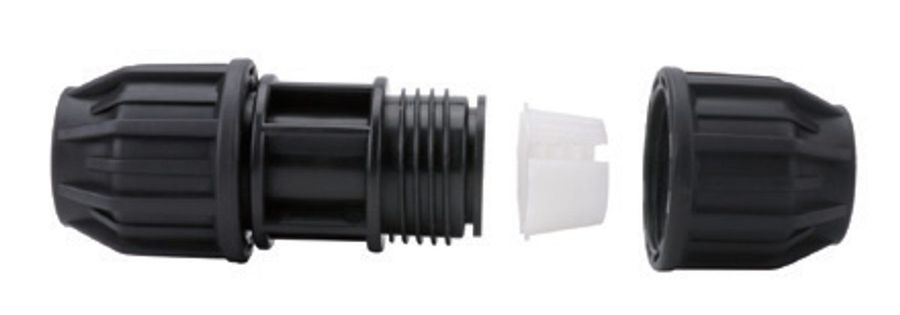
Open one up — as in the exploded view below — and a compression fitting is four honest parts doing three jobs. The body carries the socket and a coarse external thread. Inside sits an O-ring — the actual water seal, wiping the pipe's outer wall. Then the white split grip ring (clamp ring): a tapered, toothed collar that does the mechanical holding — as the nut drives it into the body's taper, it closes onto the pipe and its teeth bite, locking the pipe against pull-out and pressure thrust. The compression nut is just the loader: winding it down compresses ring and O-ring by controlled amounts. Two consequences worth understanding. First, sealing and gripping are separate functions — the O-ring seals at modest compression, so a joint doesn't need gorilla torque to stop leaking; extra force mostly loads the grip ring. Second, the whole mechanism is reversible: back the nut off and the taper releases the ring, the joint opens, and the same parts re-make — which is why compression is the field-service joint for poly pipe.
Compression is just one way to join pipe — see all seven pipe coupling types and when each is the right joint.
Why "Adjusts Freely Without Sticking" Is the Quality Tell
Everything a compression fitting does routes through one interface: the nut on the body thread. And that interface is where cheap fittings fail first — coarse molded threads with flash left in the roots, out-of-round nuts, or brittle regrind material that gall and seize half-way down the travel. On site that turns into cross-threading, "one more heave" with a wrench, cracked nuts, and joints that can never be fine-tuned or reopened. The video shows the 605's answer: the nut runs its entire thread travel smoothly in both directions, so tightness genuinely adjusts on demand — snug it, test it, nudge it a quarter turn, back it off for a re-route — with nothing binding at any point. That behaviour isn't luck; it's molded-thread precision (clean profiles, matched tolerances between nut and body) plus a PP compound chosen for toughness rather than filler content. A simple bench rule follows for any brand you evaluate: run every nut through its full travel by hand before the fitting ever meets a pipe. Smooth full travel predicts a serviceable joint; a nut that sticks dry will fight you forever wet.
Compression vs Fusion: Which Joint for Poly Pipe
| Factor | PP compression | Butt / electrofusion |
|---|---|---|
| Tools & power | Hands (a strap wrench at most) | Fusion machine, power, trained operator |
| Joint nature | Mechanical — demountable, adjustable | Welded — permanent, monolithic |
| Typical sizes | 20–63 mm service work | Everything, incl. large mains |
| Weather / conditions | Any — wet trench, wind, cold | Fusion wants clean, dry, controlled |
| Speed per joint | Under a minute | Setup + cycle + cool time |
| Best at | Repairs, meters, irrigation, transitions | Buried mains, gas, long welded runs |
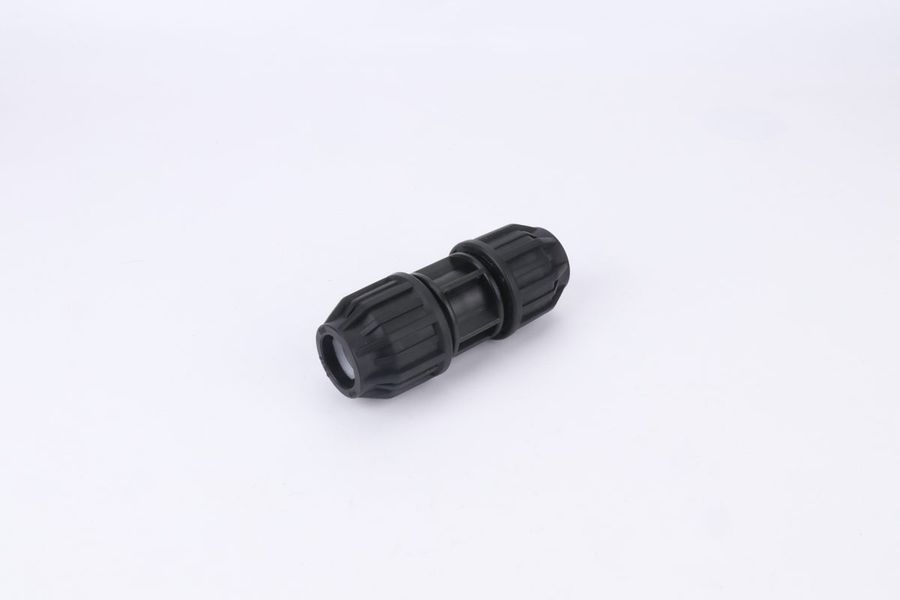
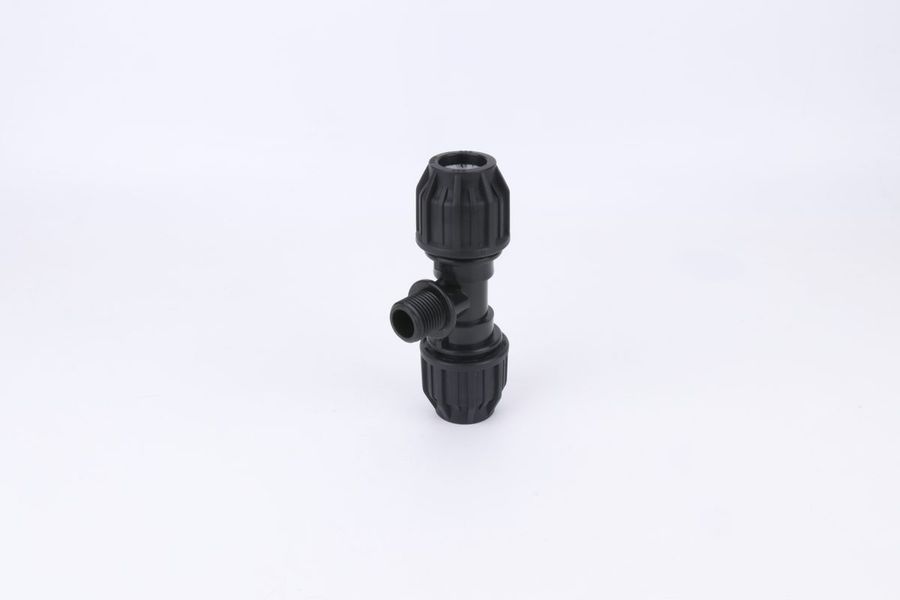
The rule mirrors the rest of the poly world: infrastructure gets fused, field work gets compressed. A buried municipal main wants the monolithic weld (see butt fusion vs electrofusion); the service line tapping off it to a meter, a farm trough, or a drip manifold wants a joint one person makes by hand in a wet trench — and can open again next season. Male- and female-threaded variants (like the tee below) are also how poly pipe meets valves, meters, and brass components without any welding at all.
What the 605 Series Does Differently
The 605 is IFAN's new-generation PP compression family, and its design brief was exactly the pain points installers report on commodity fittings. Free-running threads: nut and body threads are molded to matched tolerance with clean profiles, so tightness adjusts smoothly through the whole travel — the on-camera behaviour — instead of grabbing at the first quarter turn. Tough PP body: the housing takes wrench torque and trench handling without the whitening and hairline cracks that betray high-filler regrind. Full system: couplings, elbows, equal and threaded tees (male and female), reducers, and end caps across the common 20–63 mm service sizes, so a complete assembly comes from one catalog — and it slots beside IFAN's HDPE fusion fittings, valves, and the wider product range for everything the compression family doesn't cover. The claim is bench-testable and we invite the test: sample orders are welcome — run every nut through its travel by hand, exactly as the video does, before you commit a container.
| What you observe | Commodity compression fitting | IFAN 605 series |
|---|---|---|
| Nut travel (dry) | Grabs, squeals, seizes part-way | Smooth full travel, both directions |
| Adjusting tightness | One-shot — reopening risks the joint | Snug, test, re-adjust on demand |
| Wrench torque | Nut whitens, hairline cracks | Body takes site handling |
| At scale | A per-box failure rate you install around | Every joint serviceable for its life |
Installing Compression Fittings Right
The joint is simple; the failures are all preventable. Cut square and clean — a ragged or angled end can nick the O-ring on entry. Mark insertion depth on the pipe and push fully home past the O-ring to the stop; half-inserted pipe is the number-one leak cause. Hand-tighten, then a controlled final turn — the O-ring seals early; the extra travel is for the grip ring, not for chasing a leak that insertion depth caused. Don't grease the O-ring with petroleum products (silicone lubricant only, if anything), and don't wrap the body threads with PTFE tape — they're a mechanical drive, not a seal, and tape just falsifies the torque feel. On coiled poly pipe, straighten the last 200 mm so the pipe enters the fitting on axis rather than levering the ring sideways. Follow those habits and a compression joint made in a minute holds for years — and opens in a minute when the layout changes. Pipe-side context (PE grades, SDR, sizing) lives in the complete HDPE pipe guide.
Run the nut test on the 605 yourself
Request IFAN 605 PP compression samples — spin every nut through its full travel by hand, then decide. Smooth is the spec.
Request a Quote & SamplesCommon Compression-Fitting Mistakes
Half-inserted pipe. The O-ring never gets wiped by the pipe wall. Mark depth, push to the stop, then tighten.
Chasing leaks with torque. If it weeps at sensible tightness, the cause is insertion, a nicked O-ring, or an out-of-round pipe end — more force just cracks the nut.
PTFE tape on the body thread. That thread drives the nut; it doesn't seal water. Tape only ever belongs on the male/female pipe-thread ends.
Petroleum grease on the O-ring. It swells rubber. Silicone lubricant or nothing.
Using compression where fusion belongs. Long buried mains and large diameters want welded joints; keep compression for the service sizes it's built for.
Frequently Asked Questions
How does a compression fitting work on poly pipe?
Four parts share the work: the body carries the socket, an internal O-ring seals against the pipe's outer wall, a split grip ring bites the pipe to lock it against pull-out, and the compression nut loads both as it winds down. Sealing and gripping are separate jobs — the O-ring seals at modest tightness — and backing the nut off releases the ring, so the joint is fully demountable.
Are PP compression fittings as good as fusion for HDPE pipe?
They serve different duties. Fusion makes a permanent monolithic weld — the choice for buried mains, gas, and large diameters. Compression makes a demountable mechanical joint by hand in under a minute, in any weather, with no machine — the choice for 20–63 mm service lines, meters, irrigation, repairs, and transitions to threaded components. Real systems use both.
Why does my compression fitting nut keep sticking?
Sticking comes from the factory, not from you: rough molded threads with flash in the roots, out-of-round nuts, or brittle high-filler material that galls under load. A quality fitting's nut runs its full travel smoothly in both directions — the test IFAN's 605 video demonstrates. Check nut travel by hand on samples before buying in volume; a nut that sticks dry only gets worse in service.
How tight should a poly pipe compression fitting be?
Hand-tight plus a controlled final turn is normally enough: the O-ring seals early, and the remaining travel loads the grip ring that holds the pipe. If the joint weeps at sensible tightness, the real cause is usually half-inserted pipe, a nicked O-ring, or a ragged pipe end — fix that instead of adding torque, which only cracks the nut.