
HDPE Pipe Fittings: Types, Jointing Methods & How to Choose
The main HDPE fitting types: butt-fusion fittings (welded joints for mains), electrofusion couplings (built-in heating coils, ideal for trench and repair work), mechanical compression fittings (tool-free, small bores), flanged stub-end connections (tie-ins to valves and metal pipe), plus saddles and transition fittings. Fusion joints are as strong as the pipe itself; compression wins where no power is available.
The pipe is only as reliable as the joint. Most HDPE failures in the field don't happen in the pipe wall — they happen at a fitting that was the wrong type, the wrong pressure class, or joined the wrong way. HDPE pipe fittings fall into three families: butt-fusion, electrofusion, and mechanical (compression and flanged). Each has a place, and getting the match right is what separates a line that runs leak-free for 50 years from one that seeps at every branch. This guide walks through the fitting types, when to use each, how they're rated, and the specification points that catch out first-time buyers.
For the full system picture — pipe grades, sizes, and jointing — see the complete HDPE pipe guide; this article focuses on the fittings.
If you're still choosing pipe dimensions, start with the HDPE pipe sizes and SDR guide — fittings must match the pipe's OD and pressure class, so the pipe spec comes first.

Key Takeaways
- Three families: butt-fusion (DN63+), electrofusion (any size, tight spaces), mechanical compression (small diameters, no power).
- Fusion fittings make a joint as strong as the pipe itself — a monolithic, leak-free weld.
- Fitting SDR and grade must match the pipe (PE100 to PE100, SDR11 to SDR11).
- Compression fittings are fast and tool-light but rated lower pressure and best under DN63.
- Transition (flange/threaded) fittings connect HDPE to metal, valves, and other systems.
- Buy fittings and pipe from one qualified source so OD, SDR, and grade are guaranteed to match.
The Three Families of HDPE Fittings
Every HDPE connection method belongs to one of three groups. The choice depends on pipe size, whether you have power on site, how much space there is around the joint, and the pressure the line will carry.
Which fitting you need depends on the job — see the range of HDPE pipe applications from water mains to cable ducting.
| Family | How it joins | Best for | Joint strength |
|---|---|---|---|
| Butt fusion | Heated ends pressed together | DN63+ straight runs, mains | Full pipe strength |
| Electrofusion | Embedded coil melts the joint | Any size, tight spaces, repairs | Full pipe strength |
| Compression | Nut and gasket clamp the pipe | ≤DN63, no-power sites, irrigation | Lower, mechanical seal |
| Flanged / transition | Bolted stub + backing ring | HDPE-to-metal, valves, pumps | Depends on flange class |
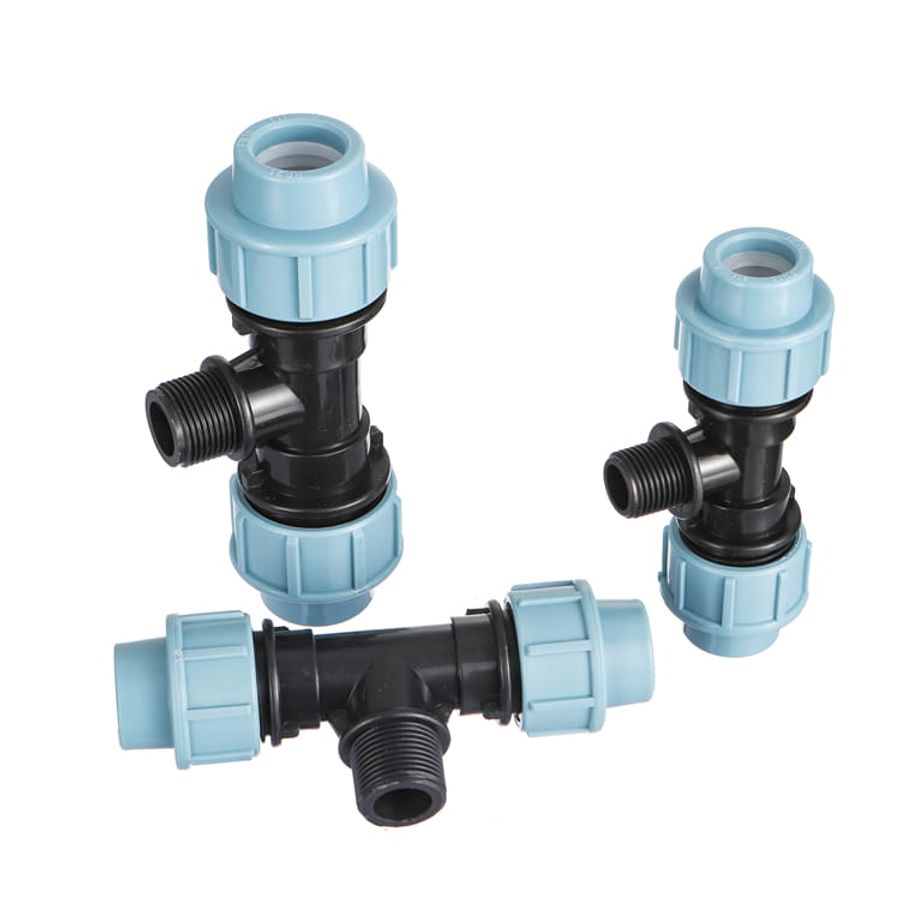
Butt-Fusion Fittings
Butt fusion joins two pipe ends — or a pipe and a fitting spigot — by heating both faces against a hot plate, then pressing them together under controlled force until they cool into one continuous piece. Done to procedure, the joint is as strong as the parent pipe: there is no gasket to age, no thread to corrode, nothing to leak. This is the backbone method for water and gas transmission mains.
Butt-fusion fittings are moulded or fabricated spigot-end components — equal tees, reducing tees, elbows (45° and 90°), reducers, and end caps — all made in the same PE100 resin and SDR as the pipe. Because the whole assembly is one material welded end to end, a butt-fusion network behaves as a single flexible pipe that tolerates ground movement and pressure surge. The practical limit is size: below about DN63 the pipe is too small to clamp and face reliably, so small-bore work moves to electrofusion or compression.
The trade-off is equipment. Butt fusion needs a fusion machine sized to the pipe, a trained operator, and clean, aligned pipe ends. For a full walk-through of parameters and quality checks, see butt fusion vs electrofusion.
Electrofusion Fittings
Electrofusion fittings have a resistance wire coil moulded into the socket. You clean and scrape the pipe end, insert it into the fitting, clamp it, and pass current through the coil via a control box. The coil heats, melts the interface, and fuses the fitting to the pipe from the inside. Like butt fusion, the result is a fully welded, full-strength joint — but it works at any diameter and in confined spaces where a butt-fusion machine won't fit.
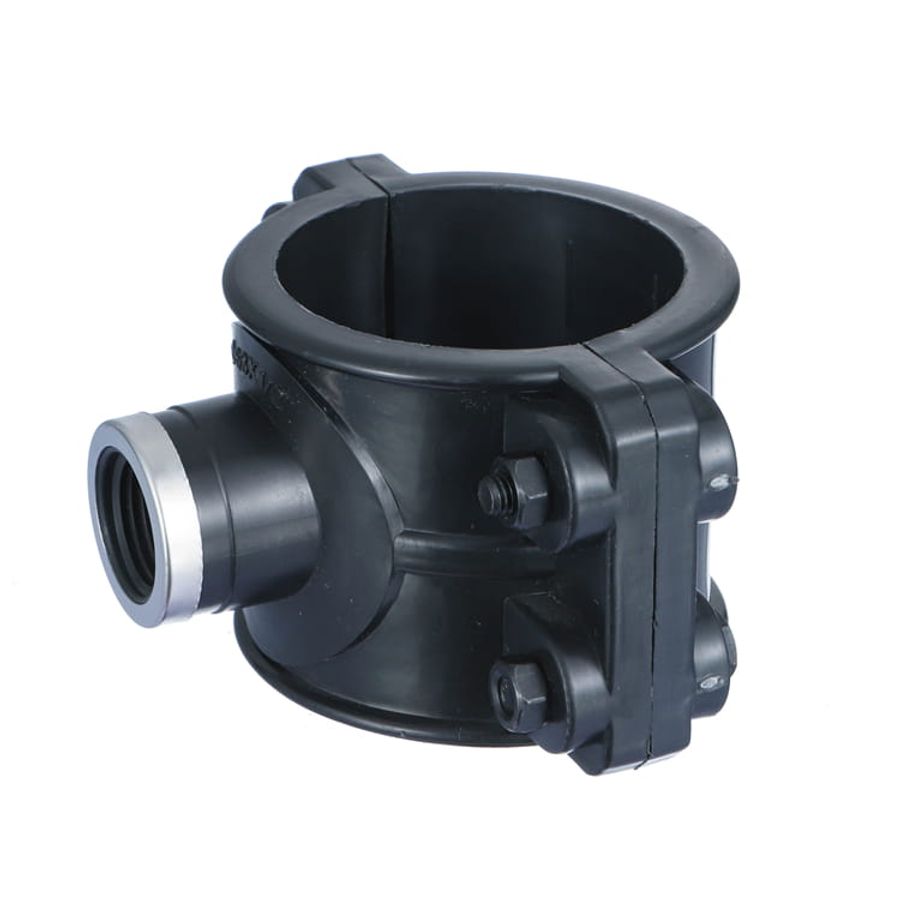
Common electrofusion parts are couplers, reducers, elbows, tees, and — importantly — tapping saddles and branch saddles for adding a service connection to a live or existing main without cutting it out. Because the heat is generated inside the fitting, electrofusion is the go-to for repairs, tie-ins, tight trenches, and small-diameter service pipe. The fitting costs more than a butt-fusion equivalent, but it needs a lighter, cheaper control unit and less pipe-end preparation space.
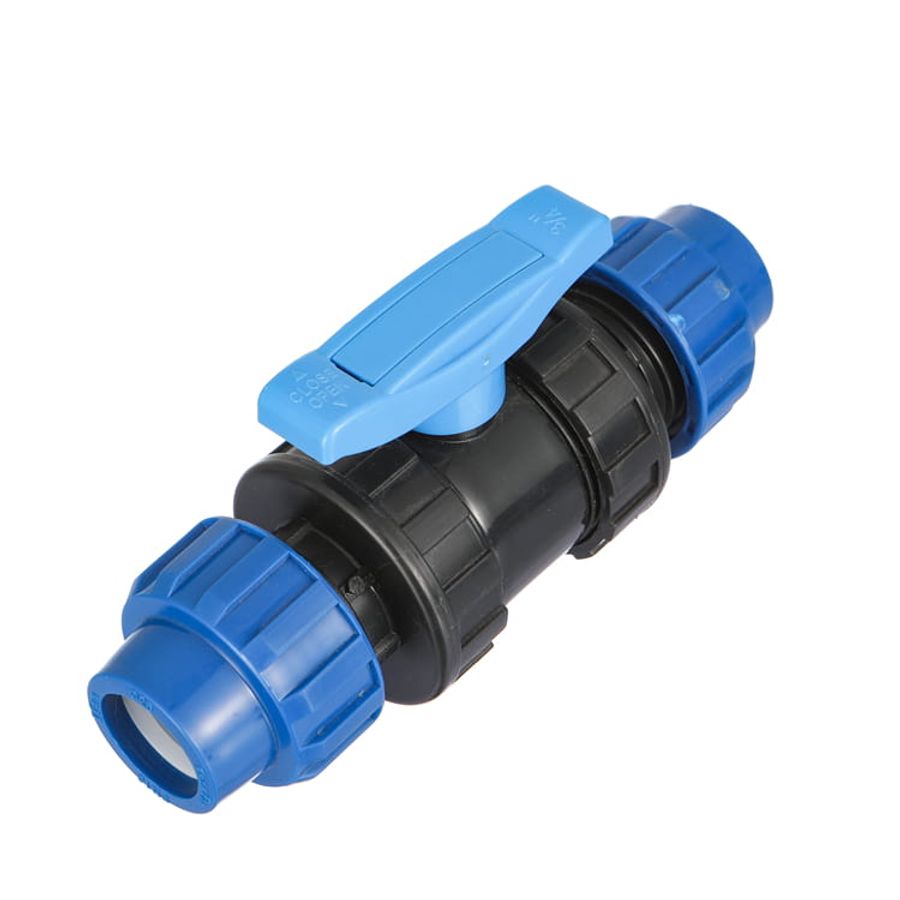
Compression Fittings
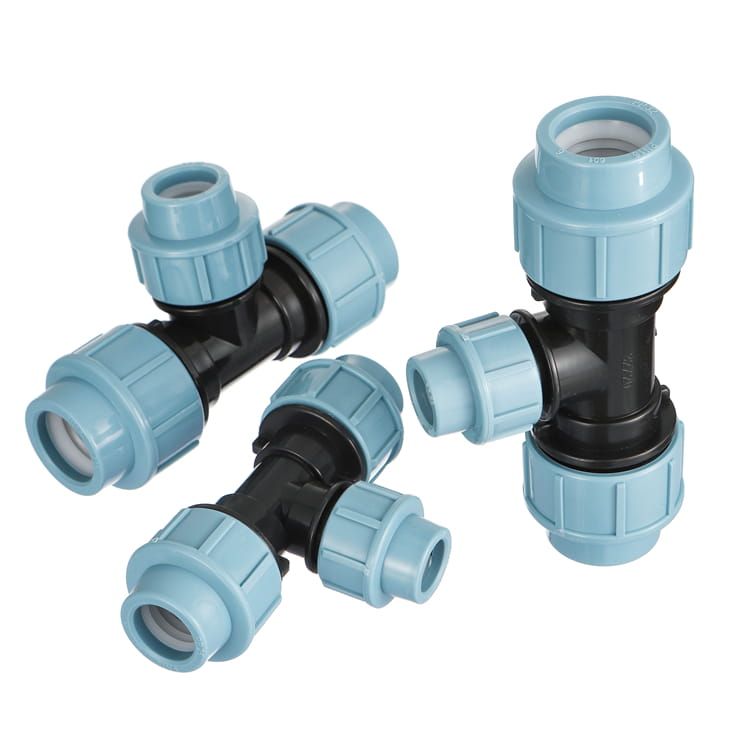
Compression fittings seal mechanically. The pipe pushes into the fitting body, and tightening a nut squeezes an internal gasket and grip ring around the pipe, holding it and sealing against pressure. No heat, no power, no special machine — just a wrench. That makes them the practical choice for irrigation, rural water, small service lines, and any job where getting a fusion rig to site isn't worth it.
The trade-off is pressure and size. Compression fittings are rated lower than fusion joints and are best kept to DN63 and below; on larger diameters and higher-pressure mains, fusion is the correct method. Compression bodies come in PP (polypropylene) for the standard range and in brass for threaded transitions. Typical parts include couplers, elbows, tees, and male/female threaded adaptors that let you connect HDPE pipe to a threaded valve, meter, or metal fitting.
Transition and Flanged Fittings
Almost every HDPE line has to connect to something that isn't HDPE — a pump, a steel main, a cast-iron valve, a meter. That's what transition fittings are for. A flange assembly uses a fused stub end (a short HDPE spigot with a flat face) plus a loose steel or GRP backing ring; you bolt it to a matching flange on the metal side, with a gasket between the faces. The bolt class and gasket set the pressure rating of that connection, so match them to the line duty.
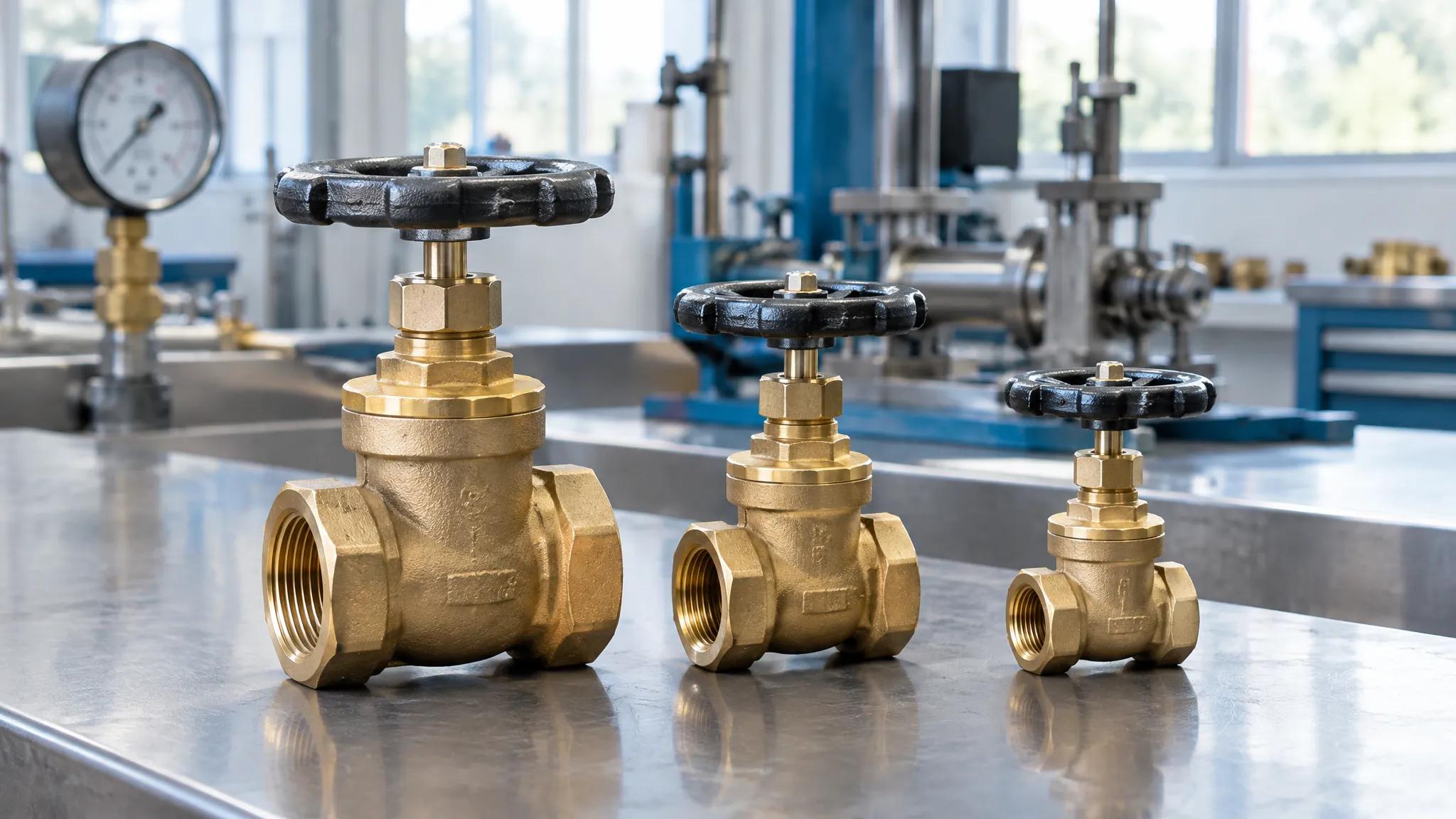
Threaded transitions — brass or PP compression fittings with a male or female thread — handle the smaller connections to valves and meters. The key rule with any transition is that the weak point is the interface, not the HDPE: spec the flange class, gasket, and thread to at least the pipe's pressure rating so the joint isn't the thing that limits the system.
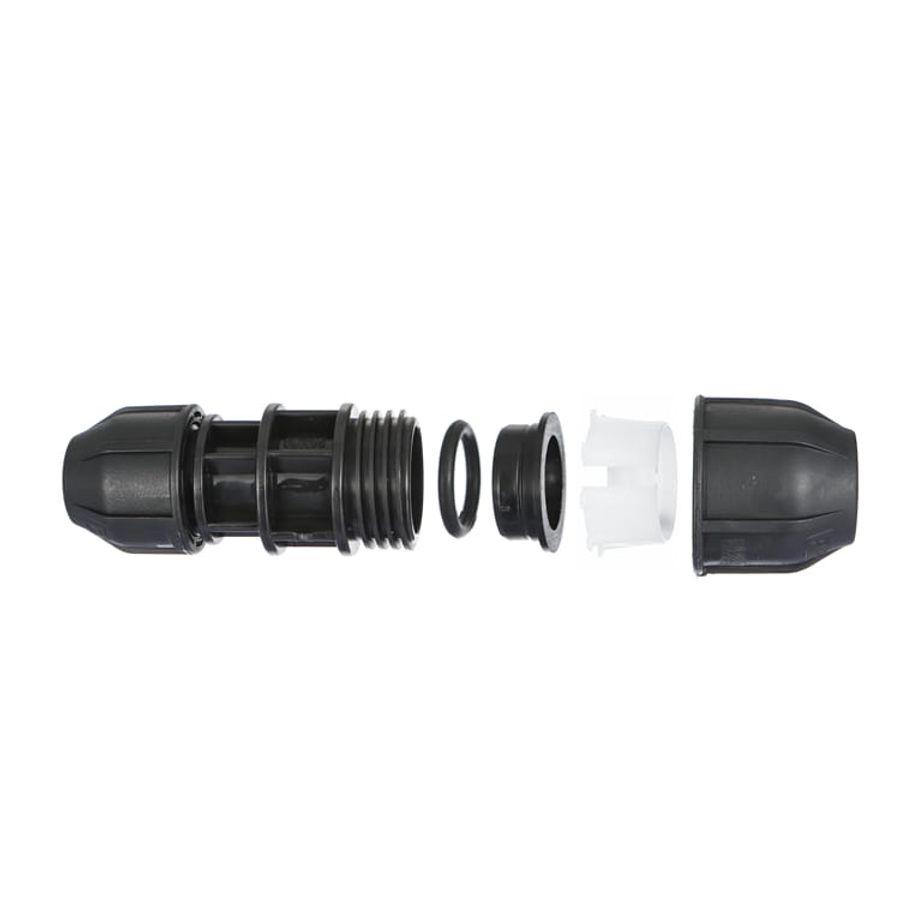
How to Choose the Right Fitting
Work through four questions in order:
1. What diameter? DN63 and below opens up compression and electrofusion; DN63 and above is butt-fusion territory for main runs, with electrofusion for branches, repairs, and tight spots.
2. What pressure? High-pressure mains need fusion (full-strength joints). Low-pressure irrigation or service lines can use compression.
3. Power and access on site? No power or no room for a butt machine points to electrofusion or compression. Open trench with power favours butt fusion for speed and cost per joint on long runs.
4. What is it connecting to? HDPE-to-HDPE uses fusion or compression; HDPE-to-metal or HDPE-to-valve uses a flange or threaded transition.
Specification Points Buyers Miss
Match the SDR and grade. A fitting must be the same material grade and pressure class as the pipe. Fusing a PE100 SDR11 pipe to a mismatched fitting compromises the joint. Reputable suppliers print grade and SDR on every fitting.
Match the OD standard. Metric (ISO 4427) pipe needs metric fittings; imperial (IPS) needs imperial. They are not interchangeable, and a near-miss OD will not fuse or seal.
Buy pipe and fittings together. The single most reliable way to guarantee OD, SDR, and grade all agree is to source pipe and fittings from one qualified manufacturer. It also puts one company behind the whole joint if anything goes wrong. See how to verify a manufacturer before you commit an order.
Check the standard. Fittings should be made to ISO 4427 (water) or ISO 4437 / EN 1555 (gas), and the certification should be verifiable, not just claimed. IFAN produces HDPE pipe and the full fitting range — fusion, compression, and transition — to matched specifications, so buyers get a single guaranteed system rather than parts that might not agree.
Fitting Mistakes That Cause Leaks
Most fitting failures trace back to a handful of avoidable errors, not to the fitting itself.
Skipping the scrape on electrofusion. The oxidised skin on the pipe surface must be scraped off before the pipe goes into an electrofusion socket — the coil can't fuse to an unprepared surface, and a joint that looks fine will leak under pressure. Scrape the full insertion depth, all the way round, and don't touch the cleaned surface with bare hands.
Mismatched SDR or grade. Fusing a pipe and fitting of different SDR or resin grade gives an uneven melt and a weak interface. Confirm the printed markings on both parts match before you clamp anything.
Under-inserting compression pipe. If the pipe isn't pushed fully home before the nut is tightened, the grip ring bites in the wrong place and the seal fails under surge. Mark the insertion depth on the pipe first, then push to the mark.
Fusing dirty or wet ends. Dust, mud, or water on the faces ruins a butt-fusion weld. Cut clean, wipe with a lint-free cloth, and face the ends immediately before fusing — not an hour earlier.
Over-torquing flange bolts unevenly. Tighten flange bolts in a star pattern to the specified torque so the gasket compresses evenly. Cranking one side down first distorts the face and starts a slow weep.
Need matched HDPE pipe and fittings for a project?
Get a quote on a full HDPE system — pipe, fusion, compression, and transition fittings to one spec.
Request a Quote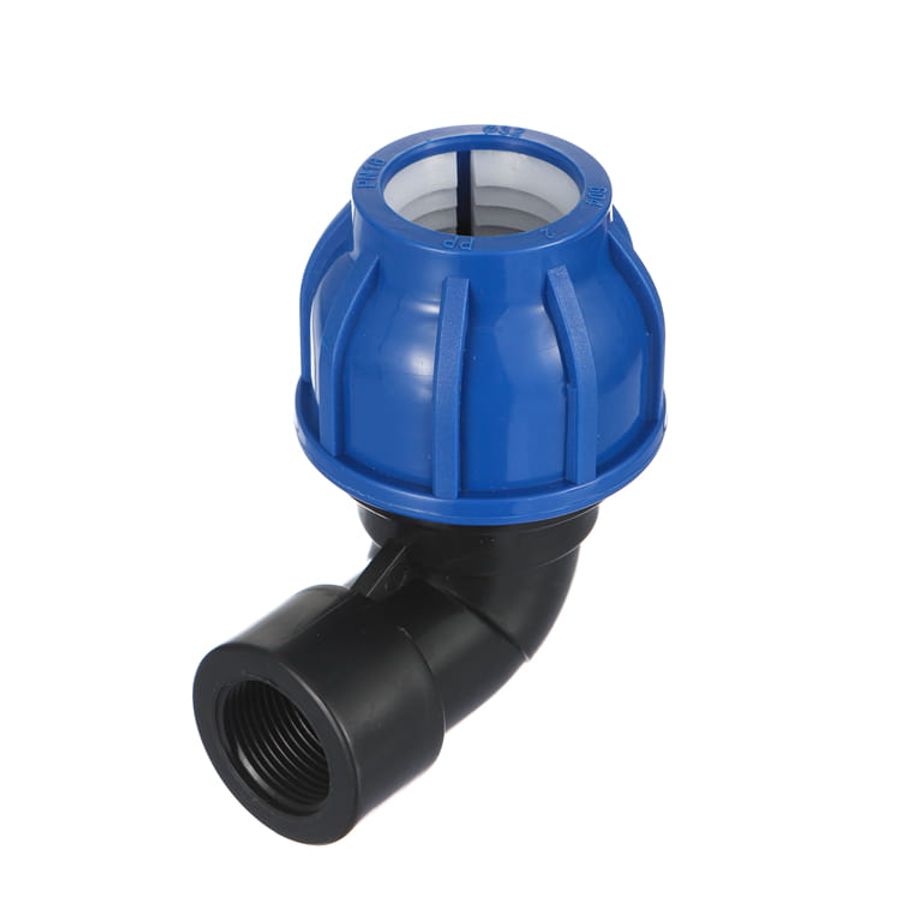
Frequently Asked Questions
Can you use compression fittings on large HDPE pipe?
They exist above DN63 but are rarely the right call. Large-diameter, higher-pressure mains should use butt fusion or electrofusion for a full-strength joint. Keep compression to DN63 and below, where its speed and no-power convenience outweigh the lower pressure rating.
Do HDPE fittings have to be the same brand as the pipe?
Not the same brand, but the same grade (PE100), SDR/pressure class, and OD standard (metric vs imperial). The safest way to guarantee all three agree is to buy pipe and fittings from one qualified supplier, which also gives you a single point of accountability.
What fitting connects HDPE pipe to a steel or PVC line?
A transition fitting. For larger connections use a flanged stub end with a backing ring bolted to the other system's flange; for smaller ones use a threaded (brass or PP) compression adaptor. Rate the transition to at least the pipe's pressure so the joint isn't the weak link.
Which is stronger, butt fusion or electrofusion?
Both produce a full-strength, fully welded joint when done to procedure. Butt fusion is faster and cheaper per joint on large straight runs; electrofusion wins in tight spaces, on small diameters, and for saddles and repairs. Choose by access and size, not by strength.
What are the types of HDPE pipe fittings?
Five families: butt-fusion, electrofusion, mechanical compression, flanged stub-end, and saddle/transition fittings. Choose by joining method — fused joints for buried mains, compression for small-bore field work, flanges where the line meets valves or metal pipe.