

C900 DR 14, DR 18 and DR 25: Read a US Water Tender
AWWA C900 PVC pipe: compare DR 14, DR 18 and DR 25, separate AWWA and FM ratings, and resolve old pressure-class wording before approving a bid.
For a US water tender, read C900 as the pipe standard, DR as the wall-thickness ratio, and pressure class as a separate capacity. Published C900 products pair DR 14 with 305 psi, DR 18 with 235 psi and DR 25 with 165 psi. That does not authorize replacing a tender’s older Class 150/DR 18 wording or using an AWWA rating as an FM fire-service rating. Resolve the edition and the owner’s acceptance requirements before approving the offer.
This distinction matters when a bid looks stronger on paper than the requested pipe. A higher catalogue number can describe the same wall geometry under a revised design approach, or a different approval basis. It can also accompany a genuine product change. The reviewer has to identify which happened. This article explains that document decision; it does not claim that IFAN manufactures or supplies approved C900 pipe.
Key Takeaways
- C900-22 is AWWA’s listed PVC pressure-pipe standard; its scope extends from 4 through 60 inches.
- At the same material and outside diameter, a lower DR means a thicker wall.
- DR 14, DR 18 and DR 25 commonly appear as 305, 235 and 165 psi respectively in published C900 product data.
- Older Class 150/DR 18 tender wording needs written clarification; a current pressure label cannot amend a contract.
- AWWA capacity and FM approval ratings can differ for the same product.
- Pressure class alone does not settle surge design, fitting compatibility, restraint or the field-test procedure.
This Waterworks Training lesson provides related C900 pressure-pipe context. The tender and approval checks below remain separate.
Establish the standard edition before choosing a DR
AWWA’s current standards list identifies C900-22 as covering PVC pressure pipe and fabricated fittings from 4 through 60 inches. An older summary limiting C900 to 12 inches is not an adequate description of the listed edition. Keep the standard’s scope separate from a manufacturer’s available range: a standard permits a framework; a catalogue identifies actual products.
Record the edition named in the project documents alongside the offered product’s compliance statement. If the tender says only “C900,” look for an incorporated edition, a general latest-edition clause, approved-material list or an issued clarification. Do not settle that ambiguity from the publication date of a supplier’s website. A page can contain a current product alongside an older compliance description.
The same discipline applies outside the US. C900 does not become equivalent to a metric PVC-U system because both carry water under pressure. The dimensional family, product standard and connection system must match the specified system. The plastic-pipe standards map explains that broader distinction; here the task is to compare a specific C900 offer with a specific tender.
What changes between DR 14, DR 18 and DR 25
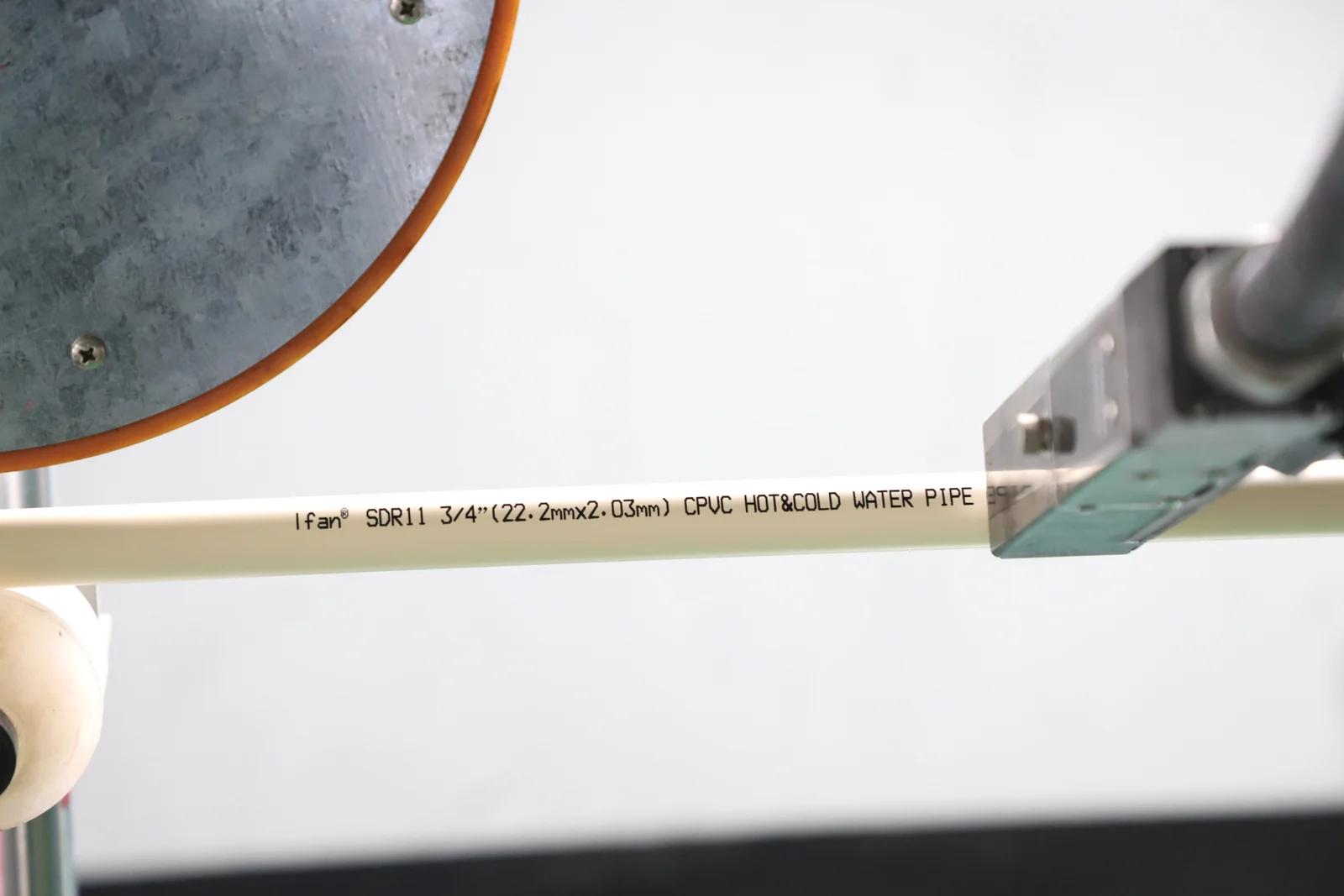
Dimension ratio, abbreviated DR, compares outside diameter with minimum wall thickness. Northern Pipe’s C900 dimensions and ratings show the relationship in actual product tables. With a common outside diameter, reducing DR increases wall thickness. That increases the published pressure capacity but leaves less internal space for water. Nominal diameter alone does not describe the bore.
The common three-class comparison below uses published AWWA pressure classes. It is a reference for checking a submittal, not a design selection based only on static pressure. Other DRs also exist in the C900 product range; these three do not exhaust the standard.
| DR (dimensionless) | AWWA pressure class (psi) | Same-OD consequence |
|---|---|---|
| 14 | 305 | Thickest wall of these three |
| 18 | 235 | Intermediate wall and bore |
| 25 | 165 | Thinnest wall of these three |
Source: JM Eagle Blue Brute C900, cross-checked with Northern Pipe Products. These are published third-party product classes, not IFAN ratings.
A concrete 8-inch comparison: JM Eagle’s January 2026 Blue Brute data sheet lists the same 9.05-inch average OD for nominal 8-inch DR 14 and DR 18 pipe. DR 14 has a 0.646-inch minimum wall and AWWA PC 305; DR 18 has a 0.503-inch minimum wall and AWWA PC 235. The sheet’s nominal IDs are 7.68 and 7.98 inches respectively. These are that manufacturer’s published dimensions, not dimensions guaranteed by the nominal “8-inch” label or an IFAN offer.
| DR (dimensionless) | Average OD (in) | Minimum wall (in) | Nominal ID (in) | AWWA class (psi) |
|---|---|---|---|---|
| 14 | 9.05 | 0.646 | 7.68 | 305 |
| 18 | 9.05 | 0.503 | 7.98 | 235 |
Source: JM Eagle Blue Brute submittal/data sheet, updated January 2026, page 2. Average OD, minimum wall and nominal ID are distinct published descriptors; do not reconstruct guaranteed ID by subtracting twice the minimum wall. The AWWA and FM bases remain separate below.
Changing the DR can change hydraulic performance even when the nominal size and connection diameter remain the same. For a proposed substitution, obtain the offered pipe’s documented internal diameter and repeat the project’s hydraulic check on that basis. A higher pressure class does not guarantee an equivalent pressure loss at the required flow. The designer decides whether the changed bore matters for the system.
There is no defensible “always choose DR 18” answer here. If the project has already specified a DR, the bidder must supply that documented item or obtain approval for a substitution. If the project leaves the choice open, the designer needs working pressure, transient conditions, installation loads and the complete component arrangement. A list of pressure classes is an input to that decision, not its result.
When Class 150 and DR 18 appear on the same tender
The City of Dixon’s 2022 construction specifications, section 8.3, use legacy Class 150/DR 18 wording for C900 water mains. The same section calls for Class 200/DR 14 where specified and retains a 2.5 safety-factor statement for distribution pipe. This is a real document example, not a rule for every US municipality.
Compare that wording with the current product classes in the table above. The difference is not explained by simply saying that the DR 18 pipe has become thicker. The PVC Pipe Association’s pressure-design resource explains that the 2007 C900 revision changed pressure classes while leaving pipe dimensions and wall thicknesses unchanged. A legacy label and a newer capacity label can refer to the same DR geometry.
That technical explanation still does not decide the contract. The owner may intentionally retain a conservative design limit, require an older edition, or have wording that needs correction. The reviewer cannot choose among those possibilities without the project’s interpretation. Accepting PC 235 because it is numerically above 150 can conceal the very assumption the tender writer intended to control.
For this documented example, the useful clarification asks whether the owner requires the specified DR 18 geometry with the legacy design basis, accepts a named current-edition product under its published class, or requires another stated basis. Quote the conflicting line and attach the offered compliance statement. Keep the quantity and commercial offer separate until the material requirement is resolved. A response should identify the accepted item and governing criteria, not merely say “C900 is acceptable.”
AWWA pressure class is not an FM approval rating
A manufacturer can publish more than one pressure number for the same DR. JM Eagle lists AWWA PC 235 for DR 18 while identifying an FM approval rating of 185 psi; its DR 14 example pairs AWWA PC 305 with FM 250 psi. The product’s own approval scope is the controlling evidence for that product. Do not copy these FM values onto another manufacturer’s model.
| Published example | AWWA class (psi) | FM rating (psi) | Review consequence |
|---|---|---|---|
| JM Eagle DR 18 | 235 | 185 | Do not label FM capacity as 235 |
| JM Eagle DR 14 | 305 | 250 | Keep approval and AWWA bases separate |
| Another offered model | Verify its data | Verify its approval | Do not inherit these example values |
Source: JM Eagle Blue Brute product page. Approval scope is model-specific.
For a fire-service tender, identify the required listing or approval and verify the exact manufacturer, product designation, size and applicable rating. A familiar DR is not an approval record. Nor does compliance with the C900 manufacturing standard by itself resolve a project’s fire-code acceptance. This article does not decide the requirements of an adopted NFPA edition or an authority having jurisdiction.
The consequence is concrete. An offer can match AWWA class and still leave a required fire-service approval undocumented. Mark the capacity check as documented and the approval check as held. Increasing wall thickness does not repair an absent approval record, and a generic factory certificate does not identify the offered product.
The pipe class cannot approve the whole water main
The connection needs its own dimensional evidence. Northern Pipe’s product information identifies cast-iron outside-diameter C900 products and gasketed joints. Do not assume that another PVC pipe with the same nominal inch size will fit. Record the exact outside diameter and the coupling or fitting manufacturer’s allowed range. The BS pressure-class reference describes a different system; its labels are not C900 equivalents.
A gasketed connection also needs a complete restraint design. The barrel’s pressure class describes neither the supplied fitting’s capacity nor the means of preventing separation at a change in direction. Keep the restraint arrangement, joints and fitting pressure limits in the system review. A compatible diameter establishes fit; it does not establish the force resistance of the installed assembly.
Working pressure and pressure transients are separate inputs. A designer needs the transient conditions caused by the actual pumps and valve operations rather than a borrowed universal surge allowance. Likewise, field hydrostatic testing follows the approved project procedure and relevant installation requirements. A factory proof-test number is not a field-test instruction. AWWA lists C605 separately for underground PVC/PVCO installation.
These are precise hold points. Without the offered coupling’s range, dimensional fit is open. Without the project’s transient basis, pressure suitability is open. Without the approved testing procedure, commissioning is open. Once each input arrives, compare it with its corresponding component or design limit; do not use one successful pipe-class check to close all three.
Turn the conflict into an answerable submittal
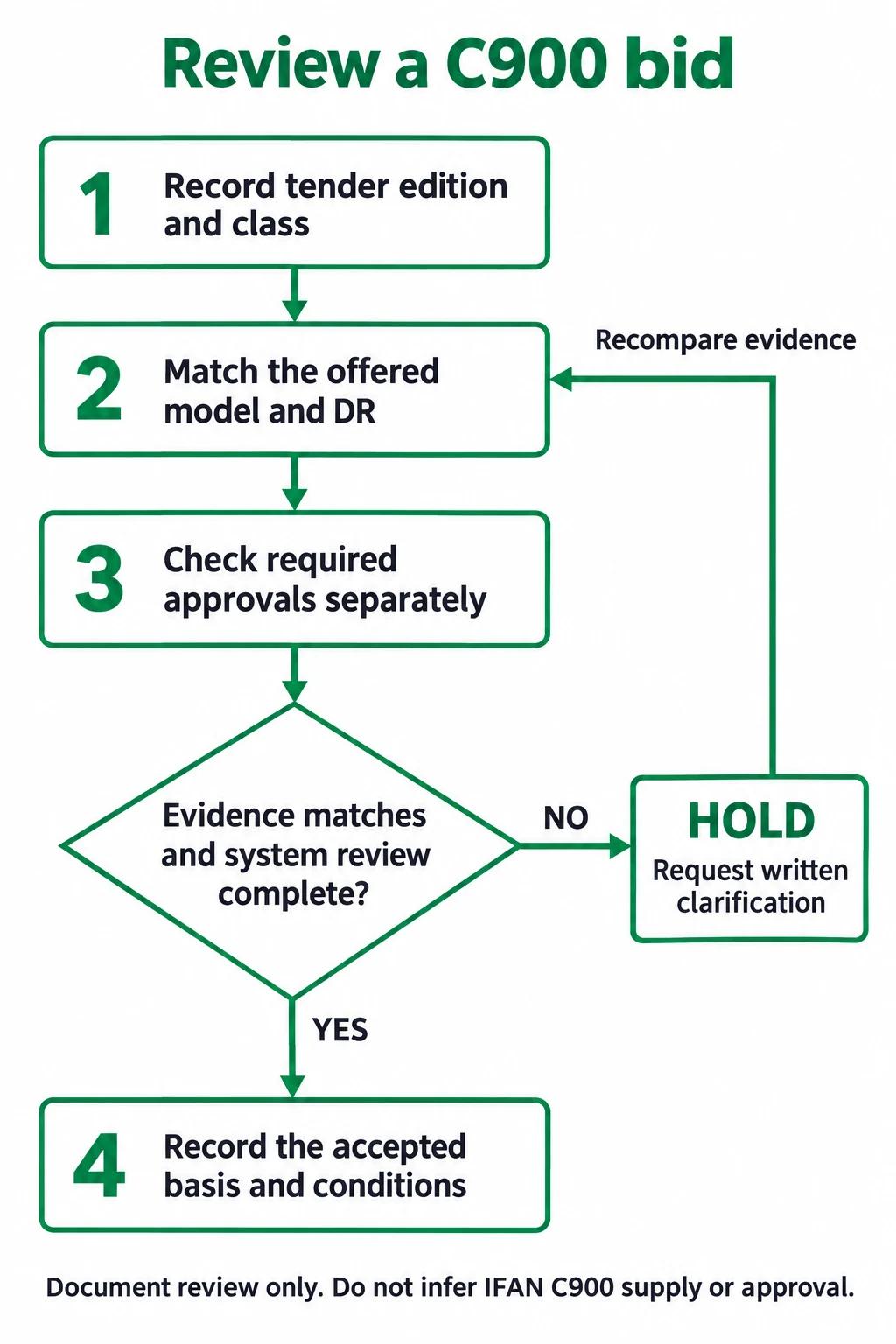
Use a short record that ties every acceptance statement to a document. Start with the tender line, including the edition and any local amendment. Beside it, identify the offered maker and exact product, dimensional basis, DR and pressure-class statement. Then add required approval records and the unresolved system checks. This gives the authority a defined question rather than a bundle of unrelated certificates.
- Copy the requested standard, edition, DR and pressure wording without silently updating them.
- Identify the offered product and match its dimensions and published rating basis.
- Compare separate required approvals on their own scope and rating.
- Hold the unresolved item and request written clarification of the specific conflict.
- Record the accepted product and conditions before treating the bid as compliant.
If every requested attribute is documented and the system designer has completed the duty checks, record the supporting references. If a conflict remains, name it and leave acceptance open. The after-input rule is simple: the authority’s written interpretation sets the requested basis; the offered model’s evidence then either matches it or requires a permitted substitution. Neither the writer nor the supplier can grant that permission unilaterally.
Commercial scheduling comes after the technical item is defined. Ask for actual availability, project quantity, production or sourcing lead time, and the effect of approval or documentation work on delivery. No C900 price, stock level, MOQ or lead time is established here. A generic PVC catalogue cannot answer those model-specific questions.
For buyers reviewing other plastic-pipe systems, the IFAN product catalogue is a starting point for identifying documented product families. Establish the exact standard and available model before treating any item as a C900 alternative.
Conclusion
Start with the contract’s edition and pressure wording. Compare the offered DR and capacity, verify separate approvals, and leave system checks visible. When legacy Class 150/DR 18 meets a PC 235 offer, obtain a written interpretation rather than upgrading the contract yourself. The accepted result is a named product on a named basis, with the remaining conditions recorded.
FAQ
Does C900 stop at 12 inches?
No. AWWA lists C900-22 for 4 through 60 inches. A particular manufacturer’s range can be narrower.
Can DR 18 mean both Class 150 and PC 235?
Legacy specifications can retain Class 150/DR 18 wording while newer product data lists PC 235. The project authority must clarify the required basis.
Is DR 25 automatically unsuitable for every fire main?
A DR label alone cannot settle fire-service acceptance. Verify the exact product’s required listing or approval and the project authority’s requirements.
Does this confirm IFAN supplies C900 pipe?
No. This is a document-review reference using public technical sources. IFAN C900 models, approvals and supply terms have not been established.
Related Briefings
Storm Sewer vs Sanitary Sewer: Identify the Service Before Specifying Pipe
Storm Drainage Pipe Sizing: Rainfall to Required Bore
Y-Strainer Selection for Water: Mesh, Pressure Drop, Blowdown
Check water Y-strainer screen openings, model pressure loss and cleanout access. Decide what fits, what is missing and when basket or duplex designs suit.