
Buried HDPE Under Vacuum: Can the Design Count on Soil Support?
Prepare a buried HDPE vacuum-line enquiry. Separate soil-support assumptions, unsupported vacuum checks and exposed stages before supplier confirmation.
Soil support can be credited only within a substantiated buried design basis; it does not remove the separate unsupported-vacuum question or cover an unreviewed exposed stage. Before ordering, ask the responsible engineer to connect those assessments to the exact selected pipe and installation sequence.
Key Takeaways
- Tie any soil-support credit to documented installation assumptions.
- Request an independent vacuum-without-soil assessment.
- Identify groundwater, vacuum duration, temperature and relevant pipe geometry.
- Include temporary exposure and crossings in the reviewed stages.
- Separate buckling acceptance from grout-placement and flotation decisions.
- Send only the engineer-selected specification for supplier confirmation.
Ask what the supported result assumes
The quotation names a pipe grade and SDR, and the design pack says the buried line passes a collapse check. Before treating that statement as a purchasing release, ask what supports the pipe in that result. Does the calculation rely on an effective soil surround, and does the installation evidence establish that assumed condition for the relevant stage?
This is a specification checklist for buyers collecting a responsible engineer’s design basis. It does not calculate collapse resistance, select a wall thickness or approve a trench detail. The useful purchasing output is a record of which assumptions are established, which remain open and who must resolve them before the selected specification is ordered.
A real Eng-Tips discussion from January 2017 asks whether buried HDPE under vacuum can rely on the constrained condition and later raises exposed crossings. That historical engineering question identifies a practical uncertainty. Its proposed dimensions, calculations and replies are not design evidence for your project, an IFAN customer case or proof of current demand volume.
The distinction is consequential: an engineer-reviewed supported result can be meaningful within its stated assumptions while remaining insufficient for a different stage. Keep the question attached to the actual pipe, loads and installation condition instead of reducing it to whether HDPE is generally suitable for vacuum.
Keep the technical source and its limits visible
An official PPI-hosted Chapter 6 of the Handbook of PE Pipe, at a path identified as the 2008 second edition, discusses a constrained combined-load assessment and an independent vacuum assessment without soil support where construction may not develop the full support. The relevant discussion is on printed pages 221–223. That is historical technical support for this distinction; it is not presented here as the latest edition or a current project design prescription.
The Vinidex PE Buckling technical page, currently available without a publication date, separately discusses unsupported collapse and stable soil surround. It also identifies time and temperature dependence and ovality as relevant considerations. Its local standards references and numerical recommendations must not be transferred into an IFAN pipe specification.
This guide therefore gives no formula, safety factor, burial-depth threshold or universal PN/SDR choice. The responsible engineer must identify the applicable current design documents and product data for the project. If a recommendation depends on a particular equation or edition, resolve that applicability before relying on it; a historical handbook link is not a shortcut around that step.
Build one record for pipe, load, support and stage
Start with the pipe identity: specified material or grade designation, outside diameter, SDR or wall specification, governing product standard and the proposed product reference. Do not silently substitute an apparently similar material designation or treat PE100 and PE4710 as interchangeable. The review has to concern the item being purchased, not a generic family name.
Next, ask the engineer to state the internal and external pressure basis, vacuum magnitude, duration, temperature and relevant duty events. Identify groundwater and other external loading assumptions. A short event and sustained loading should not inherit the same evidence merely because both are called vacuum service. This checklist records the engineer’s basis; it supplies none of those missing values.
Keep the soil evidence beside that load record. Identify the surround and installation condition assumed in the supported assessment, its documentation and any limitations. Note the roundness or ovality information used where relevant. If the required support has not been demonstrated, the supported premise remains unconfirmed even when the calculation itself is legible.
Finally, divide the drawing into actual stages and locations. Completed embedment, incomplete surround, a temporary exposed length and a permanent exposed crossing need explicit consideration in the review. A final as-built drawing can describe the intended end state without establishing what happens while the work is incomplete.
| Input group | Record to request | If missing |
|---|---|---|
| Pipe identity | Grade, OD, SDR/wall and product standard | Cannot connect review to offered pipe |
| Loads and duration | Vacuum, external pressure, groundwater, temperature and relevant events | Actual duty remains unresolved |
| Soil support | Assumed surround and evidence of its applicability | Supported premise unconfirmed |
| Stages | Completed, temporary and exposed conditions in scope | Unreviewed stage stays open |
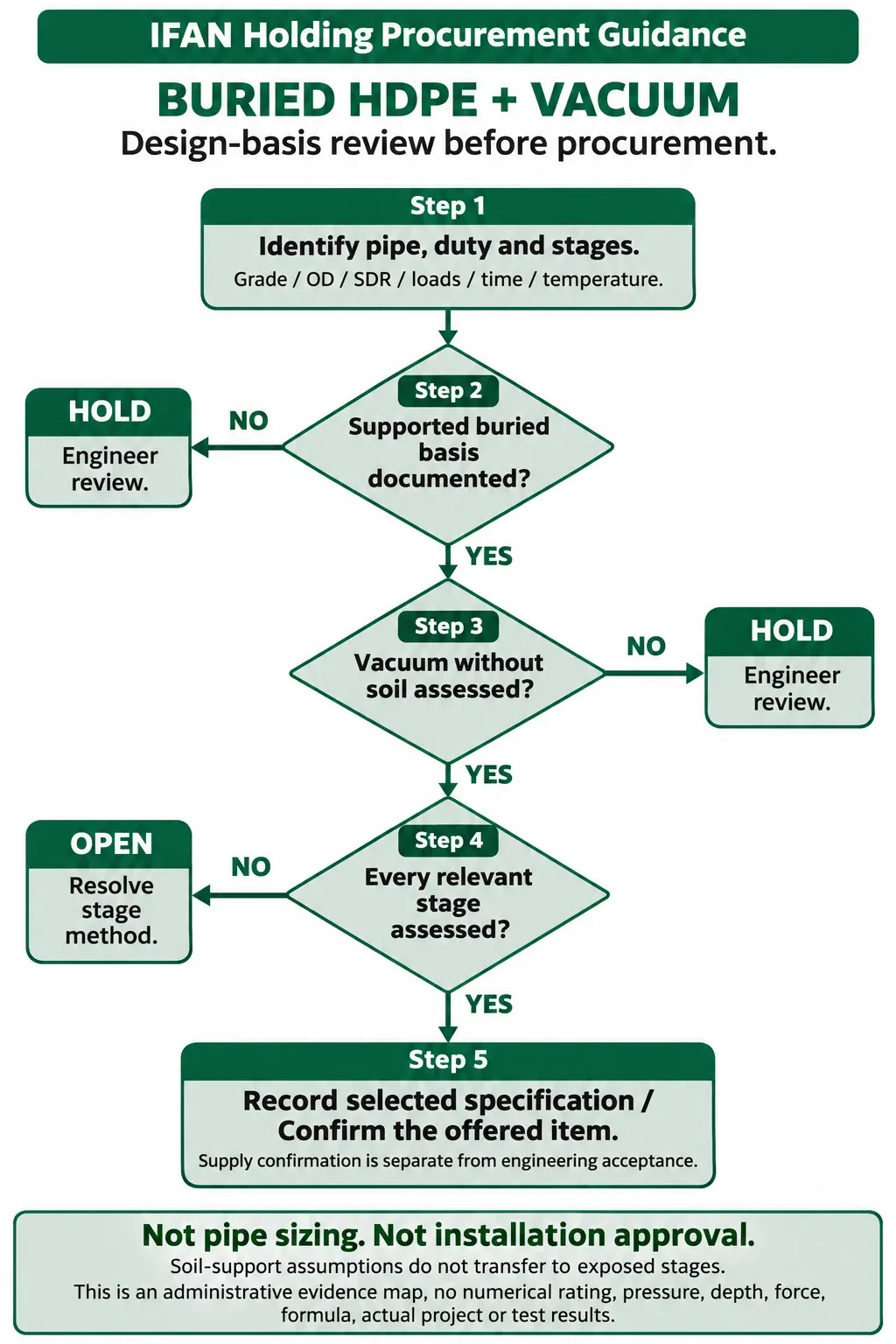
Open the review map at full size.
- Identify the pipe specification, duty, loads, time, temperature and relevant installation stages.
- If the supported buried design basis is not documented, hold for the responsible engineer’s review.
- If an independent vacuum assessment without soil support is absent, hold for the responsible engineer’s review.
- If a relevant temporary or exposed stage is not assessed, keep its stage method open for the responsible engineer.
- Record the engineer-selected specification and confirm the offered item separately; supply confirmation does not approve engineering or installation.
Record A: a supported pass is the only collapse evidence
Consider a fictional bid pack containing an internal-pressure designation, pipe dimensions and an engineer’s buried supported-collapse result. The record identifies the intended soil condition and groundwater case, but contains no independent vacuum-without-soil assessment. The buyer is being asked to release the same specification for procurement.
The completed disposition is “design basis incomplete for this procurement decision.” Request the responsible engineer’s separate unsupported-vacuum assessment and clarification of the support assumptions. Do not infer a passing result from the internal-pressure designation or choose a thicker SDR yourself to close the missing item.
Change a material condition: the installation evidence no longer establishes the soil surround assumed in the supported assessment. There are now two open matters, not just the missing independent check. Ask the engineer to revisit the supported premise as well. The existence of a calculation headed pass cannot replace evidence that its assumptions apply.
If the engineer subsequently supplies an applicable independent assessment and confirms the support basis, those gaps can be reviewed against the actual documents. The buyer can advance the specification enquiry on that defined basis; supplier availability and conformity to the selected specification are still separate questions.
Record B: the completed buried case excludes an exposed stage
In a second fictional record, the engineer-reviewed pack covers the completed buried line, including its documented support and relevant loads. A proposed construction sequence introduces an exposed section while a vacuum-producing operation is contemplated. That stage is absent from the reviewed pack.
The decision is “temporary-stage method unresolved.” Identify the exposed length or location, the actual operating event and the time for which the condition may exist, then refer that combination to the responsible engineer and method owner. Do not apply soil-supported resistance to a stage in which that support is not present.
A temporary dewatering proposal likewise needs its actual water levels, sequence and resulting loads assessed rather than an automatic label of safe or unsafe. This article does not prescribe filling the pipe, strapping it, adding a bypass or using any other construction remedy. A method has to be qualified for the real circumstances.
Change the record so the responsible engineer explicitly assesses the proposed stage and issues the corresponding method constraints. That can resolve the stage-coverage gap. It does not mean an earlier buried result was valid for the exposed condition, or that a later change to the sequence can reuse the assessment without review.
Record C: the design basis is complete but supply is unconfirmed
For a third fictional enquiry, the responsible engineer has documented the relevant supported and independent unsupported assessments, load durations, temperatures and temporary or exposed stages, and has selected a specific pipe specification. The supplier has not confirmed an available product matching that selection.
The next action changes from seeking missing design evidence to requesting a specification-matched supply response. Send the selected grade designation, OD, SDR or wall requirement, standard, applicable temperature and service conditions, drawing revision and the engineer’s documented restrictions. Ask the supplier to identify the offered item and state what documentation is available.
If the response substitutes a different grade, wall specification or standard, return the discrepancy for engineering and procurement review rather than accepting a nominal-size match. A clear supplier response can establish what is being offered. It does not itself approve the collapse design, prove an IFAN vacuum rating or demonstrate a project installation result.
| Record | Established | Missing | Next action |
|---|---|---|---|
| A | Supported result supplied | Independent unsupported vacuum assessment | Hold basis for engineer review |
| B | Completed buried case assessed | Proposed exposed construction stage | Hold stage method for assessment |
| C | Applicable engineering basis and pipe selection documented | Matching offered product and documentation | Request exact supplier confirmation |
Keep this check separate from grout and flotation decisions
Our HDPE installation guide supplies general installation context. Its discussion of bedding is not an independent acceptance of this vacuum and support basis. Similarly, a pipe’s internal-pressure selection does not settle which soil assumptions are justified in a collapse assessment.
A sliplining annulus or grouting review asks about a different installation arrangement and its placement loads. Do not replace that assessment with an open-trench soil-support statement. A flotation review also has a different decision: maintaining position against uplift does not establish resistance to buckling. Where more than one concern applies, record separate review references and resolve their interfaces.
This separation helps preserve responsibility. The supplier identifies the offered product and supporting documents. The responsible engineer accepts the design basis and selected specification. The appointed installation or method owner establishes how the approved sequence is followed and recorded. None of those roles is transferred by attaching a product catalogue to a drawing.
| Question | Party to answer | Evidence to retain |
|---|---|---|
| Do support and load assumptions apply? | Responsible engineer | Applicable design-basis assessment and revision |
| Is the proposed temporary stage covered? | Engineer and appointed method owner | Stage assessment and method constraints |
| What exact item is offered? | Supplier | Product identification and stated deviations |
| Which product documents are available? | Supplier, with required scope defined by buyer and engineer | Actual documents and their applicability to the offered item |
Prepare an exact HDPE supply enquiry
IFAN Holding’s product range includes HDPE pipe and fittings. Use that route to ask about availability and documentation against the engineer-selected specification. Include the application and constraints so the enquiry cannot be mistaken for an ordinary internal-pressure-only order.
Ask for identification of the proposed product and any stated departures from the request before comparing commercial terms. Confirm which technical documents can actually be provided, their scope and their applicability to the offered item. Do not assume a certificate, a batch record or a vacuum acceptance letter exists merely because a general catalogue uses broad quality language.
This article establishes no IFAN civil or soil-design service, guaranteed stock, vacuum rating, certification or per-batch documentation promise. If the offered product and engineering selection have not been reconciled, keep the purchasing release open. When they are reconciled, retain the named documents and revisions rather than converting the result into a blanket approval of every HDPE line.
Conclusion
Prepare the enquiry with the pipe identity, support basis, independent vacuum assessment and every relevant stage reference. Mark whether the open question belongs to engineering, the installation method or the supplier’s offered specification. A defined missing item is actionable; a general statement that the pipe is buried is not a purchasing release.
Frequently Asked Questions
Does burial automatically establish vacuum resistance?
No. The supported assessment must have a substantiated soil basis, with the separate unsupported-vacuum question and relevant stages addressed by the responsible engineer.
Can I choose a thicker SDR to close a missing calculation?
This checklist does not select SDR. Return the missing assessment and proposed pipe specification to the responsible engineer.
Does a completed buried assessment cover an exposed crossing?
Only if the actual crossing and its loads are explicitly included in the applicable review. Do not transfer soil-support assumptions to an unsupported stage.
Can IFAN’s catalogue approve my vacuum design?
A catalogue can support an enquiry about an offered product. It does not replace project engineering acceptance or establish a product-specific vacuum rating.
Written by Justin · IFAN Holding procurement guides