
Replacement Pressure Gauge: Match the Port and Seal Before Ordering

Match a replacement pressure gauge to its retained port. Check thread, sealing seat and both adaptor interfaces before accepting a substitution.
A replacement pressure gauge must match both the process thread and the sealing interface. “Same nominal size” is insufficient: the proposed connection must mate correctly, and its intended seal must actually reach the matching seat. Before accepting a substitution, compare the old and proposed instrument drawings with the port drawing. An unresolved connection or seat geometry means the replacement remains unconfirmed.
Review the proposed replacement, not the catalogue label
A maintenance purchaser may receive a replacement offer with a similar dial and pressure scale but a different process connection. In the comments beneath WIKA’s pressure-gauge connection explanation, one reader describes an existing instrument with two G connections and a proposed replacement with two NPT connections. The practical task is accepting or rejecting that substitution, rather than learning another generic list of pipe-thread names.
Keep the existing port, proposed instrument and any connecting component as separate items in the review. A supplier’s label for the new gauge identifies only one side of the joint. It does not identify the retained female port, its seat or the space available around the assembly. Do not infer those details from the country where the equipment was bought.
IFAN’s pipe-fitting overview covers the wider distinction between incompatible thread families. This page starts at the next decision: what evidence would establish that a specific replacement gauge and retained port can form their intended seal?
Find the intended sealing interface
WIKA distinguishes a tapered NPT connection using the threaded interface from its illustrated parallel G gauge connection using a separate sealing washer. That makes “add more sealing tape” an unsuitable general response to an unidentified interface. A replacement review needs the exact product’s sealing arrangement, not a universal remedy for anything that screws in.
The retained port matters as much as the instrument thread. In a separate response, WIKA explains that the counterpart geometry must allow the intended gasket to seal. A connection can bottom out before that happens when the counterpart geometry is wrong. This is a reason to compare drawings and sealing faces, not an invitation to tighten harder or modify a port on site.
Ask the instrument supplier to identify the thread standard, size, male/female form, intended seal and matching counterpart requirements. Where those details are missing, leave the interface unconfirmed. A photograph may help identify the assembly, but it should not replace a drawing when seat position or engagement geometry decides acceptance.
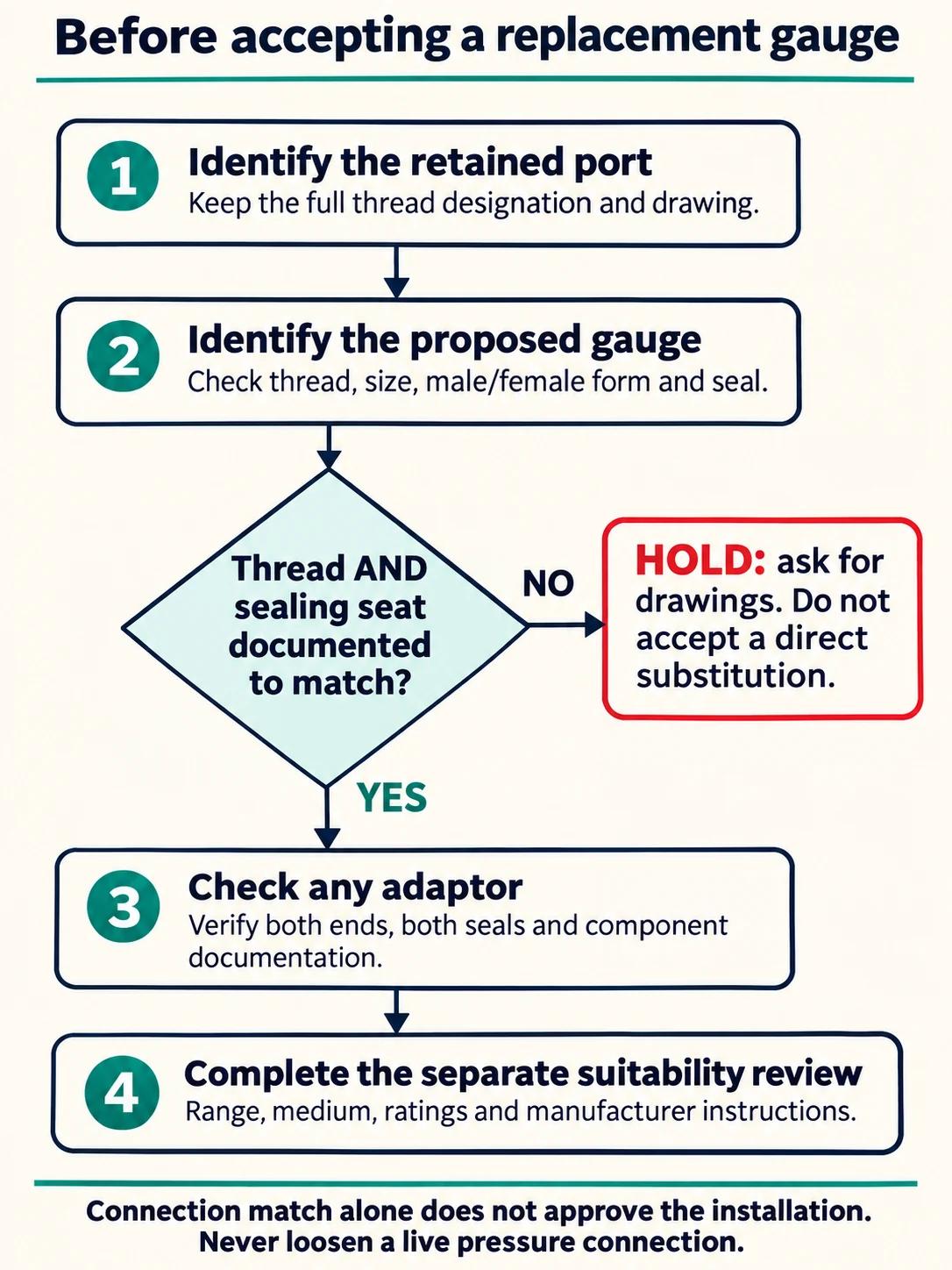
- Identify retained port
- Identify proposed gauge
- Resolve thread and intended sealing-seat match; hold unresolved substitution
- Verify both adaptor ends and complete separate suitability review
A worked substitution review
Consider this illustrative purchasing situation: the retained port is documented for one named G gauge connection, and the replacement offer names an NPT connection. No adaptor has been specified. The initial disposition is “do not accept as a direct replacement.” Similar nominal size or a plausible first turn of engagement does not resolve the difference.
| Proposal | Review result | What would change the result? |
|---|---|---|
| Direct substitution with a different thread family | Direct fit unconfirmed; do not accept this line as specified. | A matching documented connection option or a fully specified interface arrangement. |
| Offer changed to the matching thread designation | Thread question narrowed; complete seal still unconfirmed. | Drawings establish the intended seal and matching seat geometry. |
| Adaptor suggested without drawings | Two undocumented joints replace one unresolved joint. | Identify both adaptor ends, seals, ratings and installed arrangement. |
Changing the offered thread name therefore changes only part of the assessment. If the revised gauge has the correct thread but its seal cannot reach the intended seat, the purchase line is still unresolved. Conversely, a documented interface match addresses the connection question without establishing that the gauge is suitable for the process.
Open WIKA manufacturer installation context
An adaptor needs two accepted interfaces
Draw the proposed chain as retained port → adaptor → gauge. For each arrow, record the male and female thread definitions and the sealing method. Then check the proposed assembly against the required service and the manufacturers’ instructions. This keeps an adaptor from disappearing into the vague phrase “fitting included.”
The supplier should identify the actual component and provide its supporting documentation. Do not transfer a gauge’s pressure rating to the adaptor or infer material compatibility from thread fit. Equally, a correctly rated adaptor does not cure an unsuitable gauge range, reference or wetted material. Those are separate acceptance decisions.
This article gives no installation torque, minimum engagement or live-removal procedure. Follow the responsible site’s isolation and depressurisation process and the exact manufacturers’ instructions. Never loosen a pressure connection merely to identify its thread.
Send a specific replacement question
An effective request identifies the retained port, the existing gauge and the proposed replacement as three references. Attach their available drawings; mark an unknown drawing or seal explicitly rather than guessing. Ask the supplier to return a proposed connection arrangement that names every sealing interface and any remaining condition.
Illustrative enquiry: “Please confirm whether the proposed instrument is a documented replacement at the attached retained port. Identify the process thread, sealing arrangement and seat geometry. If an adaptor is required, specify both ends and their seals, the component documentation and the installed arrangement. Please keep unresolved items separate from confirmed matches.”
For wider piping requirements, use the IFAN product catalogue to identify the relevant pipe-system family. This technical explanation does not establish an available IFAN gauge, adaptor, calibration service or approved replacement package. Any exact component offer needs separate confirmation against the application and supporting documents.
| Reference | Record before accepting |
|---|---|
| Retained port | Drawing, full thread designation and sealing seat. |
| Proposed gauge | Connection drawing, intended seal and counterpart requirements. |
| Any adaptor | Both ends, both seals and component documentation. |
| Remaining assessment | Keep range, medium and installation suitability separate. |
Conclusion
Accept a replacement gauge’s process connection only when the thread and intended seal are both resolved against the retained port. Keep drawings and remaining unknowns with the purchase line. If an adaptor is introduced, verify both new interfaces; then complete the separate assessment of instrument and application suitability.
Frequently asked questions
Is the same nominal size enough?
No. Confirm the full thread designation and intended sealing interface, including the matching seat.
Can sealing tape fix a mismatched connection?
Do not use tape as a substitute for identifying a compatible interface. Follow the exact component’s specified sealing method.
Does a correctly fitting gauge finish the selection?
No. Range, pressure reference, fluid, temperature and other application requirements remain separate decisions.