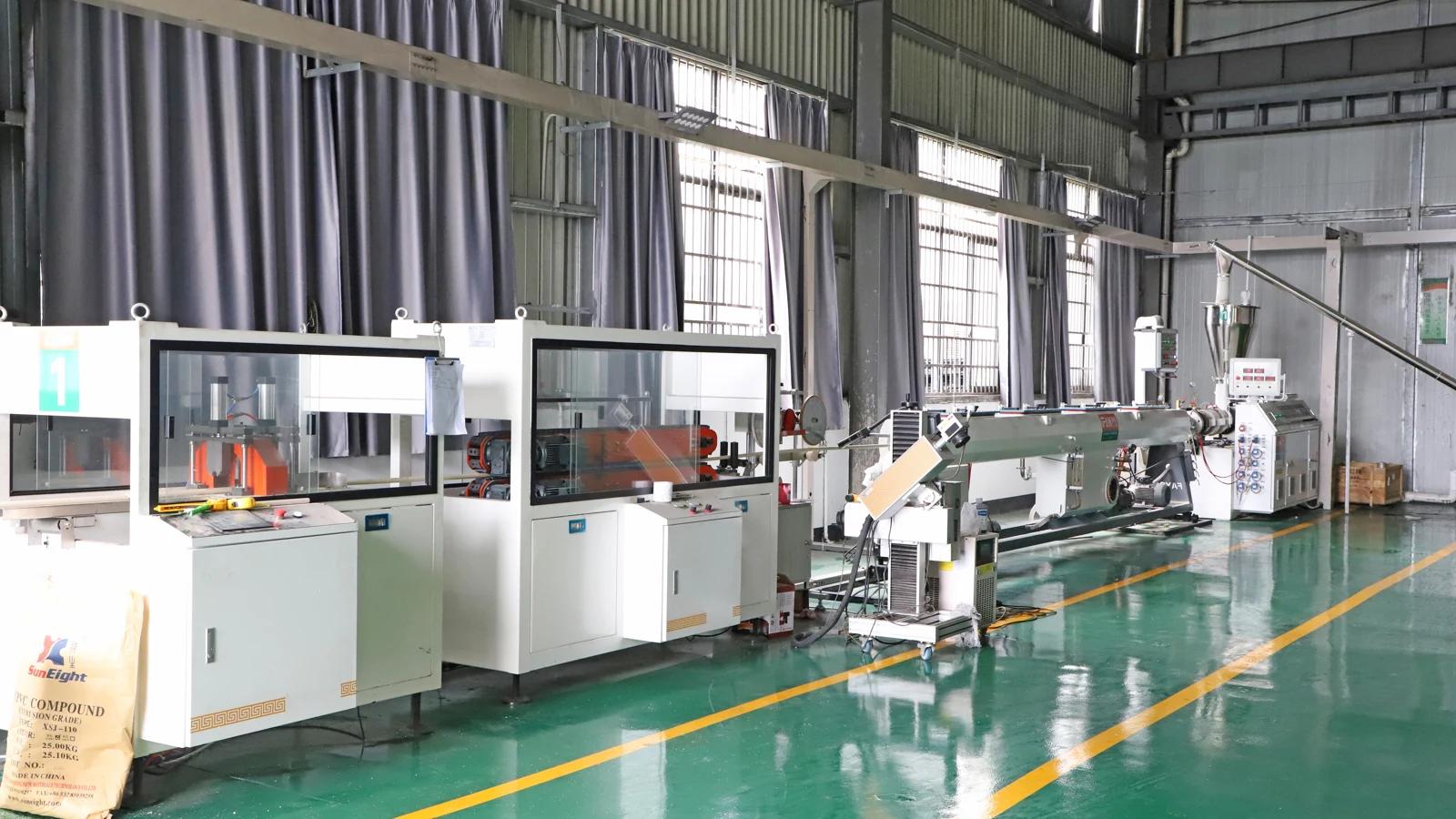

Keep Collector and Carrier Pipe Separate in a Drainage Order
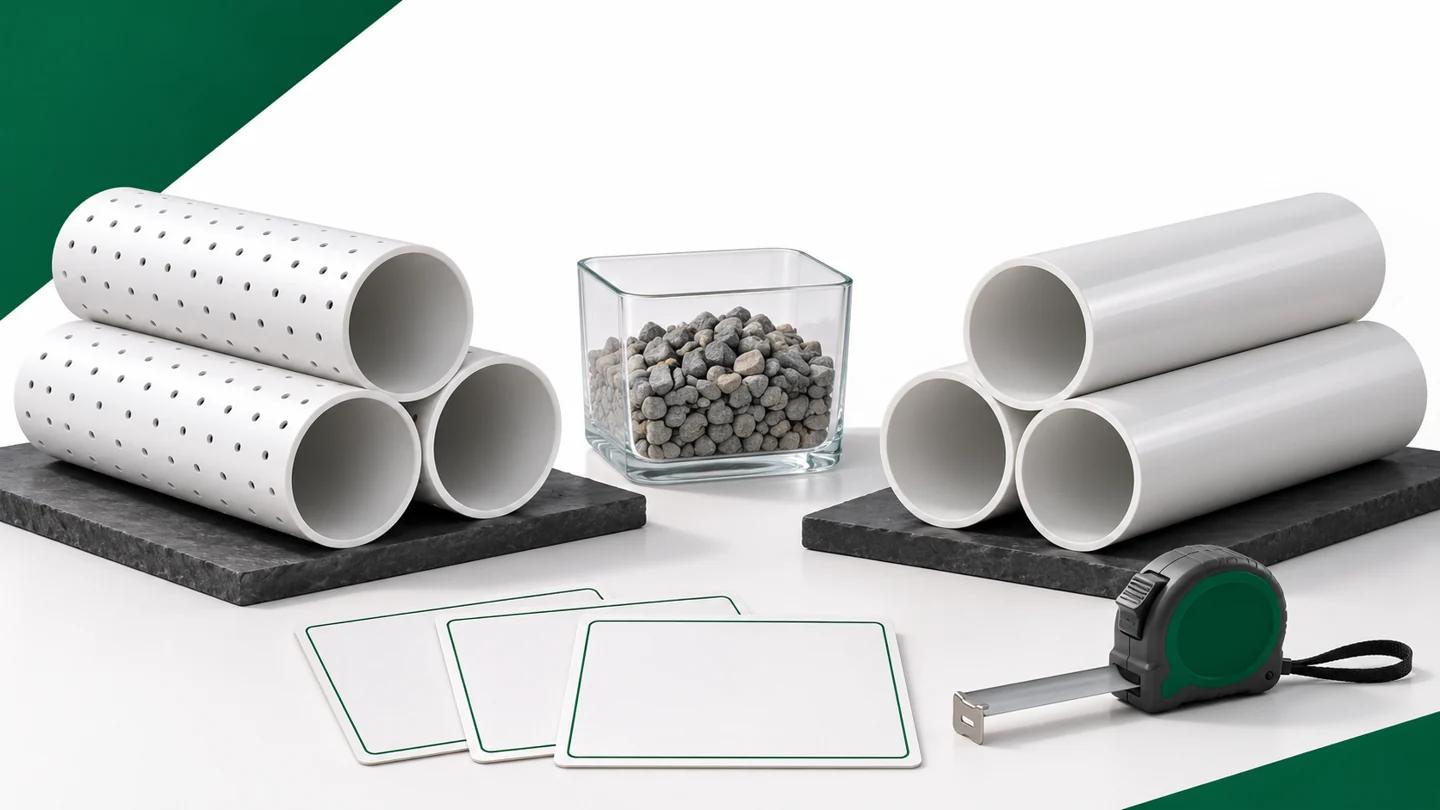
Build a drainage purchase schedule that separates collector pipe, solid carrier pipe and aggregate bundles, with worked quantity and pipe-inclusion checks.
Order perforated collector pipe and solid carrier pipe as separate lines in a drainage purchase schedule. Start from the approved route and assign each section its required function, then reconcile the exact product and effective quantity. A shared diameter does not make solid and perforated pipe equivalent. If the proposal uses an aggregate bundle, confirm whether the selected model actually includes pipe before counting it toward the pipe requirement.
Key Takeaways
- Keep route length, pipe length and aggregate-bundle quantity in separate fields.
- A matching nominal diameter and connection do not prove that a pipe has the required openings.
- Pipe-containing and aggregate-only bundles cannot satisfy the same purchase line automatically.
- Change the schedule when the route function changes, even when the diameter stays the same.
- Resolve the outlet, filter, loading and installation requirements through the actual design and product instructions.
- Public manufacturer examples identify distinctions to check. IFAN product availability requires its own confirmation.
Open the NDS EZ-Drain installation context video
Divide the route before counting pipe
A drainage drawing can contain a section intended to admit water through openings and another section intended to carry collected water toward an outlet. Give those sections different identifiers before preparing the order. The purchasing task is to preserve the design distinction through the quotation, delivery and installation handover.
Do not infer the route from a product listing. Establish where the collector begins and ends, where the connecting carrier begins, and which destination the designer has specified. If the destination, levels or collection requirement remain unresolved, record that gap. Buying a longer roll does not answer it.
A project-specific example appears in the geotechnical report hosted by the City of San Diego for Rady Children’s Hospital. Its wall-drain detail shows perforated PVC followed by solid outlet pipe. That is evidence of a design separating collection and conveyance. The detail’s slope, fabric and wall requirements belong to that project and are not installation specifications for a different French drain.
This distinction also limits the advice here. The schedule below is a procurement check after the route functions have been established. It does not size a drain, approve an outfall, select filter material or authorize excavation beside a foundation. Have those inputs resolved by the appropriate project designer and current local requirements.
Separate products that share a diameter
A supplier can offer two pipes with the same nominal size, outside diameter and connection while supplying different wall-opening patterns. Charlotte Pipe’s current plastics technical manual provides a concrete example. Its four-inch D2729 entries distinguish PVC 30040 from perforated PVC 30040P. Both are listed with a 4.215-inch average outside diameter. Their dimensional match does not make them the same ordered item.
The added letter matters because it identifies the perforated version in that manufacturer’s table. It is not a universal coding rule. Another manufacturer may use a different suffix or a separate product family. Require the exact offered designation and its accompanying product description instead of telling a seller simply to add a “P.”
Record the opening requirement explicitly beside the manufacturer’s model. A line reading “four-inch drainage PVC” leaves the distinction hidden. A line that identifies the specified system, exact product and solid or perforated construction gives the receiving inspector something to compare with the delivery.
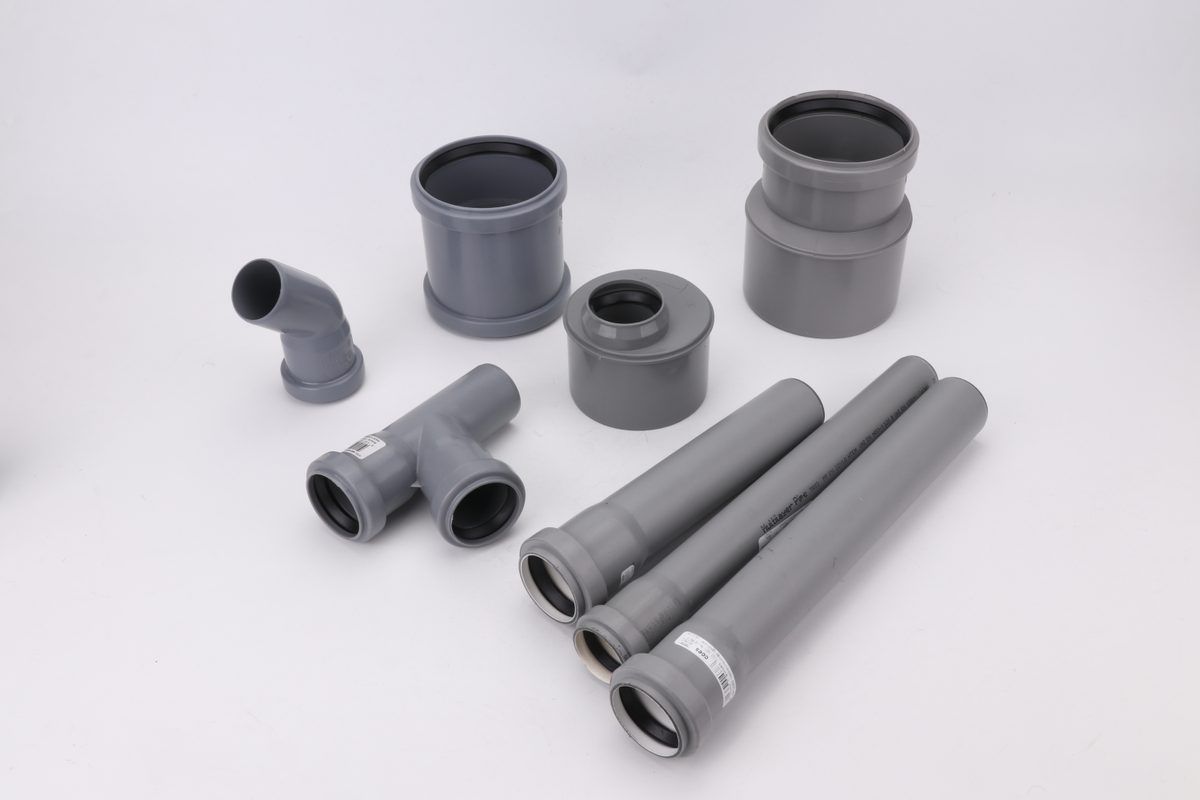
Socket compatibility is a separate column. Our SDR35-to-Schedule-40 adapter guide addresses the exposed-end and transition question. Passing that check does not settle the pipe-opening requirement. Keep the dimensional-system review in the D3034 sewer-pipe submittal guide separate from the section-by-section quantity decision here.
Build the purchase ledger around section identifiers
The following quantities are invented examples for checking an order. They are not a drainage design, an IFAN quotation or an installation record. Assume an approved drawing requires an 18-metre collector section and a separate 12-metre solid carrier section. The arithmetic preserves two requirements even though their total route length is 30 metres.
| Section | Required function | Drawing quantity | Purchase identity to resolve |
|---|---|---|---|
| C1 | Collection through specified pipe openings | 18 m | Exact perforated or slotted product required by the design |
| T1 | Conveyance through a specified solid pipe | 12 m | Exact non-perforated product required by the design |
| Interfaces | Connect the documented sections and outlet | Count from actual junctions | Compatible end forms, joining method and components |
Buying 30 metres of perforated pipe satisfies the total-length number while leaving the solid section unmatched. Buying 30 metres of solid pipe has the inverse problem. Neither order becomes acceptable simply because the combined delivered length equals the route length.
Maintain three quantity fields for each line. The drawing quantity records the required installed section. The purchase quantity records the proposed units or lengths. The reconciliation explains how those purchased items cover the drawing quantity, including cuts, joints and the actual product’s usable length. Do not assume a universal allowance or that every nominal stick length contributes that full length after joining.
Leave unresolved allowances visible. For example, the order can show C1 drawing quantity 18 metres, purchase quantity pending, and “confirm effective lengths and cut plan” as the next action. That is more useful than adding an unsupported percentage and presenting it as a measured requirement.
Find the missing-pipe error in a bundle quotation
NDS states that its EZflow French drain kits are available with or without slotted pipe. That creates a second purchasing risk beyond solid-versus-perforated construction. A delivered drainage bundle may provide the aggregate assembly while leaving the internal pipe to be supplied separately.
Read the exact model description and manufacturer documentation before assigning a bundle quantity to the pipe ledger. The presence of mesh and aggregate does not establish pipe inclusion. Conversely, an assembly that includes pipe should not automatically receive a second internal-pipe order without checking whether that would duplicate the specified component.
Consider an illustrative quote for six bundles, with each bundle described by the seller as covering three metres. The proposed bundle coverage is 18 metres. If the exact selected model excludes pipe, the collector pipe requirement remains 18 metres outstanding. The bundles may meet a separately approved aggregate-assembly requirement, but that does not close the pipe line.
If the documented version includes compatible pipe and its effective coverage actually satisfies C1, reconcile that quantity against C1 once. The solid T1 carrier remains a separate requirement. This is the changed condition that determines the order result: pipe inclusion changes, rather than the nominal route length.
| Verified offer | Collector pipe counted | Result |
|---|---|---|
| 18 m aggregate-only coverage | 0 m from the bundle | Keep 18 m collector pipe unresolved |
| 18 m effective coverage with specified pipe included | 18 m, subject to the exact approved assembly | Reconcile C1 once and avoid double counting |
| Pipe inclusion not documented | Unknown | Hold that line and obtain the model description |
Do not infer suitability from this counting exercise. Pipe inclusion, filter arrangement, soil, loading, burial conditions and the permitted application still require the exact assembly’s instructions and project acceptance. An accurate material count can still describe an unsuitable assembly.
Recalculate when the collector boundary moves
Suppose the designer revises the same illustrative 30-metre route to 12 metres of collector and 18 metres of solid carrier. The total length stays at 30 metres. A total-only purchase schedule would conceal the change.
Compare the revised schedule with the earlier 18-plus-12 split. It now needs six metres less collector coverage and six metres more solid carrier coverage, before resolving effective lengths and the actual cut plan. Those differences are arithmetic consequences of the example, not suggested allowances for a real project.
Retain the original line identifiers and drawing revision in the change record. Ask which unopened products can be reassigned, which quantities need to change and whether the seller accepts a return or substitution. Keep price, restocking conditions and delivery timing unknown until the actual supplier confirms them.
The same discipline applies to interfaces. Moving the boundary can change where a transition, access point or assembly connection is required. Update the junction count from the revised layout. Do not assume that maintaining the same total route length preserves the fitting list.
Release the order against resolved inputs
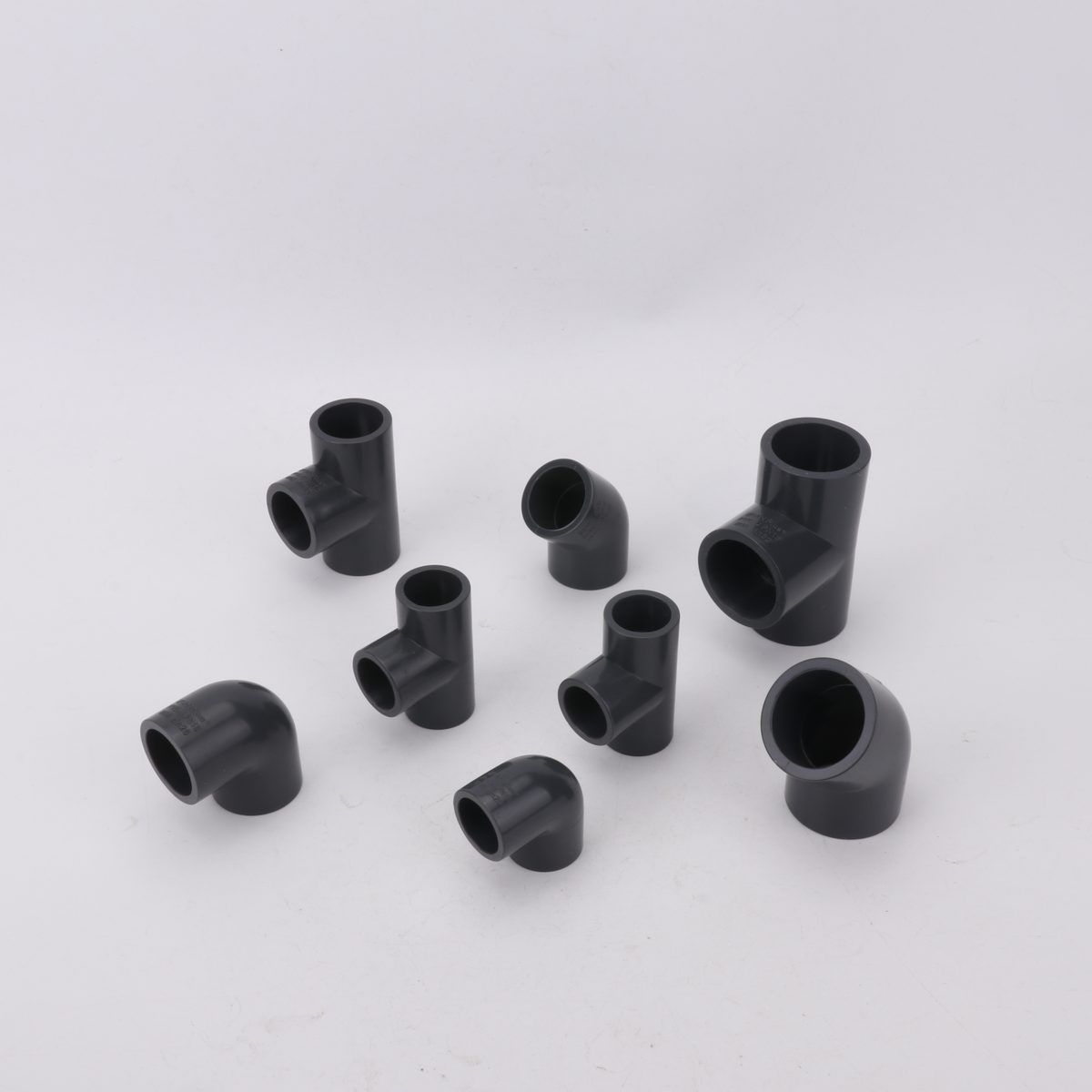
Ask the supplier to respond against the section ledger, preserving C1 and T1 in the quotation. For each line, obtain the proposed product identification, construction, effective supplied quantity and connection documentation. Where a bundle is offered, add an explicit pipe-included field and identify any separate required components.
At receipt, compare the delivered markings and packaging with those accepted lines. Separate a verified match, a documented difference requiring review and an unresolved identity. Keep affected materials identifiable until the mismatch is resolved. A photograph can support the record but should not replace the exact product documentation.
The IFAN product catalogue is an entry point for an availability enquiry. Send the destination, design-specified pipe system, section quantities, solid or perforated construction, connection requirements and requested documents. Ask which exact models can be offered. The Charlotte and NDS examples here do not establish IFAN stock, equivalent products, prices, minimum quantities or delivery promises.
Before ordering, freeze the approved drawing revision, the functional section ledger, the exact offered identities and the unresolved-item list. Release the matched lines according to the project’s purchasing process. A missing outfall decision or unknown bundle contents should remain a named action with an owner, rather than disappearing inside an apparently complete metre total.
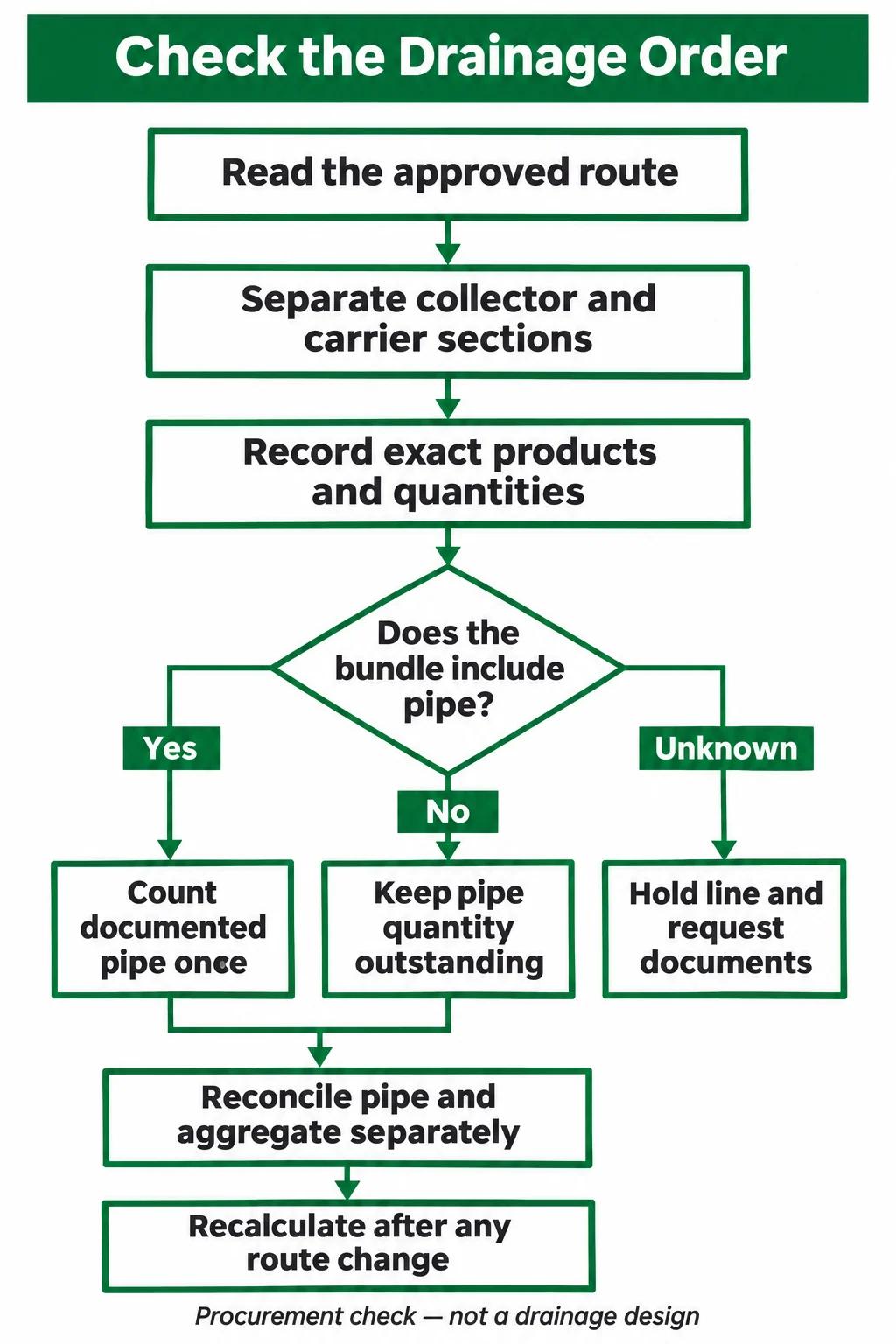
- Read the approved route revision.
- Separate collection and solid carrier sections.
- Record exact construction, model and effective quantities.
- Does a quoted bundle include the specified pipe?
- If unknown, hold the affected line and ask for the model documents.
- Reconcile pipe quantities separately from aggregate coverage.
- When the route changes, recalculate each section and its junctions.
Conclusion
A useful drainage purchase schedule preserves what every section must do. Reconcile collector pipe, solid carrier pipe and aggregate assemblies separately, then check the exact product and effective quantity. When the route or bundle contents change, recalculate the affected lines before treating the order as complete.
Frequently asked questions
Can the same diameter prove solid and perforated pipe are interchangeable?
No. Charlotte’s named four-inch D2729 examples share an average outside diameter while identifying separate solid and perforated items. Check the required construction and exact product.
Does every French drain aggregate bundle include pipe?
No. NDS describes versions with and without slotted pipe. Confirm the exact selected model and count pipe coverage only when inclusion and suitability are documented.
Can I use this example to set drainage slope or trench depth?
No. The numbers illustrate purchase reconciliation. Obtain the project’s route, levels, filter, loading, outlet and installation requirements separately.