
Grease Interceptor Sizing: Check the Method Before Ordering

Check the local sizing method, fixture schedule, rating units and approval record before ordering a grease interceptor. Use a quote-review checklist.
Grease interceptor sizing starts with the method accepted for the project location, the fixtures it must serve and the kind of rating the method produces. Before ordering, match that requirement to the exact proposed unit and obtain the required project approval. A flow rating, liquid holding volume and grease storage capacity answer different questions; one number cannot stand in for all three.
A large number on a quotation can still describe the wrong requirement. The practical purchasing task is to preserve the chain from the authority’s instructions to the supplier’s model, so a change in kitchen equipment or connection arrangement can be checked before money is committed. This guide shows how to build that review record. It does not calculate a final size for an unidentified kitchen.
Key Takeaways
- Identify the local sewer or wastewater authority and the applicable project review requirements first.
- List fixtures by use and connection route, including each relevant sink compartment and equipment discharge.
- Keep flow rate, liquid volume and grease storage ratings in separate, labelled fields.
- Record the approved assumptions; do not import a drain period or percentage from another method.
- Match calculations, drawings and model data to the same project revision.
- Release an order only after the required approval and exact-model checks are resolved.
 Watch the educational example on YouTube
Establish which method governs this project
Start with the project address, the receiving wastewater service and the work being proposed: a new kitchen, a change of use, equipment additions or replacement of an existing interceptor. These are identification fields for the review, not a formula. They help the designer and reviewing authority establish which instructions actually apply. A supplier’s calculator can only be evaluated after that basis is known.
Austin Water’s published criteria give a clear local example. They call for building-plan approval and an Industrial Waste letter specifying size and design before purchase. The page also asks buyers to confirm approval of the specific model. Its fixture-unit procedure calculates flow and then liquid holding capacity; the reviewing staff retain professional judgment. Those are Austin requirements, not a universal sizing recipe.
Save the relevant instruction or written clarification with its date and project reference. Record what it authorizes: a method, a proposed arrangement, a particular unit, or the completed design. An approval of one part should not be silently expanded to the others. If the authority has not confirmed which route applies, the useful outcome is a named open item, rather than a provisional model presented as approved.
The Johnson County Wastewater requirements illustrate why the process can differ. Their gravity-interceptor provisions require sizing calculations sealed by a Kansas professional engineer and use a connected-fixture DFU calculation. Their hydromechanical provisions separately address grease production and storage. Copying only a tank volume from that page would omit the local design submission and the distinction between device routes.
For an international procurement team, the transferable result is the review sequence, not either jurisdiction’s legal minimum. Record the competent authority, accepted method, applicable project conditions and person responsible for the design. If two documents appear to disagree, identify the exact fixture or assumption causing the disagreement and obtain clarification before comparing products.
Make the fixture schedule auditable
A kitchen inventory and an interceptor sizing schedule are related, but they are not automatically identical. The inventory describes what exists. The sizing schedule must show what discharges through the proposed interceptor and how the governing method treats it. Preserve both the equipment tag and its drainage route so another reviewer can follow the load back to the drawing.
Metro Vancouver’s public tool instructions request a fixture list, dimensions or rated flow as appropriate, and the manufacturer’s rated flow for an existing interceptor. The tool is regional guidance under its named bylaw and does not replace professional advice. Its public input screens ask for every sink compartment and identify manufacturer peak-discharge information for dishwashers.
Build each schedule row around an identifiable item: equipment tag, use, compartment information or equipment discharge data, route to the interceptor, and the basis used in the calculation. Where a fixture drains through a receptor, show that relationship rather than leaving two unrelated names in a list. The applicable method determines how it is counted; the buyer should not invent a double-counting rule.
For uncertain equipment, write a specific question. “Dishwasher DW-1 peak discharge data missing” identifies a resolvable gap. “Kitchen details to follow” does not. The missing rate matters because the calculation cannot be reproduced from the equipment description alone. Obtain the exact model’s data, have the responsible designer apply the accepted treatment, then update the result and quotation comparison together.
The schedule should also distinguish proposed connections from surveyed existing ones. A new layout can be complete while the route of an old floor receptor remains unconfirmed. Keep that uncertainty attached to the affected fixture. The service-identification guide explains the broader source-and-receiver question; identifying sanitary service still does not establish the interceptor’s required fixture connections.
Separate the three capacity questions
Write the meaning beside every quoted number before deciding whether two offers are comparable. A unit of volume measures an amount of liquid; a volume-per-time unit measures a rate; a mass unit measures an amount of grease. Converting litres to gallons changes the unit used for a volume. It does not turn that volume into a rated flow or a grease storage rating.
| Field | What the number describes | What to compare | What remains separate |
|---|---|---|---|
| Rated flow, with stated units | Liquid flow rate for the proposed unit | The accepted flow requirement and the exact model’s documented rating | Liquid holding volume and grease storage |
| Liquid holding capacity, with stated units | Liquid volume identified in the design or product data | The local design requirement and the model’s corresponding liquid-capacity definition | Flow acceptance and grease storage |
| Grease storage capacity, with stated units | Grease quantity identified by the applicable requirement and model documentation | The required grease quantity and the exact unit’s corresponding documented capacity | Flow acceptance and liquid volume |
This separation does not prescribe three universal sizing tests for every installation. It prevents information from one field being used to answer a different field. The local method establishes which requirements must be satisfied and how. Austin’s page expressly ties hydromechanical selection to both flow rating and a liquid-capacity requirement; Johnson County’s hydromechanical section illustrates an additional grease-production basis.
Likewise, a product’s outside dimensions cannot establish its useful liquid holding capacity, and a pipe connection diameter does not establish the unit’s flow rating. Ask the supplier to identify the relevant rating on the exact data sheet, with the unit and configuration clearly stated. If a quote merely says “capacity 100,” record the offer as unclassified until the supplier identifies what 100 measures.
Once the meanings match, check unit conventions before comparing numerical values. Preserve the original units in the review record and show any conversion separately. Avoid an unlabeled “gallon” conversion where the underlying unit convention has not been established. A clear record lets a second person reproduce the comparison without inferring units from the supplier’s country.
Check the assumptions behind a flow result
The City of Calgary’s two-page sizing guide provides a bounded example: two sink volumes of 64 and 27 litres are each multiplied by 0.75, giving 48 and 20.25 litres. Their combined 68.25 litres produces 68.25 litres per minute under the guide’s stated one-minute drain-down assumption. The guide also identifies operating factors outside that simple calculation.
The important review distinction is between the combined liquid quantity and the resulting rate. They have the same numerical value here only because the stated duration is one minute. The percentage applies to the fixture volumes in this example. It is not evidence for reducing the whole kitchen’s simultaneous load, nor permission to use that percentage in another authority’s procedure.
As a dimensional demonstration only, if the same assumed discharge quantity were divided by two minutes, the arithmetic would give 34.125 litres per minute. That calculation does not establish that a two-minute period is permitted, that the fixtures drain that way, or that such an interceptor is acceptable. Changing a denominator changes the answer; it does not supply evidence for changing the design assumption.
Use this as a check on a supplier worksheet. Locate the volume, the factor and its intended scope, the drain period and the resulting flow unit. If any is missing, ask for that specific input and the accepted basis. A lower result is useful only when the calculation remains applicable. It is not a reason, by itself, to replace an established project requirement with a smaller unit.
Resolve two different quotation problems
The following are illustrative document-review cases, not IFAN projects or approved equipment selections. They show how the same purchasing process produces different outcomes without pretending to finish a site design.
A flow worksheet is compared with a tank-volume offer
Suppose the design schedule states a required flow in litres per minute, while the quotation supplies only liquid volume in litres. The supplier has answered a different question. Do not divide the tank volume by an arbitrary retention time to manufacture an equivalent flow rating. Keep the offer on hold for technical comparison and request the exact model’s applicable flow documentation and the designer’s confirmation of the proposed device route.
If the local design instead calls for a gravity unit selected by liquid volume, review the offer against that approved basis and its additional requirements. The result can change when the governing design route changes. The buyer’s job is to preserve that distinction, so the comparison does not favor whichever offer happens to display the larger numeral.
An approved kitchen changes before the order is released
Suppose the approved schedule describes the original kitchen, but the latest equipment list adds a dishwasher. The earlier calculation may have been correct for its own inputs. It does not prove that the revised arrangement is covered. Identify the added equipment, its discharge information and its proposed route, then return the changed package to the responsible designer and required reviewer.
The purchase decision is to hold release of the affected interceptor until the revised requirement and selected model are reconciled. If a documented review establishes that the previous selection remains acceptable, keep that confirmation with the updated schedule. If the selection changes, update the model and connection schedule as well. Merely replacing the date on the old calculation would erase the reason for the review.
Build the order-release record
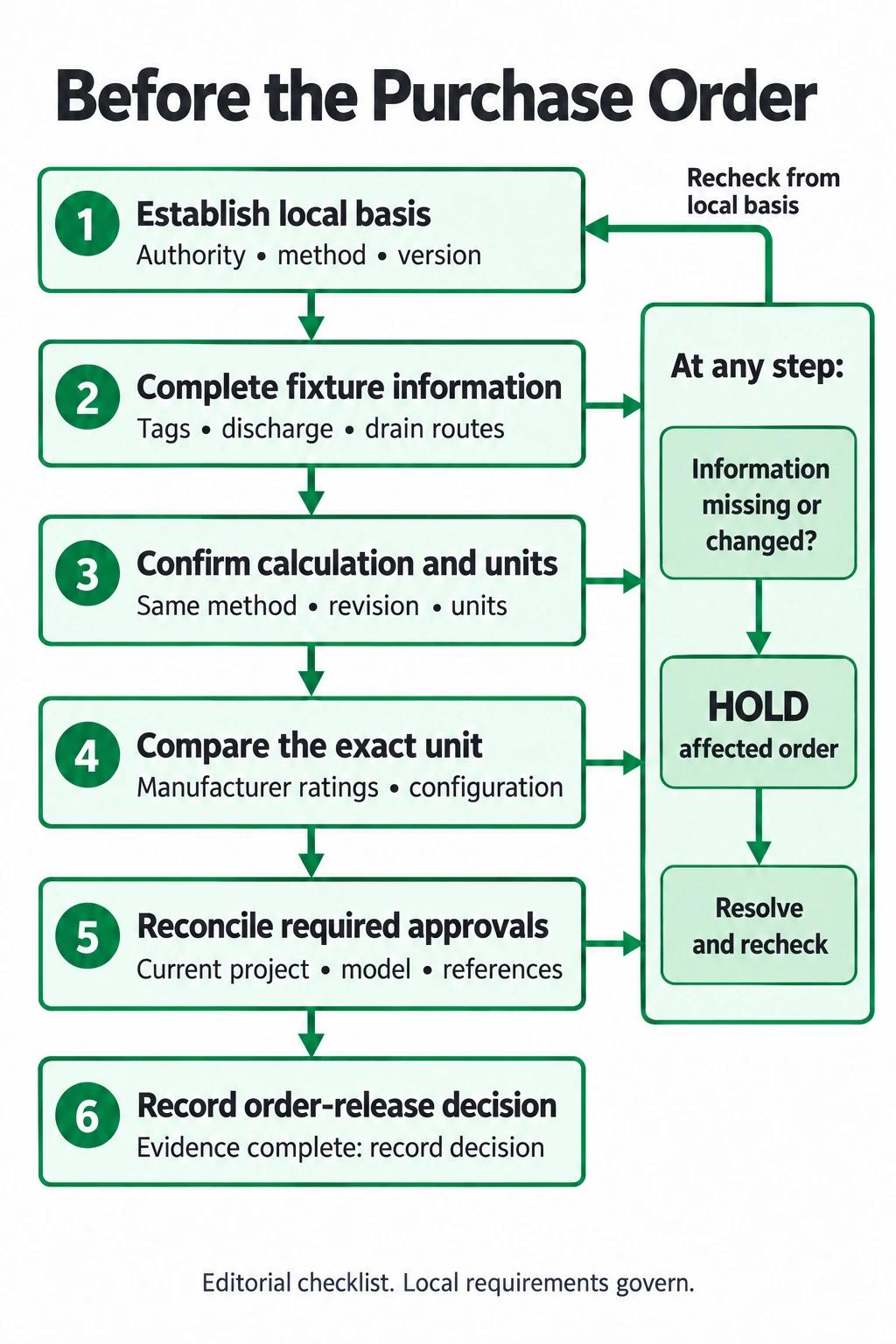
- Establish local basis
- Complete fixture information
- Confirm calculation and units
- Compare exact unit
- Reconcile required approvals
- Record order-release decision
Missing or changed information: HOLD the affected order; resolve the affected step and recheck.
Keep one record that joins the design basis to the commercial offer. This is an editorial procurement checklist, not a municipal approval form. Its purpose is to make unresolved items visible and to preserve the evidence behind a release decision. Attach the actual documents rather than copying isolated figures into an email with no source.
| Record item | Evidence to attach | If unresolved |
|---|---|---|
| Project and authority | Address, service authority, work scope and applicable review reference | Confirm which local procedure governs |
| Fixture revision | Tagged equipment list, dimensions/discharge data and connection drawing | Identify missing fixture data or uncertain route |
| Method and assumptions | Calculation with source, factor scope, units and required designer sign-off | Return the specific discrepancy for clarification |
| Required outputs | Each applicable flow, liquid-volume or grease-storage requirement labelled separately | Do not compare unlike capacity fields |
| Proposed unit | Exact model, configuration, rating documentation and installation drawing | Obtain corresponding model evidence |
| Approval and release | Required project/model approvals matching the current package | Hold affected order release until reconciled |
Follow the record in order: establish the local basis; complete the fixture information; confirm the calculation; compare the exact unit; reconcile the required approvals; then record the purchase-release decision. If a material input changes, return to the affected step. A worksheet that passes arithmetic still needs a valid method and complete inputs, while a model that meets one numerical requirement still needs the remaining project checks.
Make the release decision explicit in the record. “Ready for procurement review” means the evidence package is assembled; it does not mean the authority has accepted the unit. “Approved model, unchanged schedule” needs the corresponding reference. “Hold: revised fixture data outstanding” identifies both the affected purchase and the information required to restart the check. These status descriptions are suggested purchasing language, not regulatory labels.
Keep the requirement and offer revisions beside each other. If the quotation is reissued with a different model, compare the replacement documentation with the accepted design again, even if the price or delivery date is the only change mentioned in the commercial email. A substituted model may have different rating fields or connection information. The earlier comparison belongs to the earlier offer until the new one is reviewed.
Before release, reconcile the physical connection information too. Ask the project team to confirm the inlet and outlet details, available levels, venting arrangement and cleaning access against the accepted installation. These are coordination questions, not dimensions this article can prescribe. Keep the interceptor selection and adjoining pipework schedule distinct so replacing one component does not silently substitute a different connection standard.
The IFAN product catalogue is a starting point for reviewing pipe and fitting categories around the project. For a possible matching pipework offering, provide the project country, approved product standard, dimensions, joint type, installation duty and quantities. Availability and suitability need confirmation against that specification. This article does not establish an IFAN grease interceptor offering or approval of a particular device.
Conclusion
Before the purchase order, have these ready together: the applicable local method, current fixture schedule, labelled design outputs, exact-model documents and required approval references. Any mismatch needs a named resolution before release. That record makes the order reviewable and keeps later changes tied to the requirement they affect.
Frequently Asked Questions
Can a gallons figure replace a GPM rating?
No. Gallons describe volume; gallons per minute describe flow. Compare the quantity required by the accepted method with the corresponding documented rating. A volume alone does not establish a flow rating.
Can I use a longer drain period to buy a smaller unit?
Only an accepted, applicable design basis can justify that change. A longer period reduces the arithmetic flow result, but does not prove the assumption is permitted or representative of the fixture.
Does an existing interceptor remove the need for review?
No automatic conclusion follows. Identify the existing model and ratings, current fixtures, proposed changes and applicable local review requirements. An old installation or label alone does not settle a revised kitchen’s needs.
Is this checklist an approved sizing calculation?
No. It helps a buyer review the evidence connecting a local method, fixture inputs and a proposed unit. The responsible project professionals and authority determine the design and approval requirements.