
HDPE Conduit Specifications: Pressure Pipe, SDR and Order Fields
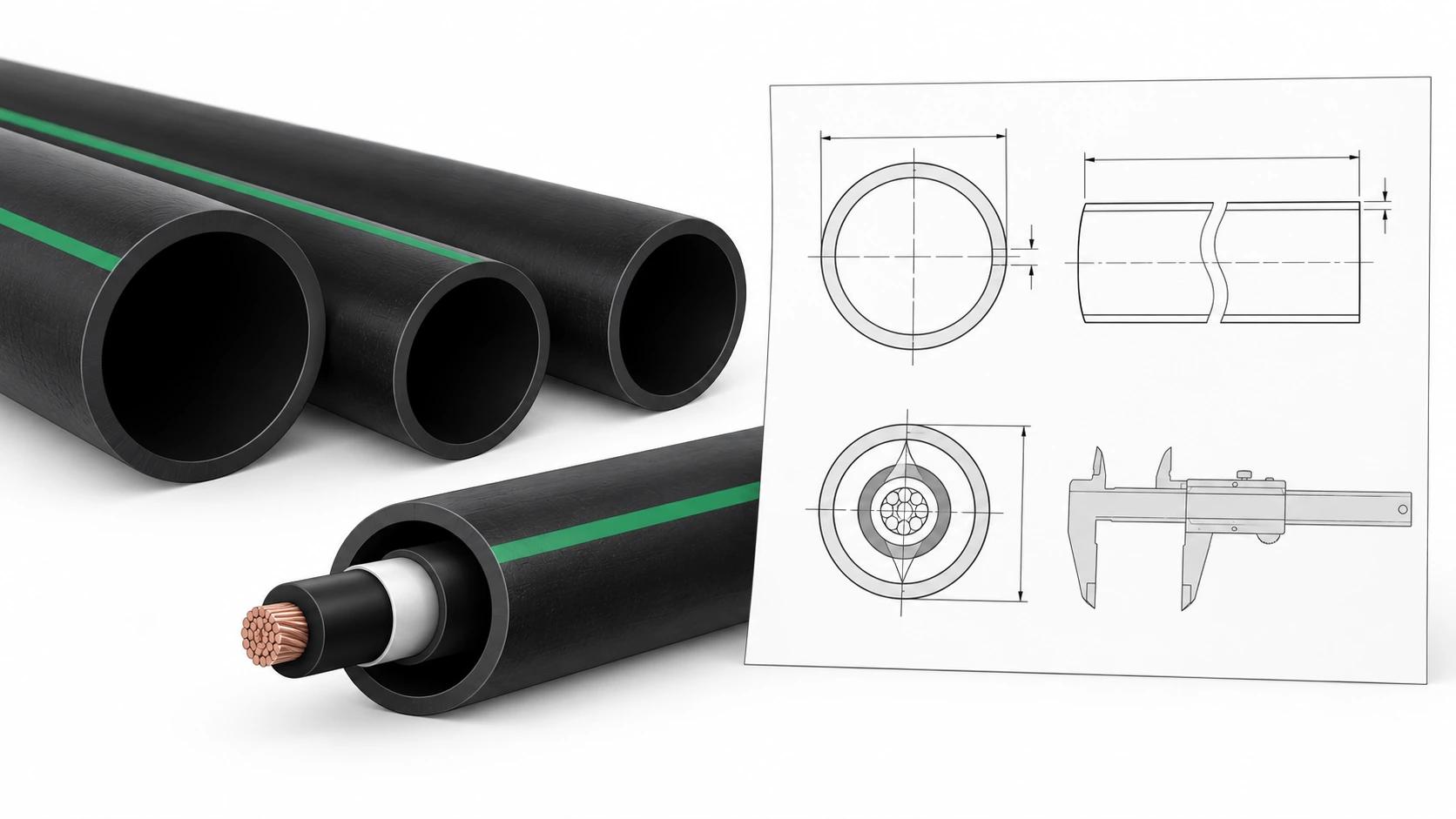
Separate HDPE cable conduit from pressure pipe. Choose the applicable standard family, clarify wall and diameter, and complete the cable-duct order fields.
Specify HDPE cable conduit for its application, not by a water-pipe PN rating. Start with communications or power; for power, distinguish empty duct from factory cable-in-conduit and determine whether a listed product is required. Then name the dimensional basis, wall type, usable bore, installation method and delivered configuration. Matching SDR alone does not make a pressure pipe an approved electrical raceway.
The misleading comparison is easy to make: two black polyethylene products have the same outside diameter and a similar wall designation. One quote names a water-pipe standard; the other names a conduit standard. The geometry may look interchangeable while the performance and acceptance evidence differ. This guide resolves the specification fields before a buyer compares the offers.
Choose the conduit standard from the cable application
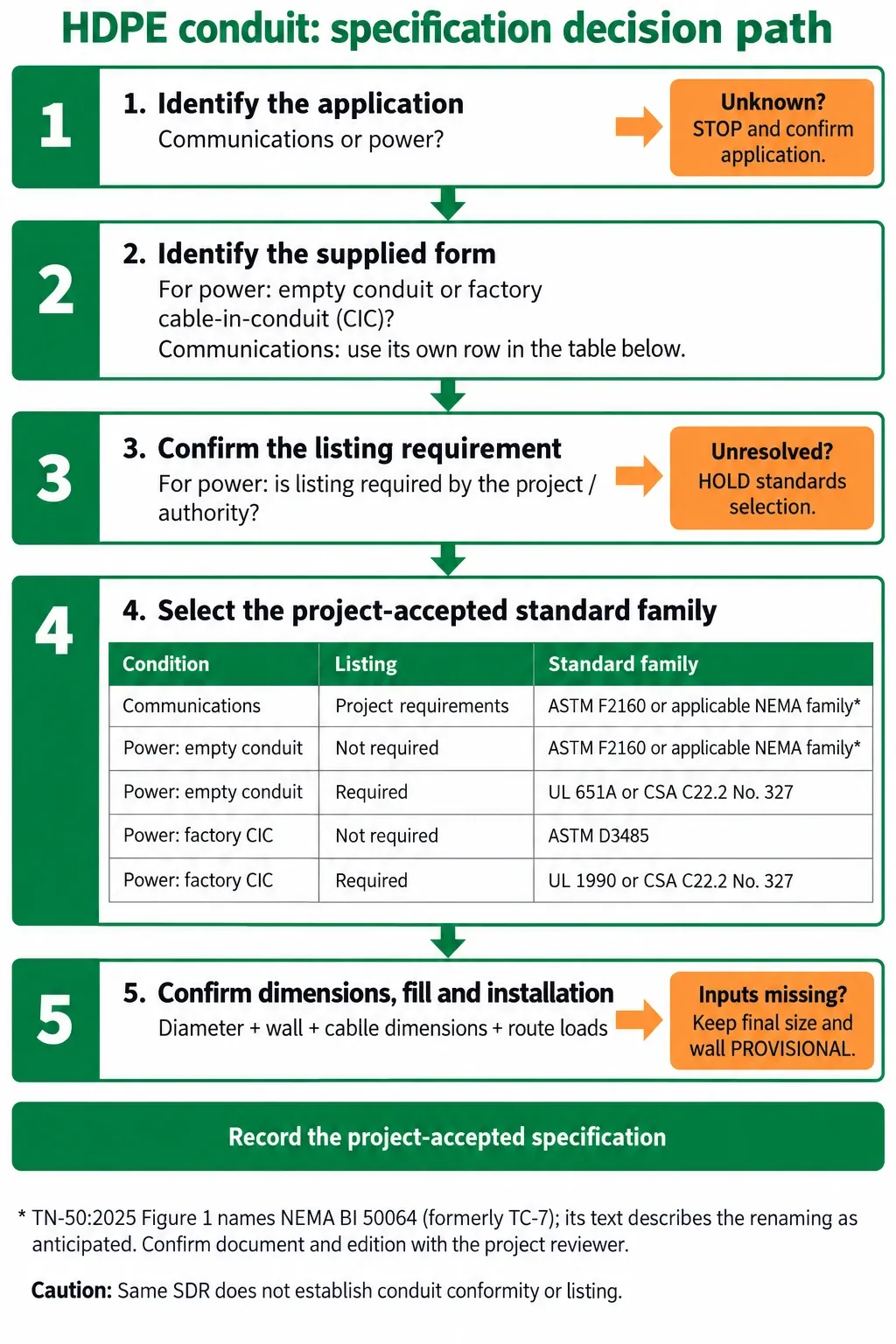
The Plastics Pipe Institute’s TN-50:2025 guide starts its selection chart with the application. That order matters: a communications duct, an empty electrical raceway and a factory assembly already containing conductors are not the same purchase. Determine the project’s acceptance requirement before using a supplier’s material description as the specification.
- Identify the application. For communications, use the communications conduit branch. For power, continue to the empty-conduit or cable-in-conduit branch. If the cable application is unknown, stop before choosing the standard.
- For power, identify the supplied form. Empty conduit is a raceway into which cable will be installed. Cable-in-conduit is supplied as a factory assembly; use its own standards branch rather than an empty-duct description.
- Establish whether listing is required. Use the project specification and the responsible utility or approving authority’s requirement. If that requirement is unresolved, hold the standards selection; an ASTM conformity statement cannot answer it.
- Select the applicable standard family. TN-50’s 2025 Figure 1 labels the communications and unlisted empty-power branches ASTM F2160 and NEMA BI 50064 (Formerly TC-7); its explanatory text still names NEMA TC 7 and calls the renaming anticipated. Record that source naming difference and confirm the applicable NEMA document and edition with the project reviewer before using that branch on the order. Listed empty-power branches point to UL 651A or CSA C22.2 No. 327. Unlisted cable-in-conduit points to ASTM D3485; listed cable-in-conduit points to UL 1990 or CSA C22.2 No. 327. Select the family accepted for the project; do not stack every name into one order.
- Complete the dimensions and installation inputs. Select diameter and wall type, establish the applicable cable-fill requirement, and check the installation method. If cable dimensions or route loads are missing, keep the final size and wall selection provisional.
“Listed” and “made to a specification” carry different evidence. Where a listed electrical product is required, obtain the listing covering the offered configuration. A material grade, a water-pressure certificate or a general catalogue does not supply that identity. Jurisdiction and utility requirements remain project inputs; this branch chart does not grant universal permission to install a particular duct.
Read versions with care. In the same TN-50:2025 document, Figure 1 prints “NEMA BI 50064 (Formerly TC-7),” while the scope text names NEMA TC 7-2021 and Table Note 2 describes the renaming as anticipated. These are two different naming statements within the saved source; this guide does not decide which has normative priority. For a NEMA-based order, obtain the actual document designated for the project and confirm its name and applicable edition before release. Neither name establishes that the offered product is listed. Also, the current UL 651A public page records a September 8, 2025 revision, later than the UL revision cited in TN-50’s text. Use the applicable current standard and the project’s edition rule, rather than freezing a historical cross-reference into an order.
SDR describes wall geometry; PN is the wrong order shortcut
For outside-diameter-controlled conduit, dimension ratio relates the specified outside diameter to wall thickness. At the same outside diameter, a lower SDR means a thicker wall and less internal space. It does not, by itself, determine cable capacity, acceptable pull force or electrical listing. The PPI sizing FAQ explains that lower SDR also changes mechanical resistance; the installation still has to be checked for its actual conditions.
The following example is deliberately simplified. Assume a perfectly circular 50 mm outside diameter and use nominal geometry only: wall thickness = OD ÷ SDR; calculated bore = OD − twice the wall. These inputs are teaching assumptions, not IFAN dimensions, certified minimum bores or a cable-fill allowance. Manufacturing tolerances, ovality and product-specific internal features must be handled with the actual dimensional record.
Assumed circular OD = 50 mm in both examples
| Assumed SDR (dimensionless ratio) | Wall (mm) | Bore (mm) |
|---|---|---|
| SDR 11 | 4.55 | 40.91 |
| SDR 13.5 | 3.7 | 42.59 |
The example explains a tradeoff, not a recommendation to choose the thinner wall. If a route’s installation conditions demand more wall strength, the larger bore cannot override that requirement. If the outside diameter changes, the comparison also changes: “lower SDR has less bore” is only a fixed-OD statement. Inside-diameter-controlled products use a different basis; do not apply this example to an SIDR offer without its dimensional definition.
ASTM F2160-22a’s public scope includes OD- or ID-controlled solid-wall forms. An order therefore needs the size system and actual dimensions, not merely “2 inch HDPE.” The existing HDPE pipe-size reference covers pressure-pipe sizing; keep that pressure context separate from the cable-duct decision here.
Pressure pipe can match dimensions and still miss the conduit specification
PPI’s conduit FAQ distinguishes F2160 and D3485 conduit standards from water-pipe specifications such as D3035, D2447, F714 and D2239. Matching dimensions do not prove that the water pipe has been tested to every conduit requirement. TN-50 recommends replacing inappropriate pressure-pipe references with the conduit standard best suited to the application.
| What the offer shows | What remains unresolved |
|---|---|
| Same OD and SDR | Conduit performance conformity, usable bore and the required listing. |
| A water-pipe standard and PN rating | The cable-protection application standard and project acceptance. |
| Conduit standard declared | Model/configuration evidence and any separately required listing. |
This does not mean that every product sold as pressure pipe is physically incapable of protecting cable. It means the pressure-pipe documents do not establish the required conduit conformity. If the offered product also has the applicable conduit evidence and required acceptance, assess that evidence. If it only has a pressure rating, the substitution remains unresolved. Buying “stronger water pipe” is not a method of satisfying an electrical listing requirement.
Write the application and accessory fields into one order line
A useful order states the selected branch and leaves no ambiguity about the delivered assembly. TN-50 identifies choices such as sizing, colour and pull media; PPI’s FAQ explains that pull tape can be installed during extrusion. Those are category options. Their availability must be confirmed for the offered product, and neither source proves an IFAN cable-duct SKU.
Blank specification example: HDPE conduit for [communications / power]; [empty / factory cable-in-conduit]; conformity to [selected standard and applicable edition rule]; [required listing and covered configuration, or accepted unlisted branch]; [dimensional system and OD/ID basis]; [diameter, wall type and usable-bore evidence]; [installation method and design conditions]; [colour/stripe]; [smooth/ribbed/lubricated interior]; [pull-tape type and rating]; [couplers and required compatibility/listing]; [stick/coil/reel, unit length and total quantity].
Each blank has a purpose. Wall and bore affect the space available for cable; the route and installation method determine the mechanical checks. Interior configuration and pull media affect the planned installation. Couplers must match the dimensional system and any required approval. Unit lengths and packaging determine what arrives and where joints are needed. Colour and stripes communicate the project’s identification convention; do not treat a customary colour as a universal code permission.
Three unresolved inputs should hold a release. Without cable dimensions and the applicable fill rule, calculate no final cable capacity. Without the route and installation conditions, select no final wall from a general SDR preference. Without the authority or utility’s listing requirement, do not accept the unlisted branch. After those inputs are supplied, apply the corresponding dimensional/fill, installation and listing checks to the exact offered configuration. The missing input must change a decision—not merely add another document to the folder.
Keep corrugated and dual-wall ducts outside the solid-wall shortcut
“DWC” or “dual wall” changes the product-form question. F2160’s stated scope is solid-wall conduit, with or without ribs; that is not a blanket certification of corrugated dual-wall duct. TN-50 describes CSA C22.2 No. 327 as including polyethylene dual-wall corrugated conduit within its electrical scope. That example shows why a different form needs its own applicable standard and jurisdictional acceptance, rather than inheriting the F2160 label.
Keep the final decision tied to the branch actually approved for the project. For solid-wall cable duct, release an order only after its application, conformity/listing requirement, dimensions, installation inputs and delivered accessories agree. For a corrugated or dual-wall offer, restart the form-and-scope check. A shared polymer name cannot close either decision, and this reference makes no claim about IFAN supplying either configuration.
Written by The HDPE technical team at IFAN Group.