
Liquid-Filled Pressure Gauges and Snubbers: Different Jobs
Separate case vibration from pressure pulsation. See where liquid fill and snubbers act, and why a steady gauge cannot rule out rapid pressure events.
A liquid-filled pressure gauge and a snubber protect different parts of the measurement chain. Case liquid damps movement inside the instrument; a snubber restricts the pressure communication path before pressure reaches the sensing element. A vibrating installation, pulsating water pressure and a need to capture rapid pressure changes therefore call for different specifications. A steady pointer alone does not prove the pressure is steady.
Key Takeaways
- Case vibration and pressure pulsation can produce similar pointer motion.
- Liquid fill surrounds the gauge mechanism; it is separate from the process fluid.
- A snubber changes how pressure reaches the instrument.
- More damping can make a display easier to read while reducing its usefulness for observing rapid changes.
- Protection selection does not replace pressure range, accuracy, temperature or wetted-material checks.
Video: what case fill does
WIKA Group explains liquid-filled gauges. This supports the case-fill discussion; it is not a demonstration of IFAN instrument products or a qualification of a particular snubber.
Watch on YouTube. Manual playback has not been verified.
One symptom, two different disturbances
Imagine a pump package with a dial that is difficult to read. The pump may shake the gauge mounting, the water pressure may fluctuate, or both may happen together. These are illustrative conditions, not a diagnosis of a particular installation. Their distinction matters because buying a visually calmer instrument does not necessarily address the loading imposed through its pressure connection.
WIKA distinguishes vibration of mechanical parts from repeated rapid increases and decreases in media pressure. Its failure guide identifies both as possible causes of pointer flutter and component damage. Thus, pointer flutter is evidence of a measurement problem to investigate, rather than a sufficiently specific purchase specification. WIKA: causes of gauge failure.
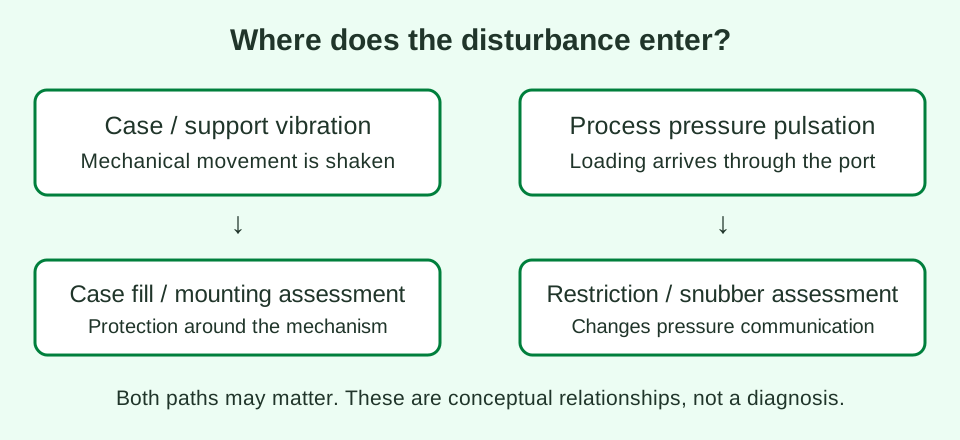
For a water-system buyer, the useful question is where the disturbance enters. If the gauge body is shaken by its support, consider vibration protection and mounting. If pressure is cycling at the tapping, consider the pressure communication path. If the source has not been established, preserve both possibilities in the application description instead of ordering a snubber solely because the needle moves.
What the liquid-filled case changes
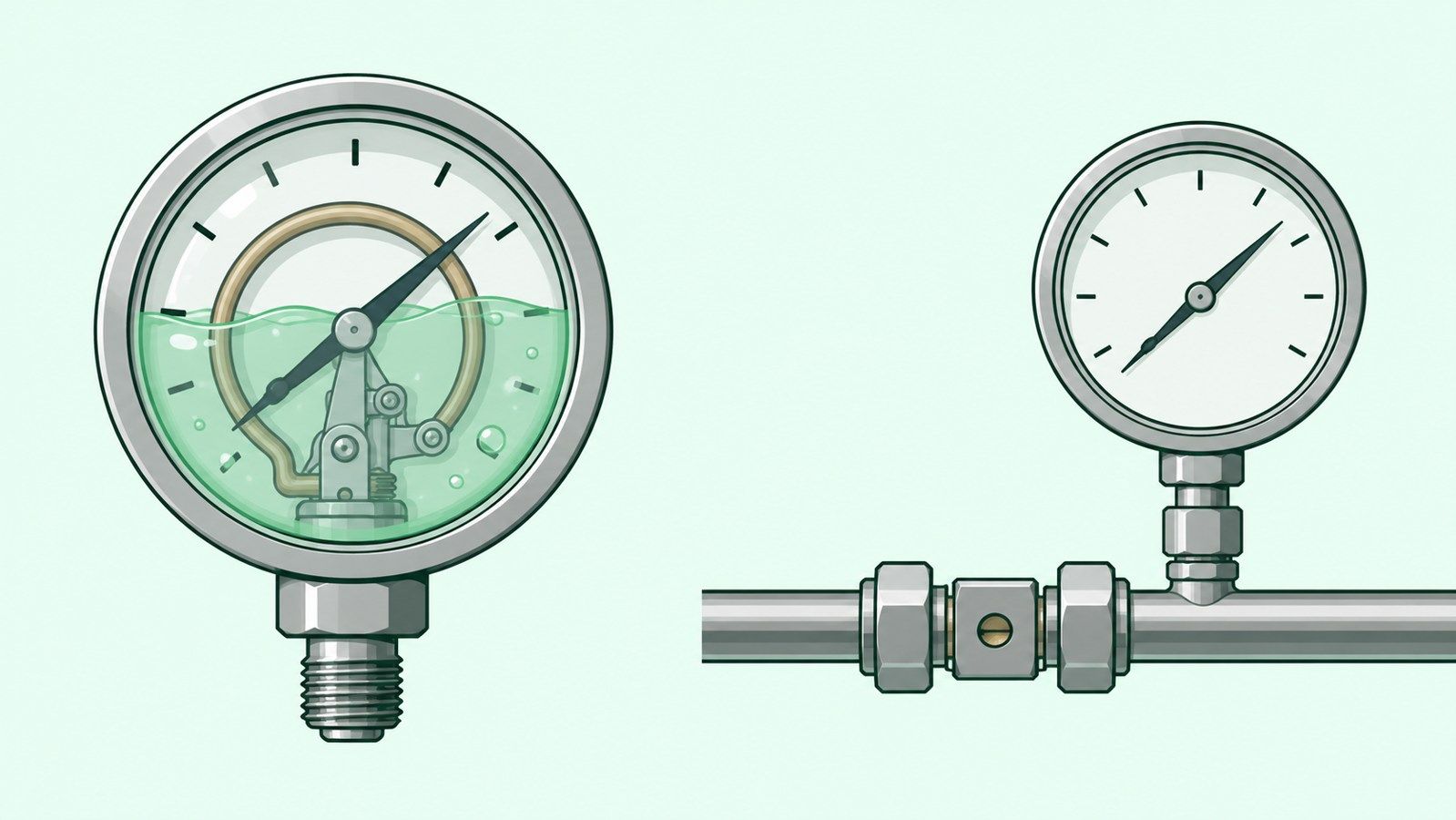
The liquid visible behind a filled gauge's window surrounds the mechanism. It is not an additive to the water line. WIKA describes this liquid as damping vibration and reducing mechanical loading, with glycerine-water mixtures and silicone oils used according to operating conditions. It also explains why a deliberate air space is left for expansion. A visible bubble is therefore not, by itself, evidence of a defective or underfilled instrument. WIKA: filling liquids and their purpose.
This makes case fill relevant when vibration affects readability or the mechanical movement. It does not turn the fill description into a complete gauge specification. Temperature suitability belongs to the particular gauge and fill combination; process compatibility belongs to the wetted components. A supplier describing only a stainless case and glycerine fill has not yet identified which materials contact the water.
Nor does a smoother pointer establish the accuracy needed for a measurement decision. Our guide to gauge range and percentage-of-span accuracy covers that separate calculation. Here the question is how the instrument experiences a disturbance, rather than how its stated indication limit converts into pressure units.
What a snubber changes before the gauge
A snubber or restrictor introduces a restriction in the connection communicating process pressure to the instrument. WIKA describes both a restriction incorporated in a pressure port and an external adjustable fitting. Its adjustable arrangement changes the available flow cross-section and can accommodate a change in media viscosity. Those are features of that arrangement, not a promise that every product sold as a snubber is adjustable. WIKA: fittings for dynamic load cycles.
The practical distinction is that case fill acts around the movement, while a restriction modifies the pressure communication reaching the sensing element. This is why the two options can be complementary. They are not necessarily competing upgrades from which the buyer must select only one.
| Application condition | Relevant specification direction | Unresolved condition |
|---|---|---|
| Mounting vibration with a routine steady-pressure reading | Assess liquid fill and mounting isolation | Actual vibration severity and gauge temperature limits |
| Repeated pressure cycling at the tapping | Assess a restriction or snubber, with case fill where appropriate | Media, restriction design and acceptable response |
| Need to observe a short pressure event | Specify the measurement response before choosing damping | Event duration and required measurement system capability |
| Pressure near or beyond the instrument's permitted exposure | Resolve pressure protection and range independently | Maximum exposure and manufacturer limits |
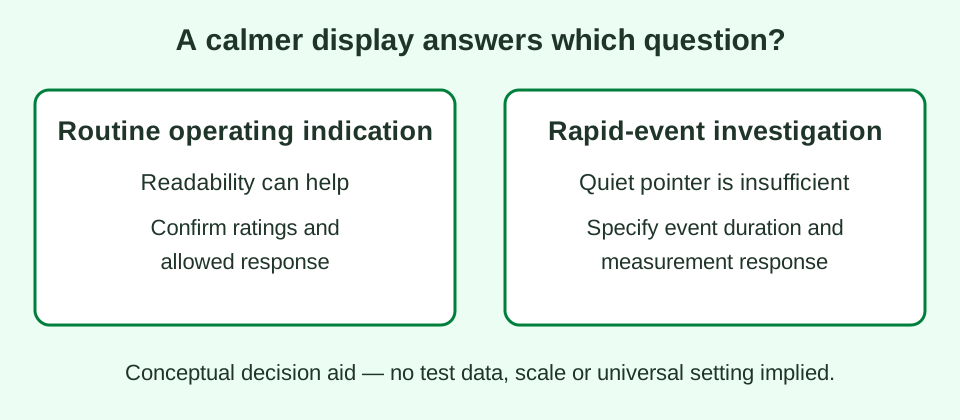
The tradeoff: a readable dial or a transient measurement?
Restriction slows the communication of changing pressure. The inference for selection is straightforward: damping selected to suppress an oscillation may also suppress an event that someone wants to observe. A buyer seeking a routine operating indication and an engineer investigating a rapid event can therefore need different measurement arrangements at the same pipe.
Consider two hypothetical purchase briefs. The first asks for a readable local operating-pressure indication on a vibrating pump skid. A protected mechanical gauge may suit that task once its other ratings are established. The second asks whether a brief startup event exceeds an equipment limit. Merely obtaining a stable reading from that same dial does not answer the second question: the selected damping and instrument response may conceal the event. No sampling rate or universal damping setting can be derived without the event duration and the proposed measuring system's response information.
This comparison also gives a useful stop point. When response is important but unspecified, do not accept “no needle flutter” as the acceptance criterion. Define the event that must remain visible, then have the instrument selection demonstrate that capability. When the goal is an ordinary operating reading, document the allowed response instead of demanding maximum damping without qualification.
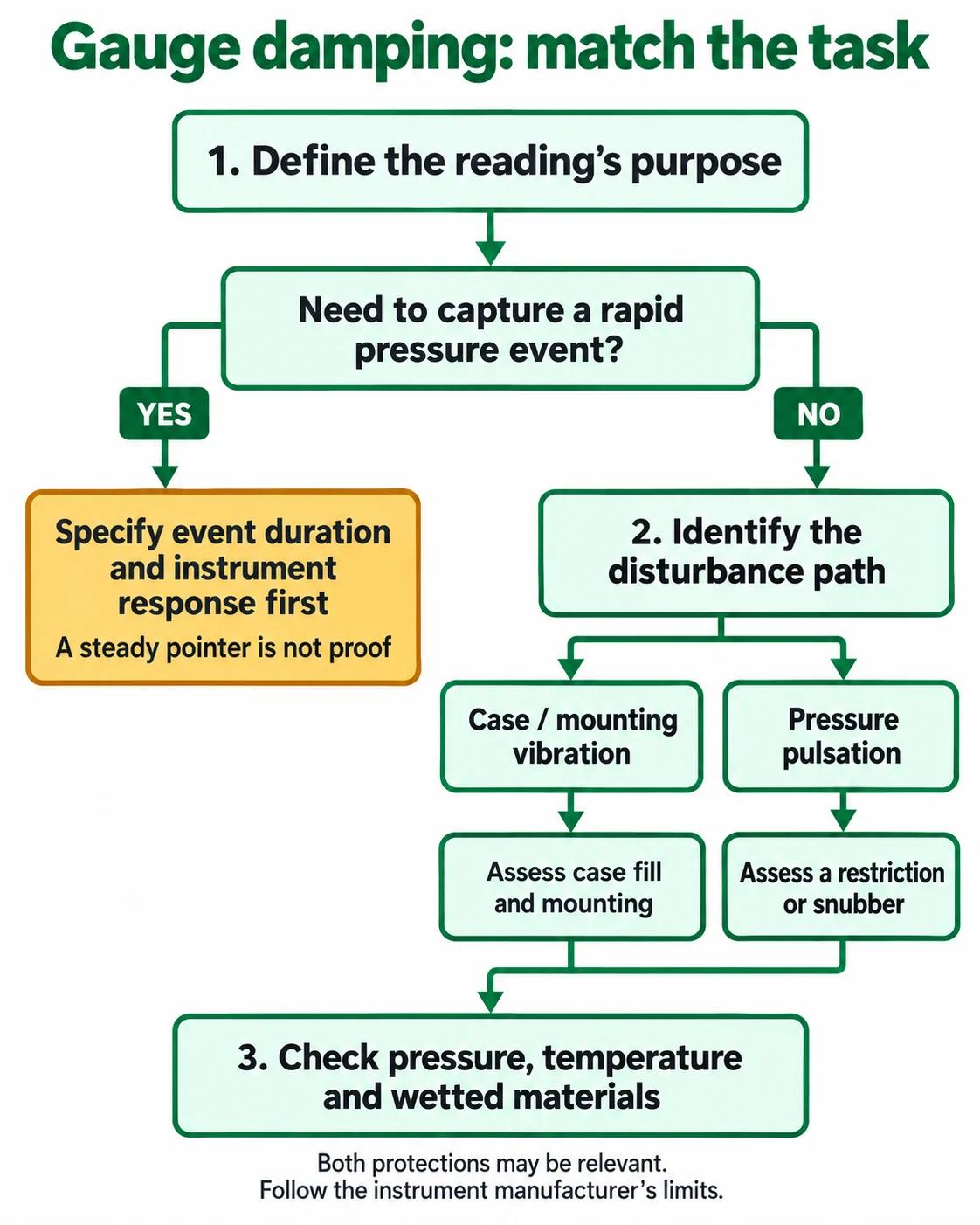
- Define whether the task is routine local indication or observation of a rapid pressure event.
- If a rapid event must remain visible, specify its duration and the required instrument response first. A steady pointer is not proof.
- Identify mounting vibration and pressure pulsation separately; assess case fill/mounting and pressure-path restriction as appropriate.
- Check pressure exposure, temperature and wetted materials against the selected instrument manufacturer’s limits.
Keep the protection package separate from pipe-system capability
A snubber does not establish a safe sustained pressure limit for the installation. WIKA treats overpressure separately and describes dedicated overpressure protection; a damped display cannot serve as proof that the piping, gauge or accessories remained within their ratings. Likewise, a restriction suitable for clean water cannot be assumed suitable for a dirty or viscous process simply because its thread fits.
For an instrument-manufacturer enquiry, describe the fluid, temperature, operating and maximum pressure, mounting conditions, connection and purpose of the reading. State whether the requirement is a local operating indication or investigation of a changing pressure. The instrument manufacturer must assess that arrangement; a pipe supplier’s offer cannot establish the gauge’s response or protection performance.
For the separate PPR portion of a water-supply project, review IFAN’s PPR pipes and fittings supply scope. Send the pipe-system service conditions and required pipe/fitting schedule for a piping quotation. That route is for the published PPR offering; it does not qualify or source an instrument arrangement. Gauge or snubber selection and response evidence remain with the chosen instrument manufacturer.
Conclusion
Case fill and a snubber act at different locations and may be needed together. Choose them around the disturbance and the reading's purpose. The valuable result is a measurement arrangement that remains suitable and readable while preserving the pressure information the task requires.
FAQ
Does glycerine fill make a gauge more accurate?
It can reduce movement caused by vibration. The specified accuracy and calibration evidence remain separate requirements.
Can a liquid-filled gauge still need a snubber?
Yes. Pressure pulsation enters through the process connection, so case fill and a pressure-path restriction can serve complementary purposes.
Is the bubble behind the window a fault?
Not necessarily. Manufacturers may leave expansion space deliberately; assess the actual instrument against its manufacturer's requirements.
Can a quiet pointer rule out pressure spikes?
No. The instrument and any damping affect what becomes visible. A transient investigation needs a measurement response suited to the event.