
PVC Sewer Acceptance: Air, Mandrel and CCTV Prove Different Things
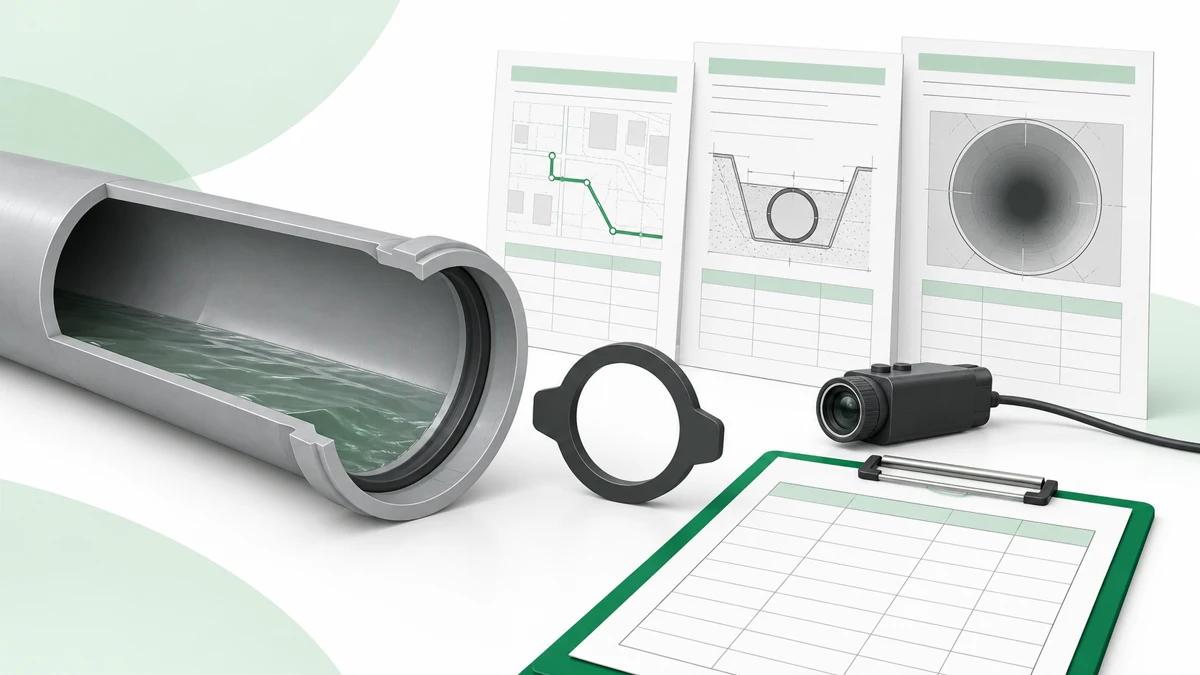
Read PVC gravity-sewer acceptance records correctly. Distinguish leakage, deflection and CCTV evidence, then resolve a pass-air, fail-mandrel result.
A passing air test does not prove that a PVC gravity sewer is round, correctly aligned or fully accepted. Low-pressure air checks leakage-related installation integrity; a mandrel checks passage against the specified deflection limit; visual or CCTV inspection examines visible condition. Accept the segment only when every test required by its project specification has acceptable, traceable results.
The distinction matters at handover. A folder containing an air-test certificate can look complete while the deflection test is premature, the camera recording belongs to a different reach, or the manhole still needs its own test. The useful question is not “Did the sewer pass?” It is “Which requirement does this result close, for which asset?”
Key Takeaways
- Leakage, deflection and visible condition are separate acceptance questions.
- Low-pressure air provisions for non-pressure sewers do not authorize air testing PVC pressure pipe.
- A passing air-loss result is not a measured service infiltration or exfiltration rate.
- The owner’s specification sets the applicable test, timing, limit and witnessing requirements.
- A stopped mandrel needs investigation; the stop alone does not identify its cause.
- Match every result and any retest to the same identified pipe reach or structure.
Decide which asset and duty the report covers
First separate a non-pressure gravity-sewer reach from a pressure main, a building drainage system and a manhole. They may connect physically, but their test requirements are not interchangeable. A form headed “PVC test” leaves too much unresolved: the pipe material does not identify the operating duty, asset or governing acceptance procedure.
The public scope of ASTM F1417-25 concerns low-pressure air testing of non-pressure plastic sewer lines. It describes installation integrity, including damaged piping or improper jointing. That is a defined scope, not a general rule for every plastic drain.
For PVC pressure pipe, the PVC Pipe Association’s September 2025 technical brief expressly requires water-only pressure testing and prohibits air-pressure testing. Even its gravity-sewer discussion warns about the forces on plugs and the danger to personnel in manholes. This article interprets records; it provides no field pressurization, plug-fitting or testing procedure.
Write the asset into the review: for example, “gravity-sewer pipe between the named upstream and downstream manholes.” List the manholes separately. If the record does not identify the installed reach, a technically valid test elsewhere cannot establish the condition of this one. Product compliance also remains a separate question: the D3034 sewer-pipe submittal review concerns what was specified and supplied, before installed-system acceptance is considered.
Read each test as an answer to one question
An actual bidding question makes the distinction concrete. In SD1’s August 2020 addendum, Question 14, a bidder asked whether a live sewer needed mandrel testing or only air testing. The project answer retained the specified mandrel requirement. That answers a substitution request for that project; it does not authorize a live-flow method on another job.
Low-pressure air testing observes the rate of air escape from an isolated sewer section. F1417-25 includes constant-pressure and time-pressure-drop methods. A result must therefore identify the actual method and applicable acceptance basis. A bare “pressure held” note does not tell the reviewer whether the specified method was used.
The standard’s public significance-and-use statement also limits the conclusion: air loss is not a quantitative measure of infiltration or exfiltration under service conditions. A pass can be accepted as the specified installation test without converting the reading into a predicted volume of groundwater entering the operating sewer.
| Record | Question it addresses | What a pass does not establish |
|---|---|---|
| Specified low-pressure air test | Does the isolated non-pressure sewer meet its prescribed air-loss acceptance? | Permitted deflection, correct grade, or a numerical service water-leakage rate |
| Specified deflection/mandrel test | Can the approved gauge pass through the applicable pipe reach? | Leak-tight joints or freedom from every visible defect |
| Visual/CCTV inspection | Are visible condition, obstructions and alignment acceptable under the project requirements? | Compliance with an independent leakage test or a prescribed mandrel criterion |
| Required manhole test | Does the identified structure meet its specified test? | Acceptance of all connected pipe reaches |
Basis: ASTM F1417-25 public scope/use; the separate visual, leakage, deflection and manhole clauses in Salisbury’s published Section IV. Apply the governing project specification.
A mandrel is a go/no-go geometry check, rather than an instrument that automatically diagnoses the defect. If it stops, possible explanations include obstruction, inappropriate gauge selection or an unacceptable installed shape. The report must establish the applicable gauge and condition before the stop is treated as evidence of excessive deflection.
Camera inspection supplies another kind of information: the location and visible character of an obstruction, displaced joint or apparent alignment problem. Its strength is the traceable view along the reach. It does not make a specified leakage test unnecessary, and an apparently clear image cannot substitute for a dimensional acceptance method expressly required by the owner.
The project specification supplies the pass line
“Five percent” and “thirty days” are common shorthand. They are not enough to complete an acceptance review. The percentage needs a defined diameter basis and approved gauge; the waiting period needs a starting event. A product table, a generic equipment guide and a local utility clause can describe different conditions without one being a universal replacement for the others.
Consider an identified example, rather than a nationwide rule. The City of Salisbury’s publicly posted Section IV, clause 3.05, specifies deflection testing no sooner than 30 days after final backfill and a 5% vertical-deflection limit. It relates mandrel diameter to the applicable pipe-standard diameter basis and prohibits mechanical pulling devices. Its leakage and manhole requirements appear in separate clauses. This saved municipal document illustrates how an owner defines acceptance; confirm the version incorporated into the actual contract.
| Missing detail | Why it changes the decision | Review outcome |
|---|---|---|
| Acceptance criterion and dimensional basis | A percentage without the specified reference diameter does not identify the correct mandrel. | Gauge suitability remains unverified. |
| Required test timing and starting event | A preliminary result may precede the condition required for final acceptance. | Keep the final test obligation open. |
| Required witness and approved method | A contractor’s internal check may not satisfy the owner’s witnessed acceptance clause. | Determine whether an accepted witnessed result is still required. |
| Segment and structure identification | A result cannot be assigned reliably to an unidentified asset. | Resolve the record mapping before closing the item. |
These are document-review consequences, not substitute test instructions. The Salisbury provisions above are a named local example.
The same reasoning applies to timing. An early test can be useful for construction control without satisfying a later acceptance obligation. F1417-25 recognizes an approving authority’s role in specifying the interval between backfill and air testing. Keep “preliminary check completed” and “required final acceptance completed” as distinct entries when the project requires both.
A line passes air and still fails acceptance
A public owner’s question from 2005 described one newly installed ribbed-PVC sanitary sewer that had been air-tested, a mandrel that would not enter, and video showing ovality. It does not expressly report a passing air result. The account illustrates the multi-test problem; its replies are not used here as repair instructions.
Illustrative review case: a newly backfilled PVC gravity-sewer reach has an acceptable leakage-test report. Its governing specification also requires a later deflection test and a visual inspection. At the required stage, the approved mandrel does not pass. The camera record identifies the same location, and the cause has not yet been resolved.
The correct disposition is leakage requirement satisfied; deflection requirement unresolved; overall acceptance incomplete. The air pass and mandrel problem are not contradictory measurements of one property. A deformed line may still have tight joints. Accepting it on the strength of the air result would erase the separate geometry requirement without evidence.
Do not jump from “mandrel stopped” to “replace the pipe.” Confirm the gauge basis and investigate the location with the responsible inspector. If the verified problem is installed deflection, corrective work must address the cause and be followed by the required retesting. The appropriate repair and any repetition of affected acceptance tests come from the owner’s specification and engineer, not from the passing report for another property.
Now change one condition: the camera shows construction debris at the stopping point. That evidence weakens the diagnosis of deformation, but it does not turn the failed passage into a pass. Clear the obstruction under the approved work arrangements and repeat the applicable check. Only the resulting evidence can close the geometry item. The difference is practical: investigate and test the relevant condition rather than selecting a repair before establishing the failure mode.
Close the evidence gap before handover
Use one evidence matrix for each identified reach, with linked entries for its structures. Start with every required item in the project specification, then enter the result. Starting with the reports already in the folder encourages an easy mistake: treating the available tests as if they were the complete required set.
| Required item | Evidence that must stay with the result | Current disposition |
|---|---|---|
| Leakage test | Reach ID; specified method and criterion; date; test conditions; required witness; result | Acceptable for this requirement only |
| Deflection test | Same reach ID; gauge/diameter basis; timing after the specified event; witness; stopping location | Open until cause is resolved and acceptable retest recorded |
| Visual/CCTV inspection | Reach ID; dated recording; location reference; defect log and required disposition | Review the recorded condition and any corrective-work evidence |
| Manhole acceptance | Separate structure ID; governing test clause; method, witness and result | Close separately where required |
Illustrative matrix, not a completed project certificate. Add or remove test obligations only to match the governing specification.
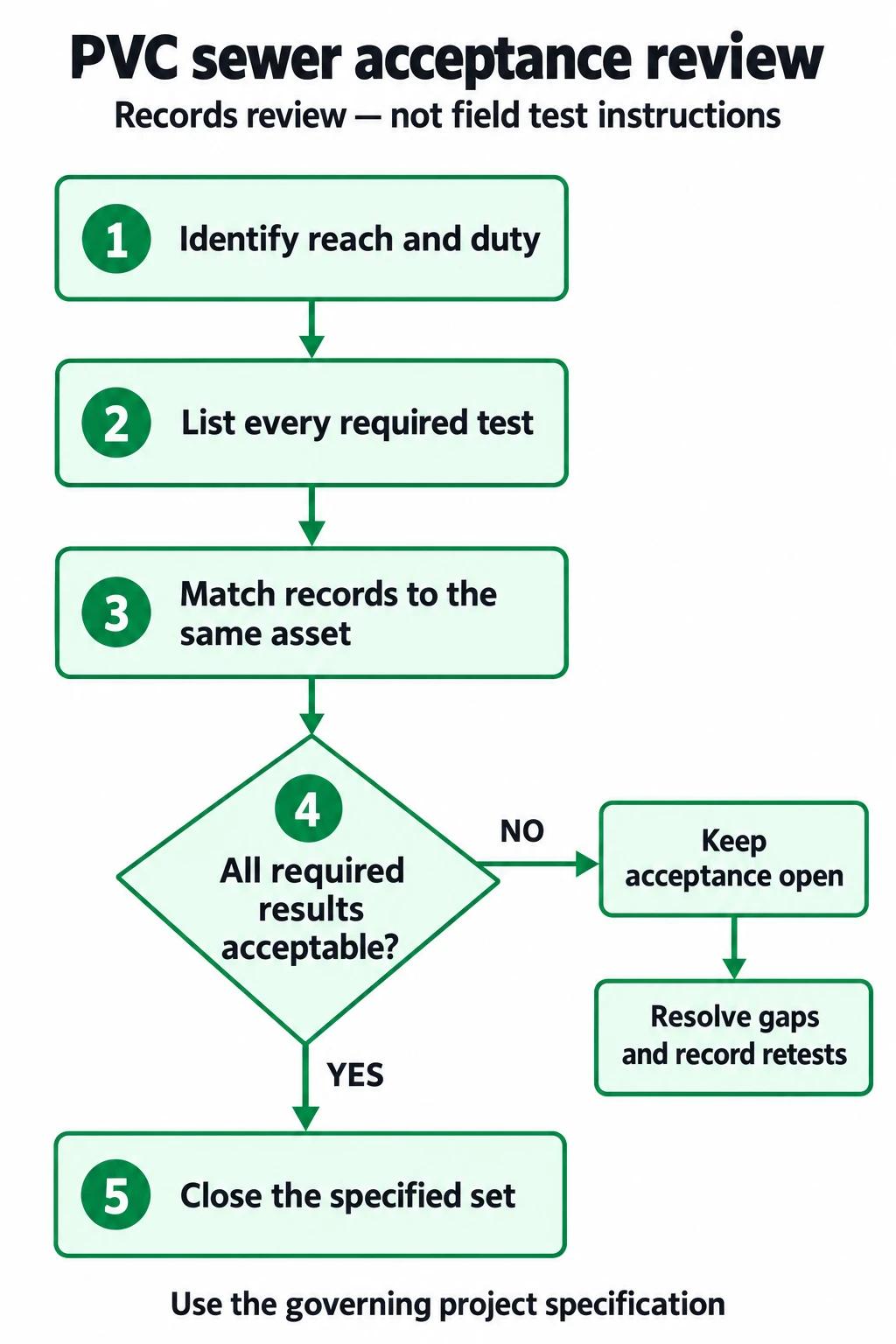
- Identify the reach and duty.
- List every test required by the governing specification.
- Match all records to the same asset.
- Check whether every required result is acceptable. If not, keep acceptance open, resolve gaps and record the required retests.
- Close the specified set only when its requirements are satisfied.
Keep original failed results with the corrective-work and retest trail. Salisbury’s published general provisions explicitly require retention of results for failed work that was corrected. A final “pass” detached from the original segment, repair location or required witness can leave the reviewer unable to establish what actually changed.
For procurement, preserve the distinction between supplied material and installed performance. The IFAN product catalogue provides category context; it does not establish that a particular sewer specification is available or that IFAN performs municipal acceptance testing. A contractor checking a future pipe package should bring the project country, governing product specification, dimensions, quantities and required documentation, then confirm matching availability.
Review the IFAN pipe catalogue before requesting a project-specific availability check. No ASTM D3034 sewer model or test-service offer is confirmed by this article.
Conclusion
A sewer can satisfy its leakage requirement while another acceptance item remains open. Read each report against its own failure mode, asset, criterion and required timing. Close the complete specified set, including corrective-work and retest records, rather than letting one reassuring pass stand for the whole installation.
Frequently Asked Questions
Does passing an air test replace the mandrel test?
No. A leakage-related pass does not establish permitted deflection. Complete the separate mandrel requirement whenever the governing project specification calls for it.
Is the mandrel limit always 5%?
No. Use the governing criterion, reference diameter and approved gauge for the installed pipe. The Salisbury 5% provision discussed here is a named local example.
Can this sewer exception be used to air-test PVC pressure pipe?
No. The PVC Pipe Association prohibits air-pressure testing of PVC pressure pipe and requires water-only pressure testing.
Does a CCTV recording prove watertightness?
It records visible condition. It does not replace an independent leakage test required by the project specification.