
PVC vs Concrete vs HDPE for Sewer Mains: A Municipal Buyer's Guide
Every municipal engineer specifying a sewer main comes back to the same three-way question: uPVC, reinforced concrete, or HDPE. This guide compares the three materials on the axes that actually decide the specification — diameter range, structural class, hydrogen sulphide behaviour, joint reliability, installed cost, and 50-year total cost of ownership — so the choice matches the network tier instead of defaulting to one material for the whole system.
Every municipal engineer specifying a sewer main comes back to the same three-way question: uPVC, reinforced concrete, or HDPE. The choice locks in fifty to a hundred years of maintenance behaviour, so the wrong material is the kind of decision that surfaces slowly and then all at once — a decade of quiet infiltration, a wave of manholes that suddenly leak, or a trunk that cracks under settlement the engineer never got to design out. The reversal of a bad specification is the cost of digging the street up.
This guide compares uPVC, reinforced concrete and HDPE on the axes that actually decide the specification: diameter range, structural class, corrosion behaviour under sewage-generated hydrogen sulphide, joint reliability, installed cost, and the fifty-year total-cost-of-ownership picture municipal buyers now increasingly have to defend. The direct answer sits in the head-to-head table below; the sections after it explain when the general rule gets over-ridden by a project-specific reality. For the material-agnostic uPVC decision chain the complete PVC drainage guide gives the framework this comparison sits inside.

Key Takeaways
- uPVC wins under DN500 for gravity sewer — lightest, cheapest per metre, best resistance to hydrogen sulphide attack, and the joint types municipalities can inspect.
- HDPE wins above DN500 and where trenchless installation matters — long fusion-welded strings mean fewer joints, and the flexible pipe survives ground movement that cracks rigid alternatives.
- Concrete only makes sense above DN800 or where the tender pre-specifies it — modern H₂S attack rates make unlined concrete a 30-year pipe, not the 100-year asset it used to be.
- Hydrogen sulphide (H₂S) in the sewage is the silent killer of concrete — bacterial oxidation turns it into sulphuric acid at the crown, and unlined concrete loses 5–10 mm of cover per year in warm climates.
- Rigid pipe (concrete, PVC-U) is graded by ring stiffness class (SN); flexible pipe (HDPE) is graded by SDR and relies on the surrounding backfill for structural performance.
- A typical municipal spec now runs uPVC DN110-DN400 in the collector network, HDPE DN500-DN1200 on the trunk, and concrete only in specific legacy sections — pick materials by diameter tier, not one for the whole network.
The Head-to-Head Comparison
uPVC vs Reinforced Concrete vs HDPE for gravity sewer main
| Property | uPVC | Reinforced concrete | HDPE |
|---|---|---|---|
| Common DN range | DN75 – DN630 | DN200 – DN3000 | DN90 – DN2400 |
| Standard | EN 1401 / ISO 4435 / ASTM D3034 | EN 1916 / ASTM C76 | EN 12666 / ASTM F714 |
| Structural type | Semi-rigid (SN2 / SN4 / SN8 / SN16) | Rigid (Class I – V) | Flexible (SDR 17 – SDR 26) |
| Corrosion / H₂S | Immune (chemical + biological) | Vulnerable at crown (needs lining) | Immune |
| Joint type | Bell + rubber ring or solvent weld | Bell + rubber ring or spigot | Butt fusion or electrofusion |
| Weight (DN400, per 6 m) | 65 kg | 1,200 kg (2.5 m length) | 130 kg |
| Design life (unlined) | 100 years | 30 – 50 years (warm sewage) | 100 years |
| Trenchless option | Limited (short bursts) | No (open cut only) | Yes (HDD, pipe bursting) |
| Installed cost (DN400, per m) | USD 55 – 90 | USD 80 – 140 | USD 90 – 150 |
The table is the head-to-head; the paragraphs below unpack when the general rule inverts. Prices are indicative for a 2026 European municipal tender in open cut; regional variation runs ±30 % based on labour, backfill availability, and tender-specific lining requirements.
uPVC: Where It Wins
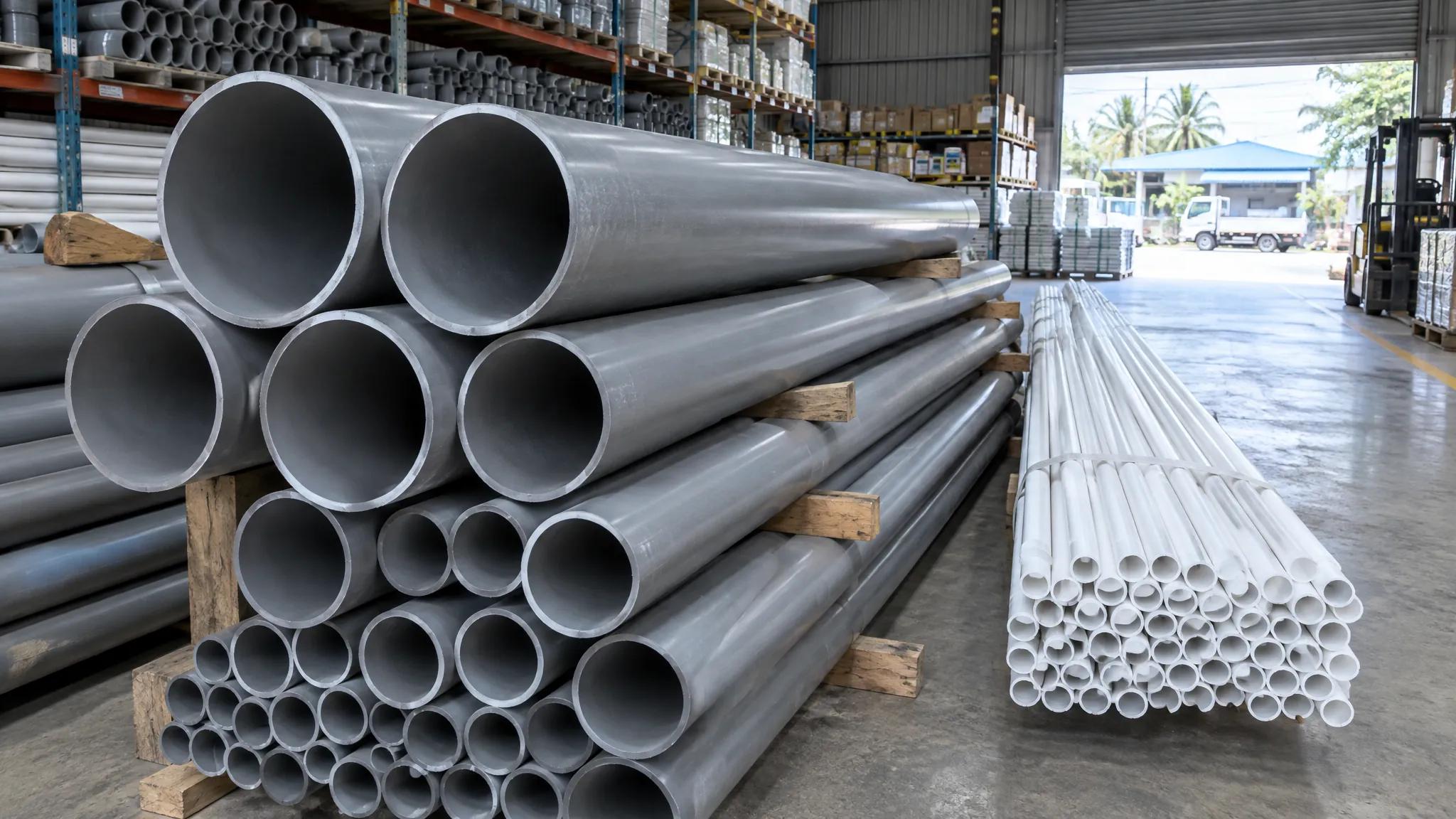
In diameters below DN500, uPVC is the default answer for municipal sewer, and the reasons are cumulative rather than dramatic. A metre of DN400 uPVC weighs about 11 kg against roughly 200 kg for equivalent reinforced concrete; a truck delivers 5 km of pipe against roughly 300 m of concrete, and a two-person crew handles it manually. The joint is a bell-and-spigot with a rubber ring gasket that installs in seconds and passes an air test on the first attempt when the socket is clean. Corrosion behaviour is the strongest single argument: uPVC is chemically inert to hydrogen sulphide, dilute sulphuric acid, and every organic contaminant a domestic or light-industrial sewer carries, so a 100-year design life is not aspirational — it is what the material actually delivers when the joints are seated correctly.
Where uPVC loses is diameter and depth. Above DN500 the pipe becomes heavy, expensive per metre, and structurally weaker than a reinforced concrete or structured-wall alternative. Under more than 6 m of cover under a heavy-traffic road, the ring stiffness class needed for uPVC pushes the wall so thick that HDPE at the same DN wins on cost. And in trenchless applications — horizontal directional drilling, pipe bursting, sliplining — uPVC's rigid segments cannot pull long strings the way fused HDPE can.
Ordering context: IFAN's ten-year shipment record for uPVC drainage shows roughly 60 % of containers ship as SN4 (light-traffic residential and interior), 30 % as SN8 (buried under driveways and medium-traffic streets), and 10 % as SN16 (heavy-traffic and industrial). The mix reflects that most municipal projects now segment stiffness by traffic tier and drop SN2 out of the specification entirely.
One buyer position: for a mixed municipal tender covering DN110 collectors to a DN800 trunk, spec uPVC for the collector network and stop the substitution talk on grounds of network standardisation. The trunk becomes an HDPE decision, not a "let's just extend the PVC" decision.
Reinforced Concrete: Where It Wins
Reinforced concrete pipe (RCP) was the dominant municipal sewer material for the second half of the 20th century, and it still shows up in specifications for two clear reasons. First, at very large diameters — DN1200 and up — RCP is manufactured to ASTM C76 or EN 1916 in Class I through V by wall thickness, and the structural class handles cover depths and traffic loads that plastic alternatives cannot match without exotic wall constructions. Second, in some jurisdictions the tender explicitly requires concrete — legacy asset management, engineer preference, or contractor familiarity — and material choice is not open.
Where RCP now fails, and municipal engineers increasingly know it, is H₂S attack. Domestic sewage generates hydrogen sulphide when biofilm on the pipe wall converts sulphates in an anaerobic environment. In warm climates and low-slope sewers, the gas rises to the crown of the pipe, dissolves into condensate, and gets oxidised by Thiobacillus bacteria into sulphuric acid at a pH below 1. Unlined concrete loses 5-10 mm of cover per year under those conditions, and a pipe designed for 100 years reaches structural failure around year 30. Modern specifications increasingly require a plastic liner, an HDPE-inserted "T-lock" cover, or a calcium-aluminate cement — and the added cost narrows the gap against uPVC and HDPE dramatically.
Position: if your project sits above DN800, do not automatically default to RCP. Compare the lined-concrete option against structured-wall HDPE at the same DN — for warm-climate systems the HDPE almost always wins on 50-year TCO, and increasingly on installed cost too.
HDPE: Where It Wins
HDPE takes over above DN500 and anywhere trenchless installation is on the table. Its butt-fusion joint welds two pipe ends into a continuous string that behaves as a monolithic tube — no gaskets to fail, no bells to seal, no infiltration path. Pulled strings up to a kilometre install in a single horizontal directional drill under a river or a road, with none of the traffic disruption of open-cut work. Pipe bursting — replacing a failed sewer main in place — is only possible with HDPE, and municipal renewal programs across North America and Europe have converged on it for exactly that reason.
On corrosion, HDPE matches uPVC: immune to H₂S, sulphuric acid at pH 1, chlorinated water, most organic solvents. Design life on a properly installed HDPE sewer sits above 100 years by ISO 9080 stress regression, and unlike concrete that life is not conditional on lining or coating. The trade-off HDPE pays is thermal expansion — a 100 m HDPE run in a 40 °C temperature swing changes length by roughly 20 cm, so the design has to accommodate it with either buried anchoring or specific joint types.
Where HDPE loses is against uPVC on small-diameter collector networks. A DN160 HDPE lateral requires a fusion joint that costs USD 50 – 80 in equipment time, against a USD 5 uPVC rubber-ring joint. On a 200-property collector network the fusion cost alone exceeds the total pipe cost — HDPE is over-engineered for the application, and the substitution never pencils.
Hydrogen Sulphide: The Silent Killer of Concrete Sewers
The single technical trend that has re-shaped sewer material choice since 2010 is the recognition of H₂S-driven acid attack on concrete. In shallow-gradient sewers — 0.3 % slope or less, common in flat coastal cities — the sewage moves slowly, biofilm has time to establish, and sulphates in the water get reduced to sulphide by anaerobic bacteria in the biofilm. The sulphide gasses out at the water surface, rises to the crown of the pipe, and encounters aerobic Thiobacillus bacteria in the condensate above the flow line. Those bacteria oxidise H₂S to sulphuric acid, and the acid attacks the cement paste at rates of 5 – 10 mm per year in warm climates, faster in tropical systems.
The failure mode is characteristic: a straight cross-section shows the crown missing 20 – 30 mm of concrete cover, the steel reinforcement exposed and rusted, and the invert (the flow line at the bottom of the pipe) intact. A pipe designed for a century reaches structural failure in the crown between year 20 and year 40, depending on climate. Lining changes the calculation — a T-lock HDPE liner cast into the concrete or a calcium-aluminate cement mix survives the acid attack, but adds cost that closes the gap on plastic alternatives.
For municipal buyers now specifying new networks: assume any unlined concrete sewer in a warm climate has a 30-year replacement horizon, not 100 years. Match the total-cost-of-ownership calculation over 50 years and uPVC or HDPE almost always wins, even if the concrete tender comes in lower per metre on day one.
Installation Cost and Total Cost of Ownership
Illustrative installed cost and 50-year TCO — DN400 gravity sewer, open cut, warm climate
| Cost line | uPVC | Concrete (lined) | HDPE |
|---|---|---|---|
| Pipe supply (per m) | USD 25 | USD 40 | USD 45 |
| Trench + backfill (per m) | USD 30 | USD 40 | USD 30 |
| Jointing (per m) | USD 3 | USD 8 | USD 20 |
| Total install (per m) | USD 58 | USD 88 | USD 95 |
| Rehabilitation at year 30 | None expected | Reline: USD 40 / m | None expected |
| 50-year cost (per m) | USD 58 | USD 128 (with reline) | USD 95 |
These are order-of-magnitude figures from a warm-climate municipal comparison and vary substantially with local labour rates, backfill availability, and the reline schedule the client accepts. What the table demonstrates is not a precise cost — it is that concrete's day-one price advantage over HDPE evaporates once the rehabilitation costs enter the picture, and uPVC's lead over both at diameters where it fits the DN range is durable.
Which Material Fits Which Project
| Project profile | Recommended material |
|---|---|
| Residential subdivision collector (DN110 – DN200), open cut, moderate cover | uPVC SN4 or SN8 |
| Municipal collector network (DN200 – DN500), warm climate, low slope | uPVC SN8 or SN16 |
| Deep trunk main (DN500 – DN1200), open cut, moderate to heavy traffic | HDPE (structured-wall) or lined concrete |
| Horizontal directional drill under road or river, any DN | HDPE (butt-fusion string) |
| Pipe bursting / renewal of a failed 20th-century concrete main | HDPE only |
| Very large trunk (DN1400+) where tender requires rigid material | Reinforced concrete with H₂S lining |
| Storm-only network (no sewage biofilm, no H₂S) | uPVC below DN500, concrete or HDPE above |
What IFAN Supplies in the Sewer Range
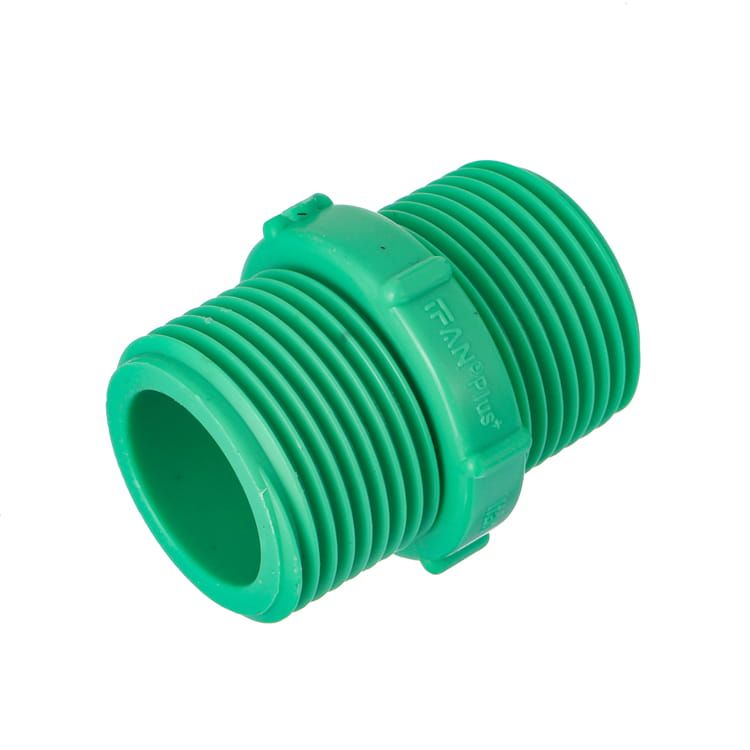
IFAN's uPVC / PVC Series is positioned for the small- and mid-diameter collector tier — the DN110 to DN400 sewer main range where uPVC out-competes concrete and HDPE on installed cost, lifetime and corrosion. The range covers:
- DN110 – DN400 uPVC pipe in SN4 and SN8 wall classes to EN 1401 and ISO 4435, bell-and-spigot with rubber ring gasket as standard.
- Fittings shape catalogue — 45° wyes, long-radius 90° elbows, sanitary tees, reducers, cleanout access, in the same diameter range so the network installs from one supplier's fitting geometry.
- Batch-traceable QC — the same per-shipment inspection routine covered in the PPR quality control checklist applies to the drainage-grade uPVC, with SN class confirmed by wall measurement, not just print stamp.
- Sizing support — pair the container mix with the PVC drainage pipe sizes guide to match SKU counts to the network's DFU load and cover depth.
- Installation guidance — the solvent-weld and rubber-ring installation guide covers the joint work for both DWV and sewer runs.
Above DN500 the natural specification moves to HDPE or lined concrete depending on installation method — a separate supplier tier that municipal procurement usually handles under a different procurement package. Third-party inspections from SGS, Bureau Veritas or TÜV are welcomed on any uPVC sewer order.
Conclusion
The three-material sewer question is not a single-answer decision. Below DN500, uPVC wins on nearly every axis — cost, weight, corrosion, joint reliability, design life. Above DN500 the decision flips: HDPE takes the trenchless applications and the deep or flexible-ground installations, and concrete survives only where the tender pre-specifies it or the diameter genuinely justifies the wall thickness. Match the material to the diameter tier and the installation method; if you spec one material for the whole network, you either over-pay in the collector tier or under-build in the trunk.
Before the next tender goes out, break the network into DN tiers and apply the head-to-head table above to each tier independently. Requirements vary by product, climate, and utility standard, so confirm the material selection with the tender's H₂S exposure calculation and design-life expectation before locking the specification.
Frequently Asked Questions
Is PVC or concrete better for sewer main?
Below DN500, uPVC is better on cost, corrosion resistance and design life. Above DN800, concrete or HDPE handle the diameter and depth better than solid-wall uPVC. Concrete needs H₂S lining in any warm-climate sewer to reach a real 50-year life.
Does PVC sewer pipe last 100 years?
Yes. uPVC is chemically inert to sewage and hydrogen sulphide, and a properly installed uPVC sewer with rubber-ring joints has an expected service life above 100 years. The joints are the limit, not the pipe.
Why do concrete sewers fail early in warm climates?
Hydrogen sulphide from anaerobic biofilm rises to the crown and gets oxidised into sulphuric acid at pH below 1. The acid attacks unlined concrete at 5–10 mm per year, so a 100-year design reaches structural failure between year 20 and year 40.
When should I use HDPE instead of uPVC for sewer?
Use HDPE above DN500, for horizontal directional drilling under a road or river, and for pipe-bursting renewal of a failed main. Below DN500 the extra fusion-joint cost is not justified — uPVC's rubber-ring joint is faster, cheaper and equally reliable.
What stiffness class of uPVC do I need for a municipal sewer?
SN4 for light-traffic residential streets and moderate cover; SN8 under driveways, medium-traffic streets and shallow cover; SN16 for heavy-traffic roads, deep burial, or under load-transfer slabs. Never SN2 for a municipal main.
Can I use a mix of PVC and HDPE in the same sewer network?
Yes — most modern municipal networks now do. Use uPVC in the DN110–DN400 collector tier and HDPE in the DN500+ trunk, with a bespoke connector at the interface. Splitting the tender by diameter tier is now standard practice.