
Hot-Media Pressure Gauges: Check the Thermal Duty

Compare actual medium, process and ambient conditions with the offered gauge arrangement’s documents. Keep missing thermal evidence on hold.
Before connecting a pressure gauge to hot media, match the actual service conditions to the offered gauge and any proposed accessory’s documented limits. Record the medium, process-temperature exposure and ambient conditions separately. A quote that says “liquid filled” or includes a siphon has not, by itself, demonstrated that the complete arrangement suits the duty. Where the necessary limits or arrangement evidence are missing, keep thermal selection on hold.
The useful result is a thermal-duty record that an instrument manufacturer can review without guessing what the installation will experience. It identifies the proposed components, the conditions to compare and the evidence supporting the connection arrangement. This guide organizes that review; it supplies no universal temperature limit, cooling allowance or installation approval.
Video: a steam-service siphon example
WARE Boilers explains siphon loops used with steam gauges and switches. This is a steam example; it does not qualify a hot-water arrangement, establish a cooling allowance, or demonstrate an IFAN instrument offer.
Watch on YouTube. Manual playback has not been verified.
Describe what reaches the gauge and what surrounds it
Write the fluid’s identity and relevant service state before choosing an accessory. A supplier reviewing a liquid-water application needs that description, rather than a generic steam example. Likewise, a vapor application must remain identified as such. This article does not establish that a protection arrangement described for one medium works unchanged for another.
Separate the process-temperature exposure from the ambient conditions around the proposed instrument. The two fields answer different questions: what the connection communicates from the process, and what environment the installed gauge occupies. Do not use one reading to fill both fields without evidence. If an enclosure, mounting location or operating change is relevant to the offered documentation, include it in the description.
Record the conditions that the responsible project specification requires the instrument arrangement to accommodate, including relevant operating modes. A routine reading alone does not establish every required exposure. If a condition is unknown, name it explicitly and identify who can establish it. This makes the missing input actionable: the selection remains open until the actual requirement and the corresponding offered limit can be compared.
Read the limits for the exact offered combination
Attach a manufacturer document reference and revision to each proposed component. “Pressure gauge plus siphon” is a component category description, not a configuration identity. The review needs the offered gauge, the specific accessory where used, and the arrangement to which the evidence applies.
For each temperature statement, retain its subject and conditions. Does it describe the process connection, the instrument environment or a particular arrangement? Are the stated conditions the same as the project’s? A comparison is incomplete when the application and the documentation use different bases and nothing explains the relationship. Do not turn an accessory’s general marketing description into the gauge’s permitted exposure.
| Record field | Evidence to retain | Unresolved result |
|---|---|---|
| Medium and service state | Actual project application description | Do not transfer a different medium’s example. |
| Process exposure | Required conditions and exact offered-document basis | HOLD the temperature comparison. |
| Ambient conditions | Installed-location conditions and applicable instrument limits | Do not substitute process information. |
| Gauge identity | Offered model/configuration and document revision | Do not apply a similar model’s declaration. |
| Accessory and arrangement | Exact identity and evidence for the proposed combination | A generic protection claim does not close the review. |
| Review outcome | Named reviewer, evidence references and remaining checks | Keep thermal review separate from overall acceptance. |
This is an editorial review worksheet, not a prescribed standard form. Its purpose is to prevent a missing relationship from disappearing inside a quotation. Pressure exposure, wetted-material compatibility, accuracy and other project requirements still need their own assessment. The gauge range and accuracy guide addresses the separate indication-allowance decision.
Understand the protection claim without inventing a cooling guarantee
Brannan’s pressure-gauge siphon explanation describes hot vapor cooling and condensate collecting in the siphon. That collected liquid forms a barrier between the hot vapor and the gauge. The manufacturer also explains that excessive heat can damage an instrument or affect its readings.
This establishes why thermal protection can require attention. It does not provide a cooling-performance curve for the assembly on your quotation. There is no basis here for subtracting a fixed temperature from the process condition or declaring that adding a coil resolves every hot-service application. A named arrangement still needs documentation appropriate to its actual medium, components and conditions.
Read a protection claim for the problem it actually answers. A description about pointer stability or a liquid-filled case does not automatically state the offered assembly’s thermal limits. Our liquid-fill and snubber comparison handles vibration, pressure pulsation and response. The present review asks a different question: has the thermal exposure of this proposed combination been addressed?
Choose a documented review branch
Begin with direct connection only as a proposal to assess. If the exact offered documentation addresses the actual medium, process exposure and ambient conditions for that configuration, retain the comparison and send it through the responsible instrument review. A completed thermal comparison is one input to that review, not permission to install.
If the proposal instead relies on thermal protection, name that arrangement explicitly. Keep the evidence that connects the accessory and gauge to the stated duty. A separate accessory document may describe its own function while leaving the complete arrangement unconfirmed. Where that relationship is missing, obtain the instrument manufacturer’s documented assessment of the actual proposal rather than guessing a cooling allowance.
Return HOLD when identity, required exposure, applicable limits or arrangement evidence remain unresolved. State the exact missing item and the branch it prevents you from closing. “Need more information” is less useful than “the offered accessory is identified, but no evidence connects this gauge’s process exposure to the proposed protected arrangement.” The latter gives the receiving party a precise question to resolve.
For the separate piping portion of a water-supply project, use IFAN’s PPR pipe and fitting enquiry route. Send the actual piping service conditions and component schedule. This route does not establish gauge or siphon supply, steam-duty piping suitability, instrument selection or thermal-performance approval. Keep the instrument arrangement with its chosen manufacturer and the responsible project reviewer.
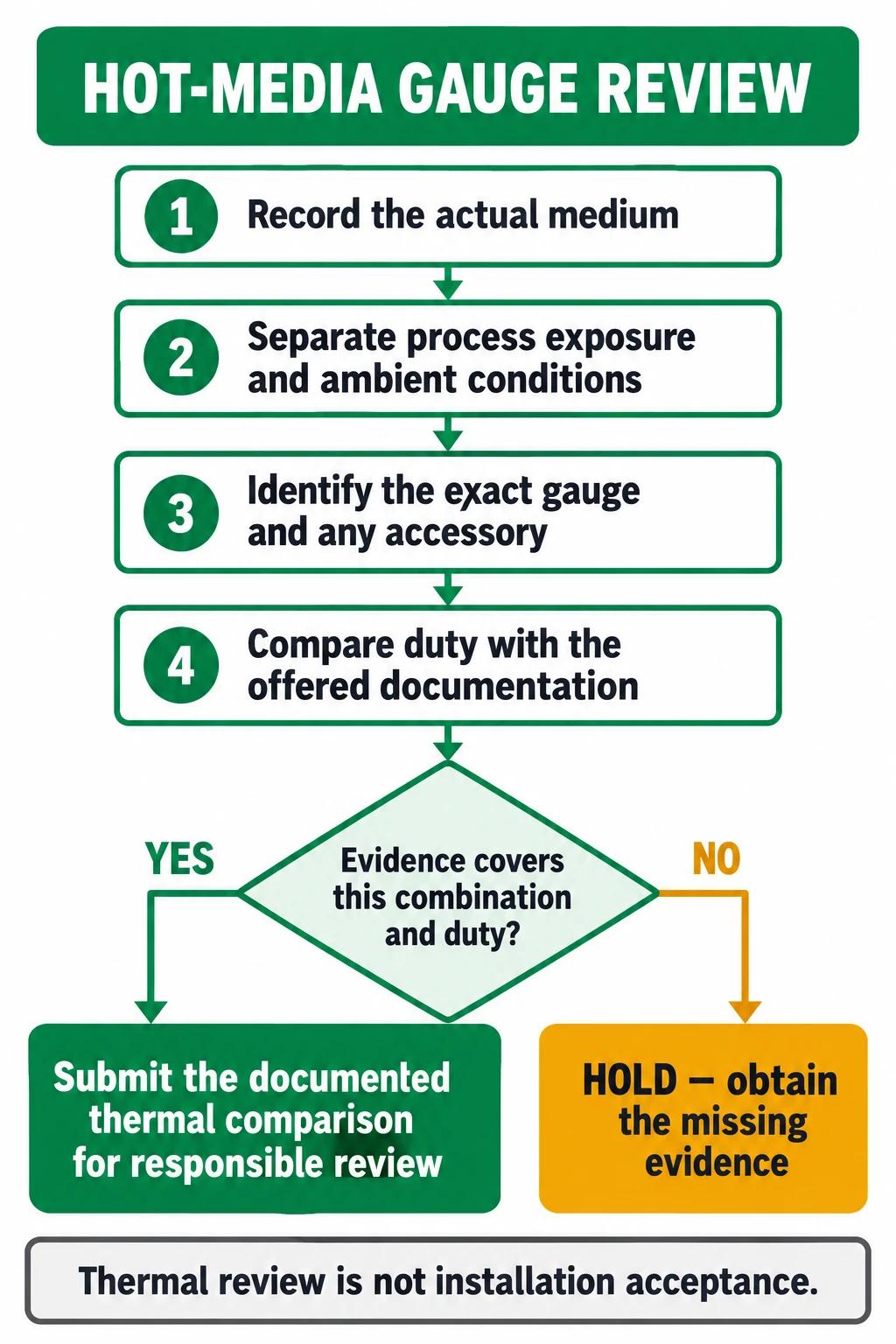
- Record the actual medium and service state.
- Record process exposure and ambient conditions separately.
- Identify the exact offered gauge and any accessory with document revisions.
- Compare the actual duty with the offered documentation.
- If evidence covers this combination and duty, submit the documented thermal comparison for responsible review. Otherwise HOLD and obtain the missing evidence.
Work through an unknown, then a confirmed document relationship
Consider a hypothetical document review, not a tested installation or an IFAN product offer. The project has identified its medium and required process and ambient conditions. The quotation identifies a gauge and accessory, but the attached material only explains what a siphon does. No document connects the offered combination to those project conditions.
The result is HOLD on the proposed protected arrangement. The missing input is not another generic explanation of condensation. It is evidence that addresses this combination and these conditions. Preserve the existing component identities and application record when requesting that assessment, so a later answer cannot silently refer to a different assembly.
| Stage | Input available | Bounded result |
|---|---|---|
| Initial proposal | Duty and component identities; generic mechanism description only | HOLD: combination-to-duty relationship unresolved. |
| Document relationship confirmed | Assume the exact instrument manufacturer provides a referenced assessment covering the named combination and all stated thermal conditions | Submit the documented thermal comparison for responsible project review; keep other acceptance checks separate. |
| One condition changes | The actual ambient condition falls outside what that assessment addresses | Reopen the thermal review; the earlier assessment does not resolve the changed duty. |
The middle row is an explicitly assumed logical input. No actual manufacturer assessment or performance result is claimed. It shows what changes the decision: a traceable relationship between the offered assembly and the required conditions. It also shows what does not change it: a quieter dial, a familiar accessory shape or a repeated claim that the product is for hot service.
Keep the completed record with the quotation and review correspondence. Record which proposal was assessed, the evidence revision and unresolved checks. If a component or relevant condition changes, compare the revised proposal again. That preserves the scope of the decision instead of allowing an earlier document to become an unlimited approval.
Conclusion
Identify the medium, separate process and ambient conditions, and match them to the exact proposed gauge arrangement’s evidence. Use the mechanism explanation to understand the protection question, then close the document relationship through the responsible instrument review. Keep unknowns visible and HOLD the affected selection until they are resolved.
FAQ
Does a liquid-filled quotation settle temperature suitability?
No. That description alone does not state the offered combination’s applicable thermal limits. Compare the actual duty with the exact manufacturer documentation.
Does a siphon provide a fixed cooling allowance?
No fixed allowance is established here. A mechanism explanation is not a performance declaration for your particular gauge, accessory and service conditions.
Can a steam example qualify a hot-water arrangement?
Not by itself. Identify the actual medium and obtain documentation that addresses the proposed combination in that duty.
Does a completed thermal review approve installation?
No. It addresses the documented thermal comparison. Pressure, material compatibility, measurement performance and the project’s installation acceptance requirements remain separate.