
Plumbing Material Takeoff to BOM: Turning a Drawing Into an Order
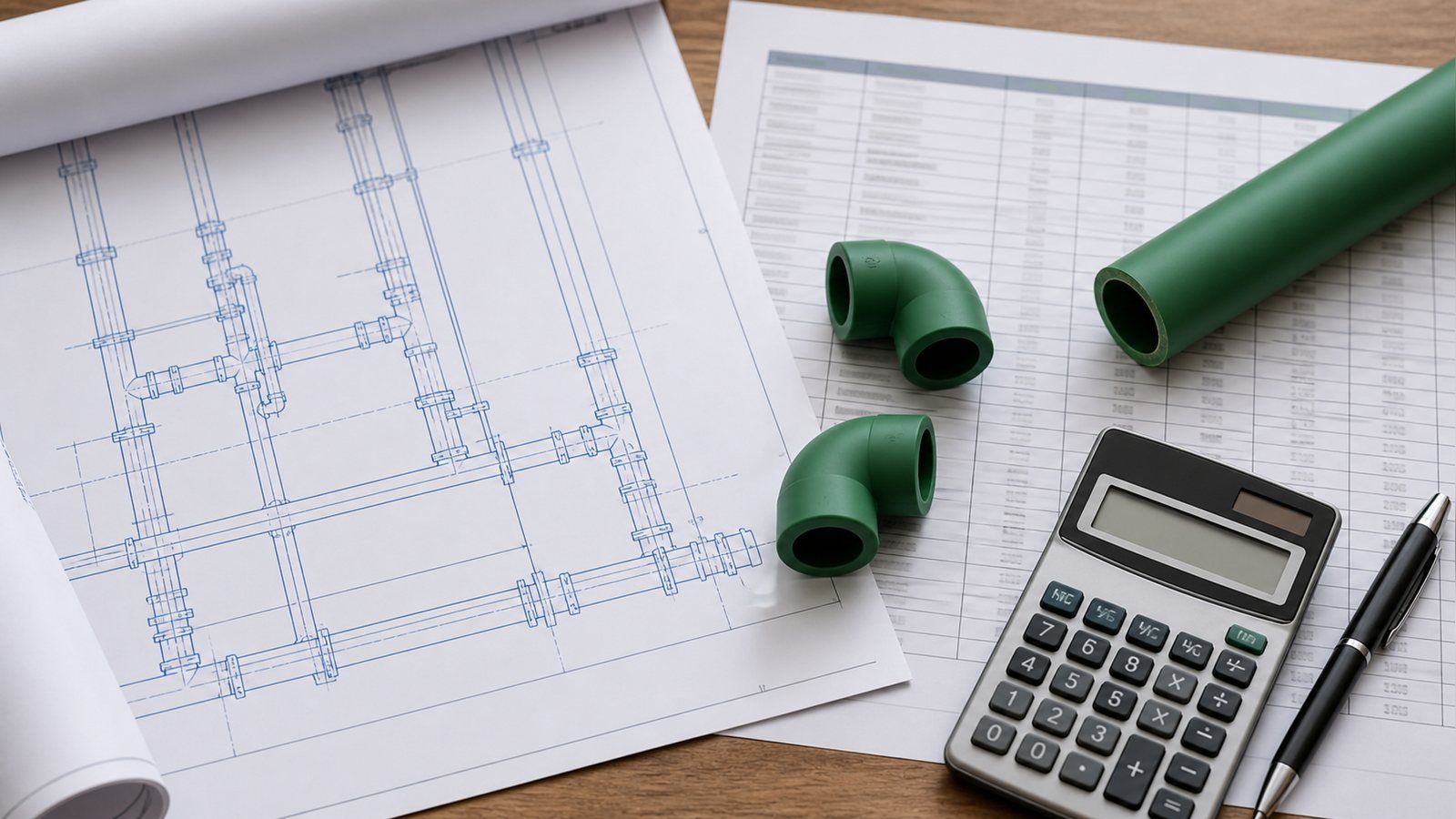
A takeoff tells you that the job needs 480 metres of DN25 and 190 metres of DN32. A bill of materials tells a factory what to put in a container. Those are not the same document, and the gap between them is where most first orders go wrong — not because the measuring was sloppy, but because nobody converted branch junctions into elbow counts, nobody subtracted the pipe that disappears inside every fusion socket, and nobody checked whether the finished list fills the container the buyer has just been asked to commit to.
Search for help with this and you get takeoff software. The estimating pages that do rank were written for a US contractor buying from a local branch in 10-foot sticks, which is a different arithmetic from a metric PP-R order arriving in 4-metre lengths from an overseas factory. This is the conversion step: drawing quantities in, orderable line items out.
Key takeaways
- Fitting quantities come from the topology of the drawing — every direction change, every branch, every diameter transition — not from a ratio to pipe length. Count the junctions, then price them.
- Socket-fusion joints eat pipe. Welding depth runs from 12 mm at d20 to 32,5 mm at d110, and every joint consumes it twice. On joint-dense work that is real metres, and no estimating page on page one mentions it.
- The coupling count is set by your supplied length, not by a rule of thumb. Carrying a US 10-foot assumption onto 4 m pipe overstates couplings by about a third.
- A BOM line needs pressure class and dimension class, not just diameter. ISO 15874-2 restricts the thinner series S4, S6,3 and S8 to PP-RCT — quoting an S4 wall on ordinary PP-R asks for something that may not exist.
- Waste has a computable part and a conventional part. Compute the socket consumption and the offcuts; treat the 5–10% figures circulating online as convention, because no standard sets them.
On this page
- What a Bill of Materials Has to Carry That a Takeoff Does Not
- Counting Fittings From Branch Topology, Not From a Rule of Thumb
- The Socket-Depth Correction Every PP-R Takeoff Misses
- Waste Allowance: What Can Be Calculated and What Is Just Convention
- Rounding the BOM Into Orderable SKU Lines
- Checking the Finished BOM Against One Container
- Frequently asked questions

The elbow, tee, coupling and reducer families a PP-R bill of materials counts as separate line items.
What a Bill of Materials Has to Carry That a Takeoff Does Not
A quantity is not a line item. "DN25 pipe, 480 m" cannot be priced, because a PP-R catalogue does not contain one DN25 pipe — it contains DN25 in several pressure classes, in several colours, in a dimension class that has to match the fittings. The line becomes orderable when it carries three things the takeoff never captured: which SKU, in what orderable unit, at what pressure class.
Pressure class is the one that causes arguments after delivery. ISO 15874-2:2013 sets wall thickness by pipe series, and the same nominal diameter carries very different walls across the series. At DN32 in dimension class A, series S5 is 2,9 mm and series S4 is 3,6 mm. Both are "DN32 pipe". They are not the same product, they do not weigh the same, and they do not cost the same.
| What the takeoff gives you | What the BOM line needs | Why the supplier asks |
|---|---|---|
| DN25 pipe, 480 m | DN25, series and PN stated, colour, in 4 m lengths | Wall thickness changes with the series, and price and weight follow it |
| Elbows, 96 | DN25 90° socket elbow, pcs, packed quantity noted | 45° and 90° are separate SKUs; cartons ship in fixed counts |
| Tees, 24 | Equal or reducing, with all three ports sized | A reducing tee is a different mould and a different part number |
| (nothing) | The print-line data to check on arrival | It is what receiving inspection compares the delivered goods against |
That last row is the one buyers leave off and later wish they had not. ISO 15874-2:2013 requires the pipe itself to carry its identification, printed not less than once per metre: the standard number, the manufacturer's name or mark, the nominal diameter and wall thickness written as a pair such as 16 × 2,2, the dimension class, the material, the application class combined with operating pressure, and traceability data giving the production year and month. Put those fields in a column on the BOM and receiving inspection has a checklist instead of an opinion.
Counting Fittings From Branch Topology, Not From a Rule of Thumb
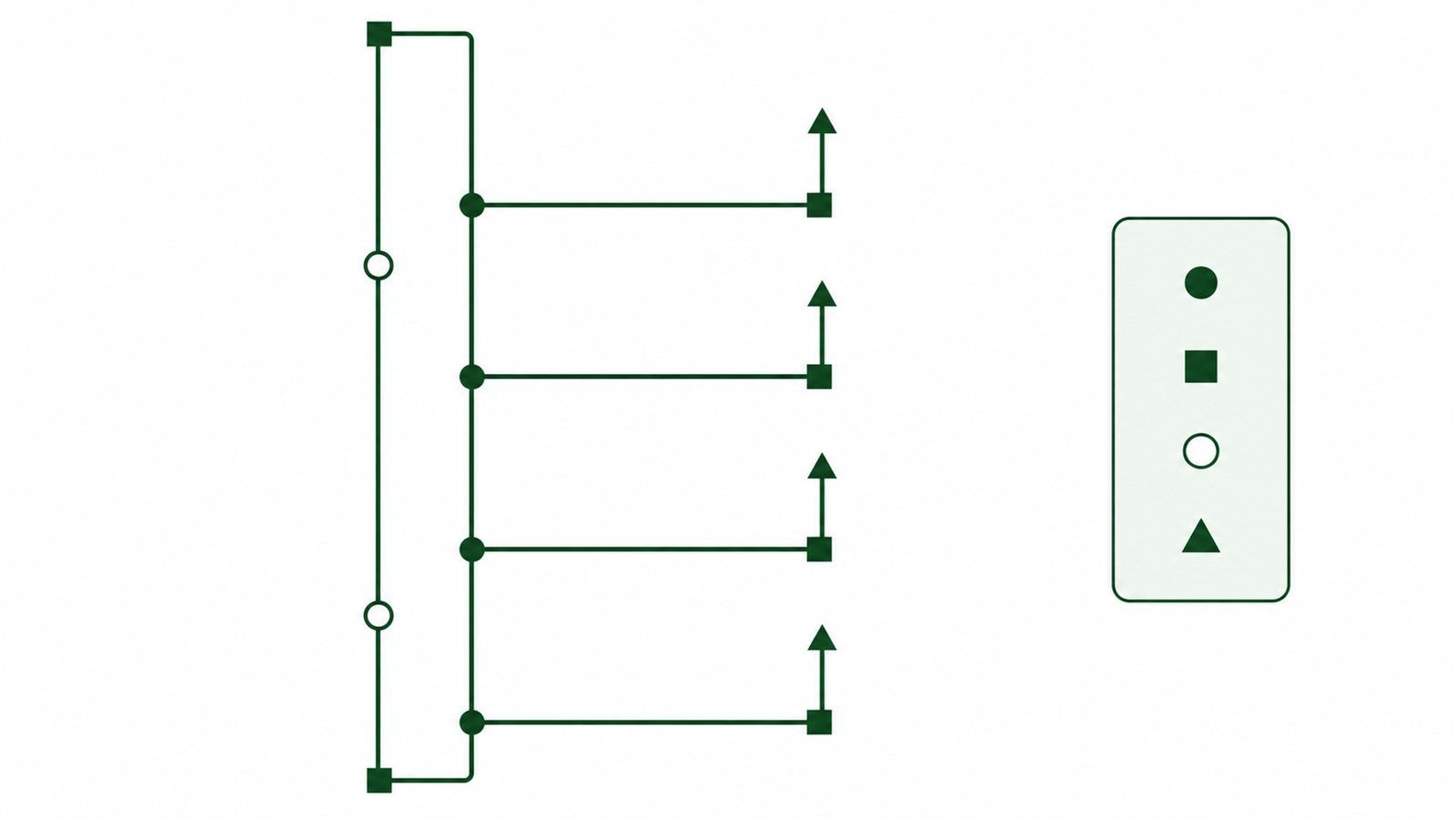
There is no honest ratio of fittings to pipe length. A 200-metre run feeding one tank needs almost no fittings; 200 metres of bathroom rough-in needs hundreds. Anyone quoting you a universal figure is describing their own last job, not yours.
What does transfer is the method. Fittings exist where the geometry changes, so read the drawing for four events and count each one:
- Direction changes. One elbow each. Split 90° from 45° while counting — they are different SKUs and mixing them is a common shortfall.
- Branches. One tee each. Note all three port sizes now; a branch off a DN32 main to a DN20 fixture is a reducing tee, not an equal tee with an adapter.
- Diameter transitions. One reducer each, wherever the main steps down.
- Terminations and isolation. Stop ends, valves, and every transition to a threaded or metal component. These rarely appear as symbols and are the most commonly missed group.
Couplings are the exception, and they are where imported advice does real damage. Couplings are not a function of the drawing at all — they are a function of how long the pipe is when it arrives. The estimating guidance ranking for this query tells readers to budget one coupling per 10 feet of straight run, "since sticks come in 10-foot lengths". That is sound advice in a US supply house and wrong for a PP-R import, where 4-metre lengths are the prevailing supply configuration.
The arithmetic is not subtle. Take a 480-metre straight-run total. At 10-foot lengths, that is 480 ÷ 3,05 = 158 pipes, so about 156 joins. At 4 m it is 120 pipes and 119 joins. Carry the US assumption and you order roughly 37 couplings per 480 metres that you do not need, per size. One caution: confirm the supplied length with your supplier before you build the arithmetic on it. ISO 15874-2 sets dimensions and tolerances, not how long the pipe is when it leaves the factory — 3 m and 5,8 m are both in circulation, and the length is a commercial convention rather than a standards requirement.
The Socket-Depth Correction Every PP-R Takeoff Misses
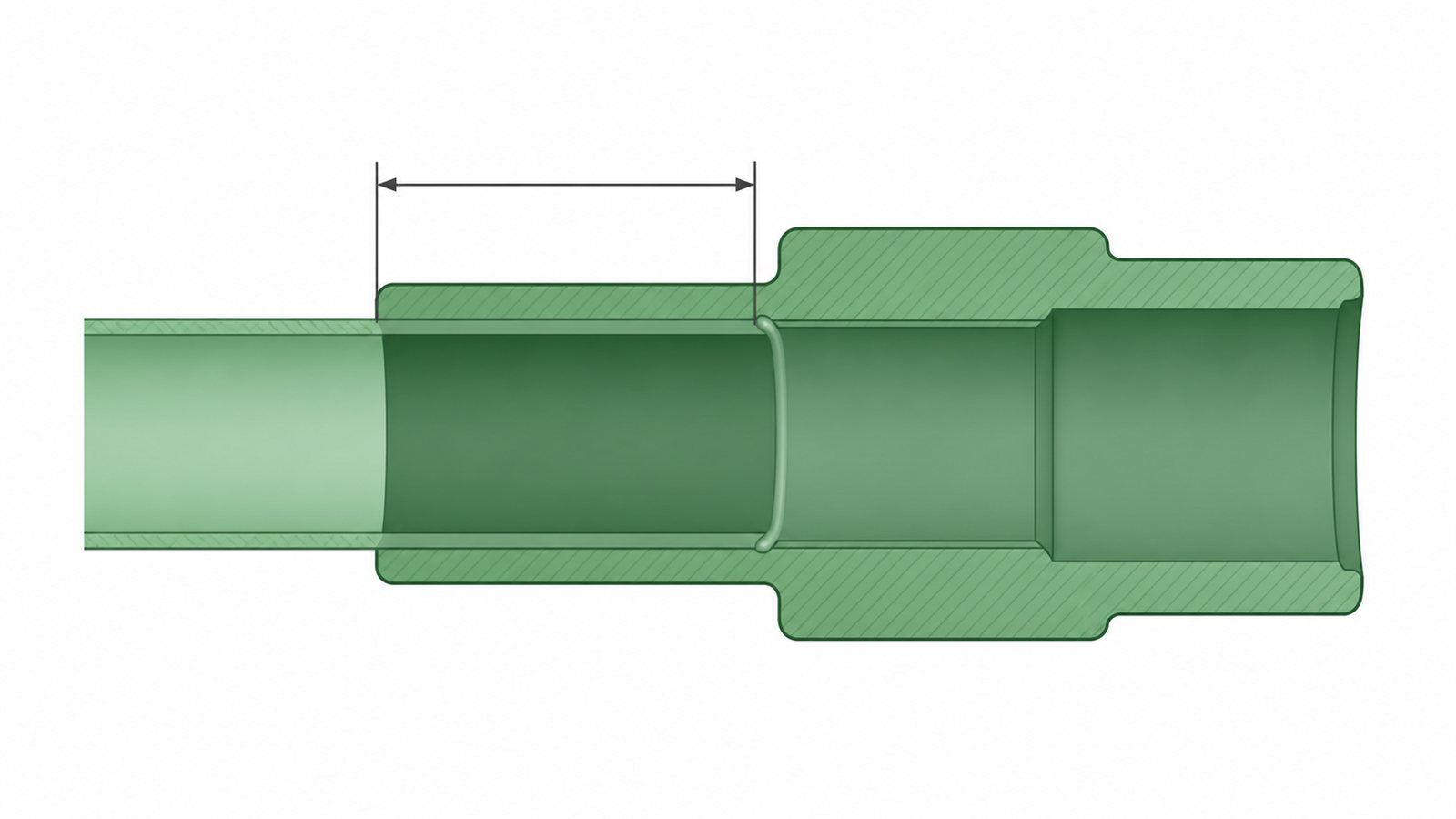
Here is the correction almost nobody applies. In a socket-fusion system the pipe end is pushed into the fitting socket to a marked depth and welded there. That length of pipe is inside the fitting permanently. It is bought, shipped, and paid for, and it spans no distance at all.
The depth is fixed per diameter and published. Pestan's PP-R technical catalogue tabulates it, and its companion heating-time table matches the DVS 2207-11 guide values reproduced in SIMONA's welding manual value for value across every diameter — two unrelated documents agreeing, which is the reason to trust the depth column beside them.
| Pipe OD | Welding depth (mm) | Consumed per joint, both ends (mm) | Heating time (s) |
|---|---|---|---|
| d20 | 12 | 24 | 5 |
| d25 | 13 | 26 | 7 |
| d32 | 14,5 | 29 | 8 |
| d40 | 16 | 32 | 12 |
| d50 | 18 | 36 | 18 |
| d63 | 24 | 48 | 24 |
| d75 | 26 | 52 | 30 |
| d90 | 29 | 58 | 40 |
| d110 | 32,5 | 65 | 50 |
Apply it to a real shape. A twelve-storey DN25 riser with a tee, an elbow and a coupling on each floor carries roughly 36 joints; at 26 mm consumed per joint that is 0,94 m of pipe swallowed by fittings — under a metre, and honestly ignorable. Now take a hotel floor plate with 400 DN25 joints across the bathroom groups: 10,4 m. At d63 with 400 joints it is 19,2 m. The correction is worth making where joints are dense and worth skipping on long straight transmission runs, and knowing which case you are in is the actual skill.
Before you specify a thin-wall series to save money: ISO 15874-2:2013 sets a floor of 2,0 mm wall thickness for any pipe intended to be joined by fusion, whatever the series calculation returns. DVS 2207-11 goes further and flags socket welding of the thinner SDR 17 wall as not recommended from d25 through d63. A wall that is legal on paper is not automatically a wall your installer can weld.
Waste Allowance: What Can Be Calculated and What Is Just Convention
Ask three estimators for a waste allowance and you get three numbers. The pages ranking for this topic offer 5–10% on piping and 10–15% on fixtures; another offers 3–10% on fittings and valves. None of them cites a source, because there is no standard to cite. These are conventions, and a convention applied to a metric import BOM is doing less work than it appears to.
Split the allowance instead. Part of it is arithmetic you have already done — the socket consumption from the table above is a known quantity, not a contingency. Part of it is offcut loss, which depends on how your cut lengths divide into the supplied length: a job whose runs are mostly 2,2 m wastes 1,8 m of every 4 m pipe unless the crew nests the cuts, and that is a scheduling decision, not a percentage. What genuinely remains for a blanket percentage is site damage, mis-cuts and theft.
So carry the allowance as its own visible line rather than folding it into the quantities. A supplier who can see that 480 m is 445 m of measured run plus a stated allowance can tell you when the allowance is doing something strange. A supplier who receives 480 m flat has nothing to check against, and neither do you when the reconciliation comes at the end of the job.
Rounding the BOM Into Orderable SKU Lines
Now the arithmetic meets the catalogue, and the number you calculated stops being the number you receive. Three things move it.
First, the series decision comes before the size decision. Pick the pressure class for the application — hot-water risers and cold-water distribution are not the same duty — and check availability in the material you are actually buying. ISO 15874-2 marks the thinner series S4, S6,3 and S8 as valid only for PP-RCT. If you are buying ordinary PP-R, a request for an S4 wall may simply have no product behind it.
Second, pipe is sold in whole lengths and fittings in whole cartons. A calculated 445 m of DN25 becomes 112 pipes of 4 m, which is 448 m. A calculated 96 elbows against a 50-piece carton becomes 100. Round every line up at the point of ordering and write both numbers down, because the difference is what you will be arguing about if a shortage appears on site.
Third, fragmentation. A catalogue running to 3,000-plus PP-R SKUs is not a menu of twelve items — the same elbow exists across diameters, pressure classes and colours, and a BOM that splits across three colours for aesthetic reasons has tripled its line count without adding a metre of pipe. Every extra line is another minimum, another carton break, another thing to be short of.
A four-floor walk-up, eight units, runs roughly like this from measured quantities to order lines:
| Line | Measured | After allowance | Ordered |
|---|---|---|---|
| DN32 riser pipe | 88 m | 93 m | 24 lengths (96 m) |
| DN25 branch pipe | 310 m | 330 m | 83 lengths (332 m) |
| DN25 90° elbow | 96 pcs | 101 pcs | 150 (3 cartons) |
| DN32×25 reducing tee | 32 pcs | 34 pcs | 50 (1 carton) |
| DN25 coupling | 78 pcs | 82 pcs | 100 (2 cartons) |
Note what happened between the third column and the fourth. The elbow line went from 101 needed to 150 ordered, because cartons do not break. That is not waste — it is the real quantity arriving, and if you have priced the job on 101 you have mispriced it. Carton sizes vary by supplier and by SKU, so ask for them before you round; they are the single most useful thing a factory can send you at BOM stage.
For distributors and project buyers holding a finished list: IFAN quotes PP-R DN20–DN160 in PN12.5–PN25 line by line, and can confirm the pack quantities your rounding depends on.
Checking the Finished BOM Against One Container
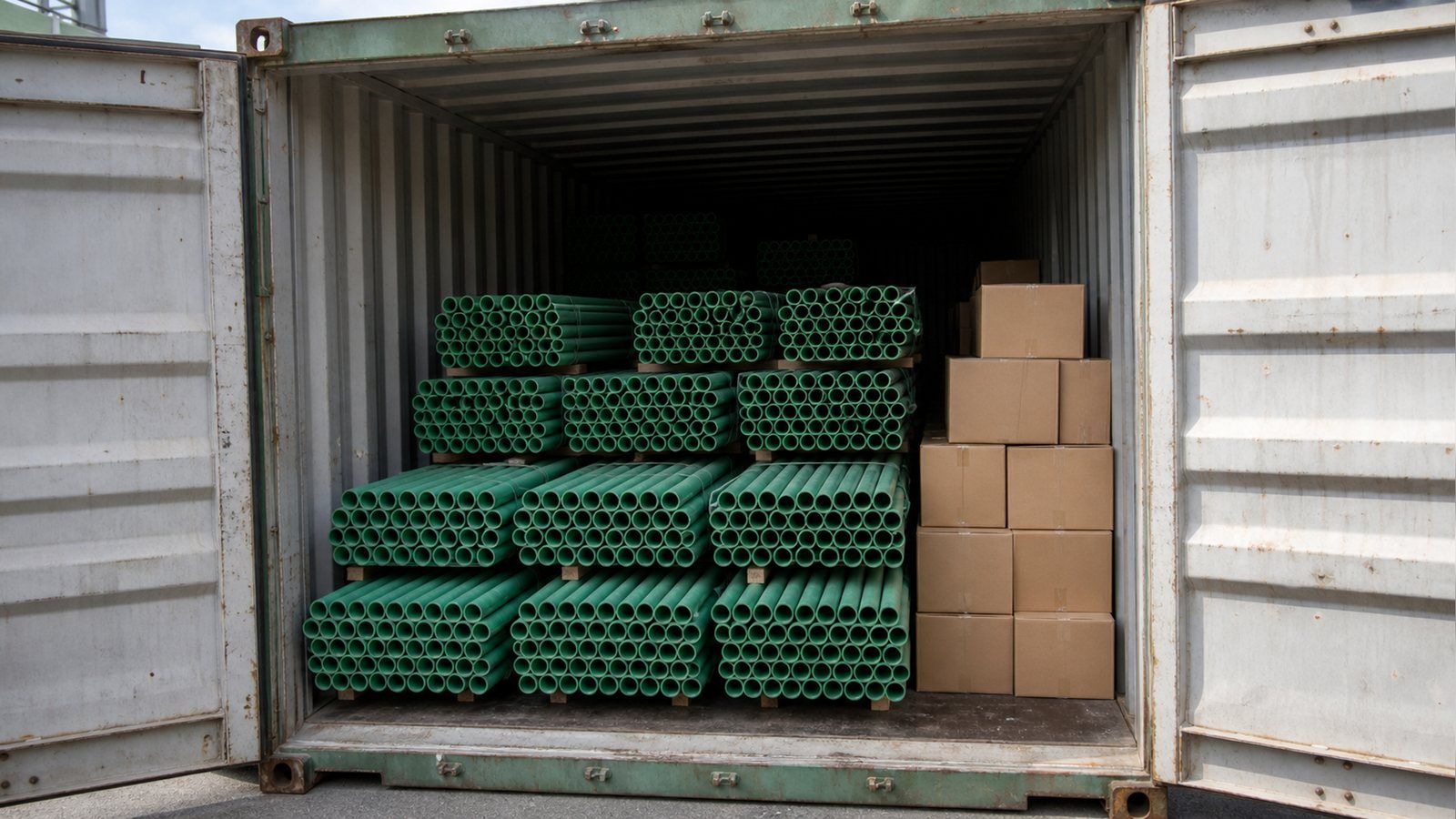
One check remains, and it is the one that decides whether the order can be placed at all. A 20ft dry container offers roughly 33 cbm of internal capacity against internal dimensions near 5,90 × 2,35 × 2,39 m, with a payload around 28,20 t. Treat those as planning figures and confirm with your forwarder — the boxes vary by manufacturer, age and what the line has available on the day.
PP-R will hit that volume long before it troubles the weight limit, which is why the check is a cube calculation rather than a weight one, and why the door aperture at 2,34 m wide matters more than the payload does. The stowage side of this — how pipe actually stacks, what nests inside what — is worked through in detail in our PPR pipe container loading guide, so the job here is only to ask whether the BOM lands near a full box.
Two failures follow, and they pull in opposite directions. Overflow is the cheaper problem: you split the shipment or trim the order, and you find out at booking rather than at the port. Underfill is the expensive one, because paying full freight for a half-empty container quietly deletes the margin the factory price won you. A BOM at 60% of a box is a signal to widen the order — pull forward the next project's fast-moving sizes, or add the stock lines you turn anyway — rather than a signal to ship it as it stands.
This is also where the supplier's order policy stops being fine print. IFAN's minimum is one container with mixed sizes accepted, which means a BOM spanning DN20 to DN110 across several pressure classes does not need to be consolidated into fewer sizes to qualify — the constraint is the box, not the SKU count. Sizes run DN20 to DN160 in PN12.5 through PN25, and samples are available before the full order, which is the sensible way to confirm that what you specified is what the print line says before a container of it sails. If the numbers are close and you want them checked against real pack quantities, that is a factory quotation conversation rather than a spreadsheet one.
What to settle before the BOM becomes an order
Four things are not on your drawing and are not in this article, because they are supplier-specific and change by order. Ask for all four in the same message as the BOM, because each one can move the quantities you have just finished calculating:
- Carton and bundle quantities per SKU. The rounding step above is guesswork without them, and they are the cheapest thing a factory can send you.
- The supplied straight length. Confirm 4 m before your coupling count depends on it.
- How the price is structured. PP-R pipe is normally quoted per metre or per length and fittings per piece, with the resin grade and pressure class driving the number — our PPR cost structure teardown takes that apart line by line. Published figures move with resin, so ask for a dated quotation rather than working from any number you read online, including ours.
- Lead time against your size mix. Production time depends on how many sizes and colours the order spans and what is already in stock, so a BOM with forty fragmented lines does not schedule like one with twelve. The order-formation side — minimums, sampling and payment mechanics — is covered in our PPR MOQ, samples and payment terms guide.
A BOM that arrives with those four answered is a document a factory can quote in a day. One that arrives as bare quantities starts a week of email, and the quantities usually change anyway once the pack sizes come back.
Frequently Asked Questions
How do I calculate how many fittings I need from a plumbing drawing?
Count junctions, not metres. Every direction change is an elbow, every branch is a tee, every diameter step is a reducer, and every run end is a stop end or valve. Couplings are separate: they follow the supplied pipe length, so a 480 m run in 4 m lengths needs about 119 couplings per size.
Is there a standard ratio of fittings to pipe length?
No, and any single figure is describing someone else's job. A long transmission run needs almost no fittings while bathroom rough-in needs hundreds over the same distance. Derive the count from the drawing's junctions instead.
How much pipe does a socket fusion joint use up?
The welding depth, at both ends. That is 12 mm at d20, 13 mm at d25, 14,5 mm at d32, rising to 32,5 mm at d110 per Pestan's PP-R catalogue. Four hundred DN25 joints consume about 10,4 m of pipe.
What waste percentage should I add to a plumbing material takeoff?
No standard sets one. Estimating sources commonly quote 5–10% on piping and 10–15% on fixtures, and they disagree with each other. Calculate the socket consumption and offcut loss directly, then apply a percentage only to genuine site damage and mis-cuts.
What is the difference between a takeoff and a bill of materials?
A takeoff is measured quantities from the drawing. A bill of materials is orderable line items, which means each line also carries SKU identity, the orderable unit, and the pressure and dimension class. A supplier cannot price a takeoff.
What pressure class should I put on the BOM line?
Match it to the duty, then check availability in the material you are buying. ISO 15874-2:2013 restricts the thinner series S4, S6,3 and S8 to PP-RCT, so specifying an S4 wall in ordinary PP-R may describe a product that does not exist.
Does my bill of materials have to fill a whole container?
It depends on the supplier's policy. IFAN's minimum is one container with mixed sizes accepted, so a BOM spanning DN20 to DN110 qualifies without being consolidated. Whether anything below that is possible is a question for the quotation, not a published policy.
What should receiving inspection check the delivered pipe against?
The print line. ISO 15874-2:2013 requires marking at least once per metre carrying the standard number, manufacturer, diameter and wall thickness as a pair, dimension class, material, application class with operating pressure, and production year and month.