
PPR Pipe Cost Breakdown: What's Really in a Per-Metre Quote
Derive PP-R pipe's resin cost floor from ISO 15874-2 wall thicknesses and a dated index — grams per metre for DN20/25/32, and how to read two FOB quotes.
You are holding three FOB quotes for the same DN20 PN20 PP-R pipe. One says US$0.72 per metre, one says US$0.95, one says US$1.28. Every supplier calls their material "100% virgin". None of them will tell you what sits inside the number, and the twenty articles you just read all gave you the same thing: a price band, no arithmetic.
This page does the opposite. It takes the one block of PP-R pipe cost that is genuinely computable from public documents — the resin in the pipe wall — and derives it in front of you, from the wall thicknesses in ISO 15874-2 and a date-stamped resin index. Then it shows you how to solve for everything else as a residual against a quote you already have.
What it will not do is invent the parts nobody publishes. Conversion cost, factory overhead and margin are not public, and a page that hands you a confident percentage for them is guessing at the exact number you came here for.
- A PP-R quote has four blocks. Only one — resin — can be computed from public data. This article computes it and refuses to fabricate the other three.
- Wall thickness is fixed by ISO 15874-2:2013 Table 5, not by the seller. A DN20 in series S2,5 must carry 3,4 mm of wall; in S5 it is 1,9 mm. That ratio is the whole price difference between "PN20" and "PN10".
- Derived from those wall thicknesses and a pipe-grade PP-R density of 0,90 g/cm³, a DN20 S2,5 pipe holds about 159,6 grams of resin per metre — 15,96 kg per 100 m.
- At the July 2026 Northeast Asia polypropylene index of US$1.20/kg, that is roughly US$0.19 of resin per metre. Everything a supplier charges above that is the residual you can actually interrogate.
- Ask every supplier for kg per 100 m alongside price per metre. Two quotes are only comparable once you know how much material each one contains.
What a PPR Quote Is Actually Made Of
Strip a per-metre PP-R price down and four blocks fall out. Resin: the polypropylene random copolymer in the pipe wall, priced per kilogram on a global commodity market. Conversion: extrusion, energy, labour, scrap, tooling amortisation. Overhead and margin: the factory's fixed costs and what it intends to earn. Commercial terms: packing, marking, palletising, certification work, and whatever the Incoterm loads onto the seller.
Here is the uncomfortable part, and it is why this article is structured the way it is. Only the first block is computable from documents anyone can obtain. Resin mass follows from a published standard and a published density; resin price follows from a published index. The other three are internal to a factory that has no reason to publish them, and they vary by plant, by line speed, by electricity tariff and by how badly the sales manager wants your container this month.
So when a page hands you a confident percentage for how much of a factory's cost is raw material, ask where it came from. Those figures circulate widely on supplier blogs with no methodology behind them, and they do an enormous amount of work in an argument about your money. This article uses none of them. You will not need one, because by the end you will be computing the material share of your own quote directly, which beats any industry average.
What the rest of this query returns
The pages currently ranking for PPR cost questions quote bands: around US$0.80–1.20 per metre for 20 mm, US$1.20–1.70 for 25 mm, a general US$0.60–3.50 spread across the range. Those figures are not wrong as observations of a market. They are simply not decomposable — you cannot use a band to judge whether the quote in your inbox is efficient, underspecified or padded, because the band contains all three.
Measured on 10 August 2026, the three closest comparable pages on this query run roughly 1,000 words each, carry no tables, and publish no mass figure at all. Not one states how much polypropylene is in a metre of pipe. That is the gap this page fills, and it is a gap made of arithmetic rather than opinion.

Wall Thickness Is Set by ISO 15874-2, Not by the Seller
Every PP-R pipe price argument eventually reduces to wall thickness, because wall thickness is material and material is money. The useful thing for a buyer is that wall thickness is not a supplier's choice. It is tabulated in ISO 15874-2:2013, the international standard for polypropylene pipes in hot and cold water installations, and the numbers below are that table.
Pipes are classified by pipe series S. The relationship to the SDR figure you will see on a datasheet is arithmetic: SDR = 2S + 1. So series S3,2 is SDR 7,4, series S2,5 is SDR 6, and series S5 is SDR 11. A smaller S means a thicker wall for the same outside diameter, which is why S2 pipe costs more per metre than S5 pipe of the same nominal size — it is simply more polypropylene.
| Nominal size | S5 (SDR 11) | S3,2 (SDR 7,4) | S2,5 (SDR 6) | S2 (SDR 5) |
|---|---|---|---|---|
| dn 20 | 1,9 mm | 2,8 mm | 3,4 mm | 4,1 mm |
| dn 25 | 2,3 mm | 3,5 mm | 4,2 mm | 5,1 mm |
| dn 32 | 2,9 mm | 4,4 mm | 5,4 mm | 6,5 mm |
Minimum wall thickness emin, dimension class A, from ISO 15874-2:2013 Table 5. Mean outside diameter for dn 20 is 20 to 20,3 mm; dn 25 is 25 to 25,3 mm; dn 32 is 32 to 32,3 mm.
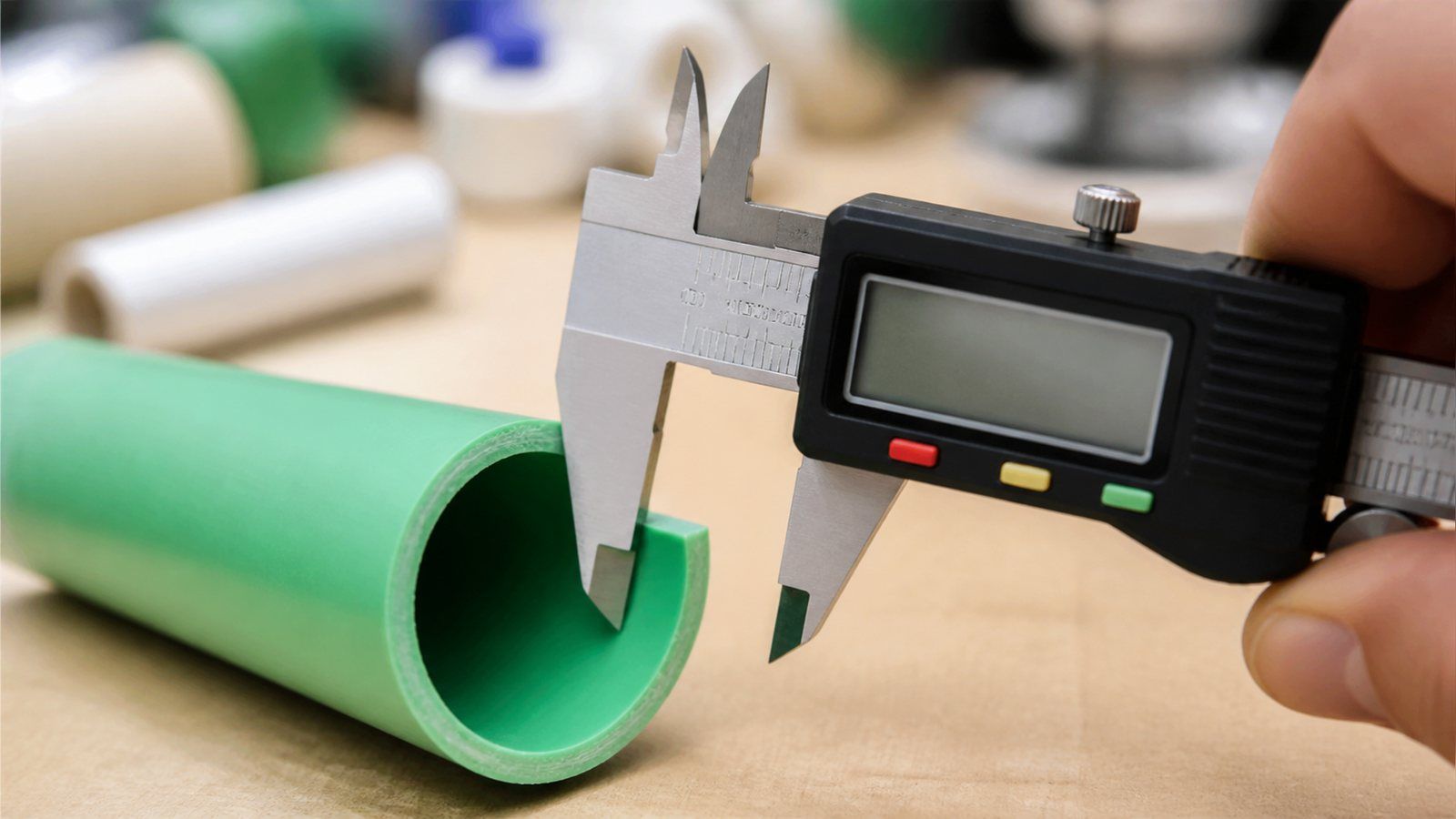
Read across the dn 20 row and the commercial point is obvious. Going from S5 to S2,5 nearly doubles the wall, from 1,9 mm to 3,4 mm. That is not a grade or a finish or a brand tier — it is 79% more millimetres of pipe wall, and it will show up in any honest quote.
The floor nobody mentions: 2,0 mm
There is one clause in the standard worth committing to memory, because it explains a cost floor that otherwise looks arbitrary. ISO 15874-2 states that "pipes intended to be joined together by fusion shall have a minimum wall thickness of 2,0 mm" — regardless of what the pressure calculation would otherwise allow.
Look back at the table. A dn 20 in series S5 needs only 1,9 mm on pressure grounds, but PP-R is a socket-fusion system, so that pipe carries 2,0 mm anyway. This is why the very cheapest small-diameter PP-R cannot get meaningfully cheaper by thinning: the fusion floor holds it up. A supplier quoting a dn 20 significantly below the material cost of a 2,0 mm wall is not being efficient. Something else is going on, and the next two sections give you the arithmetic to see what.
Where the standard's numbers come from
If you ever need to defend a specification to a client or a consultant, the derivation is in Annex A of the same standard. ISO 15874-2 assigns PP-R a design stress by application class: 3,02 MPa for Class 1, 2,12 MPa for Class 2, 3,29 MPa for Class 4, 1,89 MPa for Class 5, and 6,93 MPa at 20 °C over a 50-year service life. Those stresses, with the design coefficient for PP-R (1,5 at operating temperature, 1,4 cold), produce the maximum S values a pipe may use.
For PP-R at a design pressure of 10 bar, the standard permits Scalc,max of 3,0 in Class 1 and 2,1 in Class 2 — Class 2 being the more demanding 70 °C hot-water regime. That is the mechanism behind an ordinary sourcing decision: a pipe that is fine for a Class 1 building at 10 bar is not automatically fine for Class 2 at the same pressure, and the difference is paid for in wall thickness, which is paid for in resin.
How Many Grams of Resin Are in a Metre of Pipe
This is the number no page on this query publishes, and it is the one that makes quotes comparable. It is also a two-line calculation you can redo for any size in thirty seconds.
A pipe is an annulus. Its cross-sectional area is π × e × (dn − e), where e is the wall thickness and dn the nominal outside diameter, both in millimetres. A metre of that cross-section gives you a volume; multiply by the resin density and you have mass.
Take dn 20 in series S2,5, the pipe most commonly sold into African and Middle Eastern projects as PN20 hot-water pipe. Wall is 3,4 mm from the table above.
- Area. π × 3,4 × (20 − 3,4) = π × 3,4 × 16,6 = 177,3 mm²
- Volume per metre. 177,3 mm² × 1 000 mm = 177 300 mm³, which is 177,3 cm³ per metre.
- Mass. 177,3 cm³ × 0,90 g/cm³ = 159,6 grams per metre, or 15,96 kg per 100 m.
One caution on density, because it is the input people get wrong. The widely repeated 0,905 g/cm³ is polypropylene homopolymer. PP random copolymer is slightly lighter, which is why this article uses the pipe-grade TDS figure instead of the generic one. Using the homopolymer number would overstate every mass in the table below.
Mass per metre, DN20 to DN32
Run that same three-step calculation across the three sizes that dominate African and Middle Eastern residential work, at all four common series, and you get the table below. It is the sheet to keep beside your quotes.
| Size & series | Wall | Grams per metre | kg per 100 m |
|---|---|---|---|
| dn 20 · S5 | 1,9 mm | 97,2 g | 9,72 kg |
| dn 20 · S3,2 | 2,8 mm | 136,2 g | 13,62 kg |
| dn 20 · S2,5 | 3,4 mm | 159,6 g | 15,96 kg |
| dn 20 · S2 | 4,1 mm | 184,3 g | 18,43 kg |
| dn 25 · S5 | 2,3 mm | 147,6 g | 14,76 kg |
| dn 25 · S3,2 | 3,5 mm | 212,8 g | 21,28 kg |
| dn 25 · S2,5 | 4,2 mm | 247,0 g | 24,70 kg |
| dn 25 · S2 | 5,1 mm | 287,0 g | 28,70 kg |
| dn 32 · S5 | 2,9 mm | 238,6 g | 23,86 kg |
| dn 32 · S3,2 | 4,4 mm | 343,4 g | 34,34 kg |
| dn 32 · S2,5 | 5,4 mm | 406,1 g | 40,61 kg |
| dn 32 · S2 | 6,5 mm | 468,6 g | 46,86 kg |
Derived by this article from the ISO 15874-2:2013 Table 5 minimum wall thicknesses at 0,90 g/cm³. Theoretical minimum-wall mass — see the caveat below.
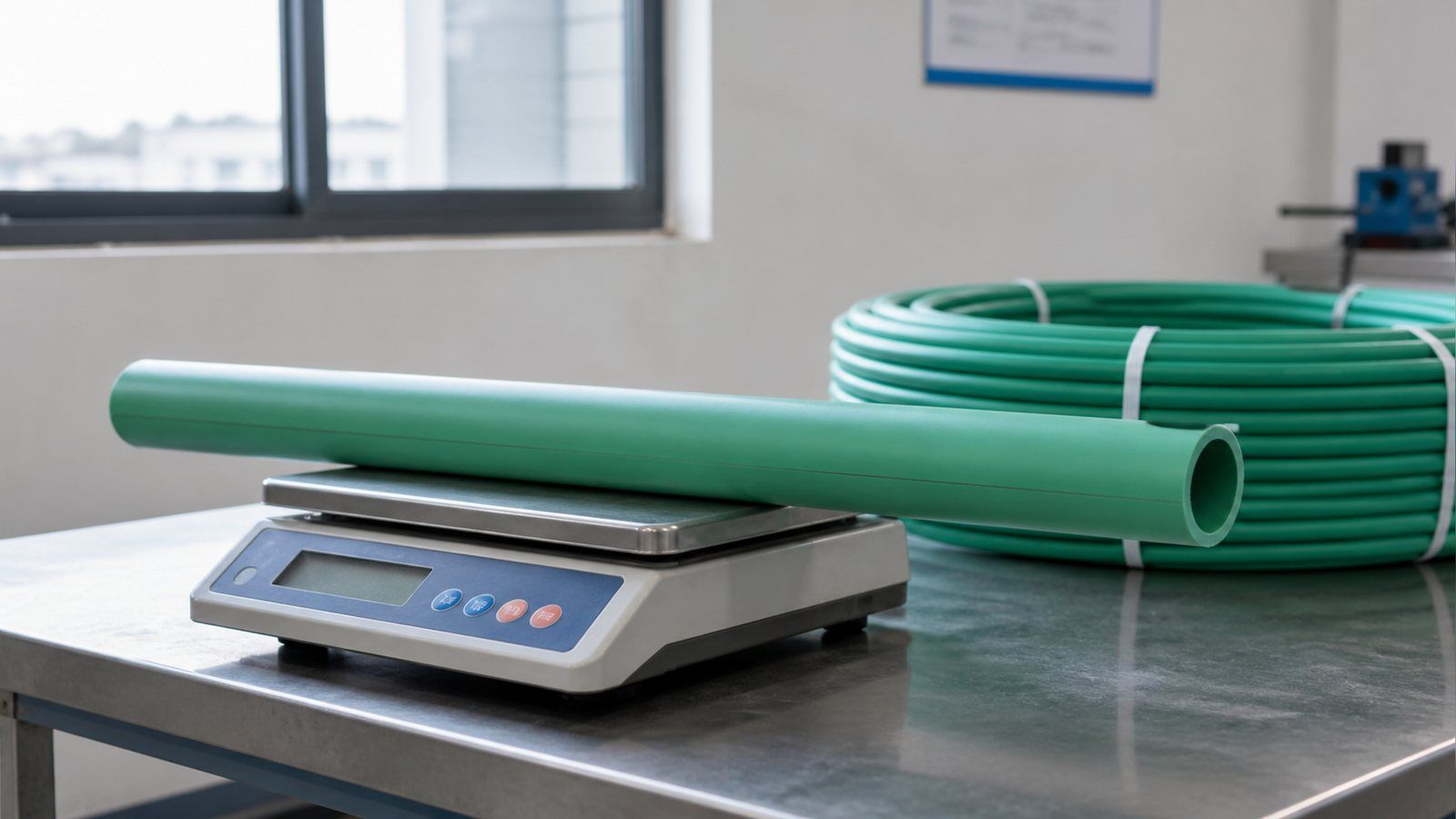
These are minimum-wall figures, so real pipe weighs more. Production runs above the minimum to hold tolerance, and the standard permits outside diameter up to 20,3 mm on a dn 20. If you weigh a delivered coil and get 165 g/m instead of 159,6, the pipe is not out of specification — it is a normal production margin above the floor. What should worry you is the opposite: a delivered pipe weighing materially less than the table, which means the wall is under the standard, whatever the print on the pipe says.
This is also the number that makes container planning work, because kg per 100 m is what converts a length requirement into a weight and a volume. Our PPR container loading guide takes that step for 20-ft and 40-ft loads.
Turning Grams Into Money: the Resin Floor
Now the grams become dollars, with one honesty requirement attached: you have to date-stamp the resin price, because it moves every month and a cost breakdown quoting an undated resin price is decoration.
As of the most recent published month, July 2026, the businessanalytiq polypropylene price index put Northeast Asia at US$1.20 per kg, down 11,1% on the month. The same publication put North America at US$1.23/kg, Europe at US$1.74/kg and India at US$1.10/kg. Those are commodity polypropylene figures for the month named — check the current month before you rely on any of them.
An important distinction, and the reason this is a floor rather than a price. A commodity PP index is not a PP-R pipe-grade contract price. Pipe-grade random copolymer with the long-term hydrostatic performance ISO 15874 requires trades above commodity resin, and a factory buying by the shipload pays differently from one buying by the pallet. So treat the figures below as the hard floor beneath which the material alone cannot be bought, not as what the resin in your pipe actually cost.
| Size & series | Resin mass | Resin floor at US$1.20/kg |
|---|---|---|
| dn 20 · S5 | 97,2 g/m | US$0.117 per metre |
| dn 20 · S2,5 | 159,6 g/m | US$0.192 per metre |
| dn 25 · S2,5 | 247,0 g/m | US$0.296 per metre |
| dn 32 · S2,5 | 406,1 g/m | US$0.487 per metre |
All figures in US dollars. Derived: grams per metre × the July 2026 Northeast Asia commodity PP index. Not a quotation, not a pipe-grade contract price, and not IFAN's price.
Set that against what the market publishes. Other pages on this query quote roughly US$0.80–1.20 per metre for 20 mm PP-R. Against a derived resin floor near US$0.19, the material is on the order of a fifth of the mid-band price — and the remaining four fifths is where every real difference between suppliers lives.
The method is what survives. When the index moves, recompute: divide the new price per kilogram by 1 000 and multiply by the grams per metre in the table. At US$1.50/kg the dn 20 S2,5 floor becomes US$0.239 per metre. Nothing else in the calculation changes, which is precisely why it is worth learning once.
If you are a distributor or importer sizing a container against these floors, the sizes and pressure classes available to quote against are listed on the PP-R product range.
Everything Above the Floor: Solving for the Residual
You cannot get a factory's conversion cost, and you should be suspicious of anyone who publishes one. What you can do is subtract, and the number that falls out is more useful than an industry average because it belongs to the actual quote in front of you.
Residual = quoted price per metre − (grams per metre ÷ 1 000 × current resin price per kg).
That residual carries extrusion, energy, labour, scrap, tooling, packing, marking, certification, overhead and margin — everything the factory does to turn pellets into a marked, bundled, export-ready pipe. You still do not know its internal split. But you now have one number per supplier, computed identically, that you can put side by side.
A worked comparison
Two quotes for dn 20 PP-R, both labelled PN20, both claiming virgin material. Supplier A is US$0.95 per metre. Supplier B is US$0.72. This example uses the price bands other pages publish rather than any real order, so treat the inputs as illustrative and the method as the point.
- Both should carry 3,4 mm of wall — S2,5 per ISO 15874-2 — so both should hold 159,6 g/m, a resin floor of US$0.192 at the July 2026 index.
- Supplier A residual: US$0.95 − US$0.192 = US$0.758 per metre. Resin is about 20% of the quote.
- Supplier B residual: US$0.72 − US$0.192 = US$0.528 per metre. Resin is about 27% of the quote.
- The question that follows: B is US$0.23 cheaper per metre. On a 3 000 m order that is US$690. Is B running a leaner plant, a thinner wall, or a cheaper material?
That is a question a supplier can answer in one line, and their answer is diagnostic. Ask for kg per 100 m. If Supplier B comes back with 15,96 kg or a little above, the wall is there and the saving is genuinely operational — buy from B. If B comes back with 13,6 kg, that is not PN20; that is dn 20 in S3,2 wearing a PN20 label, and the discount was never a discount at all. If B will not answer the question, you have learned something too.
When the residual goes the other way
A high residual is not automatically padding, and reading it that way is how buyers end up with pipe that fails an inspection. Legitimate additions live in that number: third-party testing and lab reports, destination certification such as SASO, SONCAP or NOM, per-batch material certificates, printed traceability marking, heavier bundling for a long ocean leg, and non-standard colour. A quote that includes SONCAP work for Nigeria and one that does not are not the same quote, whatever the per-metre figures say. Our guide to pipe import documents by market sets out which of those a destination actually requires.
The residual below the floor is the only unambiguous signal here. If a quoted price per metre sits at or under the derived resin floor for that size and series, the arithmetic does not close — the pipe is thinner than the stated class, the material is not what the label claims, or the price is not the price. For the broader factors that move a quote before you get to this arithmetic, our PPR pipe price breakdown covers the market-level picture.
What to Send a Factory, and What We Supply
Most quote comparisons fail before the replies arrive, because the enquiry did not pin down the things that move the price. Six lines fix that.
- Nominal size and pipe series, not "PN20". Write "dn 25, series S2,5 per ISO 15874-2". Pressure-class labels drift between markets; the series does not.
- Price per metre and kg per 100 m, on the same line. This is the single question that makes underspecified pipe visible, and it costs the supplier nothing to answer.
- The standard you are buying to. DIN 8077/8078 and ISO 15874 are the usual pair for PP-R; name them so nobody quotes to a domestic standard you cannot use.
- Material declaration and batch certification. Ask whether every batch ships with a material certificate, and whether third-party SGS or BV reports are available.
- Destination certification. Name the market. SASO, SONCAP or NOM work belongs in the quote, not discovered at the port.
- Your size mix and the Incoterm. A mixed container prices differently from a single size, and FOB against CIF changes what the number even means — our FOB vs CIF comparison covers that split.
What we publish, and where we stop
To be concrete about the six lines above, here is what this factory states openly — and a supplier that will not answer these six in writing is telling you something.
| What you ask for | What IFAN states |
|---|---|
| Size and pressure range | DN20–DN160, PN12.5 to PN25 |
| Material | 100% virgin PP-R 100 grade |
| Standards | DIN 8077/8078, ISO 15874, CE, SGS tested |
| Destination certification | SASO, SONCAP or NOM on request |
| Minimum order | One container, mixed sizes accepted |
| Batch evidence | Material certificate per batch; SGS or BV reports on request |
| Sampling | "Sample first, order later" — physical samples before a container commitment |
| Quotation turnaround | Within 24 hours |
Behind those lines is a plant operating since 1993 — a 120,000 m² facility in Zhejiang, China, running 30+ automated extrusion lines with an in-house mould workshop and ISO testing lab across 3,000+ PP-R SKUs. The full specification and certification detail sits on the PP-R supplier page.
Two things stop deliberately short of a number, and it is worth saying which. There is no published FOB price ladder, because a real one depends on the size mix, the pressure classes and the resin price in the week you order — which is the whole argument of this article. And there is no published lead time in days: IFAN states that lead time depends on order size, customisation and stock, and is confirmed with the quotation. If a page gives you a firm number for either without knowing your order, it is guessing.
Who this method is for, and who it is not
It is for importers, distributors and project buyers comparing container-scale FOB quotes, where a US$0.20 per-metre difference is thousands of dollars and a thin wall is a warranty claim two years out. It is not for a plumber pricing a single bathroom — at that scale the pipe is a rounding error against labour, and the retail price you are quoted has a distributor's margin in it that no resin calculation will explain. It is also not a substitute for a pressure-class decision: work out the class your system needs from size and pressure class first, then bring this arithmetic to the quotes.
Conclusion
The reason PP-R cost articles all read the same is that a price band is easy to publish and arithmetic is not. But the band cannot tell you whether the quote in your inbox is good, and the arithmetic can — because wall thickness is fixed by ISO 15874-2, mass follows from wall thickness and density, and resin money follows from mass and a dated index.
Compute the floor for the sizes you actually buy, subtract it from every quote, and compare the residuals. For the three sizes above that means US$0.192, US$0.296 and US$0.487 per metre in series S2,5 at the July 2026 index — recompute them the week you order, because the index moved 11,1% in a single month. Then ask each supplier for kg per 100 m and check the answer against 15,96, 24,70 and 40,61 kg. The ones who answer without hesitating are the ones selling you the wall thickness they printed on the pipe.
One last piece of arithmetic worth doing before you sign. A 3 000 m order of dn 20 S2,5 carries 478,8 kg of resin in total, at 159,6 kg per 1 000 m — so a US$0.10 per-metre gap between two quotes is US$300 on that line, and it is either a leaner factory or 0,6 mm of missing wall. Only one of those shows up again in ten years.
The same gram-weight method applies to brass valves: weigh the valve, multiply by the day's alloy price, and you have a floor no honest quote crosses. See the valve price benchmark guide for the valve-side application.
Frequently Asked Questions
How much resin is in a metre of DN20 PPR pipe?
About 159,6 grams for series S2,5 (SDR 6), the common PN20 hot-water pipe. That is derived from the 3,4 mm minimum wall in ISO 15874-2:2013 Table 5 and a pipe-grade PP-R density of 0,90 g/cm³. Real pipe runs slightly heavier because production holds above minimum wall.
What share of PPR pipe cost is raw material?
Compute it for your own quote rather than trusting an industry average. At the July 2026 Northeast Asia PP index of US$1.20/kg, the resin in a dn 20 S2,5 pipe is about US$0.19 per metre — roughly a fifth of a US$0.95 quote. Divide your resin floor by your quoted price for the real figure.
Why is one PPR quote 30% cheaper than another?
Usually one of three things: a leaner plant, a thinner wall sold under the same pressure label, or a cheaper material. Asking for kg per 100 m separates them. If the mass matches the standard for that series, the saving is real; if it is short, you are buying a lower series with the wrong label.
How do I convert a price per metre into a price per kilogram?
Divide the price per metre by the mass per metre in kilograms. A US$0.95 quote on a dn 20 S2,5 pipe at 0,1596 kg/m is US$5.95 per kg of finished pipe. Comparing on that basis exposes suppliers quoting different wall thicknesses against the same nominal size.
Does a higher pressure class really cost more to make?
Yes, and the amount is calculable. On a dn 20, moving from series S5 to S2,5 takes the wall from 1,9 mm to 3,4 mm and the resin from 97,2 to 159,6 grams per metre — about 64% more material. Any quote where the classes cost the same deserves a question.
What is IFAN's FOB price for PPR pipe?
There is no published price ladder, because the figure depends on the size mix, pressure classes and the resin price in the week you order. IFAN quotes within 24 hours against a stated size mix, with a minimum of one container, mixed sizes accepted.