
Plastic Pipe Recycling: What Standards Let You Claim on a Tender
A tender document lands on your desk with a line you have not seen before: state the recycled content of the supplied product, or attach an Environmental Product Declaration. You sell plastic pipe. Plastic is recyclable — everybody knows that. So you email your factory and ask what number to write in the box.
The answer that comes back, if the factory is honest, is going to surprise you. For most of the pipe sold into building services, the correct recycled content is zero, and it is zero because the standard the pipe is made to says it must be. Not zero because the factory is behind the times. Zero because the clause forbids it.
That single fact — that a pipe standard can prohibit the very thing a green procurement line is asking for — is what makes this question so much harder than it looks. It is also almost impossible to find on the open web. Search for plastic pipe recycling and you will get municipal drop-off pages telling you which bin to use, and shredder vendors selling you a granulator. Neither of them is going to help you answer the tender.
Key takeaways
- Recyclable and permitted are two different questions. PP-R, PVC and HDPE are thermoplastics and can be melted and reprocessed. Whether a given pipe standard allows that material back into new pipe is a separate matter entirely.
- The ISO building-services standards say no. ISO 15494:2015 clause 5.4 permits a manufacturer's own production reprocessable material and states that "reprocessable material obtained from external sources and recyclable material shall not be used."
- The dividing line is the standard family, not pressure duty. ISO 19220:2021 is a non-pressure soil-and-waste standard and it says the same thing. The permissive standards are the US buried-drainage ones.
- PE-X is the genuine exception. Crosslinking makes it thermoset-like, so it cannot be melt-reprocessed — and ISO 15494 carves it out of even the own-material allowance.
- The honest European number is small. Of 765,972 tonnes of PVC recycled in Europe in 2025, pipes took 41,001 tonnes — and on the post-consumer line, just 10,050 tonnes of 315,413.
- IFAN has not published an EPD or a recycled-content declaration. We are saying so rather than implying otherwise; see the last section for what we can document today.
On this page
- The short answer: recyclable is not the same as permitted
- What the pipe standards actually say about recycled material
- Where recycled pipe is normal: the US drainage exception
- The number nobody publishes: how little pipe actually gets recycled
- What a tender means when it asks for an EPD or recycled content
- What to check before you accept a recycled-content claim
- Frequently asked questions
The Short Answer: Recyclable Is Not the Same as Permitted
Three of the four polymers this industry runs on are thermoplastics. PP-R, PVC and HDPE all soften when you heat them and harden again when they cool, and that reversibility is the whole basis of mechanical recycling: grind the material, wash it, sort it, melt it, pelletise it, and you have regranulate that can be extruded into something new. The polymer chains are held together by weak secondary forces that heat can overcome and re-form.
PE-X does not work that way, and this is worth understanding properly because it explains a lot of what follows. Crosslinking ties the polyethylene chains together with covalent chemical bonds into a permanent three-dimensional network. Those bonds are exactly what give PE-X its pressure and temperature performance — and they are also what stop the material flowing when reheated. It behaves like a thermoset. Reviews of the crosslinked-polyethylene literature are blunt about it: conventional melt reprocessing does not work on PE-X, which is why the recycling routes under investigation are chemical or thermo-mechanical rather than a simple regrind.
Two questions that get merged, and what the confusion costs
So far this is materials science, and it is the part every competitor page covers. Here is the part they do not.
"Is this material recyclable?" is a question about the polymer. "May recycled material go into this product?" is a question about the specification the product is built to — and the two answers routinely point in opposite directions. A PP-R pipe is made from a thermoplastic that is perfectly recyclable in the laboratory sense, and made to a standard that will not let externally sourced recyclate anywhere near it.
The cost of merging these questions is paid at the tender desk. A distributor reads that PVC is highly recyclable, writes an optimistic recycled-content figure into a submission, and then cannot produce a batch certificate or a declaration that supports it. Or the opposite failure, which is more common and quieter: he assumes the answer must be embarrassing, writes nothing, and loses marks on a criterion he could have scored on by explaining the standards position in two sentences.
The vocabulary matters here. ISO 15270 formalises the split between pre-consumer material (diverted from a production process before it ever reached a user) and post-consumer material (which came back from an end user). It also separates mechanical recycling from chemical or feedstock recycling — conversion back to monomer or raw materials by cracking, gasification or depolymerisation. When a supplier says "recycled", ask which of these he means. The answers are worth very different amounts in a tender.
What the Pipe Standards Actually Say About Recycled Material
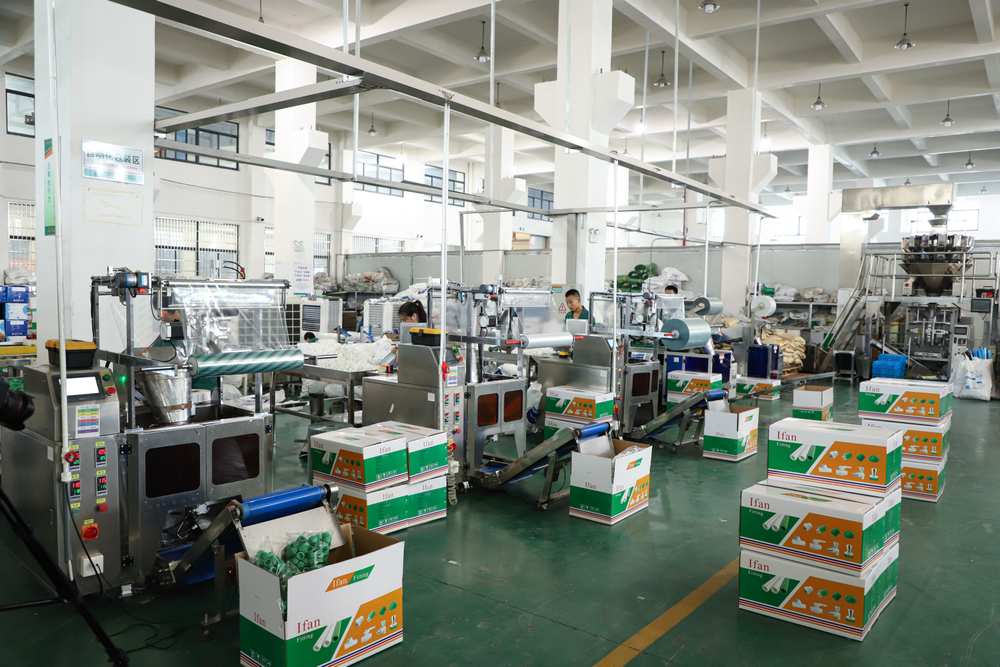
This is the section that answers the tender question, so it is worth quoting the source rather than summarising it.
ISO 15494:2015 covers plastics piping systems for industrial applications in PB, PE, PE-RT, PE-X and PP. Clause 5.4, headed Reprocessable and recyclable material, reads in full:
"The use of own reprocessable material obtained during the production and testing of components according to this International Standard is permitted in addition to virgin material, with the exception of PE-X. Reprocessable material obtained from external sources and recyclable material shall not be used."
Read that twice, because three separate things are happening in two sentences. First, a manufacturer may put his own production material back into the line. Second, PE-X is excluded even from that — the polymer chemistry above is now a standards requirement. Third, and this is the sentence that decides your tender answer, external reprocessable material and recyclable material shall not be used. Not discouraged. Not subject to testing. Shall not.
The defined terms are doing real work
The standard does not leave "own reprocessable material" to interpretation. Clause 3.2.3 defines it as material prepared from clean rejected unused pipes, fittings or valves — including trimmings from production — that will be reprocessed in the manufacturer's own plant, having previously been processed by that same manufacturer.
Every element of that definition excludes something. Clean rules out material that has been in service. Unused rules out anything that reached a customer. The same manufacturer's plant rules out buying regranulate from a broker, however good the paperwork looks. What is permitted is essentially the offcut at the end of an extrusion run going straight back into the hopper — a closed loop inside one factory, with full knowledge of the resin grade and its thermal history.
And clause 3.2.2 defines virgin material as material "to which no reprocessable or recyclable materials have been added." So when a supplier's page says 100% virgin, that phrase has a specific meaning under the standard rather than being marketing language. Our own PP-R supply page makes exactly that claim with batch certificates behind it, and the reason the claim is worth making is this clause.
The correction: it is not about pressure
The intuitive explanation is that pressure pipe forbids recyclate because a burst is dangerous, while gravity drainage is relaxed about it. That explanation is wrong, and it is worth correcting because a buyer who believes it will guess wrongly about half his product range.
ISO 19220:2021 covers plastics piping for soil and waste discharge — non-pressure, inside buildings. Its clause 4.2 states: "In addition to virgin material, the use of reprocessable material obtained during the production and testing of products conforming to this document is permitted. External reprocessable or recyclable material shall not be used." Same position, same words, on a standard with no pressure duty at all.
The dividing line is not pressure. It is which family of standards your product is built to. For PP-R specifically, ISO 15874-1:2013 — the hot and cold water standard — carries a clause 5.3 titled Reprocessable material; the free ISO preview stops before the clause text, so if you need its exact wording for a submission, buy the standard rather than trusting a summary, including this one.
| Standard | Application | Own production material | External recyclate |
|---|---|---|---|
| ISO 15494:2015 cl. 5.4 | Industrial piping — PB, PE, PE-RT, PE-X, PP | Permitted, except PE-X | Shall not be used |
| ISO 19220:2021 cl. 4.2 | Soil and waste discharge — non-pressure | Permitted | Shall not be used |
| ASTM F2306 / AASHTO M294R | Corrugated HDPE buried drainage | Permitted | Permitted — PPI reports 40–60% typical |
Where Recycled Pipe Is Normal: The US Drainage Exception
If the standards forbid it, why do you keep seeing recycled-content pipe advertised, sometimes with impressive percentages attached? Because for one large product category, in one large market, it is completely routine — and a buyer who does not know which category he is looking at will conclude that somebody is lying.
The Plastics Pipe Institute, the North American trade association for this industry, publishes the position plainly: ASTM F2306 and AASHTO M294R allow corrugated HDPE drainage pipe to be made with recycled polyethylene — PPI puts the typical figure at 40–60% — while still meeting the same 100-year service-life criteria required for roadway and culvert projects. PPI also reports that HDPE drainage-pipe makers reuse about 600 million pounds of recycled PE every year.
Treat those figures as what they are. PPI is the industry's own association and has an interest in the number being impressive, which is why it belongs here with attribution rather than quoted bare. The underlying standards are behind paywalls, so if a 40–60% figure is going into a submission, cite the standard itself and not a trade page — or this one.
Why the same industry can hold both positions
The two cases are not really in tension once you see what each is protecting. Buried corrugated drainage pipe carries no internal pressure, runs at ambient ground temperature, and is qualified on structural and long-term stiffness performance that can be demonstrated on the finished pipe. If a formulation containing reclaimed polyethylene passes those tests, the material's history is a matter of consistency, not safety.
Pressurised hot-water pipe is a different problem. It is qualified on long-term hydrostatic strength — extrapolated regression behaviour over fifty years at elevated temperature — and that behaviour is a property of a known resin with a known additive package and a known thermal history. Reclaimed material of uncertain provenance introduces variables that the extrapolation cannot see and the pipe will not reveal for years. That is why our guide to distinguishing virgin from recycled PP-R is written as a fraud-detection exercise: in hot-water pipe, undisclosed recyclate is not a sustainability story, it is a defect.
Practically, this means the answer to "does your pipe contain recycled material" depends on which product you are asking about. For a buyer carrying both a PP-R plumbing range and an HDPE drainage range, there are two different honest answers, and giving one answer for both is how a submission gets marked down.

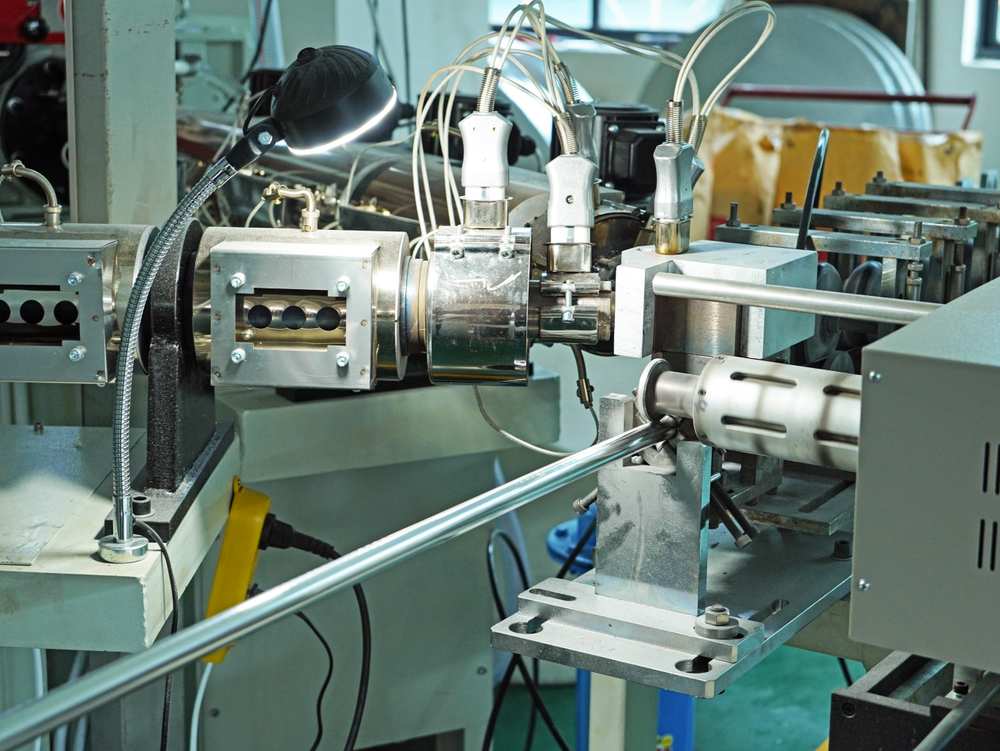
Where the material question is physically decided: resin entering the extruder. Everything a recycled-content declaration describes happens at this point in the line. (IFAN Group, YouTube)
The Number Nobody Publishes: How Little Pipe Actually Gets Recycled
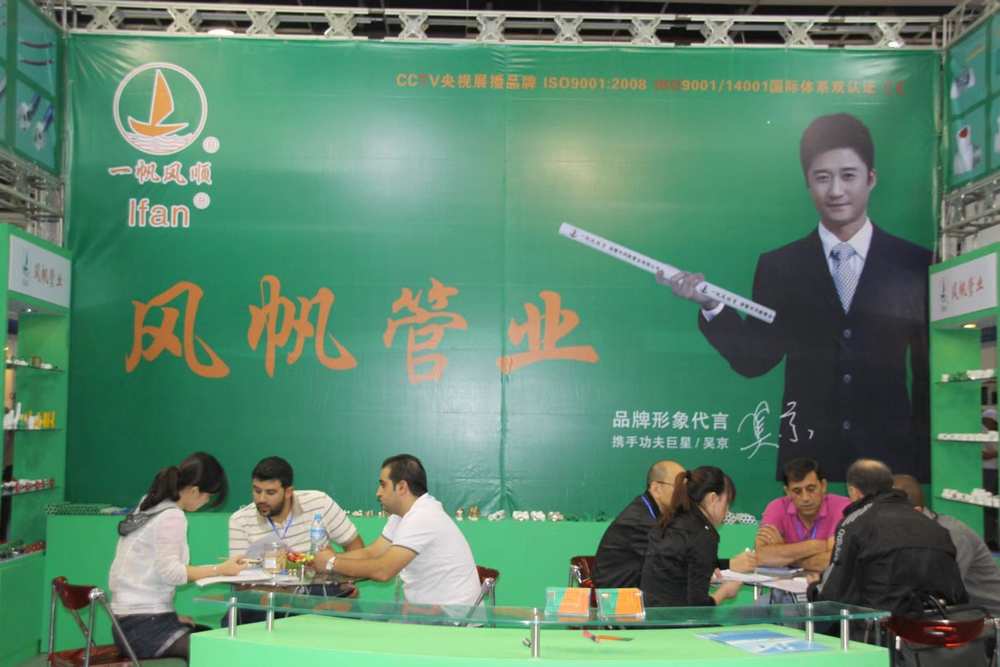
Every trade body in this sector publishes a circular-economy page. Very few of them publish the figure that tells you whether the story is big enough to lean on in a submission. That figure exists, it is audited, and it is not flattering.
VinylPlus, the European PVC industry's voluntary commitment programme, reports in its Progress Report 2026 that 765,972 tonnes of PVC waste were recycled within its framework across the EU-27 plus Norway, Switzerland and the UK during 2025 — a 5.7% increase on 2024, of which 58.8% was pre-consumer and 41.2% post-consumer material. That is a genuinely large number and a genuinely good trend.
Then you look at the application breakdown in the same table. Windows and profiles took 416,889 tonnes. Flooring took 119,873. Cables took 104,633. Pipes took 41,001 tonnes — about 5.4% of the total.
Run the post-consumer line separately
The 41,001 figure still flatters the situation, because most of it never left a factory. Split it the way the report does and pipes account for 30,951 tonnes of pre-consumer material against 10,050 tonnes of post-consumer. Across all applications, Europe recycled 315,413 tonnes of post-consumer PVC in 2025.
So: 10,050 divided by 315,413 is 3.19%. Roughly three per cent of Europe's post-consumer PVC recycling went back into pipes, and roughly three quarters of the recycled material that pipes did take was factory scrap rather than pipe recovered from a building.
This is not an accusation against the industry. It is the arithmetic consequence of the clauses in the previous section. When the standards permit only your own production material, the only recyclate a compliant pipe plant can consume is its own — and that is precisely the shape the data shows. The trend is real too: pipes took 33,458 tonnes in 2024 against 41,001 in 2025, and post-consumer more than doubled from 4,859 tonnes. Small, but moving fast.
| European PVC recycled, 2025 | Total (t) | Post-consumer (t) | Pre-consumer (t) |
|---|---|---|---|
| Windows & profiles | 416,889 | 180,724 | 236,165 |
| Flooring | 119,873 | 4,209 | 115,665 |
| Cables | 104,633 | 96,778 | 7,855 |
| Pipes | 41,001 | 10,050 | 30,951 |
| All applications | 765,972 | 315,413 | 450,559 |
The 2033 problem sitting underneath all of this
There is a constraint on the horizon that almost nobody outside the European PVC value chain is tracking, and it works in the opposite direction to every policy signal you have been reading about.
Old PVC building products contain lead-based stabilisers that the industry stopped using long ago. When you recycle a window frame or a pipe from a 1980s building, that legacy lead comes with the material. The EU currently operates a derogation covering recycled rigid PVC; VinylPlus reports preliminary study findings that ending it in 2033 could limit maximum recycled content in profiles, pipes and fittings to below 25%, because higher recycled content would push lead concentrations above the permitted 0.1% by weight. The study's authors conclude that an extension of roughly five years would materially help European PVC recycling.
Those are preliminary findings on a policy question that is still open, so do not put them in a submission as settled law. Put them in your planning. If your customers are writing escalating recycled-content targets into contracts that run past 2033, there is a real chance the ceiling on rigid PVC moves down rather than up, and the supplier who saw that coming is the one who does not get caught promising something the chemistry will not allow.
For importers and distributors buying PP-R by the container: our PP-R supply page states the material basis (100% virgin PP-R, PP-R 100 grade), the batch certificate issued per shipment, the standards referenced — DIN 8077/8078 and ISO 15874 — and the DN20–DN160 size range, so you can quote a documented position rather than a guess. Not useful if you need single-length retail quantities.
What a Tender Means When It Asks for an EPD or Recycled Content
Half the time the tender is not really asking for recycled content at all. It is asking for an EPD, and the two are related but not the same thing.
An Environmental Product Declaration is a Type III declaration under ISO 14025, and for construction products it follows EN 15804, which sets the core product category rules so that declarations from different manufacturers are comparable. It is a verified life-cycle document, not a claim. What it looks like in practice is worth seeing: a registered polyethylene pipe declaration in the EPD International library carries registration number EPD-IES-0000719:002, was produced under PCR "2019:14 Construction products (EN 15804+A2) (version 1.3.4)", declares one kilogram of installed PE pipe as its unit, and is valid from 16 September 2022 to 16 September 2027.
One thing to know if you are reading guidance written before this summer: ISO 14025 was revised in June 2026, replacing the 2006 edition that stood for two decades. The most visible change is vocabulary — where the old edition said "Type III environmental declaration", the new one adopts the term the market has used all along, environmental product declaration. If a consultant's template or a tender annex still refers to Type III declarations, it is not wrong, it is just written against the previous edition.
Note what that record contains: a number you can look up, a rule set, a declared unit and an expiry date. If a supplier tells you he "has an EPD" and cannot give you those four things, he has a brochure.
What the new CPR does — and what it does not do
The regulatory background changed this year, and it is being widely misdescribed. Regulation (EU) 2024/3110, the new Construction Products Regulation, was signed at Strasbourg on 27 November 2024. Its Article 96 states that it applies as from 8 January 2026, with a list of named articles and annexes applying from 7 January 2025, and Article 92 from 8 January 2027.
Annex II sets out nineteen predetermined environmental essential characteristics that harmonised technical specifications must cover — from climate change effects and ozone depletion through acidification, eutrophication, water use and particulate matter to human toxicity. Annex III point 3.1 lists design aspects including "maximising reused, recycled and by-product content" and "recyclability and the capability to be remanufactured."
Here is the part to get right. Annex III point 3.2(a) says voluntary harmonised standards may set out how those requirements are met by "specifying what is the state of the art for addressing the environmental aspects with regard to the respective product category, including the minimum recycled content." That is a mechanism, not a mandate. The CPR does not itself set a recycled-content percentage for plastic pipe. It creates the route by which future harmonised standards may do so. Anyone telling you that European law now requires a specific recycled-content figure in pipe is, as of today, wrong — and if you repeat it in a submission you will be corrected by someone who has read Annex III.
What we can document, and where we stop
We have not published an Environmental Product Declaration for our pipe products. We have not published a recycled-content declaration, and we do not publish a figure for the proportion of production offcut returned to our own extrusion lines.
We would rather write that sentence than imply otherwise, because on a topic where every number is checkable, an invented figure is worse than an absent one. What we do document per shipment is the material basis and the batch certificate, and those are the things a buyer can actually verify — our guide to pipe marking and batch traceability covers how to read them and what a genuine batch record should let you trace. If you need a full EPD for a specific tender, tell us the market and the deadline; that determines whether the programme operator route is realistic in your timeframe, and it is a straight answer either way.
Two industry developments are worth watching if this is becoming a recurring requirement in your market. TEPPFA commissioned two life-cycle inventory datasets for recycled PVC — one for micronised powder, one for flakes, on EU average data — which were peer-reviewed and released in July 2025, compliant with ISO 14040/14044. And TEPPFA with the BPF Pipes Group commissioned a material flow analysis of UK plastic pipes, published in early 2025, which established a baseline for pipe collection and recycling. Both make product-level declarations easier to produce than they were two years ago.
What to Check Before You Accept a Recycled-Content Claim: Six Questions, and What We Supply
This is the part you can reuse. A supplier's answers to these six will tell you within one email exchange whether his recycled-content position is documented or improvised — and they work equally well on us.
- Which standard, and which clause? Not "we meet ISO standards" — the standard number and the material clause. A supplier who cannot name the clause governing his own raw material has not read it.
- Own reprocessable, or external recyclate? The distinction ISO 15494 draws in clause 5.4. If he says he uses recycled material in pipe made to an ISO building-services standard, that is not a green credential, it is a compliance problem.
- Pre-consumer or post-consumer, and in what split? If the answer is "recycled" with no split, assume pre-consumer factory scrap. Given the 10,050-tonne European post-consumer pipe figure, that assumption will usually be right.
- What traceability sits behind the claim? A recycled-content percentage with no batch-level record is a number someone typed. Ask what document ties the claim to the container you are buying.
- EPD status: registration number, programme operator, expiry? Four facts, as above. "In progress" is an acceptable answer; a vague yes is not.
- What will you put on the purchase order? The final test. A material basis a supplier will write into the PO is a commitment; the same words on a website are marketing.
On the commercial facts that usually accompany these questions: our published MOQ is one container with mixed sizes accepted, standard quantities are 3,000–5,000m of pipe across DN20–DN160 or 5,000 pieces of fittings, and pricing is quoted per order against your size mix rather than published as a fixed list, because the mix drives the number. Lead time depends on order size, customisation and stock position and is confirmed with the quotation. Samples can be sent to your own laboratory before an order — for a material question, that is the verification route that does not require trusting anybody's paperwork.
If you are working through the standards side of a submission more broadly, our map of ISO, ASTM and DIN pipe standards shows which document governs which product, and the certification overview covers what the marks on the pipe actually certify.
Conclusion
The risk in this topic is not that you will fail to be green enough. It is that you will answer a procurement question with the wrong kind of confidence, in either direction.
Claim recycled content in an ISO-standard pressure or building-services pipe and you have described a non-compliance, in writing, to a customer who may later show it to a lawyer. Say nothing at all and you leave marks on the table on a criterion where a precise, sourced two-sentence answer would have scored — because the standards position is defensible and most of your competitors cannot explain it.
The defensible answer today, for most plumbing and building-services pipe, is that the governing standard permits virgin material plus the manufacturer's own production reprocessable and prohibits externally sourced recyclate; that the product is therefore made to a specification which excludes post-consumer content by design; and that circularity in this category currently lives in closed-loop factory material and in the buried-drainage segment, not in hot-water pipe. That is a real answer with clause numbers behind it. Watch the 2033 lead-stabiliser question, and be careful of any supplier whose recycled-content story gets more impressive the less you ask about the paperwork.
Frequently Asked Questions
Can plastic pipe be recycled?
PP-R, PVC and HDPE are thermoplastics and can be mechanically recycled — ground, washed, sorted and re-melted into regranulate. PE-X cannot be melt-reprocessed because crosslinking makes it thermoset-like. Recyclability is separate from whether a standard permits recyclate in new pipe.
Does ISO allow recycled material in plastic pipe?
ISO 15494:2015 clause 5.4 permits a manufacturer's own production reprocessable material in addition to virgin material, except for PE-X, and states that externally sourced reprocessable material and recyclable material shall not be used. ISO 19220:2021 clause 4.2 takes the same position.
How much plastic pipe is actually recycled in Europe?
VinylPlus reports 765,972 tonnes of PVC recycled in 2025 across the EU-27, Norway, Switzerland and the UK. Pipes accounted for 41,001 tonnes, of which only 10,050 tonnes were post-consumer against a 315,413-tonne post-consumer total.
Does the new EU Construction Products Regulation require recycled content in pipe?
No. Regulation (EU) 2024/3110 applies as from 8 January 2026 per Article 96, and Annex III point 3.2(a) allows harmonised standards to specify a minimum recycled content. It creates the mechanism; it does not itself set a percentage for plastic pipe.
Why is recycled HDPE drainage pipe allowed when PP-R pipe is not?
Different standard families. PPI reports that ASTM F2306 and AASHTO M294R permit recycled polyethylene in corrugated buried drainage pipe, typically 40–60%. Those products carry no internal pressure and are qualified on structural performance rather than long-term hydrostatic strength at temperature.
Does IFAN have an EPD or a recycled-content declaration?
No. We have not published an EPD, a recycled-content declaration, or a figure for production offcut reuse, and we would rather say so than publish an unverified number. We do issue a material certificate per batch and can supply third-party lab reports on request.
What is the difference between pre-consumer and post-consumer recycled content?
Pre-consumer material is diverted from a production process before reaching a user — factory offcuts and rejects. Post-consumer material comes back from an end user. ISO 15270 formalises the distinction, and in tenders post-consumer content is the harder and more valuable claim.