
PPR Pipe Colour: What to Specify for Your Market (No Standard Sets It)
No PP-R standard sets colour. What to specify instead: how colour is made, why custom shades carry a container minimum, and the delta-E clause.
Read the scope of ISO 15874-2, the international standard for PP-R pipe, and you will find it specifies service-condition classes, design pressures and pipe dimension classes. Read DIN 8077 and you get dimensions; DIN 8078 gives you general quality requirements and testing. Not one of them tells a manufacturer what colour to make the pipe. The green pipe and the white pipe in the same quotation can be the identical compound, the identical dimension class and the identical pressure rating, separated only by which masterbatch went into the hopper.
Which turns the usual question inside out. If colour carries no grade information, then "what does the colour mean" is the wrong thing for a buyer to ask. The question that decides a purchase order is what colour to specify for the market you sell into, what a colour outside the standard range costs you in minimums, and how you keep the second container from arriving a visibly different shade to the first. This page answers those three, and it tells you plainly where the published figures stop.
Key takeaways
- No PP-R product standard specifies colour. ISO 15874-2:2013 (confirmed current in 2023), DIN 8077 and DIN 8078 cover dimensions, pressure classes, quality and testing — colour appears in none of their scopes.
- Colour comes from masterbatch let down into the resin at the extruder. Ampacet, a masterbatch manufacturer, puts the ratio for light-coloured pressure pipe — blue and yellow are its worked examples — at 2% (49:1) to 4% (24:1), several times the 0.3–0.8% figure repeated across the search results.
- Grey commonly signals a glass-fibre composite, but it is a convention, not a rule: Techno Plastic's product page describes a fibre composite that is green outside with a red middle layer. Verify by marking and datasheet, never by colour.
- Colour codes that do carry legal force are national and sectoral — ASME A13.1, BS 1710 and ISO 14726 assign colours differently. They govern site identification, not what the manufacturer extrudes.
- IFAN publishes no colour-by-market shipping split and no custom-colour minimum. Any supplier quoting you a regional colour distribution without data behind it is guessing — treat it as a red flag.
- Shade drift between production runs is controlled contractually, using ΔE: below 1 is imperceptible, 1–2 barely noticeable on close inspection, 3 and above clearly visible.
What PPR Pipe Colour Actually Tells You (And What It Does Not)
Start with the documents that govern the product, because they settle the argument faster than any supplier claim. ISO 15874-2:2013 specifies the characteristics of pipes made from polypropylene for hot and cold water installations, and its scope covers a range of service conditions, design pressures and pipe dimension classes. That is the complete list of what it standardises about the pipe body. The 2013 edition was last reviewed and confirmed in 2023, so this is current, not a superseded reading.
The German pair behaves the same way. DIN 8077 is the dimensions standard for PP pipes and DIN 8078 the general quality requirements and testing standard, both covering PP-H, PP-B, PP-R and PP-RCT. Dimensions, quality, testing. No colour clause, because colour has no bearing on any property either standard is designed to guarantee.
So what is the colour actually doing?
Three jobs, none of them regulatory. It distinguishes one manufacturer's product from another on a merchant's shelf. It lets an installer tell one service from another after the walls are closed. And it satisfies whatever the local market has grown used to seeing, which is a commercial fact rather than a technical one. A pipe's actual grade lives in the print line along its length — the material designation, the dimension, the pressure class, the standard, the batch code — which is why every experienced inspector reads the marking and ignores the colour.
Where colour does carry a rule
There is one place a colour requirement is real, and buyers routinely confuse it with the product standard: pipe identification codes on site. ASME A13.1 in the United States, BS 1710 in the United Kingdom and ISO 14726 for marine and shipboard systems all assign identification colours, and they do not agree with each other across every service category. These govern how a pipe is labelled and banded once installed, and they can be written into a tender. They say nothing about the colour a factory must extrude, and they are frequently satisfied with adhesive banding over a pipe of any colour.
| Document | What it governs | Does it specify pipe colour? |
|---|---|---|
| ISO 15874-2:2013 | PP pipe characteristics, service-condition classes, design pressures, dimension classes | No |
| DIN 8077 | PP pipe dimensions (PP-H, PP-B, PP-R, PP-RCT) | No |
| DIN 8078 | PP pipe general quality requirements and testing | No |
| ASME A13.1 / BS 1710 / ISO 14726 | Identification of installed pipework by service | Identification colour only, and the three differ from each other |
The practical consequence for a purchase order: colour is a line you control, not a property you inherit. If your tender demands green for potable service, that is your local identification code speaking, and you specify green. If it demands nothing, you are free to choose on commercial grounds — and the rest of this page is about choosing well.
How a Coloured PPR Pipe Is Actually Made
A pipe extruder does not stock green resin and white resin. It stocks natural PP-R and it stocks colour concentrate — masterbatch, a carrier polymer heavily loaded with pigment — which is metered into the resin stream at a fixed ratio on the way to the screw. Change the ratio or change the concentrate and the same resin comes out a different colour. Understanding this one process is what makes the commercial terms further down predictable rather than arbitrary.

The let-down ratio, and the number the search results get wrong
Ampacet, which manufactures masterbatch for pipe compounds, states that for light colours — "colors such as blue or yellow" is its own phrasing — the let-down ratio is most often 2% (49:1) to 4% (24:1) for pressure pipe, and less for non-pressure uses such as conduit. Black runs higher: 5% (19:1) to 6.5% (14:1), with 35% carbon black loading the North American standard for pressure applications and masterbatches above 40% to be avoided.
Read that as the masterbatch economics of polyolefin pressure pipe generally: Ampacet's guidance is written around HDPE, and dosing is set by pigment loading and dispersion rather than by which polyolefin carries it. Confirm the exact ratio with whoever compounds your resin.
It still matters here, because a figure of 0.3–0.8% circulates widely across pages answering this exact query, and against the light-colour pressure-pipe range it is low by roughly a factor of five. The gap is not trivial in procurement terms: at 3% let-down, colour concentrate is a real line in the bill of materials, which is precisely why a custom colour has commercial consequences and a stock colour does not. A supplier who tells you colour costs nothing at all has either not costed it or is absorbing it silently in the unit price.
Dispersion is the quality variable, not pigment quantity
The failure mode worth knowing about is poor dispersion rather than wrong dosage. Ampacet's own guidance records pipe makers who ordered the lowest let-down ratio possible — under 5% (19:1) on black HDPE — and found their pipes failed because the masterbatch could not be mixed effectively into the fractional-melt base resin. Undispersed pigment agglomerates are stress concentrators in a pressure-bearing wall. This is the honest technical reason to care about who makes your pipe, and it has nothing to do with which colour you picked — a badly dispersed green pipe and a badly dispersed white pipe fail the same way.
What to take from this: colour is a formulation decision made at the extruder, costed in the BOM, and invisible in the standards. Judge the pipe by its hydrostatic test results, its material certificate and its marking — IFAN, for instance, works from 100% virgin PP-R (PP-R 100 grade) with a batch certificate per shipment, and that certificate is the document that tells you something, not the colour of the pipe it arrived with.
Green, White, Grey: The Conventions and Where They Break
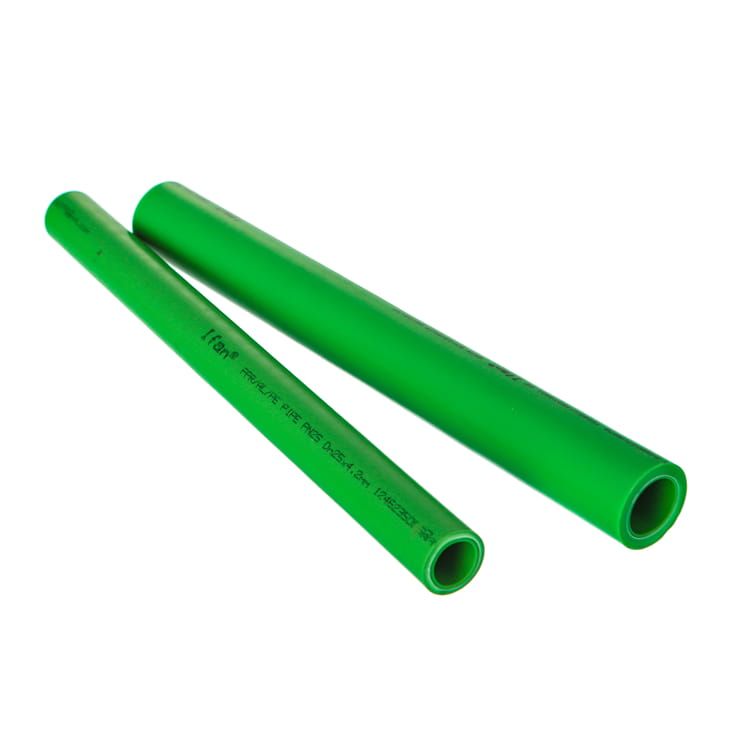
Conventions exist and they are worth knowing, provided you hold them loosely. Green is widely used for PP-R plumbing across Asian, African and Middle Eastern markets and is often associated with potable service. White is common in European-influenced markets and in visible installations where it disappears against a wall. Grey frequently indicates a glass-fibre composite. Every one of those is a habit that manufacturers and merchants converged on, and every one of them has exceptions in current production.
The grey-means-fibre assumption, tested
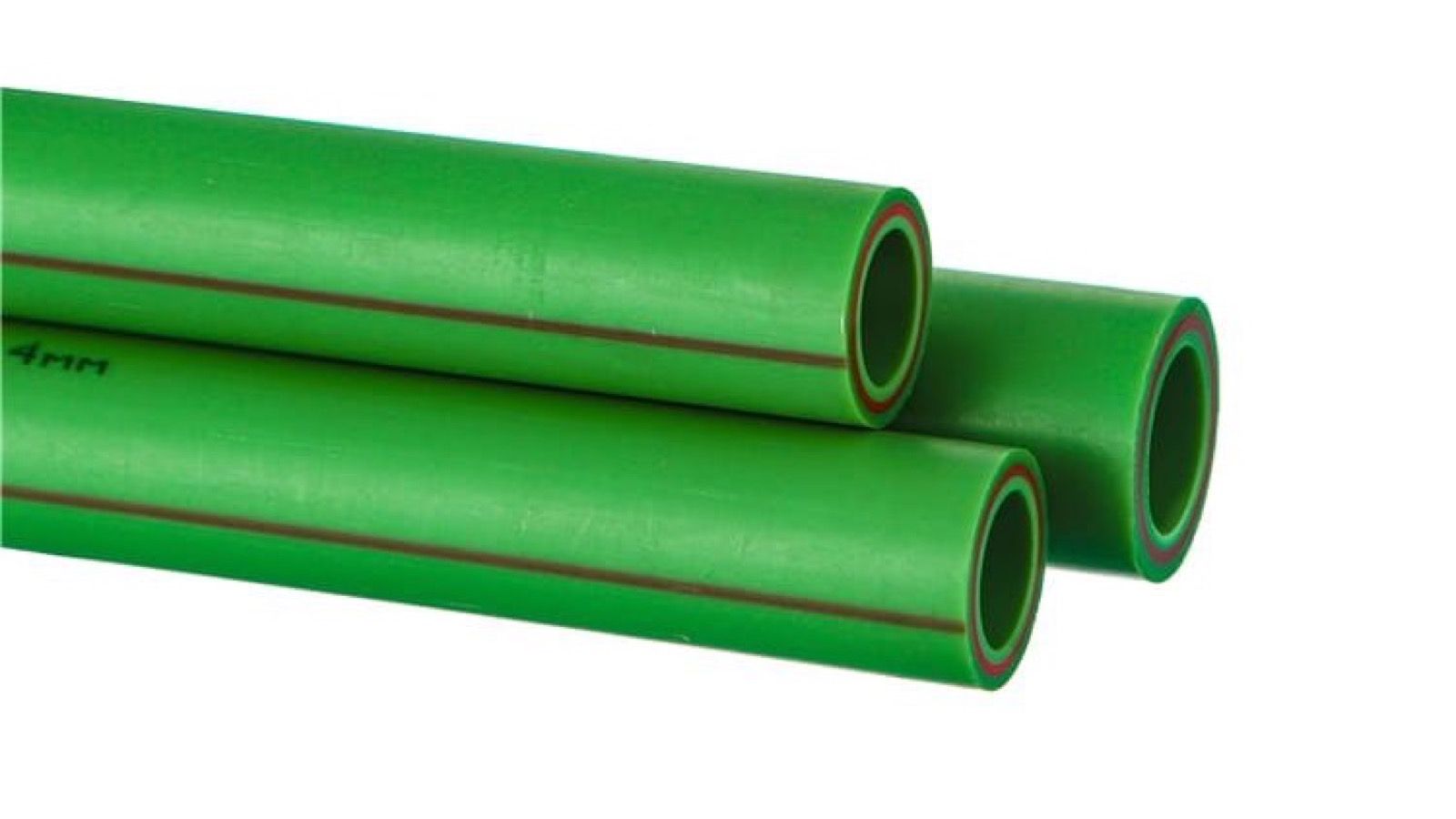
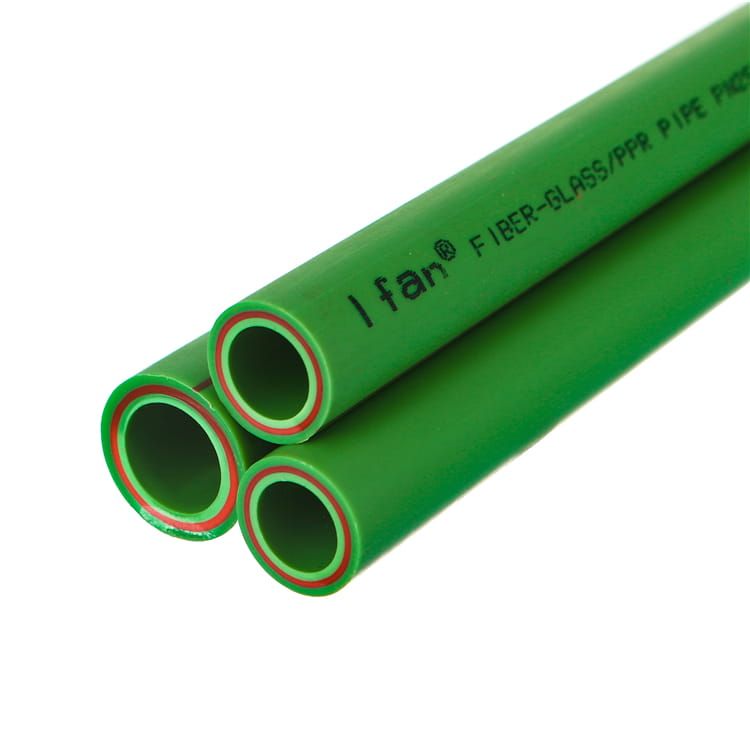
Take the most load-bearing of the conventions, because getting it wrong has engineering consequences. Techno Plastic Industry sells a PP-R multilayer pipe whose construction is exactly the fibre composite the convention describes: PP-R inner and outer layers with a middle layer of PP-R mixed with glass fibre. Its product page describes that build as "Outer layer – Green color / Middle layer – Red color / Inner layer – Green color." Grey appears nowhere in the manufacturer's own description. A buyer applying the rule "grey means fibre-reinforced, therefore green means it is not" would have mis-specified that pipe on sight.
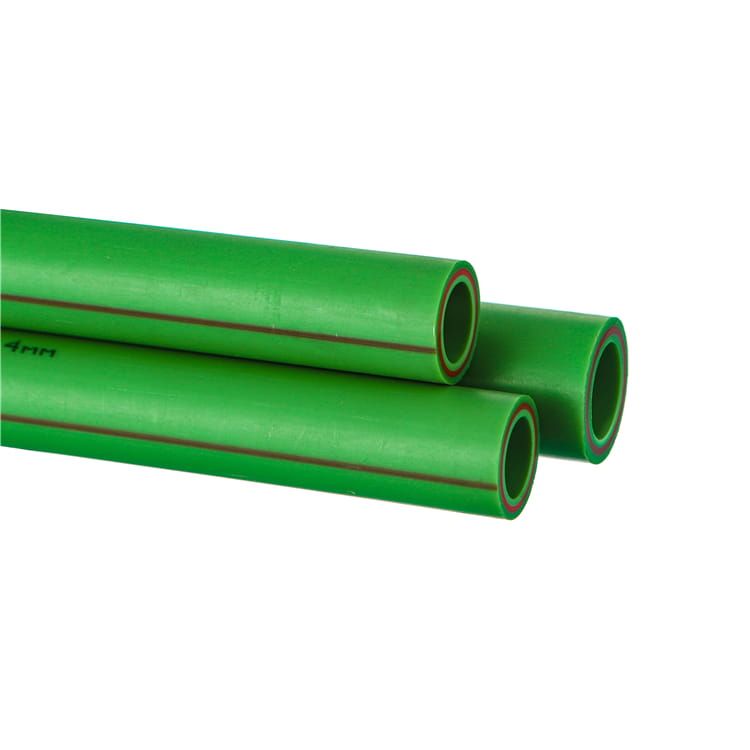
The reason to identify a fibre composite correctly is dimensional, and the numbers are substantial. Techno's product page states an expansion coefficient of α = 0.05 mm/mK for glass-fibre reinforced PP-R against α = 0.15 mm/mK for standard PP-R. That plain-pipe figure is not one company's house number: Kalde's technical data gives α = 1.5 × 10⁻⁴ K⁻¹ for PP-R tubes — the same 0.15 mm/mK — and 0.35 × 10⁻⁴ (0.035 mm/mK) for its fibreglass pipes.
Fırat Plastik publishes 0.040 mm/mK for its fibre-glass reinforced PP-R and 0.030 mm/mK for a foiled pipe. Three manufacturers, three different composite figures — 0.05, 0.040, 0.035 — which is what you would expect when fibre content is a formulation choice. What they agree on is the baseline and the direction: plain PP-R sits at 0.15, and the fibre layer cuts expansion to roughly a third of it or less.
On a long hot-water run that difference decides your bracket spacing and whether you need expansion loops. Specifying a plain pipe where a composite was designed in, or the reverse, produces either a sagging line or an over-engineered one. That decision is far too consequential to make from the colour of the pipe in a photograph.
| Colour | Common convention | How reliable is it? | What to check instead |
|---|---|---|---|
| Green | General PP-R plumbing, often potable | Widespread habit; no standard behind it | Potable suitability on the material certificate |
| White | Sometimes described as "hot water" | Weak — hot-water capability is the PN class and the service class, never the colour | PN rating and application class in the print line |
| Grey | Glass-fibre composite | Common but breaks — a green/red/green fibre composite is on the market | Cut section showing the middle layer; expansion coefficient on the datasheet |
| Custom | Brand differentiation | Carries no meaning by definition | Everything in the print line |
One more caution that colour genuinely does bear on. Unprotected PP-R is not inherently UV-stable, and prolonged direct sunlight shows first as surface yellowing or browning before it shows as embrittlement. That is a storage and installation issue, and it applies whatever the pipe's colour — but it is more visible on white, which sometimes leads buyers to assume white pipe is the weaker product. It is not; the degradation is simply easier to see. Pipe stored in a yard under the sun needs covering regardless of what colour it left the factory.
Choosing a Colour for Your Market Without Guessing
Here is where this page departs from every other answer to this query, and it does so by refusing to tell you something. There is no credible published distribution of PPR pipe colour demand by export market. IFAN ships to more than 120 countries and does not publish a colour-by-market split of what leaves the plant. This article will not invent one.
Treat that as the useful finding rather than a gap. If a supplier tells you "70% of West African buyers want green", ask what the number is derived from. A factory's own shipping mix reflects the customers it already has and the colours it already promotes, which makes it a poor proxy for what your market wants and a circular argument for what you should stock. A number offered without a stated basis on a question this un-researched is a sales instinct wearing a percentage.
The three inputs that actually decide it
- Local identification requirements. Check whether your market's plumbing code or your target tenders specify an identification colour for potable or hot-water service. Where they do, the decision is made for you and it is not negotiable. Where they only require banding or labelling of installed pipework, the extruded colour is free.
- Installer familiarity. The fitter who has installed green PP-R for a decade reads an unfamiliar colour as an unfamiliar product and prices in risk, or refuses it. This is the single most underrated constraint on a distributor's colour choice, and it is why a technically identical pipe in a new colour can sit in a warehouse.
- Your own stock-turn. Every colour you carry multiplies your SKU count by the number of diameters and pressure classes you stock. Two colours across DN20–DN160 in two PN classes is not two lines, it is dozens. Slow-moving colour variants are where a distributor's working capital quietly goes to sleep.
Determining it for your market in about a week
This is a research task with a short, finite answer, and it beats any figure a supplier could hand you. Pull the plumbing code or the standard tender specification for your country and search it for pipe identification clauses — that tells you what is mandatory.
Then walk three builders' merchants that already sell PP-R in your city and record what is on the shelf and what the counter staff say moves; the incumbent brand has already paid for this research and you can read the result off their stock. Finally, ask five fitters what they expect to be handed on a hot-water job. Where the code is silent, the merchants and the fitters agree, and that agreement is your answer.
One practical note on executing whatever you conclude. Because IFAN's stated minimum is one container with mixed sizes accepted, a first order does not have to commit entirely to a single colour. Splitting a container across two colours to test which sells is a legitimate way to buy the answer rather than guess it, and it is a reasonable thing to ask any supplier to quote. What that split does to your unit price is a question for the quotation, not for an article.
Buying a Custom Colour: What Actually Drives the Minimum
Ask a factory for a colour outside its standard range and you will be quoted a minimum. It is worth understanding what generates that minimum, because it tells you which parts are negotiable and which are physics.
The four cost drivers
- Masterbatch lot minimum. Your colour has to be compounded before it can be extruded, and colour houses have their own minimum batch. At the 2–4% let-down typical of light colours, a modest tonnage of pipe consumes a meaningful quantity of concentrate — but a small trial run may not consume even the smallest lot the colour house will make, and you pay for the remainder either way.
- Line changeover and purge. Switching an extruder to a new colour means running material through until the previous colour clears. That purge is scrap and it is machine time on a line that was producing saleable pipe. Short runs carry this cost against very few metres.
- Container splitting. A custom colour across only part of your size range means the container holds two colour families, which complicates the loading plan and the packing list, and can leave you short of a full container in the colour that actually sells.
- Re-order shade matching. The second run has to match the first, which means retaining a reference and measuring against it. This is the driver buyers forget at the quotation stage and discover on the repeat order, and it is the subject of the next section.
Only the first two are close to fixed. Container splitting is a planning problem you can solve by aligning your colour decision with your size range, and shade matching is a contractual matter you should be raising before the first order rather than after the second.
What is published, and what is not
Being precise about this is more useful than a confident number. IFAN's published terms state a minimum of one container with mixed sizes accepted, across a range of DN20–DN160 in PN12.5 to PN25, in green, white, grey or custom colours, with a batch certificate issued per shipment. What is not published is a custom-colour-specific minimum, or any contractual shade tolerance. Those are set per project, because they depend on which colour, across which sizes, at what tonnage.
The same applies to the two figures buyers ask for next, and it is worth being equally plain about them. No custom-colour price premium is published, and the price structure behind that is worth understanding: pricing is quoted per specification rather than from a colour surcharge list, because the colour concentrate sits inside a unit price that also moves with diameter mix, pressure class, resin cost at the time of quotation and your order volume. A premium quoted independently of those would be meaningless.
Nor is a custom-colour lead time published: a stock colour ships against existing production planning, whereas a custom colour has to wait for the concentrate to be compounded and delivered before the line can be scheduled at all, which is why the masterbatch lot sits first in the list above. Ask for both against your actual specification rather than in the abstract, and expect the colour concentrate — not the extrusion — to be the item that sets the date.
So the productive request is not "what is your custom colour MOQ" — a question that cannot be answered in the abstract — but a specification the factory can actually price: this colour reference, these diameters, this pressure class, this quantity, with a stated shade tolerance and a retained reference sample. A supplier who can price that quickly is set up for private-label work. One who cannot is not, and you have learned that cheaply.
If a private colour is part of a wider own-brand programme rather than a one-off, the print line, packaging and carton design are decided in the same conversation — the PPR OEM and private-label process covers how those pieces are sequenced, and the MOQ, sample and payment terms guide covers the commercial side this article deliberately leaves to a quotation.
Writing the Colour Line on Your Purchase Order
The complaint that actually arrives is rarely "the colour is wrong". It is "the second container does not match the first", discovered when two deliveries end up on the same shelf or, worse, in the same building. Nothing in any pipe standard protects you here, because colour is not in any pipe standard. The protection has to be written into your order.
ΔE: the vocabulary that makes a tolerance enforceable
Colour difference is measured as ΔE in the CIELAB colour space, and it is the language a colour house and a QC lab both already speak. Konica Minolta, which manufactures the measuring instruments, gives the perceptibility scale plainly: ΔE below 1 is imperceptible to the human eye, ΔE of 1–2 is barely noticeable under close inspection, and ΔE of 3 or above is a clearly visible difference that is often unacceptable depending on the industry. Tolerances are set by application — the same source notes ΔE ≤ 1.0 for luxury cosmetics against ΔE ≤ 2.0 accepted for some automotive internal components.
Pipe is not cosmetics. A tolerance demanding ΔE below 1 across production runs months apart is expensive and probably unnecessary for a product that will be partly concealed. The point of knowing the scale is to name a number you can defend rather than writing "colour to match", which is unenforceable and means whatever the party with more leverage says it means when the dispute arrives.
The five lines to put on the order
- Name the reference. A retained physical sample from the approved first article, or a named colour reference. Not a screen image, not a photograph, not a colour name in words.
- State the tolerance as a ΔE figure and say which formula and illuminant it is measured under, since ΔE values are not comparable across different bases.
- Say who retains the reference and for how long, covering both parties, and long enough to span your realistic re-order cycle rather than a single season.
- Tie colour to the batch certificate that already accompanies each shipment, so the colour check sits with the documentation you are receiving anyway rather than becoming a separate process nobody owns.
- State the remedy for an out-of-tolerance batch before you need it — rework, discount, or replacement — because agreeing it after a container has landed is negotiating from the weaker position.
None of these five costs anything to include at the quotation stage, and a supplier's reaction to being asked is itself informative. The reference in clause one has to come from somewhere, so agree at the quotation stage how the first article is approved and who keeps the retained piece: approve, retain, then cite that retained piece in every subsequent order. Buyers who verify what actually arrives will also want to read the pipe's own print line properly; the guide to PPR pipe marking and batch traceability covers what each field in that line means and how to trace a batch back.
The Short Version
Colour is the one thing about a PP-R pipe that no standard governs, which means it is the one thing you are entirely free to decide — and therefore entirely responsible for deciding well. Run through these before the order goes out:
- Confirm whether your market's code or your tender mandates an identification colour. If it does, that decision is closed.
- Check the shelves and ask the fitters before choosing anything unfamiliar. Installer habit is a real constraint, not a soft preference.
- Count the SKUs a second colour creates across your diameters and pressure classes before you commit to carrying it.
- Verify grade from the print line and the material certificate. Never infer a fibre core, a pressure class or a potable rating from colour.
- If you go custom, specify colour reference, ΔE tolerance, retained sample, retention period and remedy in the first order, not the second.
- Discount any regional colour distribution quoted to you without a stated basis.
If you are specifying a full system rather than a single line, colour sits alongside the decisions that do carry standardised consequences — diameter and pressure class selection is where the engineering actually lives, and it is worth settling before anyone discusses what the pipe should look like.
Frequently Asked Questions
Does the colour of PPR pipe affect its quality?
No. ISO 15874-2, DIN 8077 and DIN 8078 specify dimensions, pressure classes and testing — none specifies colour. Quality comes from the resin, the masterbatch dispersion and hydrostatic performance, not the pigment.
Is white PPR pipe for hot water and green for cold?
That is a market convention, not a technical rule. Hot-water capability comes from the pressure class and application class in the print line. Both colours are produced across the full PN range.
Does grey PPR pipe always mean glass-fibre reinforced?
No. Grey is a common convention that breaks in practice: Techno Plastic's product page describes a PP-R fibre composite that is green outside with a red middle layer. Confirm a fibre core from a cut section or the datasheet.
How much pigment is actually in a coloured PPR pipe?
Ampacet puts the let-down ratio for light colours such as blue or yellow at 2% (49:1) to 4% (24:1) for pressure pipe, and 5% to 6.5% for black — well above the 0.3–0.8% figure often repeated online.
Can I order PPR pipe in a custom colour, and what is the minimum?
Custom colours are available. The published minimum is one container with mixed sizes accepted; no custom-colour-specific minimum is published, as it is set per project. Quote against a specific colour reference and size list.
Which colour is preferred in African or Middle Eastern markets?
No reliable published distribution exists. Determine it locally: check the plumbing code for identification rules, check what incumbent brands stock in merchants, and ask fitters what they expect. Treat any unsourced percentage as a sales claim.
How do I stop a repeat order arriving in a different shade?
Specify it contractually: name a retained reference, state a ΔE tolerance with its formula and illuminant, agree who keeps it and for how long, tie the check to the batch certificate, and pre-agree the remedy.