
PPR Union Fittings: Where to Put Them So You Can Service the Line
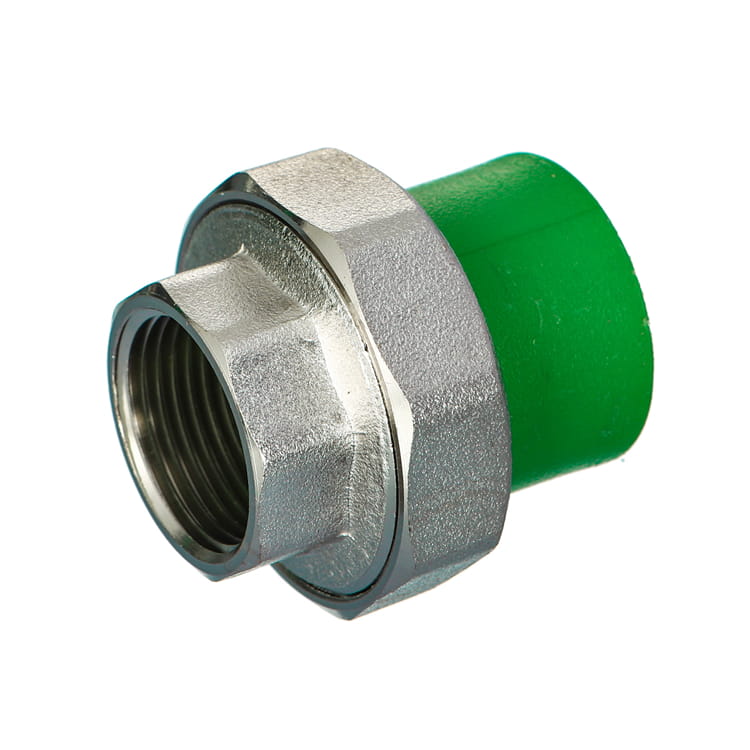
Every other joint in a PP-R system is permanent. Socket fusion melts the pipe and the fitting into one piece of plastic, and the only way to undo it is a hacksaw. The union is the exception — the one fitting designed to come apart with a wrench and go back together without heat. Which means the question is never "do I need unions." It is "where do I put them," and that decision gets made once, at rough-in, by whoever is holding the welder.

Key Takeaways
- A union is not a coupling. A coupling joins two pipes permanently. A union joins them through a threaded nut and a seal, so the joint can be broken and remade an indefinite number of times without touching the fused sockets on either side.
- Put one on both sides of anything you will ever remove. Water heaters, pumps, filters, meters, mixing valves. One union lets you disconnect; two let you lift the component out without springing the pipework.
- The O-ring is the part that decides quality, and it is the easiest part to substitute. EPDM is the correct elastomer for potable hot water. NBR looks identical, costs less, and degrades in hot water and ozone.
- Brass-insert unions belong at the transition, not everywhere. ISO 15874-3:2013 explicitly covers fittings made from other materials fitted to PP pipes — the standard anticipates the brass thread. Using one where an all-plastic union would serve just adds a dissimilar-material joint.
- PP-R moves 0.15 mm per metre per kelvin. A 20 m riser through a 50 K swing wants to grow 150 mm. A union is a fixed point, not an expansion device — placing one mid-run without an expansion loop transfers that load into the nut.
- The failure nobody plans for is the one with no union at all. A fused line with no demountable point turns a ten-minute pump swap into a cut-and-reweld with the water off.
What a PPR Union Actually Is
A PP-R union is three pieces that ship as one: two halves, each with a fusion socket on its outboard end, and a captive threaded nut that draws the two halves together against a seal. You weld each half onto the pipe the same way you would weld a coupling — heated tool, socket fusion, the method covered by DVS 2207-11. The difference is what happens after. The fused sockets stay fused forever; the joint between them opens with a wrench.
That distinction is the entire reason the fitting exists, and it is worth being precise about why it matters in PP-R specifically rather than in plumbing generally. A threaded steel system can be broken at any joint, given enough effort and a pipe wrench. A soldered copper system can be unsweated with a torch. A fused PP-R system genuinely cannot be taken apart — the weld is not a joint between two materials, it is a single continuous mass of polypropylene.
When an installer needs to get a pump out of a fused line and there is no union, the options are cut the pipe and weld in new fittings, or cut the pipe and weld in a union so the next person does not face the same problem. There is no third option.
This is also why unions get value-engineered out of jobs and why that decision is so expensive. On a bill of materials a union is one of the dearer fittings in the range while doing the same visible thing a coupling does — it connects two pipes. The difference only shows up years later, at the first service call, and by then the person who saved the money is long gone.

One detail decides whether the fitting works at all, and it is not written on the box. The nut is captive on one half only. It has to be sitting on that half, facing the right way, before either socket is welded — once both halves are fused to their pipes, a nut that was left off or threaded on backwards cannot be fitted, because there is no longer a free pipe end to slide it over. The joint is then unmakeable and both welds have to be cut out. Installers who work in PP-R daily do this automatically; installers coming from copper or steel, where nothing is captive, are the ones who lose an afternoon to it.
The second-order version of the same trap is orientation on a run with several unions. Each nut travels toward the half it is captive on, so a line assembled with all the nuts facing the same direction has to be broken in that direction too. On a plant-room wall where one end is against a corner, that decides which component can actually be pulled first.
Where Unions Go — and Where They Must Not
The placement rule is simple to state: put a union wherever a component will one day be removed, and put one on each side of it. The single-union version lets you break the connection; it does not let you lift the component clear, because the pipework on the far side still holds it captive. Two unions turn a removal into a two-wrench job.
| Location | Unions | Why |
|---|---|---|
| Water heater inlet and outlet | 2 | The single most-replaced component on the line |
| Circulation pump | 2 | Bearings are consumable; the pump comes out, the pipe stays |
| Filter or softener | 2 | Serviced on a schedule, not on failure |
| Meter / manifold entry | 1–2 | Utility swaps meters; the joint must be reversible without a welder on site |
| Riser mid-span, no expansion loop | 0 | A union is a fixed point; thermal load lands on the nut |
| Buried or cast into slab | 0 | A demountable joint you cannot reach is a leak path with no benefit |
The last two rows are where installers get into trouble, and the reason is thermal. PP-R has a linear expansion coefficient of 0.15 mm per metre per kelvin. That is a property of the unreinforced material, and it is worth knowing what changes it: the same source puts glass-fibre-reinforced PP-R at 0.035 and aluminium-foil-reinforced at 0.030 mm/m·K — a fifth to a quarter of the movement. If a riser is specified in composite pipe rather than plain PP-R, the expansion problem largely goes away, and so does the argument against a mid-run union.
Run the arithmetic on a plain PP-R riser and the number is hard to argue with: 20 metres of pipe, cold-filled at 15 °C, carrying 65 °C water, is a 50 K swing. That is 0.15 × 20 × 50 = 150 mm of growth the pipe will take somewhere. Properly designed systems take it in expansion loops, offsets and sliding supports. What a union does is create a rigid, clamped point in the middle of that movement. Put one mid-riser with no loop to absorb the travel, and the thermal load concentrates on the threaded nut and the seal face rather than being distributed along the run.
The buried case is simpler. A fused PP-R joint underground is a continuous piece of plastic with no seal to fail. A union underground is an elastomer seal you cannot inspect, cannot re-torque, and will not find quickly when it weeps. If a joint has to be buried, it should be fused.
There is also a size at which the argument changes. PP-R unions are commonly stocked from 20 mm to 110 mm — the same band as the PP-R pipe sizes they land on — and the fitting is at its best in the small and middle of that band — the sizes where a component is light enough that one person lifts it out once the two nuts are off. Toward the top of the range the union stops being the cheap serviceable option: the fitting is bulky, the nut needs a long strap wrench and room to swing it, and the component on the far side is usually heavy enough to need support before anything is undone.
At that point a flanged connection is doing the same job with better mechanics, and the union is being specified out of habit rather than because it is the right joint.
All-Plastic vs Brass-Insert Unions

Two families exist, and they are not interchangeable. An all-plastic union is PP-R throughout: both halves and the nut are polypropylene, and the seal is an O-ring seated between the two faces. A brass-insert union carries a moulded-in brass thread on one side, so it can land on a threaded component — a pump flange, a heater tapping, a brass valve.
ISO 15874-3:2013 anticipates exactly this: the fittings part of the standard covers fittings made from PP and fittings made from other materials intended to be fitted to pipes conforming to Part 2. The brass thread is not a workaround, it is inside the system's scope. What matters is that you use it for the reason it exists. A brass insert at a heater tapping is a transition doing its job. A brass insert used mid-run, where both sides are PP-R anyway, adds a dissimilar-material interface and a moulding boundary for no functional gain — and a moulded-in metal insert is a place where thermal cycling works the plastic against the metal for the life of the system.

The practical selection rule: all-plastic wherever both sides are PP-R; brass-insert only where the union is the transition to a threaded metal component. If a supplier's quote is all brass-insert unions on a job that is PP-R end to end, that is a question to ask, not a spec to accept.
The O-Ring Is the Whole Product
Everything above the seal is polypropylene doing an easy job. The seal is the part under thermal cycling, compression set and water chemistry for the whole service life, and it is a component most buyers never specify. That combination — critical, cheap, unspecified — is precisely where substitution happens.
The correct elastomer for potable hot water is EPDM. It is the standard material for sanitary plumbing and drinking-water seals because it holds up to continuous hot water, ozone and UV. The material itself has considerable headroom: sulfur-cured EPDM is rated to a maximum of about 120 °C and peroxide-cured to about 150 °C. Those are elastomer ceilings, not system ratings — in a PP-R line the pipe body is the limiting component long before the ring is, and any supplier quoting an O-ring temperature as the system rating has the engineering backwards.
The substitution to look for: NBR (nitrile) rings. NBR is excellent against oils and fuels and is cheaper than EPDM, which is why it turns up in low-cost unions. In continuous hot potable water and in ozone it is the wrong material. Visually the two are the same black ring. The only reliable checks are the material certificate and a specification line that says EPDM in writing.

Two failure modes survive a correct specification, and both are about force rather than material. The first is over-torque. The seal is made by squeezing the O-ring, and that happens well before the nut feels tight; every turn after it is stress in a plastic thread with nowhere to go. A cracked union nut on a system that never leaked in service is almost always an assembly signature, not a product defect, and it usually shows up as a hairline split running along the thread root rather than a clean break.
The second is compression set. An elastomer held squeezed at temperature slowly stops springing back, and a ring that has spent years compressed in a hot line will not re-seal at the same nut position when the joint is opened and closed again. This is the practical reason a union that has been opened for service should be reassembled with a new ring rather than the old one: the joint was not leaking before because the ring had taken a set in that exact position, and it will not find that position twice. EPDM holds up better here than the alternatives, which is a second reason the material specification matters beyond hot-water resistance.
Four Checks Before You Accept a Union Lot
None of these need a lab. Run the nut down by hand on a sample from each carton — it should turn the full thread length freely; progressive tightening from the first turn is moulding shrinkage, and that nut splits under a wrench. Pull the O-ring and look at the groove for flash, because a ring seated on a flash line weeps on the first thermal cycle. Ask for the elastomer certificate by name — "EPDM" in writing, not "rubber seal" on a spec sheet. Check socket depth against a pipe offcut: a shallow socket makes a weak weld no matter how good the union is.
IFAN manufactures PP-R unions in both configurations alongside the rest of the PP-R fittings range. We have not published lot-level O-ring certification for this article, so treat the four checks as what to ask any supplier for — us included.
Conclusion
A union is the only reversible decision in a system built entirely from permanent joints, and it is made once, at rough-in, by someone whose incentive is speed. Two unions at every serviceable component, all-plastic unless the union is a transition to metal, EPDM in writing, and nothing demountable buried or cast in. That list costs very little at the material stage and is not recoverable afterwards without a saw.
If the fused joints on either side of the union are the part you are less sure about, the socket-fusion temperatures, heating times and the mistakes that cause weeping welds are covered in our PPR welding and installation guide.
Frequently Asked Questions
Can a PPR union be reused after it is opened?
Yes — that is the point of the fitting. The fused sockets are untouched by opening the nut. Inspect the O-ring each time it is opened and replace it if it shows flats, cracks or compression set.
How tight should the union nut be?
Hand-tight plus a short pull on a strap wrench. The seal is made by the O-ring compressing, not by thread tension, so extra torque adds stress to the plastic nut without improving the seal.
Is a union the same as a coupling?
No. A coupling is a permanent fused joint. A union is a demountable joint made by a threaded nut and a seal, with fusion sockets only on its outboard ends.
Which standard covers PPR unions?
ISO 15874, the standard for PP piping systems in hot and cold water installations. Part 3 covers fittings, including fittings made from other materials — which is where brass-insert unions sit.