
HDPE Pipe Color Code: What It Means, Region by Region
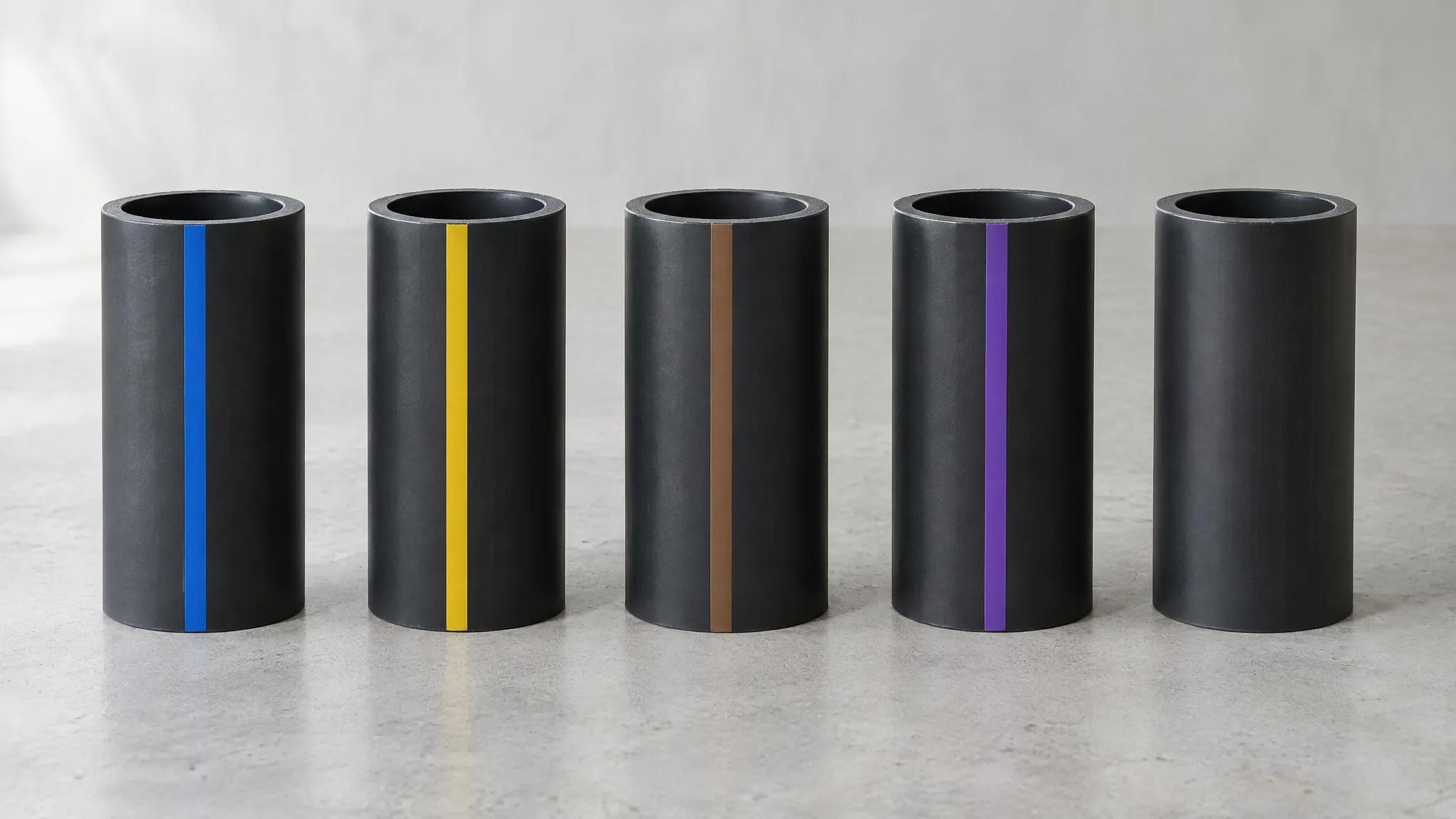
There is no global HDPE colour code. What blue, yellow, black, brown and purple mean under the North American, UK and Australian rules, and how to order.
There is no global HDPE colour code. Across the documents below, blue means potable water in North America, a shade graded to the PE grade in the UK, and only one of two acceptable drinking-water markings in Australia, where plain black is equally correct. Colour is set by the specification the destination accepts; pipe marked to the wrong document is rejected on site.
Key Takeaways
- No single HDPE colour code exists. The documents cited here disagree with each other about what blue, black and purple mean.
- North America codes by service under the APWA code, and the Plastics Pipe Institute limits that code to solid-wall pipe used outside buildings.
- UK potable blue is graded: light blue for PE 80, dark blue for PE 100, both to named BS 5252 ranges. Brown stripes mark a barrier pipe, not a service.
- In Australia and New Zealand a plain black main is legitimate drinking water. Purple, not the absence of blue, marks non-drinking water.
- No cited document ties colour to pressure class. The chart pairing yellow with PN 4 and blue with PN 10 is a factory convention.
On this page
- Black Is the Material, Not the Message
- North America: One Code, and It Stops at the Building Line
- United Kingdom: Blue Is Graded, Brown Means Barrier, Yellow Means Gas
- Australia and New Zealand: The Same Two Services, a Different Palette
- The Table That Says Colour Equals Pressure Class Is Not a Standard
- Writing the Colour Line on a Purchase Order
- Frequently Asked Questions
Black Is the Material, Not the Message
Black is a specified quantity. UK Water Industry Specification WIS 4-32-19 sets carbon black at 2 per cent to 2.5 per cent measured to ISO 6964, with a primary particle size of 10 nm to 25 nm. That loading is the ultraviolet protection, and why pressure pipe starts black. Our complete guide to HDPE pipe covers the material.
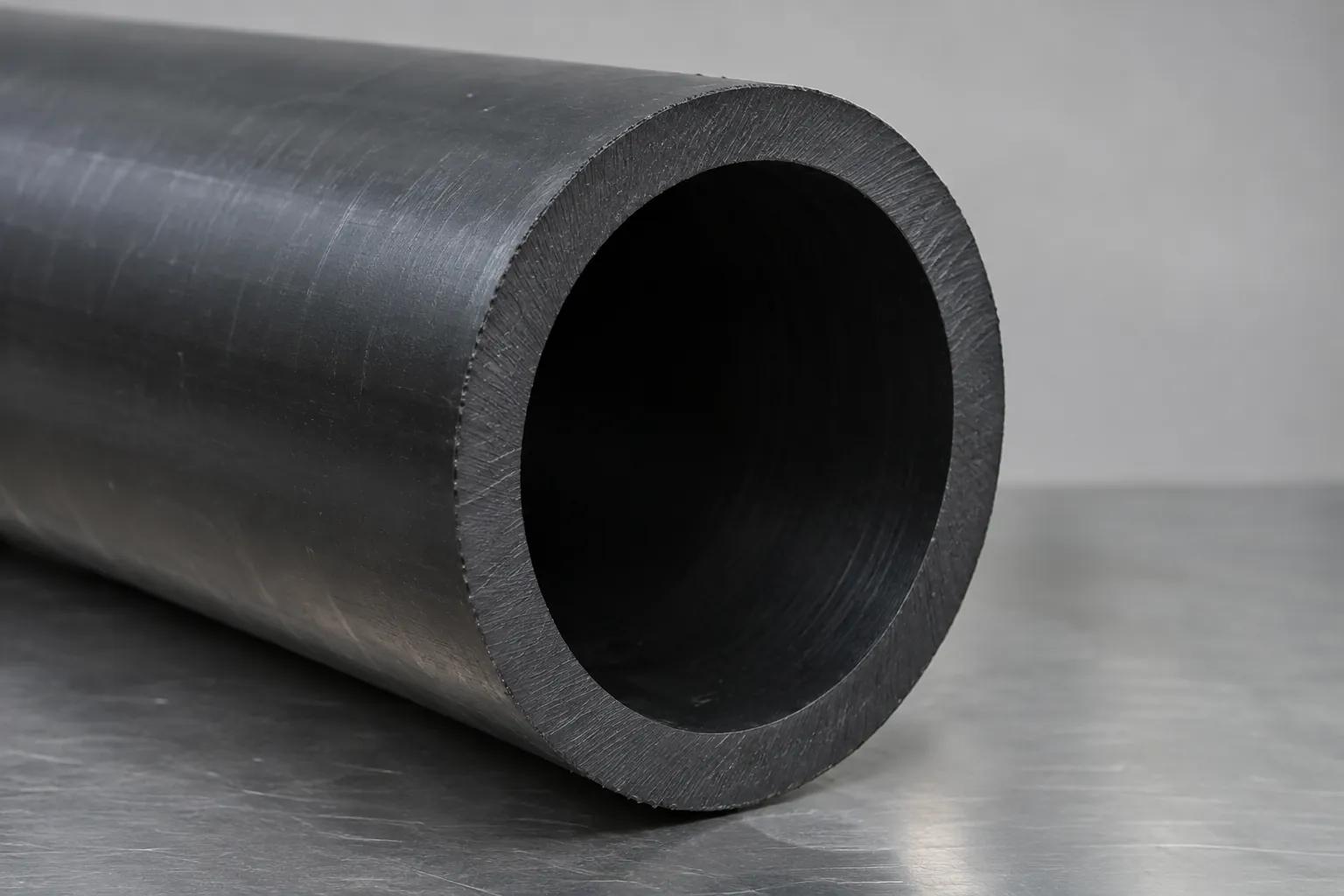
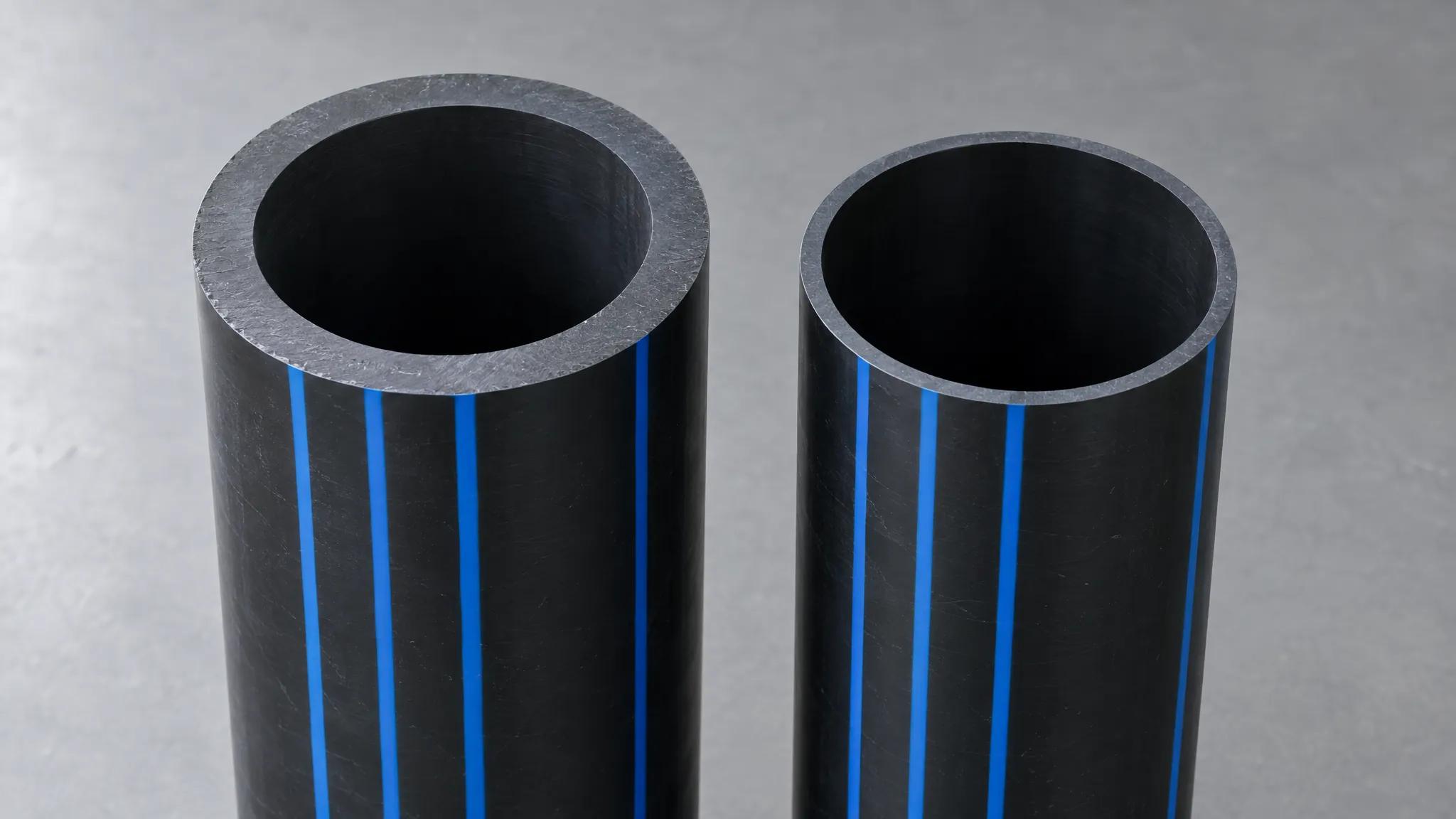
Identification goes on top, as stripes or as a jacket: a continuous coloured outer layer co-extruded into the pipe wall, in the wording of the Australian commentary on AS/NZS 4130. A solid pipe and a striped pipe can carry identical duty, so the question is whose scheme is on it.
North America: One Code, and It Stops at the Building Line
Plastics Pipe Institute Statement V, reviewed April 2017, follows the American Public Works Association Uniform Color Code. That code assigns colour by service: red electric power, orange telecom and signal lines, yellow fuel gas and petroleum, green sewers, blue potable water, purple reclaimed water.
It also states a limit most summaries drop: the code “is only intended for solid wall pipe used outside of buildings”, not corrugated pipe and not pipe indoors. The gas rule is narrower than it reads. ASTM D2513, F2785 and F2945 do not require gas pipe to be yellow, only that any identifying colour be yellow. ASTM D3035, F714, F2160 and NEMA TC7 forbid yellow on theirs.
United Kingdom: Blue Is Graded, Brown Means Barrier, Yellow Means Gas
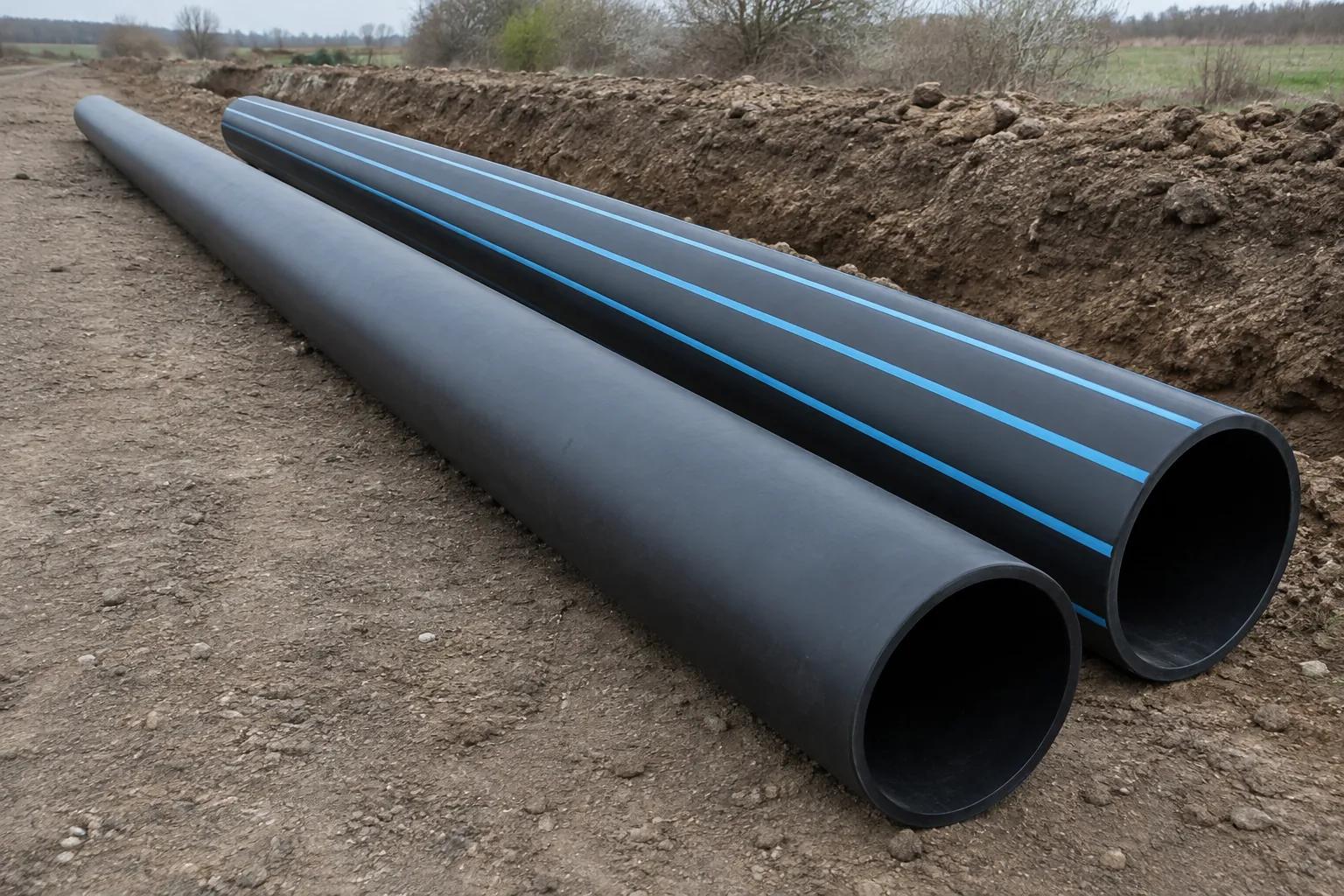
WIS 4-32-19, Issue 3 of November 2011, fixes the potable-water colour to the PE grade: light blue for PE 80 within BS 5252 range 18E51 to 18E53, dark blue for PE 100 within 20D44 to 20D45 or 20E53 to 20E56. Stripe count is specified too: four stripes up to 180 mm, eight above it.
The stripes on that pipe are brown, and brown is not a service here. Scottish Water’s guidance says external brown stripes identify a multi-layer pipe built for contaminated ground. Gas is a separate rulebook. Street Works UK Volume 1, Issue 9 lists buried gas PE as yellow, or yellow over a removable brown-striped skin, up to 2 bar, then orange to 7 bar. The product specification GIS/PL2-2:2022 puts the same yellow in clause 6.2, but it is access-restricted: confirm the wording with the network operator. The water side sits on BS EN 12201-1 and its UK National Annex.
Australia and New Zealand: The Same Two Services, a Different Palette
Table 4.1 of the WSA Water Supply Code of Australia gives PE reticulation mains as plain black or black with blue stripes for drinking water, and plain purple or black with purple stripes for non-drinking water. Plain black is therefore a correct potable marking there, which a North American reading would call unmarked stock. The industry commentary on AS/NZS 4130 names the recycled-water colour lilac and pins the shades to RAL numbers. The same table forbids sleeving purple over a blue pipe, or the reverse.
The Table That Says Colour Equals Pressure Class Is Not a Standard
One chart circulates widely: yellow for PN 4, red for PN 6, blue for PN 10, green for PN 16. On 18 September 2026 it sat at ranks four and seven of the US results for this query, and it is in none of the documents above. ISO 4427-1:2019, published August 2019 and 17 pages, is titled Part 1: General. Ask for blue expecting PN 10 and you get a potable marking at whatever class the line ran. Pressure class comes from the SDR, covered in our size and SDR guide. The ISO 4427-2 and EN 12201-2 colour clauses are paywalled and are not quoted here.
Writing the Colour Line on a Purchase Order
| Marking on the pipe | Governing document and where it applies | What it means there | Verdict if read under another system |
|---|---|---|---|
| Solid blue, or blue stripes | PPI Statement V and APWA code; North America, buried, outside buildings | Potable water | Inside a building, or on profile pipe, this code does not apply |
| Solid yellow, or yellow stripes | PPI Statement V and APWA code; North America | Fuel gas, oil, petroleum, steam | Assuming ASTM mandates yellow; it reserves the colour instead |
| Purple or lavender | PPI Statement V and APWA code; North America | Reclaimed water, irrigation, slurry | Reading purple as a material grade or pressure marking |
| Light blue PE 80 or dark blue PE 100, brown stripes | WIS 4-32-19 Issue 3; United Kingdom potable water | Barrier pipe for contaminated ground | Reading brown as a service colour rather than pipe construction |
| Yellow, or yellow over a removable brown-striped skin | Street Works UK Vol 1 Iss. 9; UK buried gas up to 2 bar | Buried gas main or service; orange above 2 bar | Buying to a water specification for a gas network |
| Plain black, or black with blue stripes | WSA 03 Table 4.1; Australia and New Zealand | Drinking-water reticulation main | Rejecting plain black as unmarked or non-potable stock |
| Plain purple, or black with purple stripes | WSA 03 Table 4.1; Australia and New Zealand | Recycled, non-drinking water | Sleeving purple over blue pipe, which the same table forbids |
| Any colour read as a PN pressure class | No document cited on this page | Nothing; a factory convention | Ordering a pressure class by asking for a colour |
Source: PPI Statement V (2017); WIS 4-32-19 Iss. 3 (2011); Street Works UK Vol 1 Iss. 9 (2018) Table 1; WSA 03 Table 4.1; PIPA TC4130.
Five lines make a colour instruction enforceable:
- the governing document and its edition, written out in full;
- the country or utility that will accept the delivery;
- the service the line will carry;
- the marking method: solid colour, stripes, or a co-extruded jacket;
- the shade reference and stripe count where the document gives them, as WIS 4-32-19 does at four stripes below 180 mm and eight above.
Where a destination has no national rule, the utility or tender specification governs; get it in writing. Grade, SDR and standard are separate order lines, in our standards guide and on our product pages.
For an importer holding a tender clause: send it with your enquiry.
Conclusion
The expensive mistake is assuming the chart you read governs where the container lands. Pipe bought to the North American code can fail a UK inspection on stripe count alone at 180 mm. Name the document, not the colour.
Frequently Asked Questions
What colours does HDPE pipe come in?
Base black, plus identification in blue, yellow, orange, green, red, purple or lilac, applied as stripes or a co-extruded jacket. Which of those is correct depends entirely on the specification the destination market accepts.
Is blue always potable water?
No. Blue is potable under the APWA code in North America and under WIS 4-32-19 in the United Kingdom, but in Australia and New Zealand plain black is an equally correct drinking-water marking.
Does HDPE pipe colour indicate the pressure rating?
No. The pairing of yellow with PN 4 and blue with PN 10 appears in none of the documents cited here. Pressure class comes from the SDR and the PE grade, not from a colour.
Why is HDPE pipe black?
Carbon black gives ultraviolet resistance, and the loading is specified. WIS 4-32-19 requires 2 per cent to 2.5 per cent carbon black content measured to ISO 6964, with a primary particle size of 10 nm to 25 nm.
What does a brown stripe on a blue water pipe mean?
In the United Kingdom it identifies a multi-layer barrier pipe with an aluminium layer, intended for potentially contaminated ground. It describes how the pipe is built, not what it carries.
Related Briefings
HDPE Pipe Flow Rate Chart: Bore and Capacity by OD and SDR
uPVC Pressure Pipe Class B, C, D and E: What the BS 3505 Classes Mean in East and West African Tenders, and How They Map to PN