
Types of Valves: Ball, Gate, Globe, Check, Butterfly & PRV Explained
Every water system is really a network of decisions, and valves are where those decisions get made: stop the flow, let it pass, hold it to one direction, knock its pressure down, or dump it in an emergency. Specify the right valve type in the right place and the system isolates cleanly, services easily, and protects itself. Specify by habit — a gate valve where a throttling valve belongs, ordinary brass where the water demands DZR, a bargain body where the seat matters — and the system works until the day it expensively doesn't. This guide covers every mainstream valve type: what each one actually does, how it does it, where it belongs and where it fails, what the bodies are made of, and how a buyer should put together a valve schedule for a real project.
Key Takeaways
- Valves divide by job: isolation (ball, gate, butterfly), regulation (globe, PRV, balancing), non-return (check), and safety (relief).
- They also divide by motion: quarter-turn (ball, butterfly, plug) is fast; multi-turn (gate, globe) is gradual and gentler on the system.
- Never throttle with an isolation valve — a half-open gate or ball erodes its own sealing surfaces.
- For potable water the body grade is as important as the type: lead-free, dezincification-resistant (DZR) brass.
- A typical building needs four kinds working together — isolation at every branch, check valves against backflow, a PRV at entry, relief at heat sources.
- Match every valve on size, pressure class (PN/WOG), thread standard (BSP/NPT), and potable approval.

How Valves Are Classified: Job and Motion
Every valve catalog makes more sense once you see the two axes underneath it. The first axis is the job. Isolation valves exist to be fully open or fully closed — they shut a line down for service (ball, gate, butterfly). Regulation valves are built to sit part-open and control flow or pressure without destroying themselves (globe, pressure reducing, balancing). Non-return valves act automatically to keep flow one-directional (check valves, foot valves). Safety valves stay shut and open only in an over-pressure emergency (relief valves). The second axis is the motion. Quarter-turn valves (ball, butterfly, plug) go from open to shut in a 90° flick — fast and unambiguous, but capable of causing water hammer if slammed on a fast-moving column. Multi-turn valves (gate, globe) wind a stem over several rotations — slower to operate, gentler on the system. Cross the two axes and nearly every valve you'll ever buy falls into place. The most expensive mistakes come from crossing the job boundary: throttling with an isolation valve, or isolating daily with a valve built to sit still for years.
The Quick Reference: Every Type at a Glance
| Valve | Job | Motion | Best for |
|---|---|---|---|
| Ball | Isolation | Quarter-turn | Everyday shutoff, frequent use |
| Gate | Isolation | Multi-turn | Full-bore mains, infrequent use |
| Globe | Regulation | Multi-turn | Throttling, flow control |
| Check | Non-return | Automatic | Backflow prevention, pump lines |
| Butterfly | Isolation (+ coarse control) | Quarter-turn | Large diameters, tight spaces |
| Pressure reducing | Regulation | Automatic | Service entries, pressure zones |
| Relief / safety | Safety | Automatic | Water heaters, closed circuits |
| Angle / stop | Isolation | Quarter- or multi-turn | Fixture supplies under sinks/toilets |
| Plug | Isolation | Quarter-turn | Gas cocks, industrial slurries |
Ball Valves: the Everyday Default
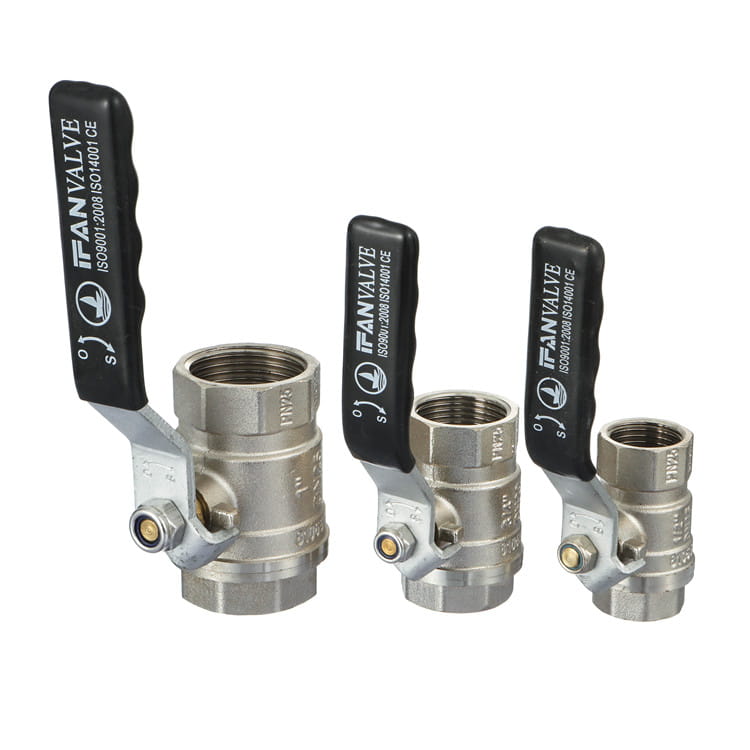
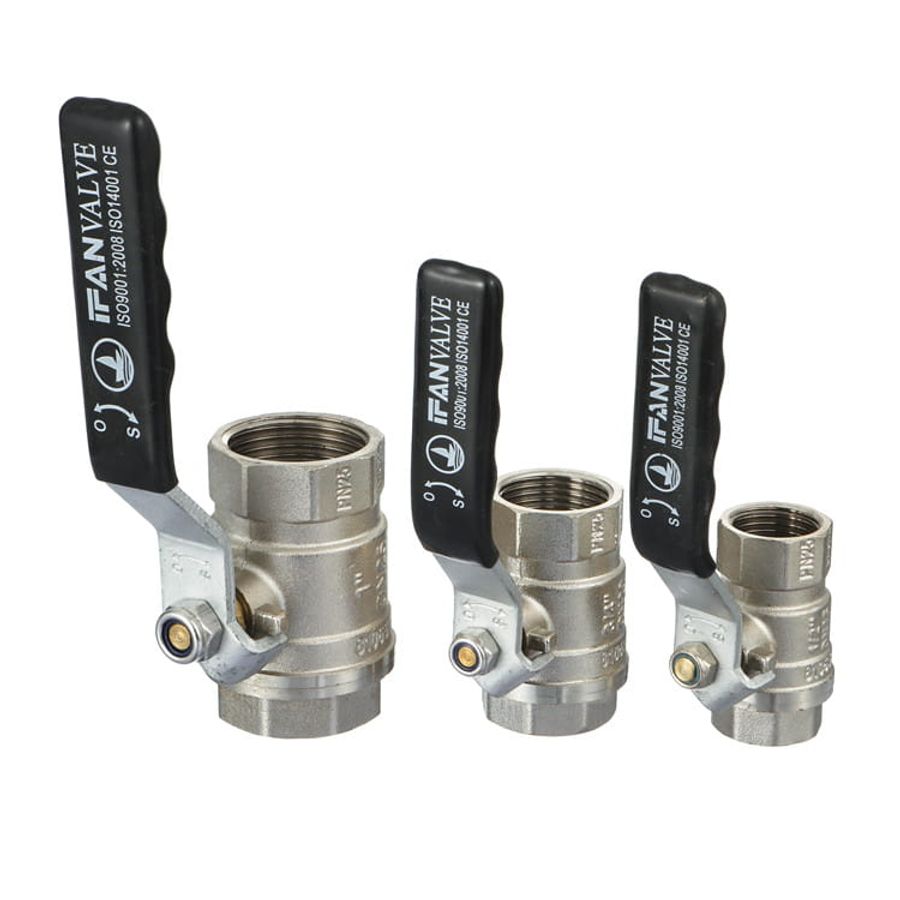
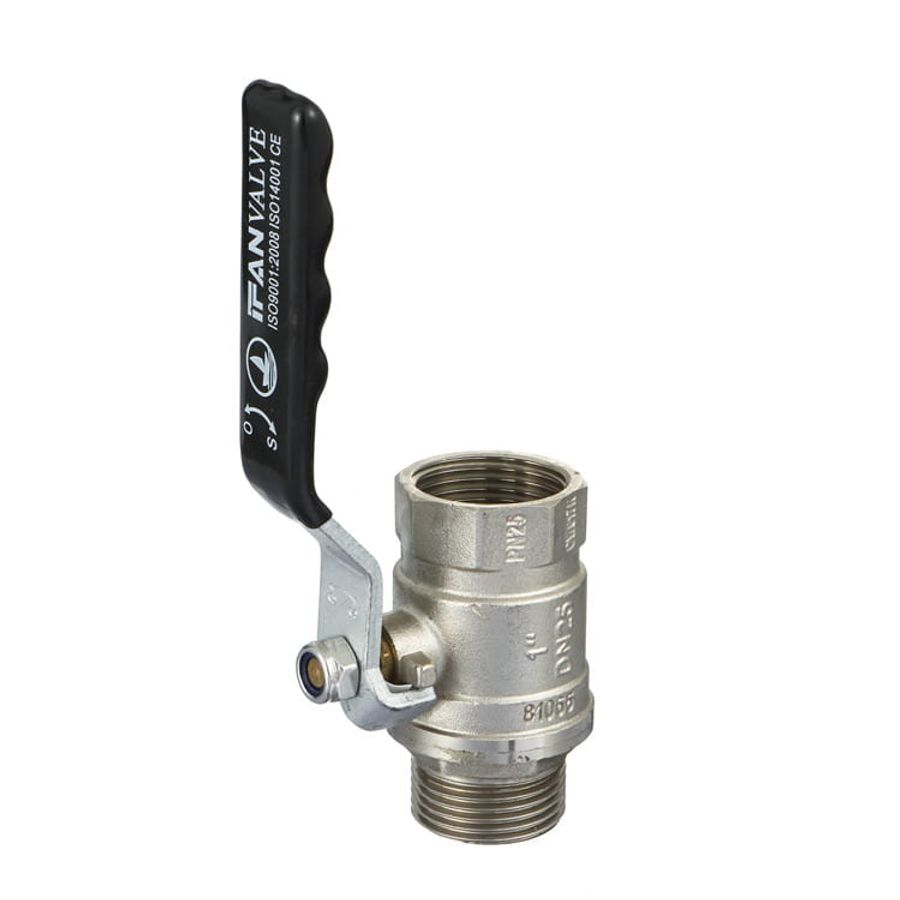
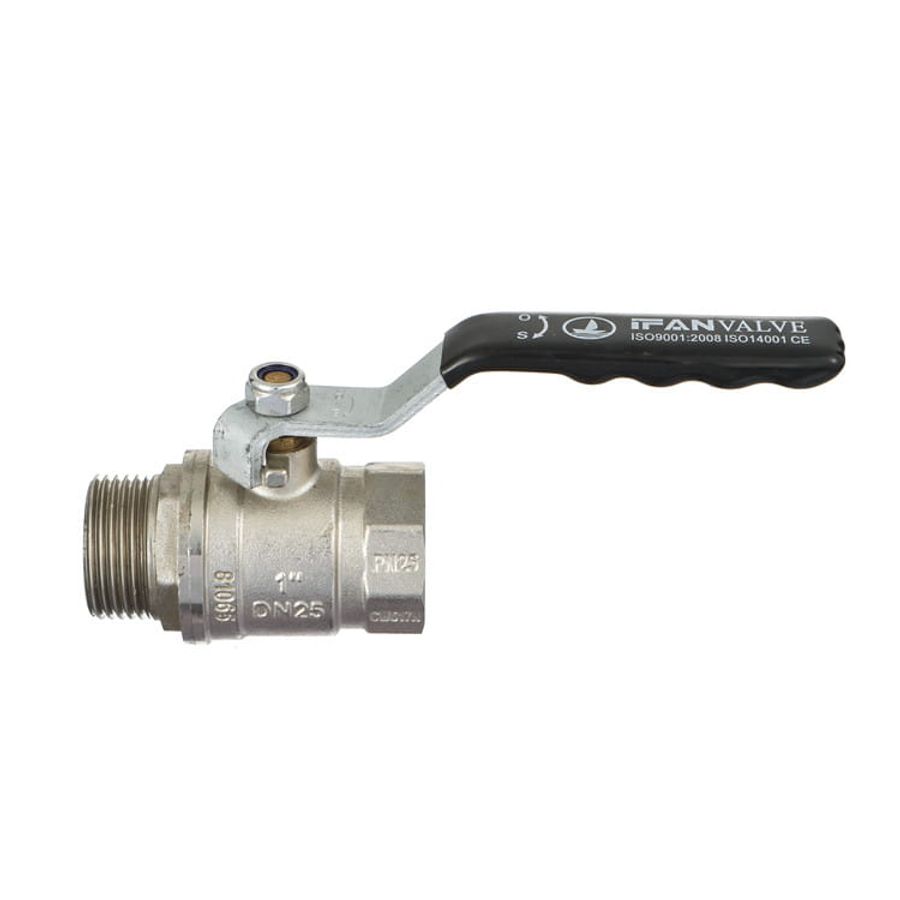
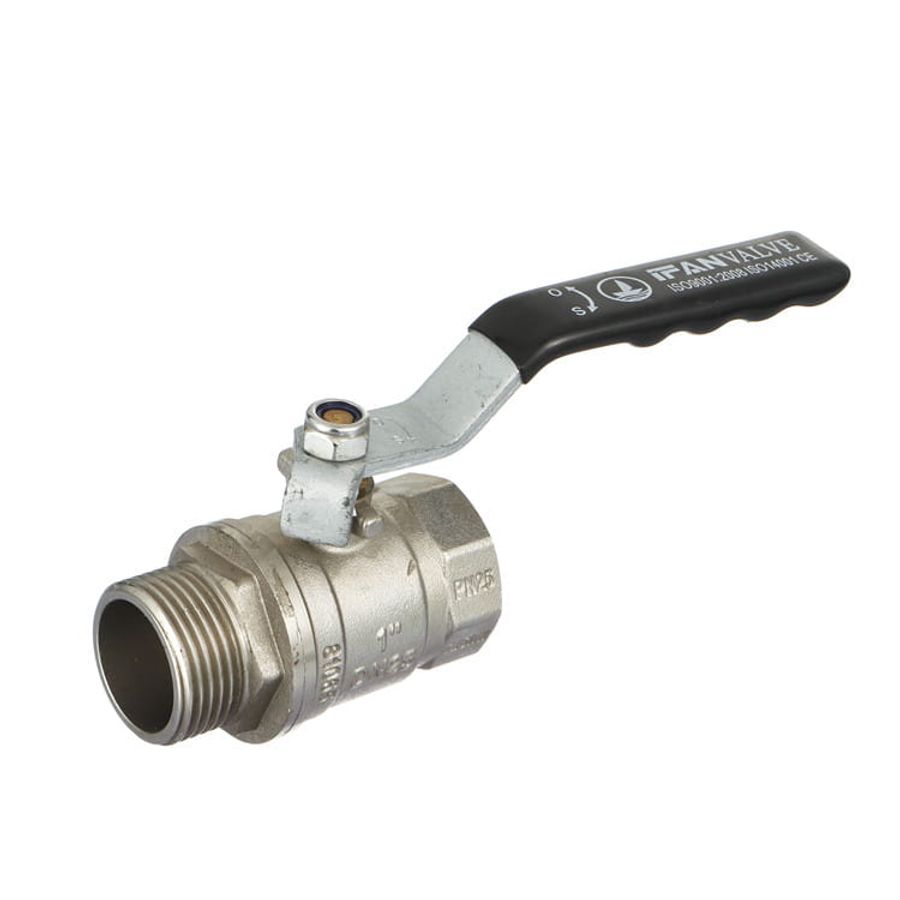
A ball valve holds a drilled sphere in the flow path: a 90° turn of the handle swings the bore in line (open) or across it (shut). That geometry gives it the combination that made it the modern default for isolation: fast, visually unambiguous (handle along the pipe = open, across = shut), drip-tight over thousands of cycles, and full-bore in the right pattern so it adds almost no flow restriction. Inside a quality valve the details matter more than the concept: a solid machined brass ball (not a thin plated shell), PTFE seats that seal without swelling, a blow-out-proof stem, and — in an everyday buying decision — a full-port vs reduced-port choice, where the reduced port saves money but narrows the bore one size. Best for: any line you isolate more than once a year, appliance connections, manifold branches. Not for: throttling — a part-open ball focuses erosion on one edge of ball and seat, and the valve that throttles for a season stops sealing for good. The full buying logic — port patterns, handle types, sizes DN8–DN100 — is in the brass ball valve buyer's guide.
Gate Valves: Full-Bore Isolation for the Long Haul
A gate valve raises and lowers a solid wedge across the waterway over several turns of a handwheel. Fully open, the bore is completely clear — the lowest pressure drop of any valve type — which is why gate valves still guard mains and risers where flow efficiency matters and operation is rare. The several-turn action is also self-protective: slow closure on a big moving water column avoids the hammer a slammed quarter-turn can cause. Two design choices matter at purchase: rising stem (the stem lifts as it opens, showing position at a glance, needs headroom) versus non-rising stem (compact, for tight spaces), and the wedge/seat material pairing that determines how tightly an old valve still shuts. Best for: mains isolation, riser bases, anywhere a valve sits open for years and must not restrict flow. Not for: throttling (the part-open gate chatters and erodes its seat) and not for daily operation, where a ball valve's speed wins. The direct comparison lives in ball valve vs gate valve, and the deep-dive in the brass gate valve guide.
Globe Valves: Built to Throttle
The globe valve is the one designed to sit part-open. Flow makes a Z-shaped path through the body and passes a disc that closes onto a horizontal seat; winding the stem positions that disc precisely, so flow can be set anywhere between shut and full. The price of that control is permanent pressure drop — the tortuous path costs energy even fully open — which is exactly why a globe valve is wrong for pure isolation and right for regulation. Where you meet them: hot-water recirculation balancing, bypass lines, sample points, anywhere the question is "how much flow" rather than "flow or no flow." Two field notes worth knowing. First, direction matters: a globe valve has a flow arrow, and installing it backwards makes the disc slam and the valve noisy. Second, its geometry is the basis of the angle valve — the same seat-and-disc turned 90°, which is why fixture stop valves under sinks regulate so controllably. Best for: throttling duty, balancing circuits. Not for: mains isolation (pressure cost) or dirty fluids (the seat pockets debris).
Check Valves: One Direction, Automatically
A check valve has no handle at all: forward flow pushes it open, reverse flow (or gravity, or a spring) closes it. That automatic one-way action does three quiet jobs — keeps pumps primed, stops used or contaminated water backing into the clean supply, and protects meters and heaters from reverse surge. The type choice inside the family is about closing behaviour and orientation: a swing check hinges open with the lowest pressure loss but wants horizontal or upward flow; a spring (lift) check closes fast in any orientation, which is why pump discharges use it — the fast close is what prevents the reverse slam that hammers pipework. Sizing is counter-intuitive: an oversized check valve chatters, because normal flow can't hold the element fully open, and the flutter eats the seat. Size to real flow, mind the arrow on the body, and for potable lines hold the same DZR/lead-free grade as every other brass component. The full treatment — types, cracking pressure, water hammer — is in the brass check valve guide.
Butterfly Valves: Big Bores, Small Bodies
Above roughly DN50, ball valves get heavy and expensive fast — the sphere grows with the cube of the bore. The butterfly valve solves the economics: a thin disc pivots on a central stem inside a wafer-thin body that clamps between two flanges. A DN200 butterfly weighs a fraction of a DN200 ball valve, costs a fraction, and fits in a fraction of the space, which is why building risers, chiller circuits, and municipal lines above ~DN65 are butterfly territory. The trade-offs are honest: the disc always sits in the flow (a small permanent pressure loss), sealing depends on an elastomer liner with a service life, and precise low-flow control is not its strength — it isolates well and throttles coarsely. Best for: large-diameter isolation, HVAC and distribution mains, space- and budget-constrained plant rooms. Not for: small-bore domestic branches (a ball valve is simpler and tighter) or fine regulation. For a B2B buyer the liner material (EPDM for water, NBR for oils) and the flange standard are the two spec lines that cause mismatches — confirm both against the pipework.
Pressure Reducing and Relief Valves: the Automatic Guardians
Two valve types work without anyone touching them, and confusing them is dangerous. A pressure reducing valve (PRV) regulates continuously: it takes a main delivering 6–10+ bar and hands the building a steady 3–4 bar, balancing a spring against a diaphragm all day, every day. A pressure relief (safety) valve does nothing until an emergency — if pressure exceeds its setting, say from water-heater thermal expansion, it opens and discharges to protect the system. One regulates, the other rescues; a well-designed system usually carries both, plus an expansion vessel once the PRV closes the old expansion path. The PRV also brings its own installation grammar — isolation valve upstream, strainer against grit, gauges both sides — covered end-to-end in the pressure reducing valve guide. Best for: every service entry above ~5.5 bar static (many codes require it). Not for: substituting each other — a PRV can't relieve and a relief valve can't regulate.
The Small Ones That Matter: Angle, Stop, and Plug Valves
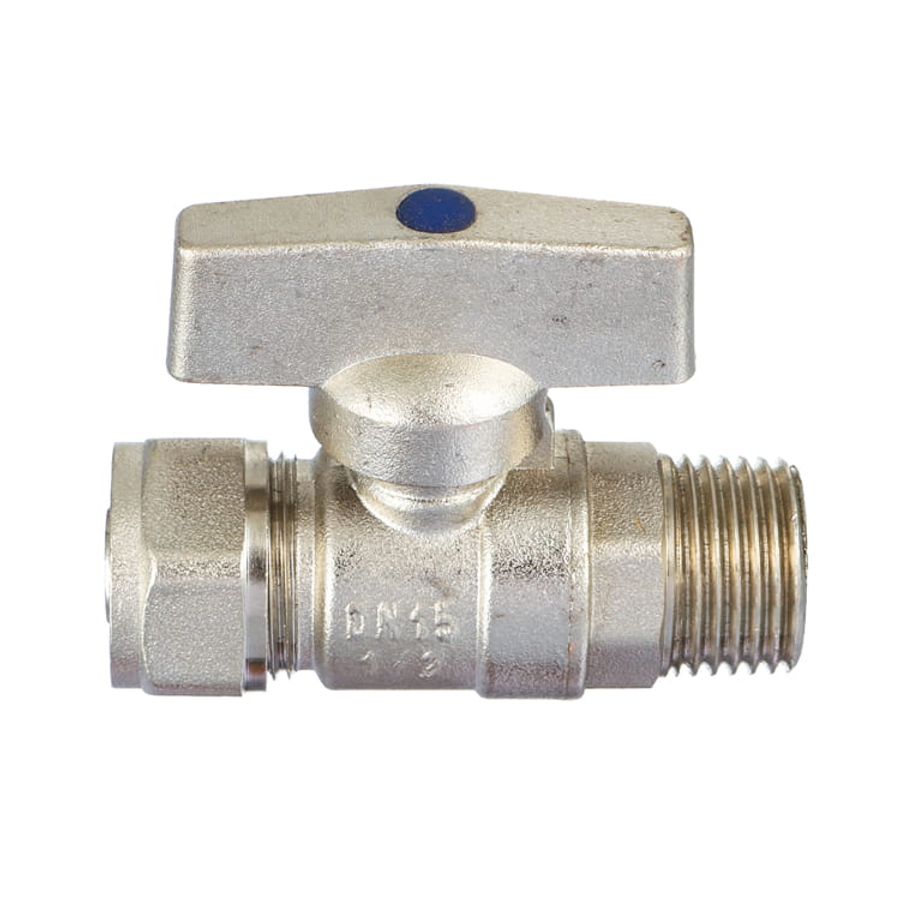
Three smaller types round out the schedule. Angle valves (fixture stops) sit under every sink, toilet, and appliance, turning the wall supply 90° into the fixture hose with a built-in shutoff — the valve a homeowner actually touches when a toilet runs. They're bought in bulk on projects, which makes their quality-per-unit economics matter more than their price suggests: a failed 1/2" angle valve floods a bathroom exactly as effectively as a failed main. Stop (globe-pattern) valves on older installations do fixture isolation with a multi-turn head — being globe-based they also throttle, which quarter-turn stops don't. Plug valves — a tapered rotating cylinder, the oldest valve design still in service — survive as gas cocks and in industrial slurry duty where a full-bore straight-through passage that wipes itself clean beats everything else. None of these headline a spec sheet; all of them appear on it in quantity, and the project that saves two dollars a piece on fifty angle valves usually meets those savings again as callbacks.
Body Materials: Why the Grade Decides the Lifespan
Type picks the mechanism; material decides how long the mechanism keeps working. Brass is the default for valves DN8–DN50 because it machines to precise, drip-tight seats and shrugs off water that corrodes steel — but "brass" spans grades. For potable water the spec is lead-free and dezincification-resistant (DZR): ordinary brass in aggressive water loses zinc, turns porous, and seizes or weeps; a mechanism with a sliding stem and a machined seat feels dezincification long before a static fitting does (the metallurgy is covered in the CW617N and lead-free brass). Forged vs cast matters equally: forging compacts the metal grain into a dense, void-free body that holds pressure reliably, while casting can trap micro-porosity that weeps under test — the difference is detailed in forged vs cast brass valves. Beyond brass: plastic-bodied valves (PPR ball valves fused straight into PPR lines, PVC ball valves cemented into irrigation systems) remove the transition joint entirely and never corrode, at the cost of pressure and temperature headroom; stainless steel takes the corrosive, food-grade, and coastal niches; bronze and iron persist in municipal and marine service. The buying rule is one sentence: the valve's body grade must match the water, and every valve on a potable system should carry the same lead-free approval — one under-spec valve is the system's real rating.
What We Check Before a Valve Ships
Because IFAN manufactures its own brass valves rather than relabeling stock, the quality gates are process steps we control and can describe exactly. The body starts as CW617N brass, hot-forged so the grain structure is dense and continuous — both forged and cast lines exist in the range, and pressure-critical valves ship forged. The ball is a solid machined brass core, not a plated shell that delaminates after a few hundred cycles. Machining brings seat and stem bores to tolerance before PTFE seats and O-rings are fitted, and assembled valves are pressure-tested against their class — the range spans DN8 to DN100 across PN16, PN25, and PN40 classes, threaded BSP or NPT to order. Certifications are held for the major markets, standard lead time runs about 10 days with common sizes held in stock, and there is no minimum order quantity — a sample order tests the quality claim as effectively as a container. The reason to buy valves from the company that also makes the fittings and pipe they connect to is dimensional: one catalog, one thread standard, one grade, zero mixed-source surprises — the full range is in the IFAN product catalog.
A Worked Example: the Valve Schedule for an Apartment Riser
Here's how the types combine on a real job — one riser of a mid-rise apartment building. At the service entry: a full-bore gate or ball valve for main isolation, a strainer, a PRV set to 3.5 bar (two PRVs zoned by floor group if the building is tall enough that the bottom floors would otherwise be over-pressured), a check valve per the backflow code, and gauges either side. At each floor branch: a quarter-turn ball valve, because floor isolation happens every time an apartment renovates and speed matters. At the water heaters: isolation ball valves on both sides for service, a relief valve on the tank, and an expansion vessel because the PRV upstream closed the expansion path. On the hot-water recirculation loop: a globe or balancing valve per branch, sitting part-open by design so every floor gets hot water at the same wait. At every fixture: an angle valve on each supply. Count it up and one riser carries five different valve types, each chosen by job — and the schedule orders them together, in one grade, one thread standard, and one pressure class, which is precisely why single-source procurement beats a parts-hunt across four suppliers.
How to Choose: Five Questions That Pick the Valve
1. What's the job? Shut off (isolation), control (regulation), one-way (check), or emergency (relief) — this eliminates most of the catalog immediately. 2. How often is it operated? Frequent → quarter-turn ball; rare and full-bore → gate; never (automatic) → check/PRV/relief. 3. What's the line size? Under ~DN50, ball valves rule; above, butterfly economics take over. 4. What's the fluid and grade requirement? Potable → lead-free DZR brass with the market's approval; corrosive or hygienic → stainless; fused-in plastic lines → PPR/PVC-bodied valves. 5. What must it match? Size and convention, pressure class (PN16/25/40 or WOG) at the working temperature, thread standard (BSP vs NPT), and connection type. Answer all five and the valve picks itself; skip one and the schedule contains the one part that binds, weeps, or fails the inspection. When two answers tie, prefer the valve that fails observably (a rising-stem gate shows its state; a lever ball reads at a glance) — systems get maintained by people who can see what's open.
Building a valve schedule for a project?
Send the line list — sizes, pressure classes, threads — and we'll quote ball, gate, check, PRV, and angle valves in lead-free DZR brass, with matched fittings, from one factory.
Request a QuoteCommon Valve Mistakes
Throttling with an isolation valve. A half-open ball or gate erodes its own sealing surfaces. Regulation is a globe/balancing valve's job.
Confusing PRV and relief valve. One regulates continuously, one rescues in emergencies. Heated systems typically need both plus an expansion vessel.
Ordinary brass on potable water. Non-DZR brass dezincifies, seizes stems, and weeps at seats. Lead-free DZR is the floor, not the upgrade.
Oversizing check valves. An oversized check chatters at real flows and destroys its seat. Size to demand, not to pipe diameter alone.
Slamming quarter-turns on long lines. Fast closure on a moving column is a water-hammer generator. Close big quarter-turn valves gently.
Mixing thread standards. BSP and NPT don't seal together. One project, one standard, stated on every line of the order.
Frequently Asked Questions
What are the main types of valves in plumbing?
By job: isolation valves (ball, gate, butterfly) that fully open or shut a line; regulation valves (globe, pressure reducing, balancing) that control flow or pressure; check valves that automatically keep flow one-directional; and safety relief valves that discharge in over-pressure emergencies. Fixture stops (angle valves) and plug valves round out a typical building's schedule.
Which valve is best for shutting off water?
For everyday shutoff, a quarter-turn ball valve: fast, drip-tight over thousands of cycles, and readable at a glance (handle along the pipe = open). For mains that are rarely operated and where flow restriction must be minimal, a full-bore gate valve remains the classic choice. Above roughly DN50–DN65, butterfly valves take over on cost, weight, and space.
What's the difference between a gate valve and a globe valve?
A gate valve lifts a wedge fully out of the waterway — full bore, minimal pressure drop, built for fully-open or fully-closed isolation, never throttling. A globe valve routes flow through a Z-shaped path onto a disc and seat — a permanent pressure cost, but precise part-open control, which makes it the throttling and balancing valve. Same multi-turn handwheel, opposite jobs.
Are brass valves safe for drinking water?
Yes — provided the grade is right. Potable systems should specify a dezincification-resistant grade such as CW602N, plus a lead-free alloy where a lead limit applies — CW617N itself is a leaded brass and is neither. Ordinary brass can lose zinc in aggressive water, weakening the body and seizing the mechanism. Every valve on a potable line should carry the same lead-free approval.
How many valves does a typical building system need?
More than most schedules first assume: isolation at the entry and every floor branch, a PRV at the service entry (often per pressure zone), check valves per the backflow code, relief valves and expansion control at every water heater, balancing valves on recirculation loops, and an angle valve at every fixture supply. One apartment riser routinely carries five different valve types, each doing a different job.