
The Complete Guide to PPR Pipe (PP-R): Grades, Sizes, Fittings & Sourcing
PPR pipe has become the green-plumbing standard for hot and cold water lines across Europe, the Middle East, Africa and Asia — and the wrong PP-R grade, size, or PN class turns a fifty-year system into a warranty problem. This guide covers PP-R material grades, DN and PN sizing, fittings, heat-fusion, standards and how to source from a real factory.
If you buy, specify, or install PPR pipe, almost every decision you make comes down to a handful of questions: is the material genuine, which grade and size do I need, how do the fittings and joints hold up, and how do I buy it without overpaying or getting a recycled batch. This guide puts all of those answers in one place — the material science, the sizing logic, the fittings and jointing, the failure modes, and the sourcing checks — and links down to the detailed guide for each when you need to go deeper.
The one idea that ties it together: PPR is a heat-fused system, not a glued or threaded one. Get the material grade, wall thickness, and fusion right and it lasts 50 years with no in-wall joints to fail. Get any of the three wrong and the failure hides in a wall until it's expensive. Everything below is about getting those three right.

Key Takeaways
- PPR = PP-R, polypropylene random copolymer — rated for hot and cold water at up to 95°C continuous and a 50-year design life.
- Three real types matter: plain PP-R, fiberglass-composite, and PP-RCT — not the PPR-vs-PPRC naming confusion.
- DN is the outer diameter; PN sets the wall, not the OD — so any DN mates with the same fittings across pressure classes.
- Joints are heat-fused at ~260°C; overheating is the #1 field mistake and looks fine until it fails under pressure.
- A quote is mostly a resin quote (75–85% of cost) — compare per kilogram of virgin PP-R, not per meter.
- Certifications that matter: DIN 8077/8078, ISO 15874, CE, SGS, plus your market's regional cert.
- Buy from a real manufacturer with batch certificates — most "factories" online are trading companies.
What PPR Pipe Actually Is
PPR stands for polypropylene random copolymer — often written PP-R, and sometimes PPRC (the "C" just means copolymer; it's the same material). The "random copolymer" part is what makes it usable for hot water. Plain polypropylene homopolymer (PP-H) is stiff but goes brittle in the cold and can't take repeated hot cycles. Random copolymer inserts roughly 3–5% ethylene units along the propylene chain, disrupting the crystal structure and giving the pipe its impact resistance and thermal tolerance.
In practice that means PP-R works across roughly -10°C to 95°C, with continuous service around 70°C and short peaks higher, and carries a 50-year design life at rated conditions. It's inert, doesn't corrode or scale like metal, and welds into a single monolithic system. A few properties matter on real jobs: it's a poor heat conductor, so hot lines lose less heat and sweat less than metal; its smooth bore resists scaling and keeps flow steady over decades; and it runs quieter than metal because it doesn't transmit water noise the same way. The one weakness to design around is thermal movement — plain PP-R expands noticeably when heated, which is exactly why long hot runs use the fiberglass-composite build covered below. The catch that runs through this whole guide: those properties only hold if the pipe is 100% virgin PP-R. Recycled blends look identical and fail early — which is why telling virgin PP-R from recycled is the first thing a serious buyer learns to check.
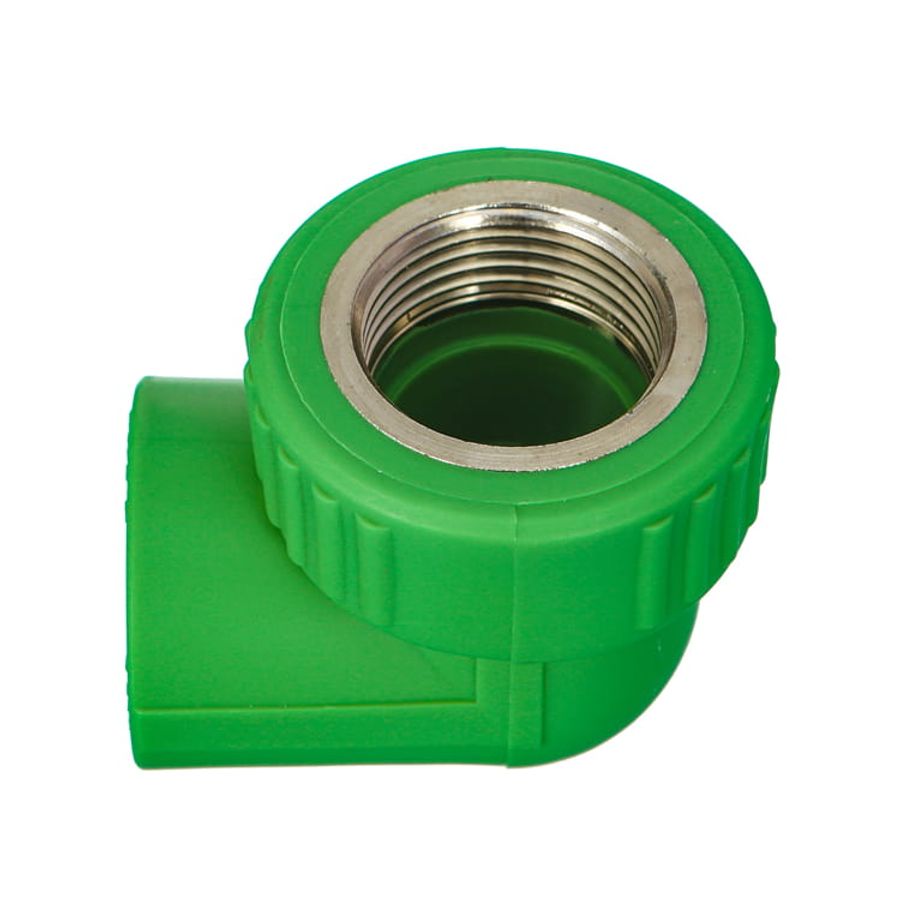
PPR Grades and Types: The Distinction That Matters
Most confusion here is a naming trap. Buyers ask about "PPR vs PPRC" as if they're different products — they're not. The real, physical choice is between three build types, and it changes how the pipe behaves on a long hot run.
- Plain PP-R: a single homogeneous wall. Cheapest, easiest to weld, fine for most cold and standard hot-water lines.
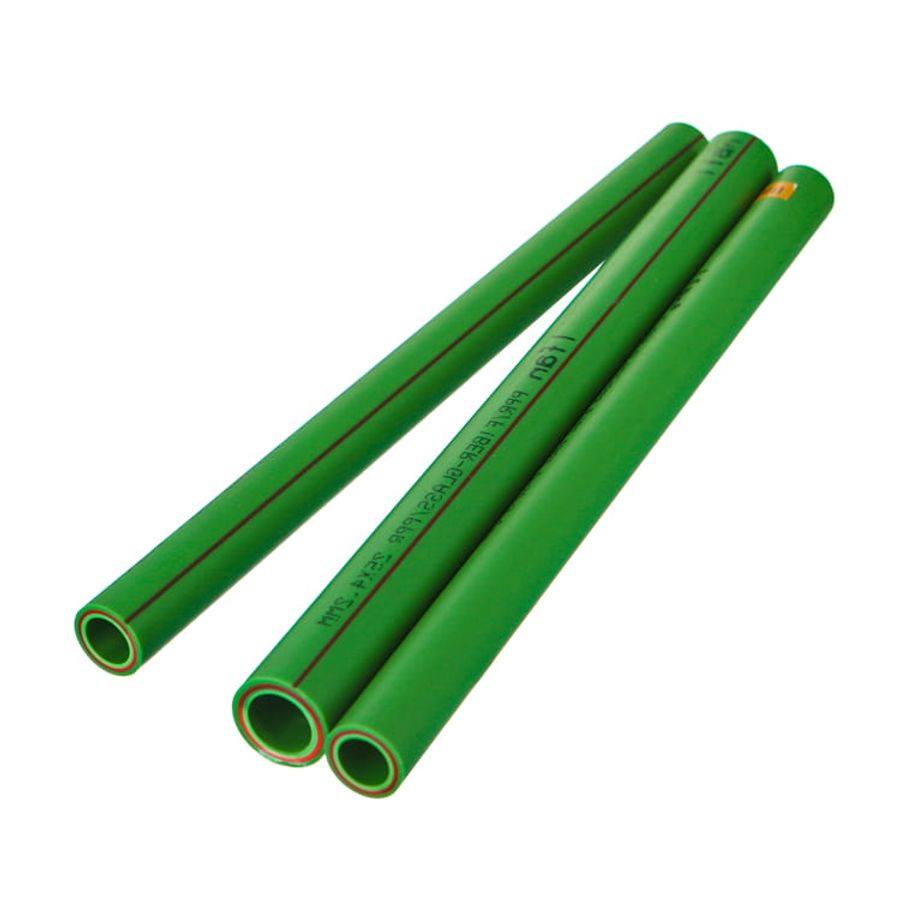
- Fiberglass-composite PP-R: a three-layer wall with a glass-fiber middle layer. It cuts thermal expansion to roughly a third of plain PP-R, so long hot runs sag and stress joints far less.
- PP-RCT (raised temperature): a modified crystal structure that holds more pressure at high temperature — for hot risers, heating loops, or thinner walls at the same duty.
All three weld with the same tools and fittings, so you can mix plain pipe on cold lines and composite on the hot riser in one job. The full breakdown of when each earns its cost is in the PPR vs PPRC comparison.
Sizes and Pressure Classes
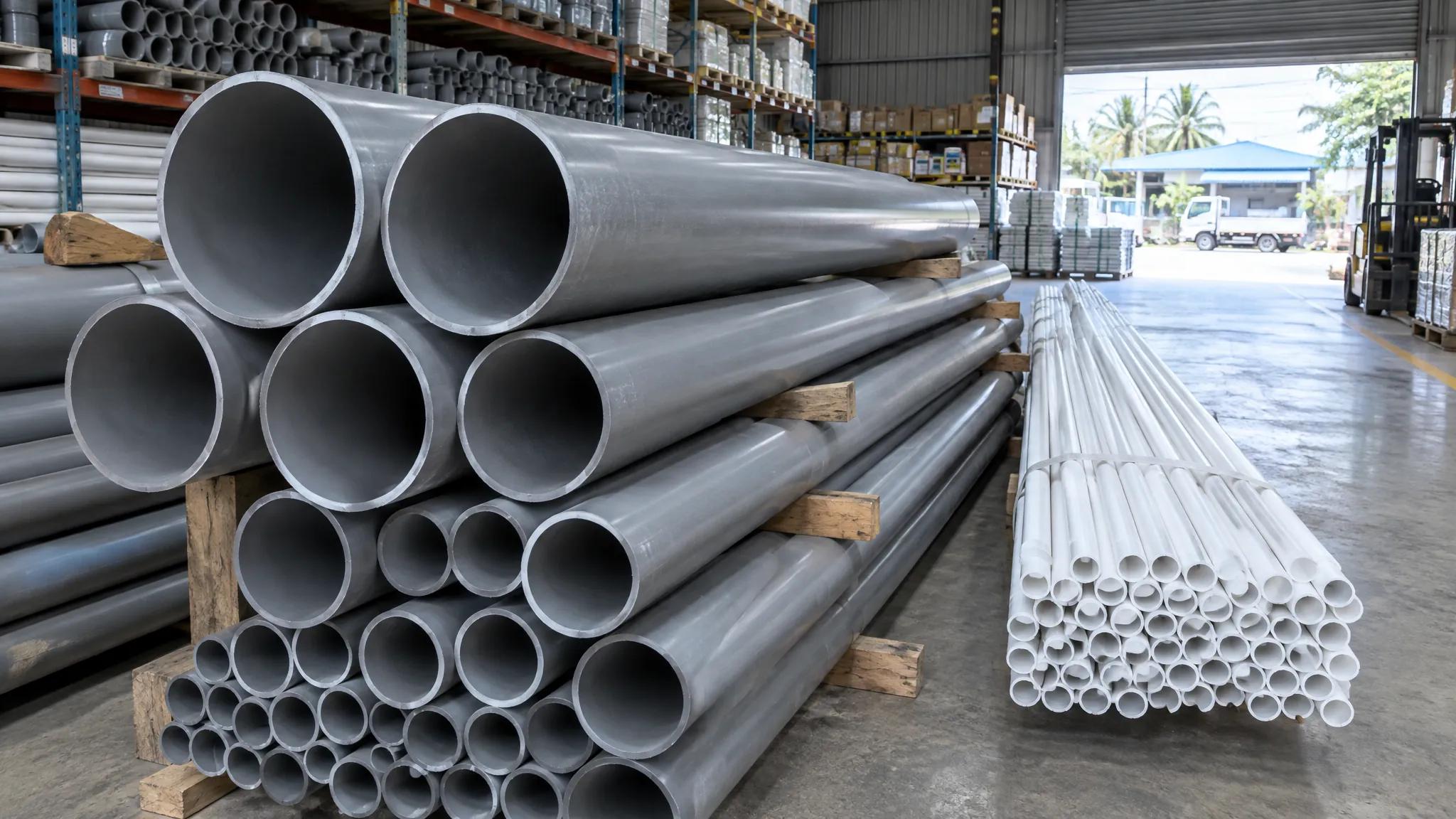
PPR pipe is made in nominal sizes from DN20 (20 mm outer diameter) up to DN160 (160 mm), in four pressure classes — PN12.5, PN16, PN20 and PN25. DN is the outer diameter and stays fixed for a given size, while PN sets the wall thickness — so a DN25 PN25 has the same OD and mates with the same fittings as a DN25 PN16, only with a thicker wall and a narrower bore. As a rule cold supply runs PN16, general hot water PN20 and hot risers PN25; the full DN20–DN160 wall-thickness chart, flow per class and mains-first sizing method are in the PPR pipe size chart.
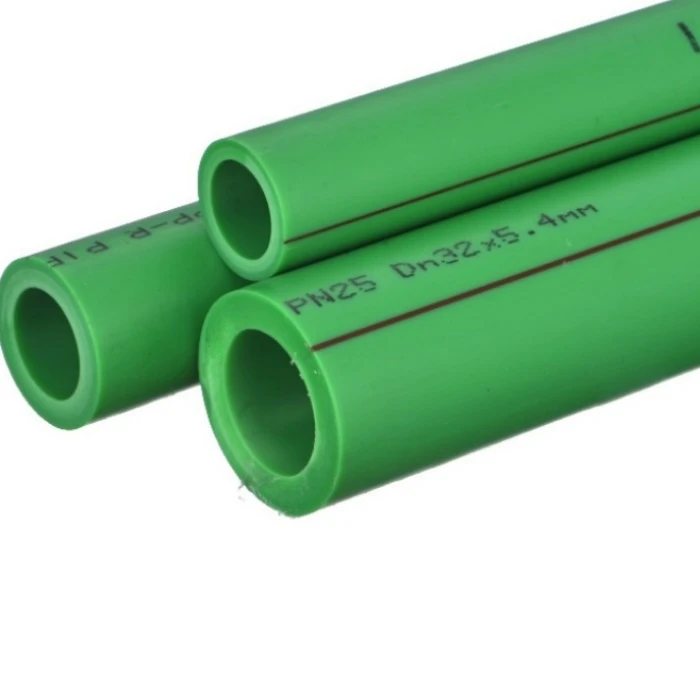
Colors and Markings: How to Read a PPR Pipe
PPR comes in green, white, grey and sometimes beige. The color is mostly a market and branding convention, not a quality signal — green dominates the Middle East, Africa and Asia, white is common in Europe and Latin America, and grey shows up on some cold and industrial lines. What matters far more than color is the printing along the pipe. A compliant PPR pipe prints its own spec: brand, material (PP-R), pressure class, diameter and wall (for example "PN25 DN32 x 5.4mm"), the standard it meets, a production date or batch, and often meter markings.
That printed line is your first quality check before anything technical. If a pipe has faint, smudged, or missing markings, treat it as a red flag — reputable factories print clearly and consistently because the marking is traceability. Match the DN and wall on the print against what you ordered, and confirm the standard (ISO 15874 or DIN) is stated. A pipe that won't tell you its own specification is not one you want in a wall.
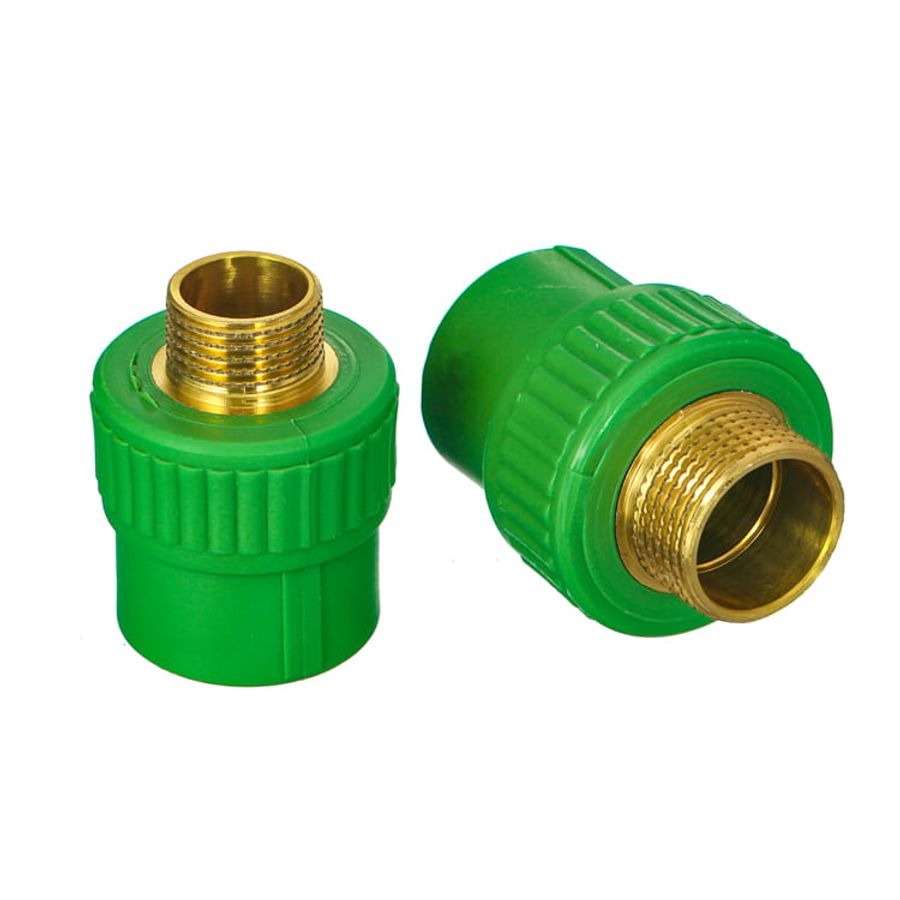
Fittings: The Connection System
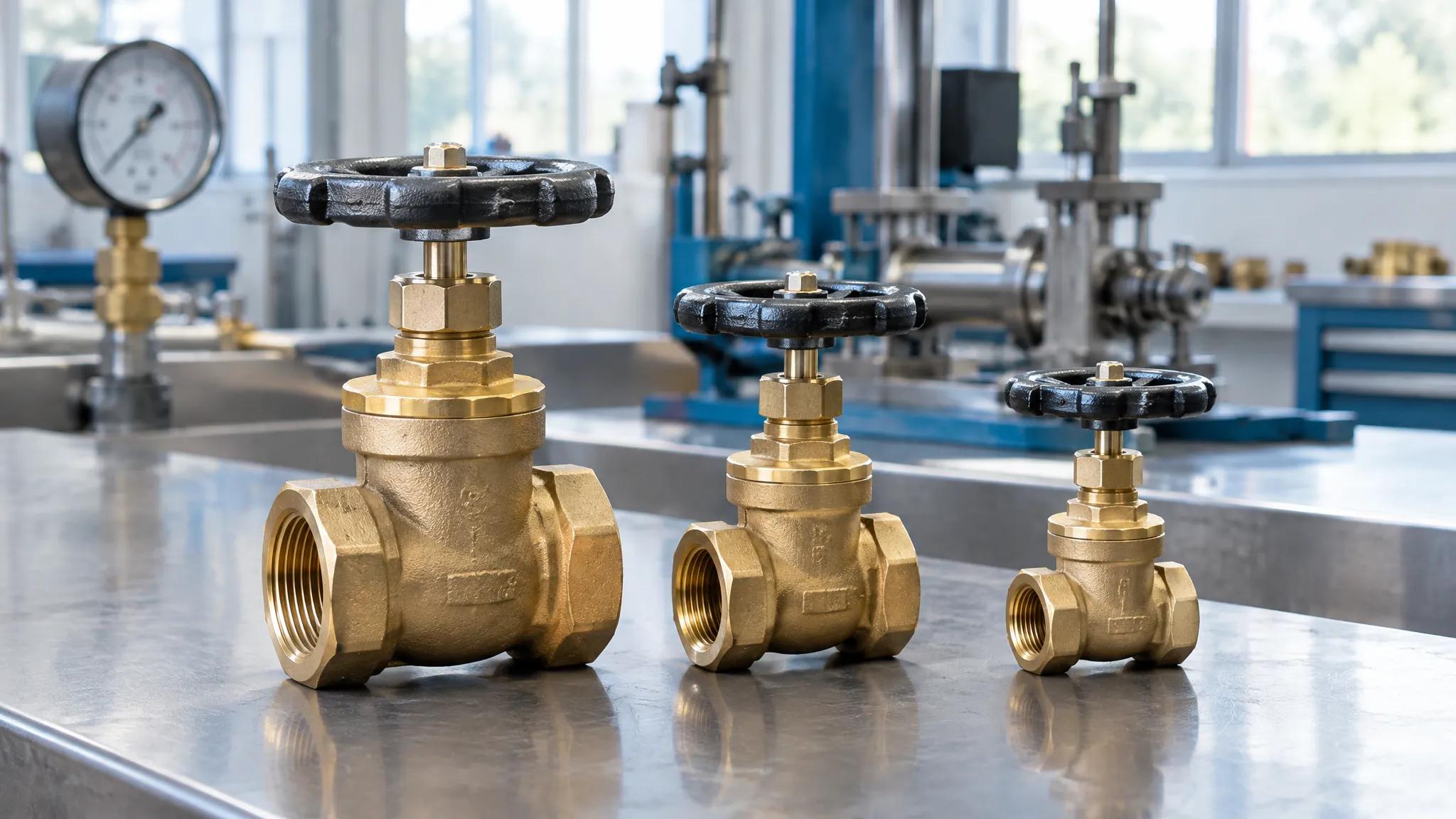
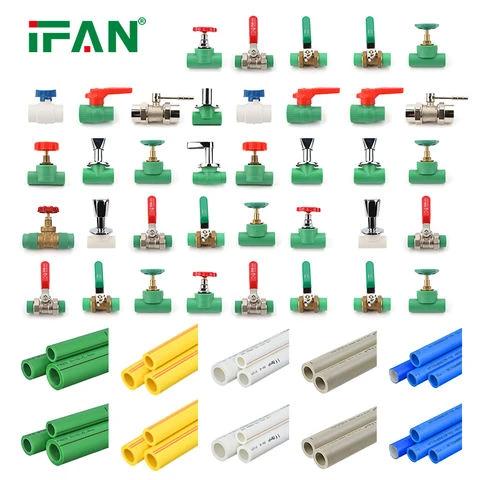
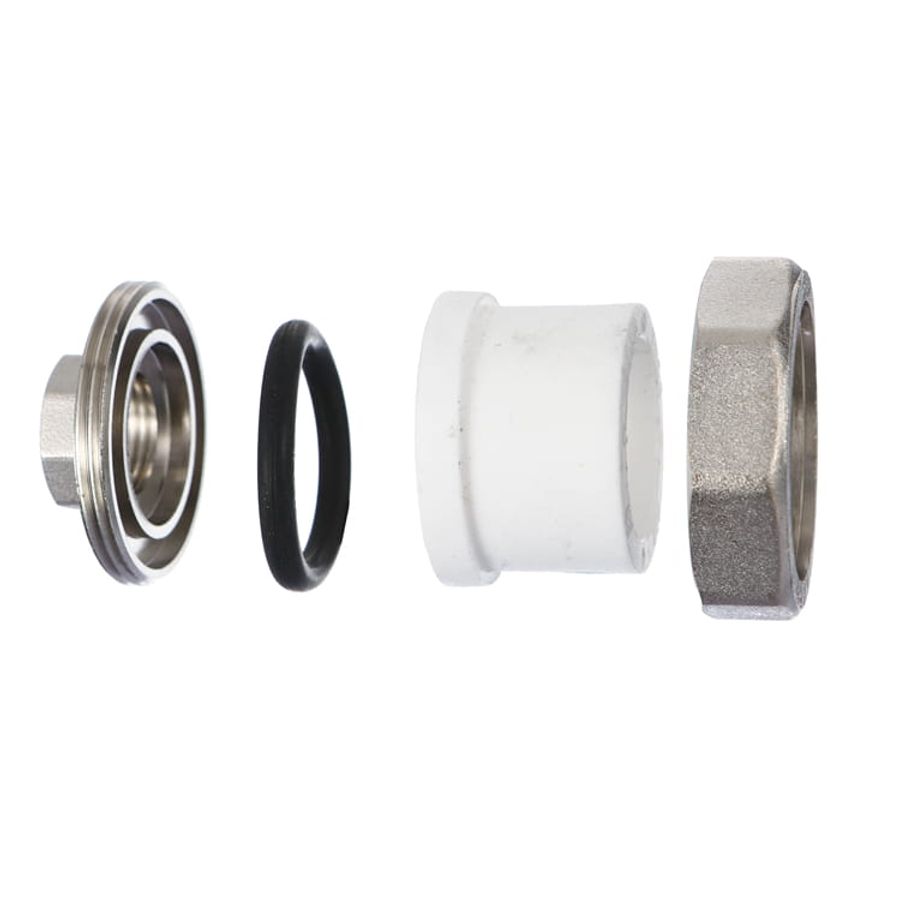
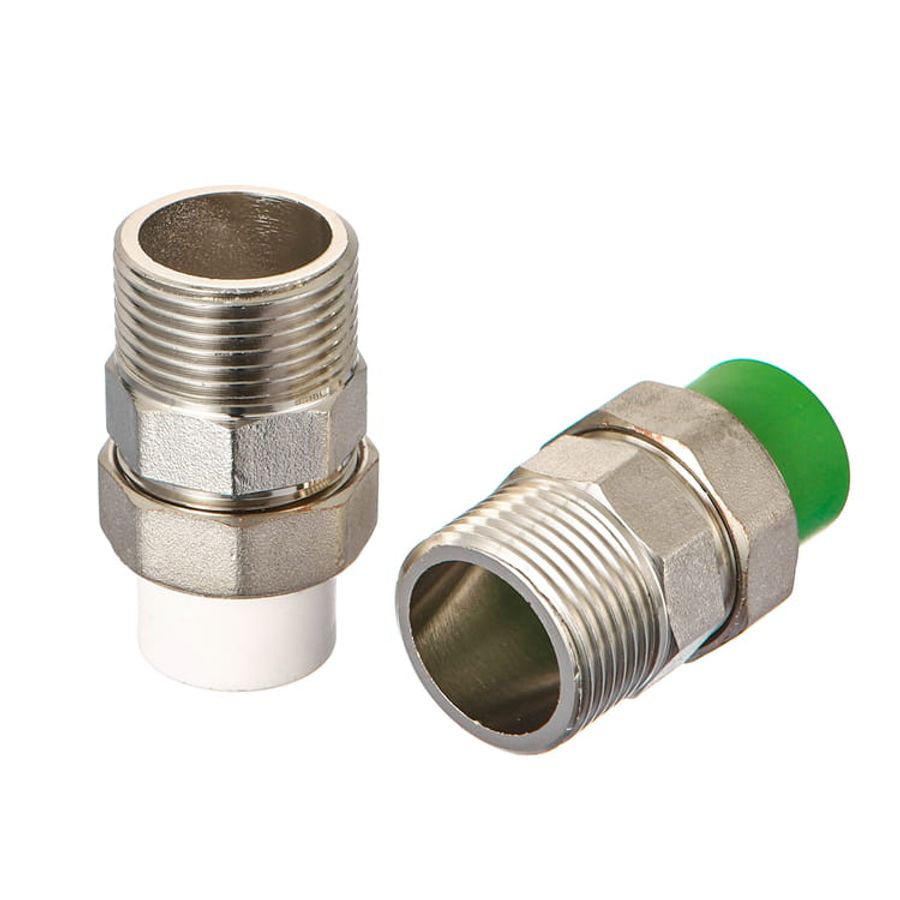
A PPR system is only as good as its fittings, because the fittings are where it joins — and where it leaks if you get them wrong. About ten shapes cover most jobs: socket couplings, 90° and 45° elbows, equal and reducing tees, reducers, end caps, threaded adapters, unions, and valves. Two rules decide whether they work: the fitting must be the same material grade and S-series wall class as the pipe, and where PPR meets metal, the brass insert quality — not the plastic — decides whether the threaded joint leaks in year two.
| Fitting | Job |
|---|---|
| Socket coupling | Joins two same-diameter pipes end to end |
| 90° / 45° elbow | Turns the line at corners and risers |
| Equal / reducing tee | Branches a line, same or smaller size |
| Reducer | Steps between diameters (DN25→DN20) |
| Threaded adapter | Connects PPR to metal — taps, meters, heaters |
| Union / valve | Serviceable break-point; shut-off and flow control |
The counterintuitive part for importers: PN20 and PN25 share fittings, but DN20 and DN25 do not couple directly — crossing sizes always needs a reducer. The full roster, the brass-insert test, and how to spec a fittings order for a container are in the complete PPR fittings guide.
Jointing: Heat Fusion Done Right
Socket fusion melts the outside of the pipe and the inside of the fitting at the same time, then presses them into one piece. The temperature is fixed at about 260°C; the heating time changes with diameter (roughly 5 seconds for DN20, 7 for DN25, longer for bigger pipe). The mistake that surprises new installers is that overheating is worse than underheating — extra "safety" seconds carbonize the plastic and create a brittle joint that looks perfect and fails under pressure. Push straight without twisting, hold while it cools, and pressure-test at 1.5× working pressure before closing the wall.
The sequence, in short:- Cut square and deburr — a clean perpendicular cut lets the pipe seat fully; a ragged cut leaves a gap that never fuses.
- Mark the insertion depth so the pipe goes fully home — not too shallow (weak) or too deep (blocked bore).
- Heat pipe and fitting together at ~260°C for the time set by diameter — no bonus "safety" seconds.
- Push straight to the mark, never twist — twisting shears the molten layer.
- Hold still while it cools, then pressure-test at 1.5× working pressure for ≥30 minutes before closing the wall.
Because the joint is fused, a correct PPR system has no gaskets, crimp rings, or glue seams to age — nothing mechanical to fail in the wall. The full temperature-and-time procedure with the common failure modes is in the PPR welding and installation guide.
PPR vs PVC vs PEX: When PPR Is the Right Choice
PPR isn't always the answer, and a good buyer knows when it is. PVC softens near 60°C and belongs on cold supply and drainage, not hot lines. PEX wins on install speed and freeze tolerance — it flexes where rigid pipe cracks — but it joins with mechanical crimp fittings, which means more potential leak points in the wall. PPR's edge is the fused, long-life, high-pressure system: for hot-water pressure lines in hot climates, and for buildings that pay their own maintenance, it usually wins the ten-year math.
| Property | PP-R | PEX | PVC |
|---|---|---|---|
| Max hot water | ~95°C | ~90°C | ~60°C (cold only) |
| Joint | Heat fusion (monolithic) | Crimp/clamp (mechanical) | Solvent cement |
| On freeze | Rigid, can crack | Flexible, tolerant | Brittle in cold |
| Best role | Hot/cold pressure lines | Fast/freeze-prone jobs | Cold supply, drainage |
The full side-by-side on temperature, pressure, joints and freeze behavior — and what to stock for your market — is in PPR vs PVC vs PEX.
PPR vs Metal Pipe (Copper and Galvanized)
Much of PPR's growth came from replacing metal, so it's worth knowing why. Galvanized steel corrodes and scales from the inside — the bore narrows, flow drops, and rusty water and leaks follow within years in hard or hot water. Copper resists corrosion better and is proven, but it's expensive, its price swings with the metals market, it can suffer pitting in aggressive water, and it needs skilled soldering with an open flame on site.
PPR sidesteps most of that: it doesn't corrode or scale, it's inert to the water it carries, there's no flame on site, and its material cost is far lower and more stable than copper. It won't match copper's raw temperature ceiling in extreme applications, and it needs a fusion tool rather than a torch, but for standard building hot-and-cold water PPR delivers copper-like longevity at a fraction of the installed cost — which is why new residential and commercial projects across Africa, the Middle East, Latin America and Asia default to it.
Where PPR Fits Best — and Where It Doesn't
No pipe is right for every line, and specifying PPR where it doesn't belong is as costly as under-specifying it where it does. The honest picture is that PPR owns pressurized hot-and-cold water and struggles at the edges — extreme cold and gravity drainage. Match it to the job below.
Best for
- Hot and cold potable water in homes, hotels, hospitals and apartments — its core use.
- Hot-water risers and heating loops — with fiberglass-composite or PP-RCT.
- Hot climates and long-life projects where corrosion-free, joint-free-in-wall runs cut lifetime cost.
- Compressed air and some industrial fluids within its temperature and pressure limits.
Not the best choice for
- Freeze-prone exposed runs without insulation — rigid PPR can crack; PEX handles a freeze better.
- Drainage and waste — that's PVC/uPVC territory on cost.
- Jobs with no trained welder — fusion needs a tool and a steady hand; factor training in.
Common Failures and How to Avoid Them
Nearly every PPR failure traces back to one of three things: bad material, a bad weld, or a mismatched fitting. Cold climates add a fourth — water freezing inside an un-insulated line. What's useful is understanding the mechanism, because each one is invisible at install and only shows under pressure or time.
Recycled or off-grade resin has lower long-term creep resistance and inconsistent melt behavior, so a joint that looked fine cools as two poorly-bonded layers and splits weeks or months later. Overheating during fusion carbonizes the polymer at the weld, leaving a brittle ring that fails the same way. A fitting from a different material grade or S-series never reaches full fusion depth with the pipe. And a threaded adapter with thin, low-copper brass — or a smooth insert that spins in the plastic — loosens under thermal cycling and weeps long after the installer has gone. The common thread: none of these show on day one, which is why material certificates, correct fusion, matched fittings, and a pressure test before closing the wall are worth the small effort they take.
- Joint leaks and burst lines: usually fusion or material, covered in how to prevent PPR bursts.
- Winter freezing: insulate exposed runs and drain at-risk lines — see PPR pipe burst in winter.
- Valve and threaded-joint leaks: often the brass insert — see PPR ball valve leak repair.
Sourcing PPR Without Getting Burned
Most problems a buyer hits aren't technical — they're sourcing. Two facts do most of the damage: a PPR price is 75–85% resin, so the cheapest per-meter quote is often a thinner wall or a recycled blend; and most "factories" on sourcing platforms are trading companies that can't fix a bad container. The defense is a short routine before any deposit:
- Compare per kilogram of virgin resin, not per meter — ask for weight per meter and a material certificate. See the PPR price breakdown.
- Verify the maker is a real factory, not a reseller — license name, registered address, catalog depth, audit reaction. See how to verify a real PPR manufacturer.
- Demand batch certificates confirming 100% virgin PP-R on every shipment — see the PPR pipe quality control checklist for exactly what a per-shipment inspection report should contain.
A practical pre-order checklist for any PPR supplier:
- Business license — Chinese entity name reads as a maker (piping/plastics), not a trading company, and the registered address is an industrial zone.
- Certificates (ISO 15874, CE, SGS/BV) held in the manufacturer's own name, plus the regional cert your market needs.
- Weight per meter and wall thickness stated in writing for each DN and PN, so "PN25" can't quietly become a thinner pipe.
- A per-batch virgin-material certificate, and physical samples before the container deposit.
- A quote you can compare per kilogram, not just per meter.
Standards and Certifications
PPR pipe for hot and cold water is governed internationally by ISO 15874 (pipes: ISO 15874-2:2013 + Amd 2:2022) and by DIN 8077:2008-09 / DIN 8078:2008-09 for dimensions and testing, with ASTM F2389-24a as the PP-R / PP-RCT specification for the US and Canadian market, with CE marking and SGS or BV test reports as the common export baseline. Beyond those, most markets require a regional certificate — SASO for Saudi Arabia, SONCAP for Nigeria, NOM for Mexico, and others. A shipment can be rejected at customs or on site for a missing regional cert even when the pipe is perfect, so confirm your destination's requirement before you order. Ask any supplier which certificates they hold in the manufacturing entity's own name — a certificate in a different company's name is borrowed.
| Certificate | Covers | Where it's needed |
|---|---|---|
| ISO 15874-2:2013+A2:2022 / DIN 8077:2008-09 / DIN 8078:2008-09 | Dimensions, material, testing | International baseline |
| ASTM F2389-24a | PP-R / PP-RCT pipe, fittings, pressure rating (US spec) | United States, Canada (with NSF/ANSI/CAN 61 for potable water) |
| CE / SGS / BV | Conformity + third-party test | Common export requirement |
| SASO | National conformity | Saudi Arabia |
| SONCAP | National conformity | Nigeria |
| NOM | National standard | Mexico |
Regional requirements shift, so treat this as a starting point and confirm the current rule with your customs broker or the destination authority before shipping — the specifics vary by product, importer role, and market.
A Buyer's Scenario, Start to Finish
Say you're a distributor supplying a mixed residential project in a hot climate. You'd run PN16 plain PP-R on cold lines and PN20 on standard hot lines, step the tall hot risers up to fiberglass-composite to control expansion, and keep the fast-moving DN20–DN32 band in stock while ordering DN40+ to project demand. You'd spec fittings at roughly 2–3 per pipe length, weighted to elbows and couplings, and insist on knurled brass inserts for the tap and heater connections. Before paying, you'd compare two quotes per kilogram, confirm weight-per-meter and a virgin-material certificate, check the supplier's business license and the regional cert your market needs, and request samples. That single pass — material, sizing, fittings, sourcing checks — is what separates a clean container from a callback, and it's the whole point of this guide.
Conclusion
PPR rewards getting three things right — genuine virgin material, the correct grade and size, and a clean fused joint — and punishes shortcuts on any of them with failures you can't see until they're expensive. Everything else, from fittings to certifications to price, sits on top of those fundamentals — get the base right and the rest is straightforward to specify and buy.
Use this guide as the map and the linked deep-dives as the detail. When your spec is ready, list your sizes, pressure classes and fitting mix, and confirm every item ships from the same certified virgin PP-R grade — that's how a PPR system reaches its full 50-year life.
What is PPR in pipe?
PPR stands for polypropylene random copolymer (PP-R), a heat-fusible plastic pipe material rated for hot and cold pressure water up to about 95°C with a 50-year design life. It is specified internationally under ISO 15874-2:2013+A2:2022 and DIN 8077:2008-09 / DIN 8078:2008-09, and in North America under ASTM F2389-24a. The three real grades are plain PP-R, fiberglass-composite PP-R and PP-RCT — the PPR vs PPRC guide explains which one each duty needs.
Is PPR pipe better than PVC?
For hot-water pressure lines, yes: PPR carries continuous hot water at up to about 95°C and fuses into a monolithic joint, while PVC softens near 60°C and belongs on cold supply and drainage. PVC still wins on cold-water cost, solvent-cement simplicity and drainage sizes, so most buildings use both — PPR for hot and cold pressure water, PVC for drains. The full comparison is in PPR vs PVC vs PEX.
Which is better, PEX or PPR?
Neither is better everywhere: PEX installs faster and tolerates freezing because it flexes, while PPR gives a fused joint with no mechanical fittings hidden in the wall and a higher pressure rating on long hot runs. Choose PEX for cold climates, retrofits and speed-driven jobs; choose PPR for hot climates, exposed or embedded hot risers and buildings that pay their own maintenance. See the PEX pipe guide for the PEX side of the decision.
What are the disadvantages of PPR pipes?
PPR's main drawbacks are high thermal expansion on long hot runs, poor UV resistance outdoors, rigidity that can crack in a hard freeze, the need for a fusion tool and trained welders, and easy adulteration with recycled resin. Each has a fix: fiberglass-composite pipe cuts expansion to roughly a third, exposed runs get UV-stable sleeving or insulation, freeze-prone lines are insulated or switched to PEX, welders follow the diameter-based heating times, and buyers demand per-batch material certificates. The PPR installation guide covers the expansion and fusion rules in detail.
Frequently Asked Questions
What is PPR pipe used for?
PPR is used mainly for hot and cold potable water in buildings, plus heating loops, compressed air and some industrial fluids. It handles continuous hot water at up to about 95°C with a 50-year design life.
How long does PPR pipe last?
Genuine virgin PP-R carries a 50-year design life at rated temperature and pressure, with no mechanical joints in the wall to age. Recycled or off-grade material fails far sooner, which is why batch certificates matter.
Is PPR the same as PPRC?
Yes. PPRC is just another way to write PP-R — the "C" stands for copolymer. The real distinction is between plain PP-R, fiberglass-composite, and PP-RCT, not PPR versus PPRC.
What temperature is PPR welded at?
Socket fusion runs at about 260°C, with heating time set by diameter (around 5 seconds for DN20, 7 for DN25). Overheating carbonizes the joint and is the most common cause of hidden weld failure.
How do I know PPR pipe is genuine and not recycled?
Ask for a per-batch material certificate and third-party (SGS/BV) reports, compare price per kilogram rather than per meter, and check weight-per-meter for the spec. A suspiciously cheap, light pipe usually means a thin wall or recycled blend.
Which PPR pressure class (PN) should I use?
PN16 suits cold supply, PN20 general hot water, and PN25 hot risers or higher-pressure systems. Since PN changes only the wall, you can step a hot line up a class and still use the same DN-matched fittings.